
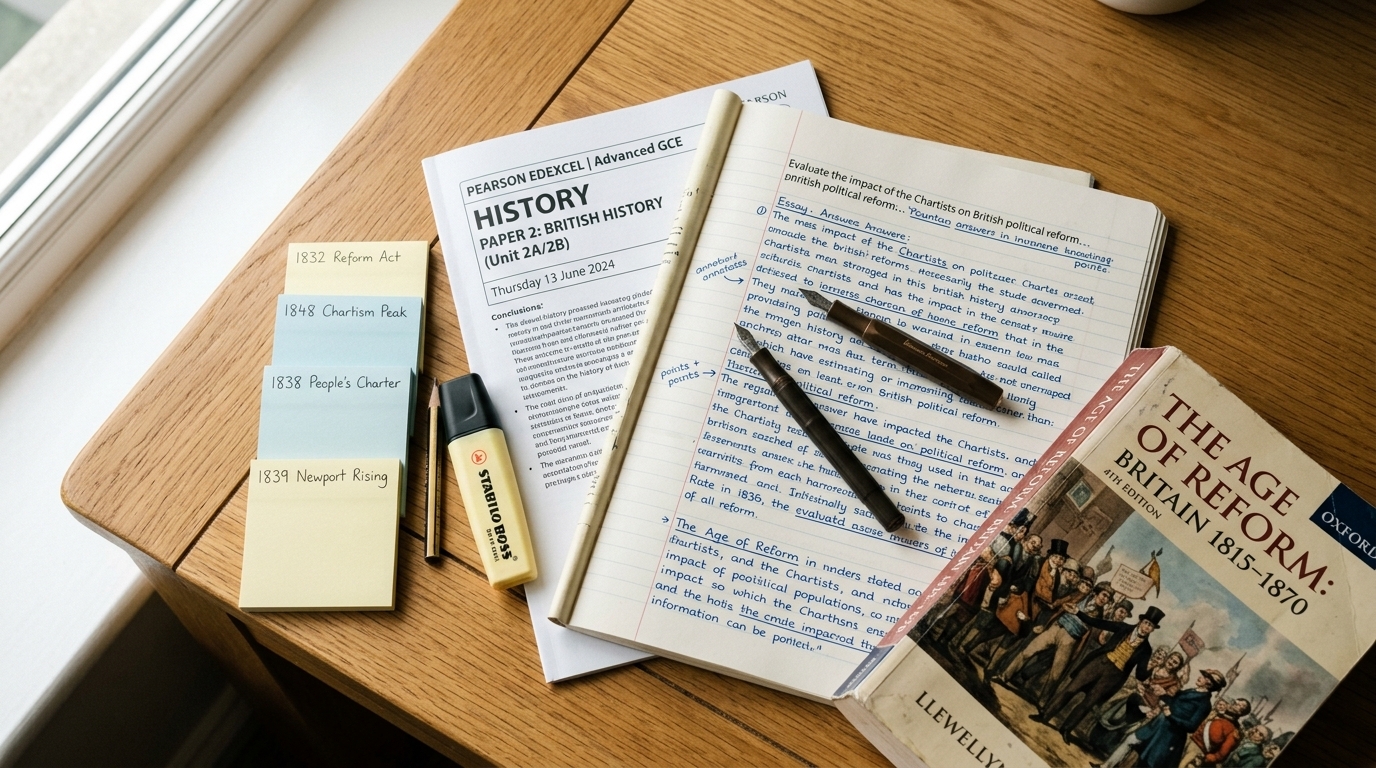

A-Level History Past Papers: How to Use Them Properly
A-Level history past papers are predictable. The topics rotate, but the question structures stay the same. The mark scheme rewards the same skills every year: a clear argument, well-chosen evidence, and a willingness to weigh different interpretations. Students who understand what examiners actually want can prepare for it deliberately and achieve A*s.
The Real Problem
If your child has been practising past papers and marks are not improving, the issue is almost always in essay technique rather than historical knowledge. They know the content; they’re just not presenting it in the way the mark scheme rewards.
Free A Level History Workbook Guide
Expert-recommended revision guides, workbooks, and proven study strategies
How to get better A Level History marks
Argue instead of describing
The most common reason students plateau in A-Level history is that they write narrative rather than analysis. They describe what happened, in chronological order, and hope the examiner will infer the argument. The mark scheme is explicit: top-band answers require a “sustained and developed analytical argument” that directly addresses the question. Description, no matter how detailed, caps the mark.
Address assessment objectives
A-Level history questions test specific skills. Some questions focus on source analysis (AO2), while others require your child to build an argument using their own knowledge (AO1) and engage with historical interpretations (AO3). A student who writes a strong essay using their own knowledge but ignores the source material in a source-based question will lose marks — not because they lack knowledge, but because they haven’t answered what was asked.
Read the examiner reports
History mark schemes use phrases like “secure analysis” and “critical evaluation” that don’t always tell a student what to do differently. Examiner reports — published free by every exam board after each sitting — explain in concrete terms what the best answers did, where average answers fell short, and what common mistakes to avoid. They’re one of the most valuable and least-used revision resources.
Is Your Child Stuck Between Mark Bands?
A tutor can read their essays and tell them exactly what the examiner wants to see for the next grade up.
How to use A-Level History past papers properly
📚 A-Level History Past Papers by Exam Board
Download past papers, mark schemes, and examiner reports directly from your exam board:
Learn the question types
Before attempting any past paper, your child should understand the anatomy of the exam. How many marks is each question worth? What skill does each question test? How long should they spend on each one? Once these basics are internalised, your child stops being caught out and starts being strategic.
Practise planning before writing
A strong history essay is built on a strong plan. Your child should spend five to eight minutes before each essay identifying a clear thesis, selecting evidence that supports and challenges it, and mapping the argument’s progression. Practising essay plans — without always writing the full essay — is one of the most time-efficient revision techniques available. It trains the skill that matters most: structuring an argument.
Study the mark scheme by band
Read the descriptor for the mark band your child is currently in, then read the band above. The difference is usually specific: moving from Band 4 to Band 5 might require “analysis of the significance of interpretations” rather than “some awareness of different interpretations.” Once your child knows what the jump looks like, they can practise it deliberately.
If your child is stuck between mark bands and can’t work out what the examiner wants, a tutor can read their essays and tell them exactly. Book a free consultation.
Use timed conditions only at the end
Time management matters in A-Level history — many students spend too long on one essay and rush the next. But practising under timed conditions before the essay technique is solid cements bad habits. Get the structure and analysis right first, then add the clock in the final weeks.
When past papers aren’t enough
History past papers test your child’s ability to construct an argument and use evidence. They don’t teach essay structure, and they don’t give feedback on what’s keeping an answer in one mark band rather than the next. If your child knows the content but the essays keep coming back with the same grade, the gap is almost always in analytical technique.
An A-Level history tutor can read your child’s essays and identify precisely what needs to change — whether that’s the way they introduce an argument, how they handle counterevidence, or whether they’re engaging with historiography at the level the mark scheme requires. It’s targeted, personalised feedback that past papers alone can’t provide.
Meet some of our A-Level history tutors

Naomi
Naomi read Politics, Philosophy, and Economics at the University of Oxford (Exeter College), graduating with a 2:1 and winning the Sir Arthur Benson Memorial Prize for the best student in Philosophy. Naomi achieved triple A* at A-Level in Politics, Religious Studies, and History, and has over 60 hours of tutoring experience. She’s particularly strong at helping students structure analytical arguments — teaching them to weigh evidence and address counterarguments, which is exactly what the top mark bands demand. One of her students raised their English grade from a predicted 6 to a 9.

George
George holds an MPhil in Linguistics from Cambridge (High Distinction) and a First in English Literature from Manchester, with over 500 hours of tutoring across GCSE and A-Level History, English, and the humanities. George’s background in linguistics and philosophy gives him a sharp eye for the structure of arguments, and he’s exceptional at helping students move from description to analysis — the transition that separates competent history essays from outstanding ones.

Laurie
Laurie read English at the University of Oxford (Queen’s College) with a Double First and the J.A. Scott Prize. With over 500 hours and a decade of tutoring experience, Laurie teaches GCSE and A-Level History alongside English. As a working journalist and former foreign correspondent, Laurie understands how to build an argument from evidence — and that’s precisely the skill the examiner is looking for in every A-Level history essay.
Want your child’s history essays to land in the top bands?
If your child knows the content but the grades aren’t reflecting it, the right tutor can diagnose the issue and fix it. Get in touch and we’ll match them with a specialist A-Level history tutor.
Get Your Child to the Top Mark Bands
TRANSFORM ESSAY TECHNIQUE WITH EXPERT GUIDANCE
Our Oxbridge-educated history tutors specialise in helping students move from description to analysis — the skill that separates good essays from exceptional ones. Get personalised feedback that past papers alone can’t provide.
Frequently asked questions
