
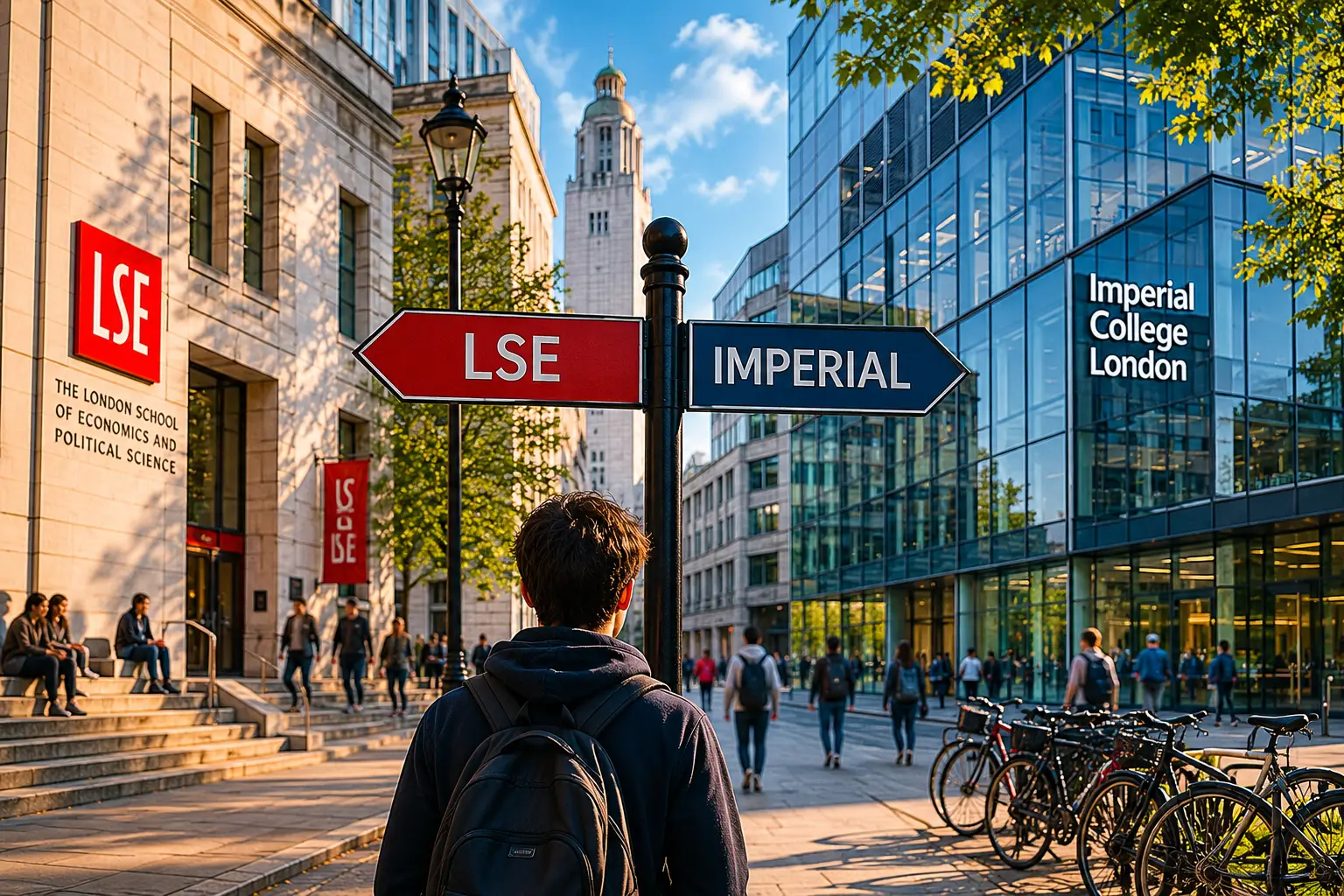

LSE vs Imperial is a comparison parents make most often when their child is targeting economics, finance, or quantitative social sciences. Both are G5 universities. Both sit in central London. However, they specialise in fundamentally different ways. LSE is a pure social sciences university focused on economics, politics, law, and related disciplines. In contrast, Imperial is a STEM-focused institution with a strong business school offering quantitative finance and economics degrees alongside engineering and natural sciences. Therefore, the right choice often turns on which approach to economics or finance your child wants: social science depth at LSE, or a more quantitative, data-driven path at Imperial.
This guide compares LSE vs Imperial across the courses where they genuinely overlap. Specifically, we cover Economics, Finance, Mathematics, and Business. Whether your child is targeting a quantitative finance career, an economics research path, or a business school education with a London location, the comparison below should help.
What actually separates LSE and Imperial
LSE is a specialist social sciences university with no interviews. Imperial is a STEM university with a Business School, and Imperial does interview for several business and quantitative courses. Even when courses overlap, the approach differs.
Choosing between LSE vs Imperial?
Our Oxford and Cambridge-educated consultants support families across LSE and Imperial: admissions tests, personal statements, and interview preparation.
LSE vs Imperial for Economics
The Economics comparison is the single most common reason families look at LSE vs Imperial together. However, the two universities offer quite different versions of economics. Therefore, the decision rarely turns on which is “better” and more often on which approach matches your child’s academic interests.
LSE BSc Economics
LSE BSc Economics is a three-year degree focused entirely on economic theory and applied economics. The standard offer is A*AA at A Level with A* in Mathematics. Specifically, Further Mathematics is desirable, and an essay-based subject as the third A Level is preferred to demonstrate analytical writing ability. Importantly, LSE introduced the TMUA (Test of Mathematics for University Admission) as mandatory for several Economics programmes from 2026 entry, including BSc Economics. Notably, LSE does not interview any undergraduate applicants. As a result, the personal statement and TMUA score carry significant weight in the selection process.
Imperial BSc Economics, Finance and Data Science
Imperial’s Business School offers a BSc in Economics, Finance and Data Science. This is a three-year programme that combines economics with finance and data science applications. The standard offer is AAA at A Level with an A in Mathematics. Specifically, the TMUA is mandatory for all applicants from 2026 entry. Importantly, Imperial conducts a 20 to 30 minute online interview with shortlisted candidates. As a result, this is one of the few Imperial undergraduate courses where interviews matter, alongside Medicine. The course is interdisciplinary and aimed at students targeting careers in fintech, quantitative finance, and data-led roles in the financial sector.
Which suits your child?
LSE Economics suits students drawn to economics as an academic discipline. The course is theory-heavy and prepares students for postgraduate economics research as much as for careers in finance or consulting. In contrast, Imperial Economics, Finance and Data Science suits students who want to apply economics through finance and data science. For example, a student passionate about machine learning applied to financial markets would find the Imperial programme a stronger match. Furthermore, the Imperial course includes substantial programming and data science content alongside core economics, which LSE Economics does not.
Need help choosing LSE vs Imperial?
Tell us the course, the year group, and your child’s strengths. We will help you weigh the trade-offs.
LSE vs Imperial for Finance
Both universities feed strongly into careers in investment banking, consulting, and asset management. However, neither offers a pure undergraduate finance degree. Therefore, the comparison at undergraduate level is between economics-based routes at each institution, with finance modules layered on top from Year 2.
Where finance careers come from
LSE produces a significant share of City of London hires every year. Specifically, BSc Economics, BSc Finance, BSc Mathematics and Economics, and BSc Actuarial Science all feed strongly into investment banking, asset management, and consulting. Furthermore, the LSE alumni network across the City and Wall Street is one of the strongest in the world. As a result, students who walk into LSE with a clear finance career goal often find the recruitment infrastructure superb.
Imperial Business School offers BSc Economics, Finance and Data Science as its undergraduate finance-adjacent route. In addition, Imperial students from mathematics, physics, and engineering backgrounds are heavily recruited into quantitative finance and fintech roles. Notably, the South Kensington campus location is slightly further from the City than LSE’s Houghton Street, but the difference is minimal in practice. Furthermore, Imperial graduates frequently find their quantitative training opens doors to algorithmic trading, risk analytics, and structured finance roles that more traditional economics graduates do not access as easily.
LSE vs Imperial for Mathematics
Both universities offer mathematics at undergraduate level. However, the depth and orientation differ significantly. Therefore, the choice depends on whether your child wants a pure mathematics education or mathematics applied to social science and economic problems.
Imperial Mathematics BSc and MSci
Imperial Mathematics is a three-year BSc or four-year MSci. The standard offer is A*A*A with A* in Mathematics and A* in Further Mathematics where offered. Specifically, the TMUA is mandatory for all Imperial Maths applicants. The Imperial Department of Mathematics is one of the strongest in the UK and feeds into postgraduate research at Cambridge, Oxford, and top global universities. Furthermore, Imperial Maths includes substantial computational and applied modules alongside pure mathematics. As a result, the degree appeals to students drawn to mathematical depth across the full breadth of the discipline.
LSE BSc Mathematics and Economics
LSE does not offer a pure Mathematics BSc. Instead, LSE offers Mathematics and Economics, Financial Mathematics and Statistics, and Mathematics with Data Science as the closest equivalents. The standard offer for Mathematics and Economics is A*AA at A Level with A* in Mathematics. Notably, the TMUA is recommended and increasingly expected for competitive applications. The course is heavily mathematical from Year 1 but always within an economics or social science framing. Therefore, students who want pure mathematics for its own sake should target Imperial. In contrast, students drawn to mathematics applied to real-world social and economic problems often prefer LSE.
LSE vs Imperial for Business and Management
Both universities offer undergraduate business and management degrees through their respective business schools. However, the focus differs significantly. Imperial Business School leans toward technology, innovation, and quantitative business management. In contrast, LSE Management focuses on the social science of management with strong emphasis on economics, sociology, and organisational behaviour.
LSE BSc Management
LSE BSc Management is a three-year degree based at LSE’s Houghton Street campus. The standard offer is A*AA at A Level with Mathematics typically required. Specifically, the course covers strategy, organisational behaviour, finance, accounting, and operations management within a social science framework. Notably, LSE does not interview Management applicants. As a result, the personal statement carries significant weight in the selection process. Furthermore, the course feeds strongly into consulting, banking, and corporate strategy careers.
Imperial Business School undergraduate offerings
Imperial Business School offers BSc Economics, Finance and Data Science as its primary undergraduate degree. The standard offer is AAA at A Level. Specifically, the TMUA is mandatory and Imperial conducts an academic interview for shortlisted candidates. Importantly, the Imperial Business School undergraduate experience is heavily quantitative and technology-focused, distinguishing it from more traditional management degrees. As a result, the programme suits students targeting fintech, quantitative trading, data science consulting, and similar tech-enabled business careers.
LSE vs Imperial: how do you actually decide?
Both universities produce graduates who go on to top careers and postgraduate programmes. The right choice usually turns on three practical questions about your child’s preferences and aptitudes. Specifically, neither university is “better” in absolute terms, and both are world-class within their respective focuses.
Pure economics or applied quantitative finance?
LSE leans toward economics as an academic discipline. Imperial leans toward quantitative methods applied to finance, data, and business problems. Specifically, students drawn to economic theory, policy work, or postgraduate economics research often find LSE the stronger fit. In contrast, students passionate about coding, data science, and the quantitative side of finance frequently prefer Imperial’s interdisciplinary approach. Furthermore, students unsure about this distinction should consider where their A Level interests sit: heavy maths and computing point toward Imperial, while economics and essay subjects often point toward LSE.
Interview comfort
LSE does not interview any undergraduate applicants. Imperial interviews for Economics, Finance and Data Science and for several other Business School courses. Specifically, the Imperial interview is 20 to 30 minutes online with an academic and focuses on motivation, analytical thinking, and communication. As a result, students who interview well often find Imperial a more rewarding application process. In contrast, students who interview poorly under pressure may find the LSE format more comfortable, since everything turns on grades, the admissions test, and the personal statement.
Campus and academic culture
LSE’s Houghton Street campus is in the heart of central London, minutes from Westminster, the City, and the major think tanks. Specifically, the campus is small and integrated into the surrounding city. Imperial’s South Kensington campus is larger, more self-contained, and built around laboratories, lecture halls, and the museum quarter of London. Furthermore, the academic culture differs: LSE feels intensely focused on social sciences and policy, while Imperial has the energy of a STEM research university with extensive industrial links. Therefore, the cultural fit often matters as much as the course content.
When should your child start preparing for LSE or Imperial?
The earlier your child builds the application, the smoother Year 13 becomes. In general, most families benefit from starting in Year 12. Specifically, the right moment is once your child has chosen the course they want to read and has settled into A Level or IB. A consultant at this stage can shape the personal statement, run TMUA diagnostics, and prepare for any required interviews well before the UCAS deadline.
Year 13 students can still apply successfully to LSE or Imperial with a focused block of preparation across the summer and autumn term. Indeed, eight to twelve weeks of intensive work covers the TMUA, personal statement, and any required interview practice. The key is choosing a consultant who knows both universities and the specific course inside out. Our guides on LSE vs Oxford, UCL vs Cambridge, and UCL, LSE and Imperial vs Oxbridge are useful companions.
Expert LSE and Imperial admissions support
TARGETED SUPPORT FROM OXFORD AND CAMBRIDGE GRADUATES
Our consultants help families weigh LSE vs Imperial realistically. We then build the application strategy around your child’s strengths.
Part of our university comparison series
This post is part of a series for parents weighing up the UK’s top universities. Each guide compares two or more institutions directly, written from real admissions experience.
Other guides in the series:
→ LSE vs Oxford
→ UCL vs Cambridge
→ UCL, LSE and Imperial vs Oxbridge
→ All Admissions Consulting
Frequently asked questions about LSE vs Imperial
