


Your child is sitting GCSE English Literature at one of the UAE’s British curriculum schools. Dubai College, GEMS Wellington, Brighton College Dubai, Cranleigh Abu Dhabi, Repton Dubai. The set texts are the same familiar names A Midsummer Night’s Dream or Macbeth, Of Mice and Men or An Inspector Calls, the AQA or Edexcel poetry anthology. The school is covering the content. Yet the marks come back at a 7, sometimes an 8. A 9 in English Literature is harder to reach than parents in the UAE often realise, because it requires a specific kind of analytical thinking that classroom teaching rarely has time to build. This guide walks through one real student’s full year of GCSE English Literature with a tutor, drawn from our own lesson records, showing how the marks actually move from a 7 toward a 9.
On this page
- What separates a 9 from an 8 in GCSE English Literature
- A real GCSE English Literature year, text by text
- Where GCSE English Literature marks really go
- What a one-to-one tutor does that a class of thirty cannot
- Preparing for the unseen poetry question
- Three GCSE English Literature tutors we’d recommend for UAE families
- Questions UAE parents ask about GCSE English Literature
The short version
A 9 in GCSE English Literature is not about reading more. It is about building the kind of analytical thinking that turns a clear point into a layered, persuasive argument backed by precise evidence.
From a 7 or 8 to a 9 in English Literature
UK-based Oxbridge tutors for UAE families, teaching the texts and the technique together.
What separates a 9 from an 8 in GCSE English Literature
An 8 in GCSE English Literature means your child has solid knowledge of the set texts, can identify themes accurately, and writes clear PEE or PEEL paragraphs. A 9 means something more specific. It means the analysis goes beyond the obvious, the arguments connect to wider context with precision, and the writing has a sense of independent literary thought. The examiners reward what the AQA mark scheme calls “perceptive” and “original” responses. So a 9-grade essay reads differently from an 8-grade essay even when both are written competently.
In practice, this means three things. First, a 9-grade essay picks evidence with care, choosing quotations that genuinely support the specific argument being made rather than the safest ones a student remembers. Second, it builds layered argument: not just stating that Steinbeck shows isolation in Of Mice and Men, but arguing how that isolation connects to the historical context of the Great Depression and the structural choices Steinbeck makes. Third, it engages with the writer’s purpose. Why does Priestley want the audience to feel uncomfortable in An Inspector Calls? What does Shakespeare want us to make of Macbeth’s culpability? The 9 lives in the answer to those questions.
A real GCSE English Literature year, text by text
What follows is the genuine year-long arc of a GCSE English Literature student we worked with at Greenhill Academics. Her name and a few identifying details have been changed for privacy, so we will call her Imogen. The aim, set out from the start, was a strong grade, and a 9 if the work transferred. Every text, struggle, and breakthrough below is real, drawn from our lesson records. We covered four major set texts across the year alongside the poetry anthology and unseen analysis. This is what reaching toward a 9 looks like, text by text, and it is the same year a UAE family would walk with us.
A Midsummer Night’s Dream: getting Shakespeare to land
Imogen’s first sessions started with the nature of poetry, analysing Sonnet 130 as a way in. She engaged well with the imagery and recalled what she already knew about sonnet form. The next session introduced the Elizabethan period and the conditions Shakespeare wrote for, before they began A Midsummer Night’s Dream. Her tutor took the play scene by scene, focusing on character analysis across the Athenian lovers and the rustics. The themes landed quickly. The challenge came when it was time to write.
When her tutor asked her to formulate a PEE paragraph from the analysis they had discussed, the structure was harder to produce than the ideas themselves. She could identify a clear Point, Evidence, and Explanation when prompted, but stringing them together without prompting took practice. Her tutor used watching adaptations of the play to compare interpretive choices, then asked her to write an “Agony Aunt” letter as Helena. The creative homework was a deliberate trick: it forced Imogen to use the text closely without the pressure of essay format. Her writing loosened up.
Of Mice and Men: from context to confident PEE paragraphs
Of Mice and Men came next. Her tutor spent the early sessions on context: the Great Depression, the Dust Bowl, the American Dream, the absence of a social security net in 1930s America. Imogen grasped the central ideas quickly and engaged with the exercise about her own dreams and what they depended on. Then the writing block began. They built PEEL paragraphs together, with Imogen leading and her tutor pushing back on weak topic sentences and superficial explanations.
The next sessions deepened the context as the characters demanded it. Racism and the Jim Crow laws as background for Crooks. Sexism and women’s position in the 1930s as background for Curley’s wife. Imogen showed a sensitive understanding of how context shapes character treatment, but expanding her explanations of key quotations in a PEEL paragraph took several sessions of focused work. By the end of the Of Mice and Men block, she could write coherent analysis on themes as difficult as loneliness, prejudice, and the failure of the American Dream. The shift was significant.
An Inspector Calls: bringing political theme to the page
An Inspector Calls posed a different challenge. The play is short, but its political message is dense. Her tutor opened with the context of the Beveridge Report of 1942, which Imogen researched for homework. Understanding the British political climate behind Priestley’s writing transformed how she read the play. She engaged thoughtfully with how each Birling responds to the Inspector’s inquiry and how each is responsible for Eva Smith’s death. Her annotations of the text became more thorough.
One area that needed sustained work was identifying individual quotes to use as evidence. She had strong opinions about the play. Finding the specific lines to back them up took practice. Her tutor pushed her to mark relevant quotes as they read together, building her own evidence bank. By the end of the An Inspector Calls block, Imogen could write a paragraph that connected a specific Birling line to Priestley’s wider social critique. That is what a 9-grade essay does.
Macbeth: comparison, challenge, and deeper analysis
Macbeth was the final major text. School was moving fast, so her tutor used the sessions to slow down on key scenes. They analysed Act 1 Scene 3 with reference to a stage production. They argued the question of whether Macbeth planned to kill Duncan or was driven by Lady Macbeth, with Imogen building a case using the text she could refer to. She brought contextual information about the Great Chain of Being naturally into her arguments.
One memorable session compared Macbeth’s character with King Henry in Henry V. Imogen rose to the comparative analysis really well, and her arguments showed the kind of independent reading that 9-grade essays develop. By the time they finished Macbeth, her writing had a different quality. The points were more original, the evidence more precise, the explanations connected to context and writer’s purpose with a fluency that had not been there at the start of the year. The grade at the end of it is between Imogen and the exam board. The work that earned it is what a GCSE English Literature tutor actually does, week after week, for any UAE family willing to commit to the writing work.
If your child is sitting GCSE English Literature in the UAE and the essays are not landing the way they should, the right tutor can find the gap between knowing the texts and writing about them. Book a free consultation.
Where GCSE English Literature marks really go
In our experience across many GCSE English Literature students, marks slip away in three predictable places. First, weak topic sentences. A topic sentence that simply restates the question, or names a theme without staking a position, locks the paragraph into safe analysis. The paragraphs that follow rarely break through to high marks. Second, generic quotations. Students memorise a handful of safe quotes and use them across every essay. The 9-grade essay picks the specific quote that supports the specific argument, even if it is less well-known.
Third, and most commonly, weak engagement with the writer’s purpose. Many essays describe what happens in a text and link it loosely to a theme. The top-band essays argue what the writer wants the reader to think and feel, and why. Priestley wants the audience to feel uncomfortable. Steinbeck wants the reader to mourn what cannot survive. Shakespeare wants us to see Macbeth’s tragedy as inevitable from the moment of the prophecy. The 9 lives in that argument. So that is where the tutoring focuses.
Build the Kind of Analysis a 9 Requires
A specialist GCSE English Literature tutor reads the writing with your child and shows where the marks go missing.
What a one-to-one tutor does that a class of thirty cannot
A class of thirty students with one English teacher cannot read every essay in detail, identify the specific phrase that signals a weak argument, and rebuild it line by line. There is not the time. A one-to-one tutor can. Sessions at Greenhill Academics involve reading your child’s writing closely, identifying the specific moves that hold the argument back, and rewriting them together. Topic sentences get sharpened. Evidence gets reviewed for fit. Explanations get pushed deeper.
The other thing a tutor can do that a class cannot is bring the context to life. Discussing Jim Crow America with a single student, exploring the Beveridge Report and what it meant for postwar Britain, comparing Macbeth’s culpability to Lady Macbeth’s in a sustained argument: these are the conversations that shape independent literary thought. They take time. A class of thirty rarely has it. A weekly hour with a specialist tutor is exactly where they happen, and the UAE-to-UK time difference makes the timing easy to find.
Preparing for the unseen poetry question
The unseen poetry question is one of the most marker-rewarding sections of GCSE English Literature, because it tests skill rather than memorised content. Students who have rehearsed the technique of close reading a new poem under time pressure walk in with an advantage. A useful framework, often taught with the acronym FLIRT (form, language, imagery, rhythm, tone), gives a starting structure. The harder skill is choosing what to focus on, since a strong unseen poetry answer is selective rather than exhaustive.
A tutor works on unseen poetry the way a coach works on technique. Multiple short poems, multiple practice analyses, with the tutor pushing for sharper observations each time. The link to the wider poetry anthology matters too. A student who has analysed the poems in the anthology in real depth has a bank of comparison points to draw on when the unseen poem arrives. The 9 in unseen poetry rewards exactly this kind of preparation.
Three GCSE English Literature tutors we’d recommend for UAE families

Louis
Louis read Philosophy and French at Keble College, University of Oxford, where he achieved a First Class degree. He scored 40 out of 45 in the International Baccalaureate, including 7s at Higher Level in Philosophy, French, and Physics. Louis teaches 13+, I/GCSE, and A Level English Literature, French, and Philosophy. He has a particular talent for building confidence in essay writing and critical thinking, which is what most GCSE English Literature students need to push from a 7 toward a 9.

Laurie
Laurie read English Language and Literature at The Queen’s College, University of Oxford, where she earned a Double First Class degree. She holds A*AAA at A Level in English, French, History, and Latin. With over 500 hours of tutoring across a decade, Laurie’s previous students have gone on to Oxford, Cambridge, Johns Hopkins, and Stanford. She specialises in essay-writing skills, which is the precise area where most GCSE English Literature students plateau.
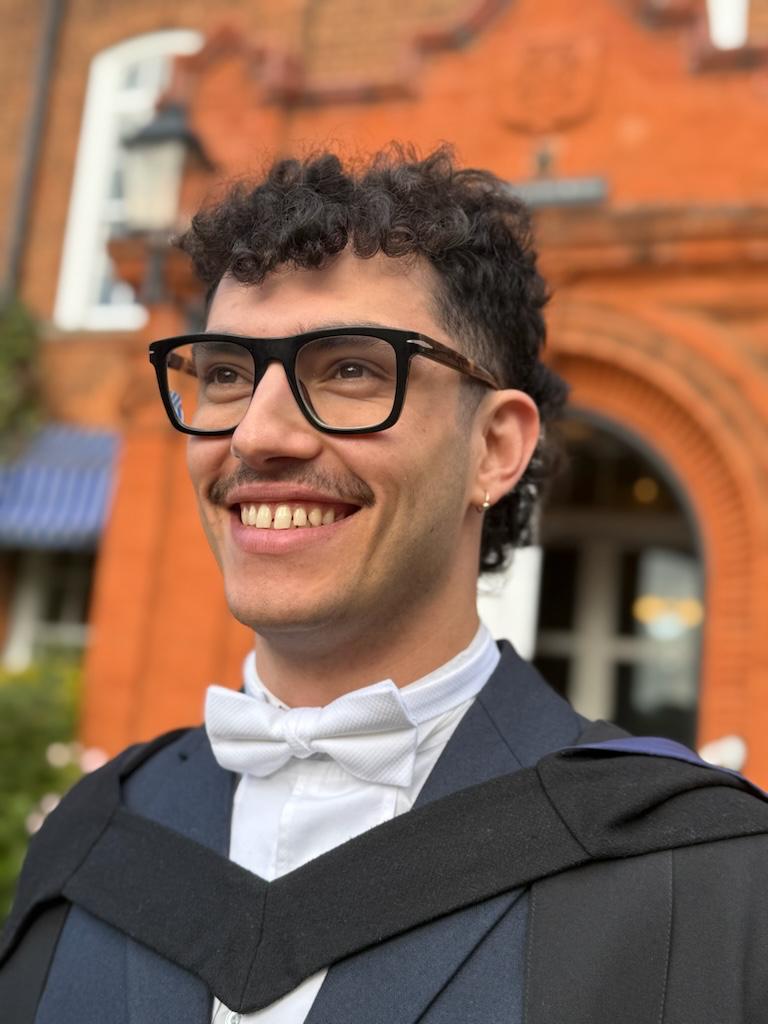
George
George holds an MPhil in Theoretical and Applied Linguistics from the University of Cambridge (High Distinction) and a First Class BA in English Literature from the University of Manchester. He will begin a PhD in Psycholinguistics in October 2026. With over 500 hours of tutoring experience, George is known for working effectively with first and second generation immigrant communities. His teaching is text-led and rigorous, ideal for young readers ready to push past the safe interpretations into the kind of independent argument the top GCSE marks reward.
These are three of our GCSE English Literature tutors. We match each family with a tutor based on the specific texts, exam board, and writing style your child needs to develop, whether they are sitting AQA, Edexcel, or another board at their UAE school.
Ready to work toward a 9 in English Literature?
If your child is putting in the work but the analytical writing has not clicked into top gear, the right tutor can build that skill, week by week. Get in touch and we will match your UAE family with a specialist GCSE English Literature tutor for a free consultation.
Move the English Lit Grade Past a Plateau
START YOUR CHILD’S PATH TO A 9
Our UK-based Oxbridge tutors teach the set texts in genuine depth and rebuild the analytical writing UAE pupils need for the top grades. The kind of essay coaching a busy class teacher cannot give them.
More English Literature resources from our blog
Worth reading next
Questions UAE parents ask about GCSE English Literature
About set texts and the 9
About working with a UK-based tutor in the UAE
