

If your child runs out of time before the end of a GCSE English Language exam, you may be wondering what a tutor could do about it. A GCSE English tutor can look at a recent timed attempt with your child, ask them how the time went, go through the paper’s own instructions with them, and work out with them where the minutes could go next time. You do not need to work out the cause first. The paper, the marks, your child’s own account of the attempt and a lesson spent watching them work give the tutor enough to start from.
The main points
- On AQA’s GCSE English Language papers, the writing task is printed last and carries the same marks as the four reading questions put together.
- A recent timed attempt, its question paper and any teacher comments can help a tutor identify unfinished answers. Your child’s account and any timing notes can help explain how they used the time.
- Lessons work on reading and checking within the time, planning the long answers, writing to a plan, and deciding when to move to the next question.
- Practice can be one question against an agreed time, a whole section or a whole paper, depending on what the tutor and your child want to look at.
Which English exam is your child sitting?
Running out of time means different things on different papers, so the first thing to settle is which paper your child will sit. The subject name does not settle it: GCSE English Language, IGCSE English and English Literature are different qualifications, each with its own papers, time allowed and marks.
The front of an official past paper names the qualification and the board and states the time allowed. A school mock may carry a school cover with no board named, so ask the school if the paper does not make it clear.
If your child is on an IGCSE course, our IGCSE Tutoring in Bahrain: A Parent’s Guide is a general guide to IGCSE tutoring for families in Bahrain. The examples below use AQA GCSE English Language. For another qualification or board, a tutor would check the child’s own paper and instructions.
Your child runs out of time before the paper is finished
Take AQA’s GCSE English Language as one example. Each of its two papers lasts 1 hour 45 minutes and carries 80 marks: 40 for four reading questions on unseen texts and 40 for one writing task. On Paper 1 the reading questions carry 4, 8, 8 and 20 marks; on Paper 2 they carry 4, 8, 12 and 16. The writing task is Question 5, printed last on both papers, and it carries as many marks as the whole reading section.
The writing task accounts for half the marks, so it needs a place in the time your child sets aside, whatever order they answer in. An unfinished answer does not tell us how many marks were lost. A tutor can look at the work and any teacher feedback with your child before deciding what to practise.
What a recent timed attempt can tell you
A script can show blank answers, writing that stops mid-sentence, a written plan and teacher comments. It cannot always tell you whether your child considered an answer finished, when they made the plan or how long each answer took. Your child’s account and any timing notes can help. A tutor can also watch a fresh attempt to see how your child uses the time.
The timed-attempt check
- Find the question paper and your child’s work from a recent timed attempt: a mock, a class test or a timed homework.
- Note which answers are blank or unfinished, without judging the quality of what is there.
- Ask your child which question they were working on when the time ended. They may not remember exactly, and a rough answer is still useful.
- Keep any teacher comments and any timing notes your child made during the attempt.
- Have these to hand when you talk to a tutor.
This check shows what was and was not finished. It does not tell you why, and you do not need to work that out, because that is something the tutor looks at with your child.
Do you have a recent attempt that was not finished?
Tell us which English paper your child is preparing for and what was left unfinished. A tutor can start from there.
Ask about a tutorHow a GCSE English tutor in Bahrain helps your child share out the time
AQA’s June 2025 Paper 1 advises about 15 minutes for reading the source and all five questions. At the start of each section, it advises about 45 minutes for that section. It also reminds candidates to plan Question 5 and leave time to check their answers. These are the instructions for that paper, so your child should check the paper they are practising with.
In a lesson, the tutor and your child can open the paper on the shared whiteboard and suggest a time for each question, taking account of the marks and the paper’s instructions. They can include time for reading and checking within the total allowed. After a practice run, they can compare the plan with what happened and adjust it for the next attempt.
Making time to read and check
The reading questions send your child back to the source, and the paper itself says to read parts of it again, so going back to a passage is part of the work rather than wasted time. What a tutor can watch is how that reading goes: whether your child reads the instructions before starting, how they find the lines a question points to, and whether they read the question again before answering it. Checking is watched the same way, as a few minutes your child plans for rather than something that happens if there is time, and the tutor can see what your child checks and what they miss.
Planning the writing task so there is time to finish it
On both AQA papers the writing task carries 40 marks, 24 for content and organisation and 16 for technical accuracy. A short plan can help your child choose what to say and put their ideas in order. Planning uses some of the available time too, so the tutor can look at how much time the plan leaves for writing and checking.
In lessons, the tutor and your child practise making a short plan and then writing to it under an agreed time. Afterwards they look at whether the plan was followed, where the writing ran long, and whether time was left to check. Paper 1’s writing task asks for a description or a story and Paper 2’s for a point of view, so the plans look different, and the tutor works from your child’s own way of planning.
An illustrative plan
An illustrative plan written for this article, not an exam question or model answer.
Task, in the style of a Paper 2 point-of-view question: “Homework does more harm than good.” Write an article for a school website giving your view.
- View: homework helps when it is short and chosen well, and harms when it fills every evening.
- Point 1: what one good piece of homework does.
- Point 2: what too much of it does: tired pupils, copied answers, less reading.
- Point 3: what a school could change: a limit per night.
- Cut: a second example of pupils being too tired to read, because point 2 already covers it.
- Ending: back to the evening at home, with the change in place.
A tutor can help your child choose points, put them in order and cut repetition. A Paper 1 story needs a different plan.
Deciding when to move to the next question
The other place the time can go is an answer that keeps growing. An 8-mark question carries a tenth of the paper’s marks, but a child who is not sure the answer is finished may keep adding to it, and each extra minute there is a minute less for the answers that carry more. A script does not show that this happened. Your child’s account of the attempt, or a practice question watched by the tutor, can.
In lessons the tutor and your child can look at three things together: what the question still asks for that the answer has not given, whether the answer has started repeating itself, and how much time is left for the rest of the paper. Those three do not remove all uncertainty, but they give your child something to decide with rather than a feeling. A short or blank answer can be returned to if time is left at the end of the paper.
Our article on common GCSE English Language exam mistakes, GCSE English Language: The Most Common Exam Mistakes, has a section on running out of time on the writing question.
Does your child leave the writing task unfinished?
Tell us which paper it happens on. A tutor can look at the planning, the timed writing and the moving-on decision with your child.
Send an enquiryPractising against the clock
A lesson can take a single question, agree a number of minutes for that attempt, and let your child work while the tutor watches: when the reading finished, when the plan was made, when the writing started, whether the answer was checked. Afterwards they compare the agreed time with what happened and decide what to try differently.
A whole section, or a whole paper under its 1 hour 45 minutes, can be used whenever it is the best way to look at a particular difficulty. A whole paper shows the overall shape of your child’s timing across all five questions in a way single questions cannot, so it does not have to wait for smaller exercises first. Which of these a lesson uses is the tutor’s and your child’s call, based on what they want to find out.
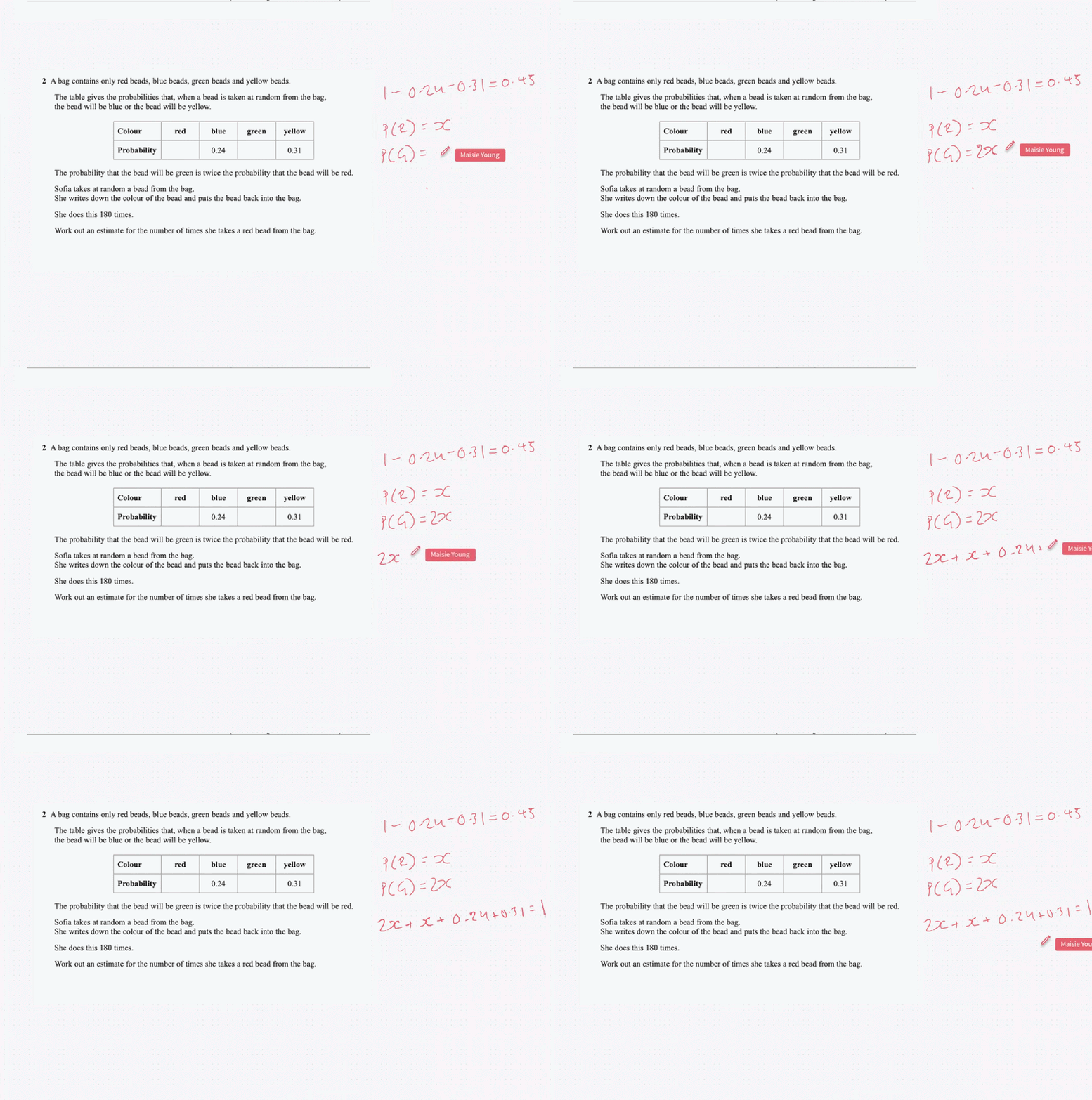
This clip shows a maths lesson recorded in Pencil Spaces, the online classroom used by Greenhill Academics.
Francesca and Kian teach GCSE English
Two Oxford graduates who teach English

Francesca specialises in English Language and Literature. She studied English at Christ Church, University of Oxford, where she earned a 2:1 and was awarded a scholarship for academic excellence, and she has tutored English since 2017, including GCSE and IGCSE English Language and Literature and A Level English Literature. She has also been a professional writer and editor since 2017.

Kian read Classics at Brasenose College, University of Oxford, graduating with a 2:1. He has tutored for over four years and teaches English, Latin, History and Politics, working with students preparing for GCSEs and A Levels.
Would you like your child to work with Francesca or Kian?
Both profiles are linked above, and you can name either of them when you enquire.
Ask about a tutorQuestions parents ask about English exam timing
My child writes well at home but not in the exam. Is that a writing problem?
If the work at home was untimed, it does not show how your child writes within an exam time limit. A tutor can watch a timed attempt with your child and talk through where the minutes went.
Does this apply to English Literature as well as English Language?
The figures and the board’s advice here are for AQA GCSE English Language only. For a Literature paper, a tutor starts from that qualification’s own paper and its instructions, not from anything on this page.
Should I tell my child how many minutes to spend on each question?
The advice printed on the AQA paper covers the two sections, not each question, and a number that suits one child may not suit another. Your child and the tutor can agree the minutes for an attempt, try them and change them.
What is useful to have ready before we start?
It helps to have a recent timed piece of English work, finished or not, together with the question paper and any marks or teacher comments. Naming the exam board and the paper also helps.
Can a tutor work on exam timing with my child online?
Yes. Lessons are online on a shared whiteboard, so your child and the tutor can look at the same paper, write the proposed minutes beside each question and go through a timed answer together.
Is your child running out of time in English exams?
Tell us which paper your child sits and what was left unfinished last time. A tutor can go through the timing with them online.
Send an enquiry