

TL;DR
- A good essay can still lose marks when it does not stay focused on the question.
- A common trap is taking a prepared argument into the exam and trying to make the question fit it.
- One marked essay and ten minutes at home can give you a clue about whether the problem is the writing or the focus.
- Ask your child to show you where each paragraph answers the title. If they struggle to point to it, that tells you where to look.
- The habit can be practised: read the question, decide what it asks, then keep bringing the argument back to it.
The essay is good, but the grade came back a 4
You have read your child’s essay. It is thoughtful, the writing is clear and they clearly know the book. Then the grade comes back and it is a 4. That is what makes the result so confusing. The problem may not be how well they can write, but how closely their writing answers the question they were given.
A student can know the text, have good ideas and write confidently, but still lose marks when the argument starts moving towards the essay they wanted to write rather than the one in front of them.
That is often the point at which parents start looking for an IB English Literature tutor. But before you assume your child needs to learn more content, there is one simple check you can try with an essay they have already written.
Which part of IB English is costing the marks?
If the IB is new to you, this is the structure you need to know. The final grade comes from a small number of assessments, and the balance is slightly different at Standard Level and Higher Level.
How IB English Literature is assessed
Paper 1 · unseen analysis
Your child analyses writing they have not seen before. At SL, they write on one text in 1 hour 15 minutes. At HL, they analyse two texts in 2 hours 15 minutes.
Paper 2 · comparative essay
Your child chooses one of four questions on the day and writes an essay comparing two works they have studied. They have 1 hour 45 minutes at both SL and HL.
Individual oral
A 15-minute oral assessment with their teacher. Your child speaks for around ten minutes, followed by questions from the teacher.
HL essay · Higher Level only
A 1,200 to 1,500-word essay on one of the works studied during the course.
At SL, Paper 1 and Paper 2 are worth 35% each, with the individual oral making up the remaining 30%. At HL, Paper 1 is worth 35%, Paper 2 25%, the individual oral 20% and the HL essay 20%.
Where the prepared essay habit bites
The important part for this article is that the same problem does not affect every assessment in exactly the same way.
It is easiest to see in Paper 2. Your child knows the books before they walk into the exam, but they do not know which of the four questions they will choose. That makes it tempting to prepare an argument in advance and then try to make the question fit it.
Paper 1 is different because the texts are unseen. The problem there is less about bringing in a prepared essay and more about keeping the analysis focused on the text and the argument they have chosen.
At HL, the essay has its own line of inquiry, so the same basic skill still matters: every paragraph needs to stay focused on the question the essay set out to answer. Current IB examiner guidance also stresses clear focus in Paper 1 and warns against Paper 2 responses that have little relationship to the chosen question.
Is it the writing, or the question? One essay can give you a clue
Take one recent marked essay and read the title out loud. Then go through the essay one paragraph at a time and ask your child: where does this paragraph answer the question?
Rather than judging whether the paragraph is good or the quotation is clever, ask your child to show you where it answers the question they were given.
The ten-minute check to run at home
Step 1
Start by reading the essay title aloud together and ask your child to explain, in their own words, what the question is asking them to do.
Step 2
Choose any paragraph and ask your child to show you where it answers the essay title, rather than simply discussing the broader topic.
The point of the exercise is not to decide whether the essay reads well. You are checking whether the argument stays focused on the question it was meant to answer.
If they can do that easily throughout the essay, the problem may be somewhere else. If they struggle to show you, or start explaining what they meant rather than what they actually wrote, the issue may be focus rather than writing ability.
That distinction matters. More revision will not necessarily help if your child already knows the text. They may need to get better at taking what they know and aiming it at the question in front of them.
How a tutor runs the same check
One of our tutors used this same approach in a recent English Literature lesson while marking a student’s paragraph on a Seamus Heaney poem.
From a real English Literature lesson
“Remember, your question was how does Heaney use language and structure to make the poem feel emotionally powerful? The key thing is to use that phrase again, so it reminds us that we’re on track.
”
Laurie, English Literature tutor, Oxford
Said mid-lesson, with the question open on the shared board.
Laurie is reminding the student to keep bringing the argument back to the question. A student can know the text extremely well and have strong ideas, but those ideas still need to stay relevant to what they have been asked.
Try the ten-minute check this week
Sit with your child’s last marked essay and ask them to underline the words in the question that their first paragraph answers. If they struggle to make the connection, you have found something worth looking at more closely. The issue may not be the quality of their writing, but how closely they are answering the question.
Three ways good essays lose marks
The names below are invented and the examples combine the experiences of students we have taught, but the problems and the teaching are real.
Nadia wrote the essay she had prepared
Nadia knew her texts extremely well. She built an argument she believed in, memorised her strongest evidence, and walked into the exam ready. Then the question asked about something slightly different, and rather than adjust, she wrote the essay she came in with and hoped it would fit. Her tutor gave her ten past questions on the same text and asked her to write only the opening paragraph for each one. Rather than spending time writing full essays, she practised taking the same knowledge and using it to answer ten different questions.
The exercise was designed to make adapting the argument part of the preparation, rather than treating one rehearsed essay as the finished product.
Ruben chose the evidence he liked, not the evidence that proved his point
Ruben knew plenty of strong moments from the text, but the parts he found most interesting were not always the strongest evidence for the argument he was making.
His tutor encouraged him to stop asking which part of the text he most wanted to discuss and instead ask which evidence best supported the point he had just made. That small change kept his evidence tied to the argument and made it less likely that the essay would drift towards whatever he happened to find most interesting.
Sasha answered the question in her head
Sasha understood the texts and still lost marks, because she skimmed the question and answered a version of it she expected to see. Her tutor had her underline exactly what was being asked before writing a single word. This gave her a simple way to slow down and check that the essay she was about to write matched the question on the page.
More than a third of HL students received a 4
A 4 can feel like a verdict on your child’s ability, but it helps to put the grade into context. In the IB’s May 2025 statistics, 30,221 students took English A: Literature at Higher Level. Of those students, 37.7% received a 4, making it the most common grade, while 1.3% received a 7.
At Standard Level, the pattern was slightly different, with a 5 being the most common grade at 38.8%.
Those figures cannot tell us why an individual student received a 4, but they do show that your child is far from alone. If their writing is already strong, the next step may not be making their sentences more impressive or learning even more about the text. It may be making sure that their argument answers the question and stays focused on it from the first paragraph to the last. That is a skill, and skills can be taught.
Did the ten-minute check reveal a gap?
Send us the essay and tell us which texts your child is studying. We will match them with a tutor who teaches those texts, and the first lesson starts with that exact essay.
Book a LessonWill tutoring help if they already write well?
Yes, because the lessons are not simply about teaching your child to write better.
The tutor reads a recent essay with them and looks at how each paragraph connects back to the essay title. That helps them work out whether the issue is the writing itself, how the question has been understood, or how well the argument stays focused on it.
From there, they can work on reading questions carefully, deciding what they are really asking and building an argument that stays relevant throughout. The practice is based on your child’s own texts and IB assessment criteria.
You receive a written report after every lesson, so you can see what was covered, what still needs work and how your child is progressing. The aim is for those habits to carry over into the essays they write at school, not just the work they complete with their tutor.
Inside a lesson
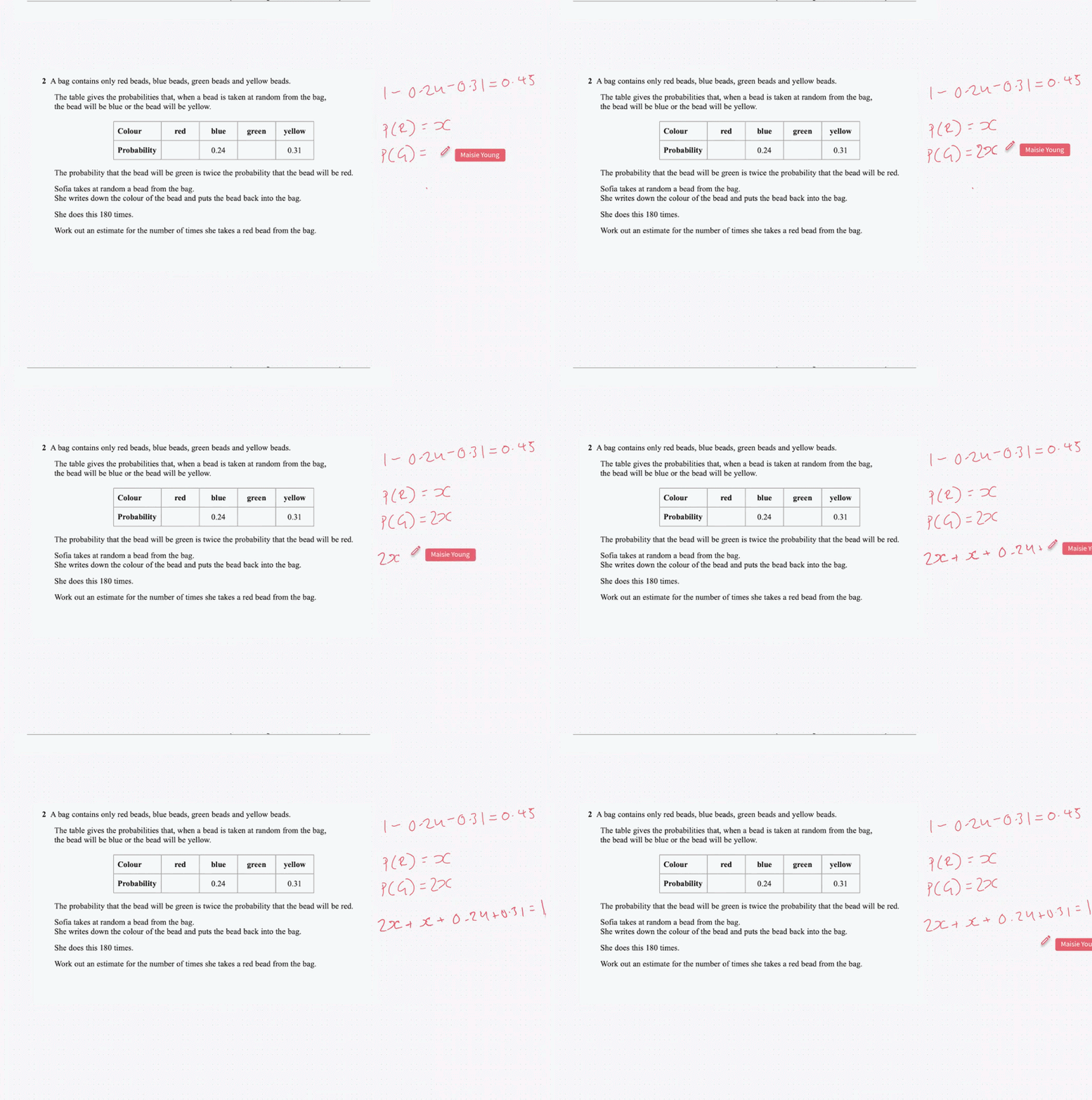
This clip is from a real Greenhill Academics lesson, recorded live. The lesson shown is maths, and an English Literature lesson runs on the same shared board, with the essay and the question open side by side.
Who your child would work with
Who reads the essay with your child
Laurie · English, Oxford (Double First)
Laurie read English at Oxford and took a Double First. He teaches IB English Literature, including the Extended Essay and Theory of Knowledge, and he is especially strong with international students meeting the UK system for the first time.

George · English Literature and Linguistics, Cambridge
George holds an MPhil in Linguistics from Cambridge and a First in English Literature from Manchester. His background in how language works gives him a sharp eye for whether an argument lands.

Lucy · English Literature, Cambridge
Lucy read Theology and Philosophy of Religion at Cambridge and teaches English Literature at IB and A Level. She is calm and patient with students who have lost confidence in a subject they used to enjoy.
Questions parents ask
My child writes well but the grade is stuck. Why?
Writing well is not the same as answering the question closely. A strong essay can still lose marks when the argument drifts away from what was actually asked.
Can essay technique really be taught?
Yes. Reading a question properly is a habit. So is deciding what it really asks, then answering exactly that. Habits improve with the right practice, on your child’s own texts.
Do you help with the Extended Essay?
Yes. Several of our tutors support the Extended Essay and Theory of Knowledge, from choosing a workable question through to structuring the argument.
Will a tutor know my child’s set texts?
We match your child with a tutor who teaches their texts and criteria. Tell us the titles when you book, and we will confirm the fit before the first lesson.
How soon could we start?
Once we know your child’s course, texts and availability, we can match them with a suitable tutor and arrange the first lesson.
The writing is there. The grade can follow.
Send us a recent essay and tell us which texts your child is studying. We will match them with a tutor who can work with those texts and identify where they may be losing marks.
Book a Lesson