

If your child is applying for Oxford PPE, you may be looking at a new test name and wondering what it actually involves. This guide explains what the TARA for Oxford PPE asks for: the three timed parts, the writing task, and a short exercise to try at home. It covers 2027 entry, with the test taken in autumn 2026.
What to know first
- Every Oxford PPE applicant sits the TARA. It is a new test from UAT-UK, used by Oxford and UCL.
- The TARA has three parts of 40 minutes each: Critical Thinking, Problem Solving, and a Writing Task.
- The first two parts are multiple choice, 22 questions each. You do not lose marks for a wrong answer.
- The Writing Task is one essay of up to 750 words. UAT-UK does not score it. A copy goes to the universities your child applied to.
- It is not built on a school course, but the Problem Solving part does expect some basic maths.
What the TARA for Oxford PPE actually tests
PPE stands for Philosophy, Politics and Economics. For 2027 entry, every Oxford PPE applicant takes the TARA, the Test of Academic Reasoning for Admissions. Oxford lists it as the test for PPE on its official admissions tests page.
The TARA is a reasoning test, not a subject test. UAT-UK, the group that runs it, says it looks at generic thinking skills and how clearly your child can write. It is a new UAT-UK test for 2027 entry. The same TARA is used for a few other Oxford courses, and by UCL, but this guide keeps to PPE.
If you are not yet sure which test your child’s course needs, our guide to the 2027 Oxbridge admissions tests maps each course to its test.
The three parts your child sits
The TARA comes in three parts, taken one after the other. Each part has its own 40-minute limit, and your child cannot go back to a part once it is done. That is 120 minutes of testing in total.
Critical Thinking (40 minutes)
22 multiple-choice questions. This part looks at how your child weighs up an argument: finding the main conclusion, the reasons behind it, any hidden assumption, and any slip in the reasoning.
Problem Solving (40 minutes)
22 multiple-choice questions. This part is about working through new problems: picking out the information that matters, finding a method, and spotting patterns in figures or data.
Writing Task (40 minutes)
One essay, chosen from three set questions. We look at this part on its own below, because it works very differently from the two multiple-choice parts.
What the writing task asks for
The Writing Task is the part that works differently from the rest, so it is worth being clear. In the Writing Task, your child picks one question from a choice of three. They then write one answer of up to 750 words, in 40 minutes.
The official TARA question guide sets out what each question asks. Your child has to explain what a statement means, give a reasoned argument against it, and then say how far they agree, and why. So it is not a free essay. It is a clear, three-step piece of reasoning on the page.
One more thing worth knowing. UAT-UK does not score the Writing Task. Instead, a copy of your child’s response is sent to the universities they applied to.
Worried about the TARA writing task?
Tell us your child’s course and where they are up to, and we can talk through how we would help them prepare.
Ask about a tutorDoes your child need to revise a subject for it?
The TARA is not tied to a PPE or school course, so there is no set list of facts to learn. The official guide says detailed knowledge of the subject of a question is not expected or required. Your child cannot revise facts for it the way they would for a GCSE.
But there is one part where a little maths helps. The guide says the Problem Solving part expects some basic maths, and it lists what that means at the back: working with numbers and percentages, the four rules, time and money and measures, simple area and volume, and reading tables and graphs. None of it is advanced. Still, it is worth your child being quick and sure with everyday maths, so the numbers do not slow them down.
How the test is scored and run
The shape of the test is easy to picture. Critical Thinking and Problem Solving are on screen and multiple choice, with 22 questions each. There is no calculator and no dictionary. Your child does not lose marks for a wrong answer, so it is worth having a go at every question.
Each of those two parts is scored on a scale from 1 to 9, reported to one decimal place. There is no single pass mark. The Writing Task is not given a score, as we said above. You can see the format on the official TARA page.
The dates for the October 2026 sitting
Booking for the October sitting was handled through the official UAT-UK system, not through Greenhill Academics or Oxford. A few dates are worth writing down.
- Test booking closed on 28 September 2026, at 6pm UK time.
- Test window: 12 to 16 October 2026.
- Results: 16 November 2026.
Candidates sitting in China, Hong Kong or Macau take the TARA on 14 October. For a standard Oxford PPE application there is no January sitting to fall back on, so the October window is the one that counts. You can check the timetable on the UAT-UK deadlines page.
Try this eight-minute reasoning warm-up at home
You can do this in about eight minutes. It is our own short exercise, not a real TARA question. You need a pen, paper and a timer. Find a short opinion paragraph, three or four sentences, from a newspaper or letters page.
- Minutes 0 to 2: Read the paragraph once. In one sentence, write down what the writer wants you to accept. That one sentence is the main conclusion.
- Minutes 2 to 4: Underline each reason the writer gives for it. Number the reasons in order.
- Minutes 4 to 6: Write one thing the writer has taken for granted but not said, something that would need to be true for the reasons to hold up. That is the assumption.
- Minutes 6 to 8: In two sentences, give one fair point against the conclusion. Then write whether you still agree, and why. Keep the page for a tutor.
What should you look for?
Watch whether your child can tell the conclusion apart from the reasons, and whether they can name an assumption the writer never states. The counter-point and final judgement echo two parts of the TARA Writing Task: giving a reasoned argument against a statement and weighing how far they agree with it.
What this cannot tell you
This is a warm-up, not a mock test. It cannot give a TARA score, show whether your child is ready, or compare them with others. It uses an everyday paragraph, not a real TARA question, and its two-minute steps are not real exam pace.
Bring the page to a first lesson. A tutor can look at how your child split the conclusion from the reasons, whether the assumption holds up, and how sharp their counter-point was, then choose what to practise next.
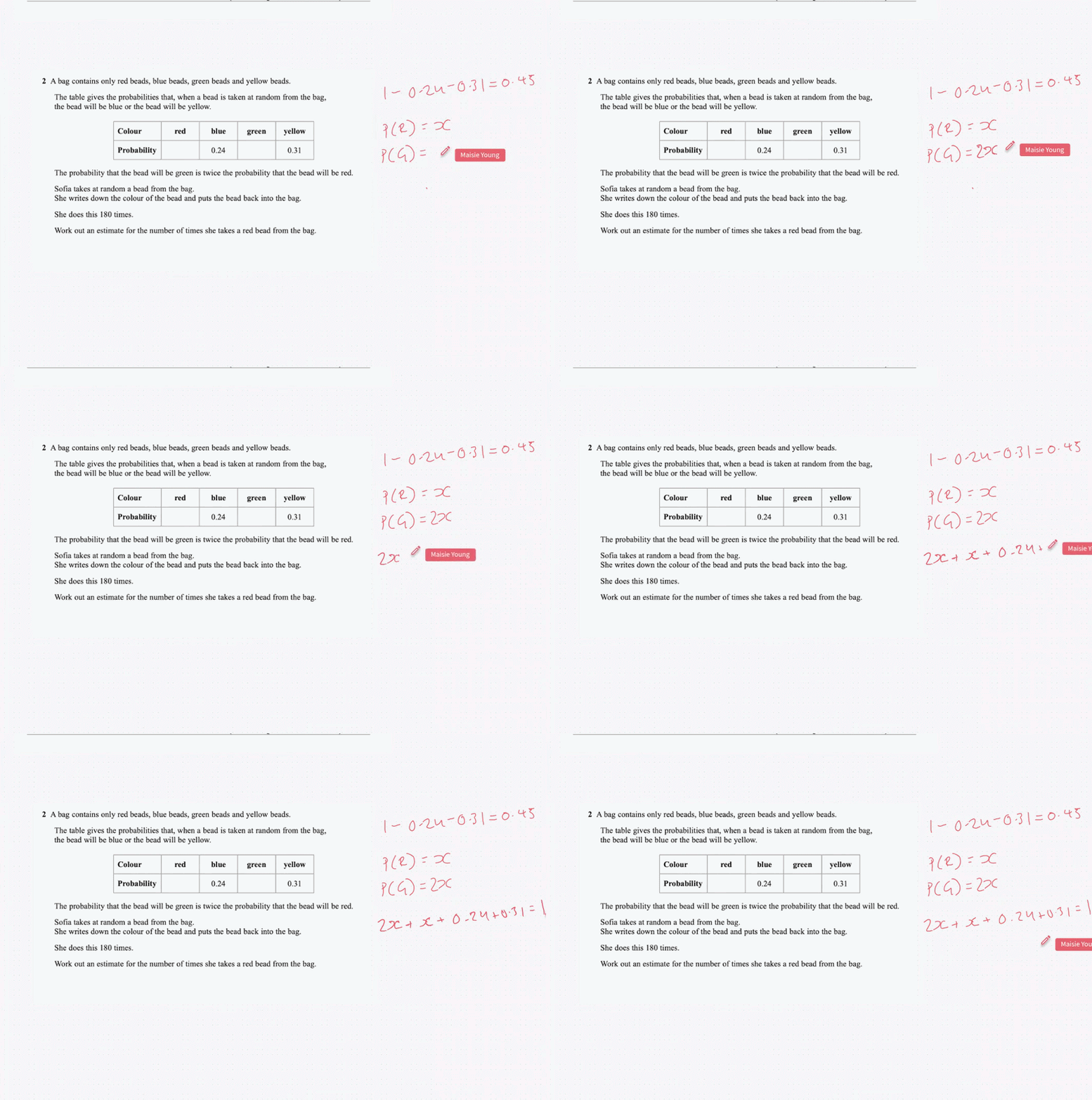
This clip shows a maths lesson recorded in Pencil Spaces, the online classroom used by Greenhill Academics.
Which tutor backgrounds are relevant to Oxford PPE?
The profiles below give each tutor’s background and what they teach. Tell us your child’s course and where they are up to, and we can talk it through. You can also see our Oxford admissions consulting and our wider admissions consulting.

Naomi read Philosophy, Politics and Economics at the University of Oxford (Exeter College), where she was awarded the Sir Arthur Benson Memorial Prize. She teaches History, Economics and Politics.

Kian read Classics at Brasenose College, University of Oxford. He teaches English, Latin, History and Politics, and supports Oxbridge applicants with personal statements, entrance tests and interviews.

Louis holds a First-Class degree in Philosophy and French from the University of Oxford (Keble College). He teaches Philosophy, and helps Oxbridge applicants with essay writing and building a clear argument.
Questions about the TARA and Oxford PPE
Does my child need to revise a subject for the TARA?
Not in the usual sense. The TARA is a reasoning test, and the official guide says detailed subject knowledge is not expected. The one exception is the Problem Solving part, which expects some basic, everyday maths.
How long is the TARA and what is in it?
It is three parts of 40 minutes each, so 120 minutes in total. Two parts are multiple choice, Critical Thinking and Problem Solving, and the third is a Writing Task of up to 750 words.
Is the Writing Task scored by UAT-UK?
No, not by UAT-UK. Your child writes one essay of up to 750 words, and a copy of the response is sent to the universities they applied to.
Can my child use a calculator?
No. The TARA is sat on screen with no calculator and no dictionary. There are no marks taken off for a wrong answer, so it is worth attempting every question.
When is the TARA and how does my child book it?
The test window is 12 to 16 October 2026, with results on 16 November 2026. Booking closed on 28 September 2026 at 6pm UK time, through the official UAT-UK system. Candidates in China, Hong Kong or Macau sit it on 14 October.
Not sure what the TARA means for your child?
Send us the course and where they are up to, and we can talk through how we would help.
Send an enquiry