

Your child may have good ideas about the text but struggle to make their argument clear in an A Level English essay. This page shows how an A Level English tutor in Abu Dhabi can work on that, starting with whether each quotation supports the paragraph’s point.
In a few lines
- A quotation can be good on its own and still not support the point a paragraph is making.
- One recent lesson worked through a single paragraph, and this page shows what that looked like.
- One recent lesson also started a revision document that the student could keep and use.
- This page also introduces two English tutors and explains how the time difference works.
Tell us about your child’s English essays
In the form, include which English course your child is taking and where their essays are getting stuck. We will reply by email.
Send us the detailsCould a good quotation be in the wrong paragraph?
In an essay about a text, each paragraph makes one point. A quotation supports the paragraph when it backs up that point. A famous line or a personal favourite may still belong somewhere else.
One recent A Level English lesson focused on exactly this. The paragraph had a clear point, and the lesson checked each quotation against it. One quotation was strong on its own, but it supported a different idea, so it was saved for another paragraph. A second quotation supported the point and stayed.
That was one lesson and one task, not a rule for every essay. It shows why the useful question is not “Is this a good quotation?” but “Does it support this paragraph’s point?”
What happens when a tutor works through one paragraph?
In the same lesson, one paragraph from the student’s own essay was the focus for most of the hour. The tutor and student worked on one small part at a time.
Before any analysis, the tutor asked what one difficult quotation literally meant. They worked it out together in plain words first. They then looked at how a character treats a feeling as if it were proof, and used that idea to develop the paragraph.
The work then moved from the paragraph’s main point to a smaller point that took the argument forward. By the end, most of the paragraph was already in the notes on the board. Those notes were joined together instead of starting the paragraph again.
That was one hour, one student and one task. A tutor can start from your child’s writing.
The plain sentence check
- Ask your child to choose one quotation from the last marked essay.
- Ask them to say in one plain sentence what it means, before any analysis.
- If they cannot explain it plainly, ask them to work out exactly what it means before using the quotation in the essay.
- Ask and listen only. The parent does not mark or judge the answer.
This is a conversation, not a test. It cannot measure a grade or judge the essay, and one quotation explained plainly is a fine place to stop.
What did the last piece of feedback say?
Tell us what your child’s teacher wrote on the last marked essay. We will reply by email. Sending the form does not book anything.
Write to usAfter the lesson, what can your child use for revision?
The lesson also included the start of a revision document. It kept quotations in one place, organised by theme or character, with analysis next to each one.
A document like this can grow between lessons. When it is time to revise, your child can return to quotations they have already worked on, with their analysis beside them, instead of starting from a blank page.
When you enquire, you can ask both what happens during the lesson and what your child could keep afterwards.
Start with the last marked essay. This week, try the plain sentence check on one quotation from the most recent marked essay. One quotation is enough. Starting with the latest essay keeps the check tied to work your child is doing now.
Who could help your child with A Level English?
Meet Francesca and Lucy
These are two of the tutors Greenhill Academics may suggest after reading your enquiry.

Francesca read English at Christ Church, University of Oxford, graduating with a 2:1 and receiving a scholarship for academic excellence. She has tutored English since 2017 and teaches GCSE, IGCSE and A Level English Literature.

Lucy read Theology, Religion and Philosophy of Religion at Clare College, University of Cambridge, graduating with a 2:1. Her subjects include English at GCSE, A Level and IB, alongside Psychology and Religious Studies.
Interested in lessons with an English specialist?
The form lets you select A Level and English Language, English Literature or both, then add anything specific. We will reply by email.
Enquire about English lessonsHow do lesson times work between Abu Dhabi and the UK?
Lessons run live online. Abu Dhabi is three hours ahead of the UK while the UK is on British Summer Time, and four hours ahead while the UK is on GMT.
When you enquire, we check each tutor’s availability individually and reply by email. This means you can see which times are available before agreeing to lessons. You can read more about the subject on our A Level English tutors page.
A minute inside a lesson
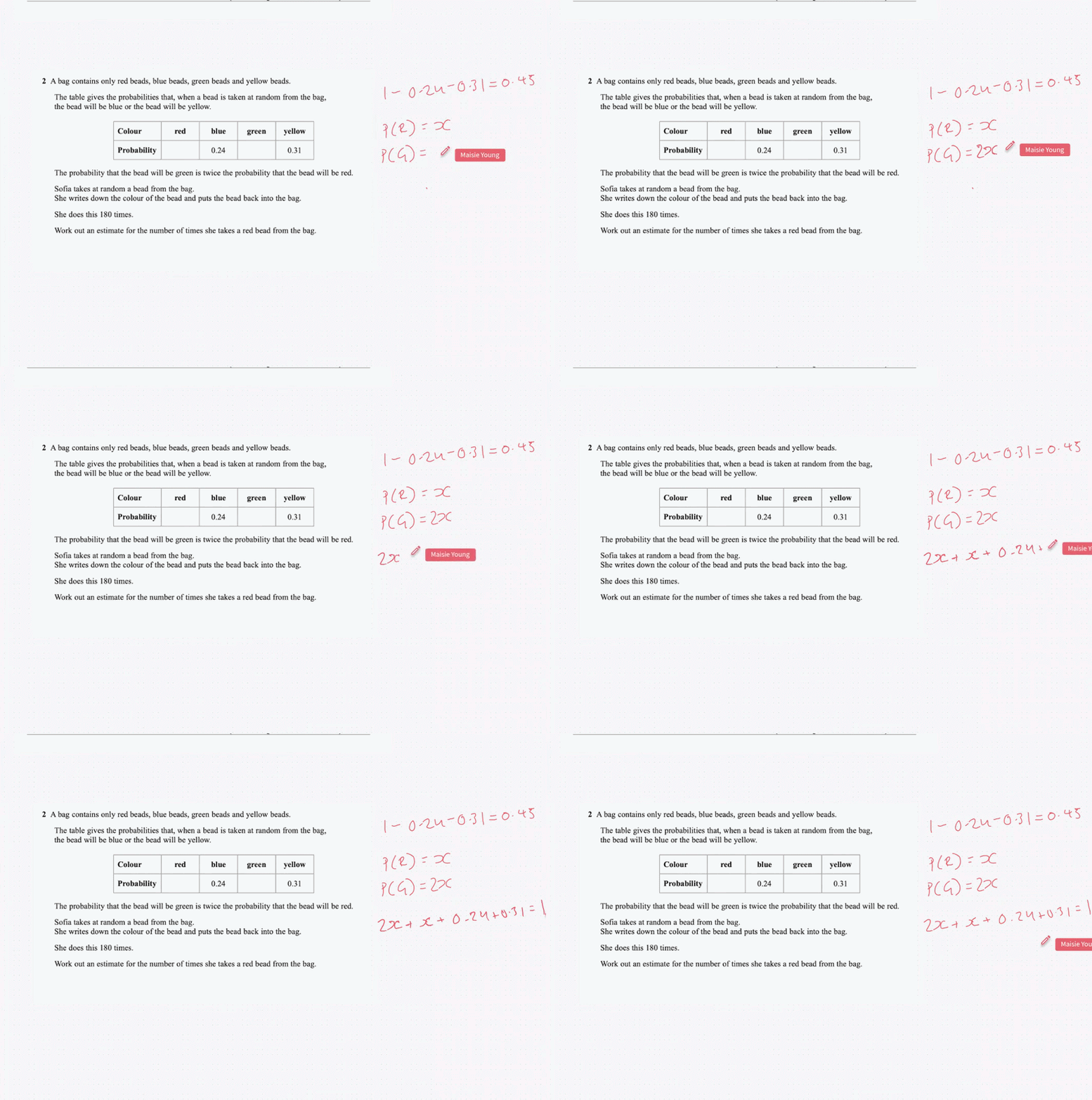
This short clip shows an online lesson on the shared whiteboard.
Worth reading next
What an A* in A Level English Literature Takes in the UAE
Read this if your child is aiming for an A* in A Level English Literature.
A Level Tutoring in Abu Dhabi: A Parent’s Guide
Read about A Level tutoring in Abu Dhabi across subjects, not only English.
What parents ask us about A Level English tutoring
My child understands the text but still gets a low essay grade. What would a tutor do?
A tutor can start with a recent essay and look for where the argument becomes hard to follow. The lesson can then focus on that part rather than going back over the whole text or assuming what the problem is.
Does it matter which texts my child is studying?
Yes. Tell us the course and current texts so we can check which tutor may be suitable. There is space in the form to add these details if you know them.
My child is already in Year 13. Is it too late to start?
Your child can still start in Year 13. Lessons can begin with the essays they are writing now and focus on one area at a time. How much can be covered depends on the exam date and the time available.
Does it matter whether my child sits English Language or English Literature?
Yes, because the two courses involve different kinds of work. The form lets you pick English Language, English Literature or both. Once we know which course your child is taking, we can review what support they need.
Will sending the enquiry form book a lesson?
No. Sending the form is an enquiry, nothing more. We reply by email, and no lesson is booked through the form.
When you are ready, we are easy to reach
The form asks who the tutoring is for, the level, the subject and anything specific. You should receive an email from us shortly.
Make an enquiry