

The quick version
- Your child can know the period well and still write essays that score in the middle, because the exam marks the written argument.
- The feedback often says “needs more depth”, but that comment can point at three different problems.
- Ask your child to explain one essay point aloud, then read together what they wrote. The difference between the two tells you a lot.
- If the spoken explanation is already stronger than the written paragraph, more knowledge may not be the first priority. The writing itself can be taught directly.
- Our UK-based tutors teach your child’s exact board and periods, online, at times that fit the Hong Kong school day.
They can explain the topic, but the essay says very little
Ask your child about their History topic and they can talk for ten minutes, full of names, dates and opinions. Then the essay comes back with an average grade and a comment like “needs more depth”. Your child sounds as though they know the material, and the grade says otherwise. It is often the point where a parent starts looking for an A Level History tutor in Hong Kong, whether their child is at Harrow Hong Kong, Kellett School, King George V School or elsewhere in the city.
Here is the first thing to hold on to. An average grade does not mean your child does not know the history. A Level History marks two things: knowing the period, and writing an argument about it, which means choosing evidence, putting points in an order that makes a case, and explaining each one in enough depth. Revision mostly builds the first. The essay is marked on both, and the second can be taught directly.
What happens when they explain one History paragraph aloud?
You can see the gap at home without marking anything. Take a recent essay, pick one point from it, and ask your child to explain that point to you out loud. Then read together what they actually wrote about it.
Say it aloud, then read it together
Outcome one
Rich out loud, thin on the page. The depth may be the gap. The explanation exists, but it is not making it into the writing.
Outcome two
Good ideas, in a jumbled order. The structure may be the gap. The points exist but do not build a case.
Outcome three
Clear writing, but general. The evidence may be the gap. The points could come from a summary rather than the period itself.
Each outcome suggests a different starting point, and any of them can hide behind “needs more depth”.
Our tutors run a version of this in the first lesson, reading a student’s essay with them. Ryan, one of the History tutors below, put the standard he teaches like this:
How our tutors put it
“If you’ve written it and you’re getting confused, how’s the examiner going to cope?
”
Ryan, A Level History tutor
It is the question he teaches students to ask of their own writing.
Ryan gives students a practical test for the same standard. After any general sentence, ask “What do you mean?” As he puts it, “If someone can go, ‘What do you mean?’ … the amount of times you can say that is an indication that you’re not being specific enough.” If your child can answer that question aloud but the answer is missing from the paragraph, the problem is likely to be depth.
Sit down with one essay this week
Run the say-it-then-read-it check on one recent essay this week. Keep the essay, and note which outcome you saw, because a real essay plus that one observation gives a tutor a useful head start on the first lesson.
Reading more can leave the essay unchanged
When a History grade disappoints, the natural response is to read more: more of the textbook, more revision guides, more notes. But if the problem is the writing, more reading alone may not change it. The next essay may look much the same, even with more material behind it.
Rereading can help your child remember the content, but it may not change how they explain evidence or structure an argument. Direct feedback on a recent essay is more likely to show what the writing needs next.
Is the essay thin, jumbled or too general?
Felix, Leila and Marcus are blends of several students we have taught, and the names are invented. The teaching in each story is real. All three had heard some version of “needs more depth”, and it meant something different every time.
Felix could say it but not write it
Felix knew his Cold War period inside out. His tutor asked him to explain a point from his essay on Soviet control of Eastern Europe, and out loud he gave a rich, thoughtful answer. The written version of the same point was two thin sentences. So his tutor made that gap the work itself: say the point out loud first, then write what you just said, one sentence at a time. Over the following weeks, his essays began to carry more of what he could say.
Leila had the ideas in the wrong order
Leila read sources with real skill. She could spot what a source revealed and what its limits were, but her ideas went down in the order she thought of them, so her essays jumped from point to point instead of building a case. Her tutor taught her to plan the order before writing a word: strongest argument first, each paragraph earning the next. Her essays began to read like a case being made rather than notes being emptied.
Marcus wrote clearly but stayed general
Marcus wrote well, yet his points could have come from someone who had read a summary rather than studied the period. His tutor pushed him to earn each point with something particular: a date, a figure, a named person, a specific event. The habit took practice, but his paragraphs slowly gained the weight the mark scheme calls depth.
One low History grade does not tell you what went wrong
A grade on its own cannot say whether the problem is depth, structure or evidence, and those need different work. The aloud-versus-written check above tells you more about your child’s next step than any national figure.
Does the essay say less than your child can explain?
An A Level History tutor can review a recent essay and identify what needs work first: depth, structure or evidence.
Book a LessonWill an A Level History tutor in Hong Kong help if school is already covering the course?
Yes. School lessons have to cover the course for the whole class. A tutor can compare one child’s spoken explanation with their written paragraph and identify what is missing. The tutor marks your child’s essay before the lesson, then spends the lesson on the specific feedback: where the depth thins out, where the order breaks the argument, where a general point needs a particular piece of evidence.
The first lesson usually starts from a recent essay or mock answer. Ideally your child sends it ahead, so it arrives already read. The tutor pins down the main issue, whether that is depth, structure or evidence, and then agrees a plan with your child, so everyone knows what the coming lessons will work on.
The lessons follow your child’s exact exam board and set periods. You receive a written report after every lesson, and follow-up practice is added to the shared board. Homework reminders are sent by email.
Inside a lesson
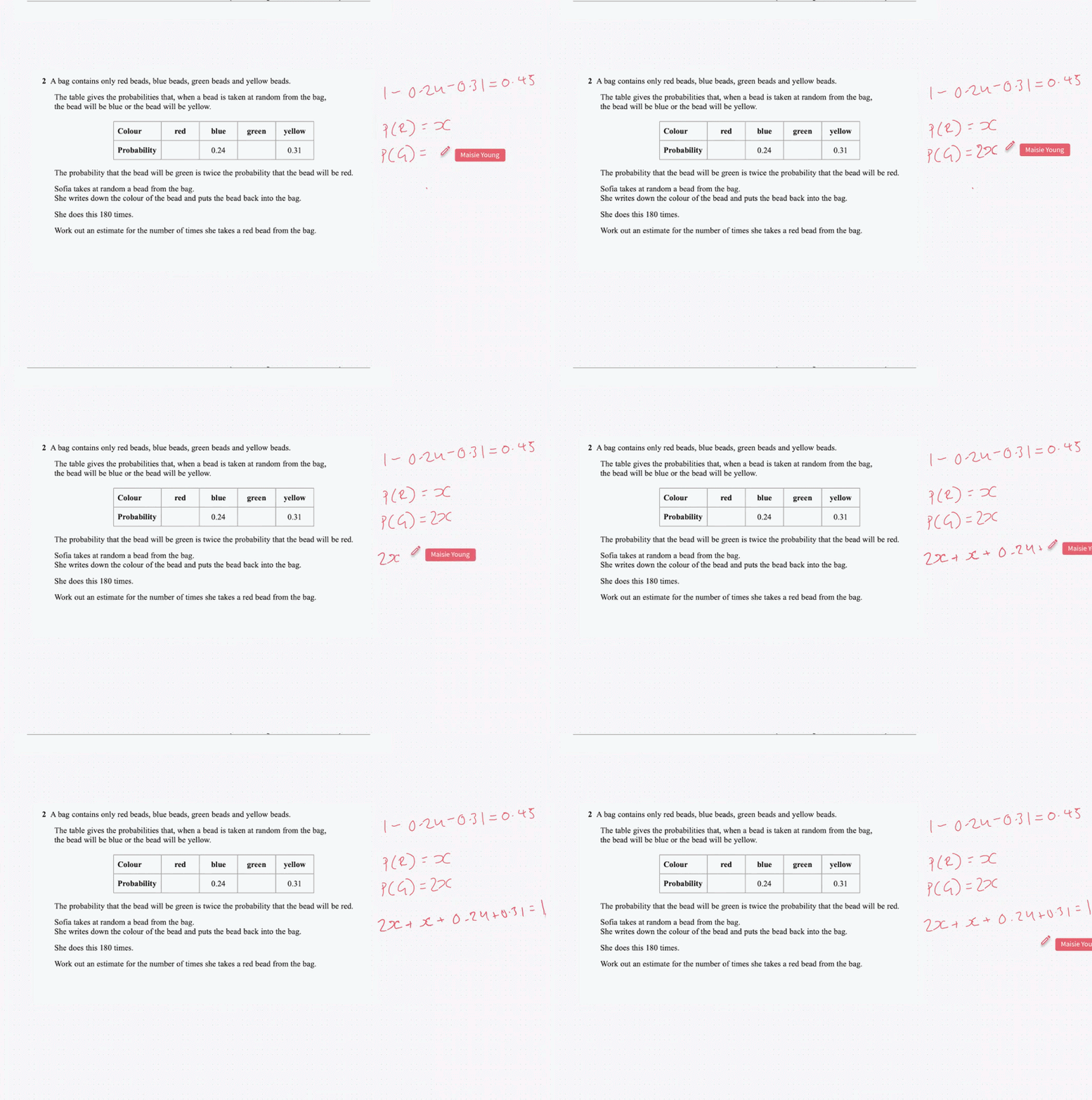
This clip is from a real Greenhill Academics lesson, recorded live. It shows a maths lesson on the same shared board your child would use in History, with the work and the feedback side by side.
Who your child would work with
Oxford-educated A Level History tutors, teaching online across Hong Kong
Ryan · History and Modern Languages, Oxford
Ryan read History and Modern Languages at Jesus College, Oxford, and holds a master’s in Modern European History. He now works in defence and security policy, which keeps his teaching connected to how history is used in the real world, and he teaches History at GCSE and A Level with a sharp focus on the written argument.

Naomi · Politics, Philosophy and Economics, Oxford
Naomi studied PPE at Exeter College, Oxford, after A*s in History, Politics and Religious Studies, and teaches A Level History, Politics and Economics, with a particular strength in essay structure: putting points in an order that builds a case.

Kian · Classics, Oxford
Kian read Classics at Brasenose College, Oxford, after A*s in History, Politics and Latin, and he teaches History at GCSE and A Level. His lessons run on open discussion, and he is particularly good at drawing out what a student already knows and helping them pin it down in writing.
Questions parents in Hong Kong ask about A Level History
How do I find a good A Level History tutor in Hong Kong?
Look for a tutor who teaches your child’s exact board and set periods, and who works from your child’s real essays rather than general discussion of the subject. At Greenhill Academics we match each student with a specialist and teach online, which works well for families in Hong Kong.
My child knows the content well. Why are the essay marks low?
History essays mark the written argument, not only the knowledge behind it. Depth of explanation, structure and exact evidence decide the mark, and these are skills in their own right. Students may understand them in principle but struggle to apply them consistently in timed essays, and that is exactly what a tutor works on.
Do you cover the source questions as well as essays?
Yes. Where source or interpretation questions form part of your child’s course, our tutors cover them alongside essay work. These questions reward weighing what a source shows against its limits, then writing that judgement clearly, practised on past paper questions from your child’s own board.
Are your History tutors based in Hong Kong?
No. Our tutors are based in the UK and teach online, so your child learns from an Oxford-educated specialist while staying at home in Hong Kong. Lessons can be arranged around the Hong Kong school day.
How quickly can essay marks improve?
It varies by child. A tutor can give you a clearer view after reading a recent essay and hearing your child explain a point from it aloud. Steady feedback on real essays across a term is the realistic route, and starting before the mocks gives the most room to work with.
Find out why the essay is losing marks
Share a recent essay and tell us your child’s exam board and periods. We will match them with an A Level History tutor who can identify what is missing and what to work on first.
Book a Lesson