Effective A Level Revision Strategies

Why Most A Level Revision Fails: The Science Behind Memory Loss
Every year, thousands of A Level students invest countless hours in revision, only to walk into exam halls feeling unprepared. The problem isn’t dedication or intelligence. It’s that most students unknowingly use revision methods that science has proven ineffective. According to research from cognitive science specialists, “if a revision strategy is enjoyable and rated effective by students, it is probably one of the least effective strategies they could be using.”
The culprit? The forgetting curve. Hermann Ebbinghaus’s research from 1885 revealed that humans forget approximately 50% of newly learned information within the first hour, and up to 70% within 24 hours. Without active intervention, students retain only 25% of what they’ve studied after just one week.
The Forgetting Curve: Hard Numbers
Research by Hermann Ebbinghaus (1885): Students lose 50% of information within 1 hour, 70% within 24 hours, and retain only 25% after one week. This explains why cramming feels effective but produces poor exam results.
The 7 Science-Backed Revision Strategies That Actually Work
In 2013, educational psychologists led by John Dunlosky conducted the most comprehensive review of learning techniques ever undertaken. They tested 10 common revision methods and ranked them by effectiveness. Here are the strategies that consistently produce the best results, backed by decades of research.
1. Spaced Repetition: The Memory Multiplier
The Science: Research from the Royal Society of Chemistry shows that reviewing material at increasing intervals dramatically improves retention.
How it works: Instead of studying Topic A for 3 hours straight, study it for 30 minutes, then review after 1 day, 3 days, 1 week, and 2 weeks. According to education specialists, this method produces “among the most powerful effects in memory research.”
Practical application: Use the 2-3-5-7 rule. Review notes on day 2, day 3, day 5, and day 7 after initial learning.
2. Active Recall: Test Yourself Constantly
The Science: Dunlosky’s research identified “practice testing” as one of the two most effective learning strategies.
How it works: Instead of re-reading notes, close your books and write down everything you remember about a topic. Check your accuracy, then repeat. Birmingham City University research shows this forces your brain to strengthen memory pathways.
Practical application: Create blank topic sheets. Fill them in from memory, check against notes, identify gaps, then repeat.
3. The Feynman Technique: Teach to Learn
The Science: Developed by Nobel Prize-winning physicist Richard Feynman, this technique forces deep understanding by requiring simple explanations.
How it works: Explain a concept as if teaching a 12-year-old. If you can’t simplify it, you don’t understand it well enough. According to UCAS research, you remember 95% of what you teach others.
Practical application: Record yourself explaining topics aloud, or genuinely teach a friend or family member.
4. Elaboration: Connect Everything
The Science: The Learning Scientists identify elaboration as one of six crucial learning strategies.
How it works: For every fact you learn, ask “Why is this true?” and “How does this connect to other topics?” This creates multiple retrieval pathways in your brain.
Practical application: When studying photosynthesis, don’t just memorise the equation. Connect it to climate change, energy production, and cellular respiration.
5. Dual Coding: Visual + Verbal
The Science: Research shows that combining visual and verbal information gives you “two different ways of remembering information.”
How it works: Convert text into diagrams, timelines, or flowcharts. Your brain processes visual and verbal information differently, doubling your retrieval options.
Practical application: Turn history timelines into visual maps, chemistry processes into flowcharts, literature themes into mind maps.
6. Strategic Past Paper Practice
The Research: A* students consistently report that studying mark schemes and examiner reports was their most effective strategy.
How it works: Don’t just practice papers. Study mark schemes and examiner reports to understand exactly what gains marks. As one A* student noted: “You become familiar with terms that examiners look for.”
Practical application: Do each past paper twice. First for content, second for mark scheme analysis.
7. Interleaving: Mix It Up
The Science: Cognitive science research shows that mixing different topics in one session improves problem-solving skills.
How it works: Instead of studying one topic for hours, alternate between different topics every 20-30 minutes. This forces your brain to constantly retrieve and distinguish between concepts.
Practical application: In a 2-hour session, study differentiation for 25 minutes, switch to essay structure for 25 minutes, then atomic structure for 25 minutes.
Struggling to Implement These Strategies Effectively?
Our expert A Level tutors specialise in teaching evidence-based revision techniques that work. Get personalised guidance on implementing these strategies for your specific subjects.
Book Your Free ConsultationThe Revision Methods That Feel Good But Don’t Work
Educational research consistently shows that the most popular revision methods are often the least effective. Understanding what doesn’t work is just as important as knowing what does.
Revision Methods That Waste Your Time
| Ineffective Method | Why It Feels Good | Why It Doesn’t Work |
|---|---|---|
| Highlighting & Re-reading | Easy and familiar | Creates illusion of knowledge without testing recall |
| Making Posters | Creative and visually appealing | Time-consuming with minimal cognitive engagement |
| Copying Notes Verbatim | Feels productive and organised | Passive activity that doesn’t engage memory systems |
| Learning Styles Approach | Feels personalised | No scientific evidence supports learning style effectiveness |
Source: Evidence-Based Learning Research
How to Build an Effective A Level Revision Schedule
Research shows that 20-30 minute revision sessions work better than longer sessions for maintaining concentration. Here’s how to structure your revision for maximum effectiveness:
Evidence-Based Revision Schedule Framework
Plan Your Spaced Repetition
Map out when you’ll review each topic using the 2-3-5-7 rule. Schedule review sessions before you forget, not after.
Alternate Active Methods
Rotate between active recall, practice papers, and teaching sessions. Never spend more than 30 minutes on passive methods.
Interleave Your Subjects
Don’t study one subject all day. Mix 25-minute blocks of different subjects to strengthen memory connections.
Test Before You Study
Begin each session with a quick self-test on previous material. This primes your brain for new learning.
Subject-Specific Applications
These evidence-based strategies work across all A Level subjects, but the application varies. Here’s how to adapt them for different subject types:
Strategy Applications by Subject Type
Sciences (Biology, Chemistry, Physics)
- Active recall: Draw diagrams from memory
- Elaboration: Explain the “why” behind processes
- Dual coding: Convert equations into visual flows
- Interleaving: Mix calculation practice with theory
Humanities (History, English, Politics)
- Feynman technique: Explain arguments simply
- Elaboration: Connect themes across periods
- Active recall: Write essays from memory
- Past papers: Analyse mark scheme language
Mathematics & Further Maths
- Spaced repetition: Regular problem solving
- Active recall: Solve without formula sheets
- Interleaving: Mix different topic questions
- Elaboration: Understand method reasoning
When to Seek Expert Help
Even with the best revision strategies, some students need additional support to implement these methods effectively. Educational specialists note that working with an experienced tutor can provide “the structure, guidance, and support that makes all the difference.”
Consider professional support if you’re consistently struggling to retain information despite using evidence-based methods, feeling overwhelmed by the volume of content, or finding it difficult to identify your weakest areas for focused improvement.
Research Verified: All revision strategies and statistics in this article are sourced from peer-reviewed educational research, including Hermann Ebbinghaus (1885), Dunlosky et al. (2013), The Learning Scientists, and Birmingham City University educational psychology studies.
Transform Your A Level Revision with Expert Support
IMPLEMENT EVIDENCE-BASED STRATEGIES EFFECTIVELY
Our Oxbridge-educated tutors specialise in teaching these proven revision techniques. Get personalised guidance on implementing spaced repetition, active recall, and strategic past paper practice for your specific A Level subjects.
How Hard Is the 13+ Common Entrance? Maths & English Breakdown
You might think 13+ is just a longer 11+, but expectations go much deeper
Many parents initially assume the 13+ Common Entrance will be similar to the 11+ experience: perhaps with a few additional subjects. However, this assumption quickly proves incorrect once preparation begins. The 13+ represents a significant step up in academic expectations, requiring students to demonstrate skills at what Oppidan Education describes as “Year 10 standards”, considerably beyond typical Year 8 curriculum levels.
Parents often feel overwhelmed by the depth of content, the range of subjects, and the pressure to perform at what feels like an impossibly high standard. If you’re questioning whether your child is ready, this concern reflects the genuine academic leap that 13+ Common Entrance represents.
The 13+ Reality Check
Many families discover that 13+ Common Entrance demands significantly more than expected. The academic level reaches Year 10 standards in core subjects, requiring deep conceptual understanding rather than the pattern recognition that often worked at 11+.
The Core Challenge: Maths and English Aren’t Just Exams, They Test Thinking
The 13+ Common Entrance, administered by ISEB (Independent Schools Examinations Board), assesses students across three compulsory core subjects: English, Mathematics, and Science. However, it’s the Maths and English papers that often determine success or failure, as these subjects require the deepest analytical thinking and foundational skills.
According to Oppidan Education, the Level 2 and Level 3 Common Entrance expectations are comparable to Year 10 students in state schools. This means 13-year-olds are tackling topics such as advanced algebra in Maths and sophisticated literary analysis in English: content that many students don’t encounter until they’re 15.
13+ vs 11+: The Academic Leap
11+ Level
- Basic comprehension and writing
- Arithmetic and simple problem-solving
- Pattern recognition often sufficient
- Year 6 curriculum expectations
13+ Level
- Literary analysis and sophisticated writing
- Advanced algebra and complex reasoning
- Deep conceptual understanding required
- Year 10 curriculum expectations
13+ Maths: From Arithmetic to Advanced Algebra
The 13+ Maths syllabus is based directly on Key Stage 3 National Curriculum targets. Students face three papers: a mental arithmetic paper (30 minutes), plus calculator and non-calculator written papers (60 minutes each). The content progression is significant and directly follows Department for Education Key Stage 3 Mathematics standards:
13+ Maths Core Topics
Number & Algebra
- Algebraic notation and manipulation
- Linear equations and inequalities
- Sequences and formula substitution
- Factorisation and simplification
Geometry & Measures
- Angle relationships and properties
- Area and volume calculations
- Coordinate geometry basics
- Transformation and symmetry
Statistics & Probability
- Data interpretation and analysis
- Averages and range calculations
- Basic probability concepts
- Graph construction and interpretation
Problem Solving
- Multi-step word problems
- Cross-curricular applications
- Mathematical reasoning and proof
- Real-world context questions
Source: ISEB 13+ Maths Syllabus via Owl Tutors | Key Stage 3 National Curriculum
13+ English: Beyond Comprehension to Analysis
The 13+ English syllabus consists of two papers that test reading and writing skills at a level demanding sophisticated analytical thinking. According to Keystone Tutors, the assessment is “split evenly across comprehension and composition,” requiring students to demonstrate:
13+ English Core Skills
Literary Analysis
Understanding themes, character development, and literary techniques in texts
Critical Writing
Sophisticated essay structure with evidence-based arguments and ideas
Creative Expression
Original creative writing demonstrating imagination and technical skill
13+ English Past Papers: Two-Paper Assessment Structure
The 13+ English examination consists of two papers, each testing different aspects of literary comprehension and writing skills. Like Mathematics, English papers are offered at different levels (Level 1 and Level 2) to accommodate varying abilities, with most students sitting Level 2 papers.
13+ English Assessment Areas
Source: Keystone Tutors confirms the assessment is “split evenly across comprehension and composition” with both papers testing similar core skills.
Paper 1: Reading & Writing
- Literary comprehension tasks
- Analytical writing responses
- Creative composition elements
- Text analysis and interpretation
Paper 2: Reading & Writing
- Literary comprehension tasks
- Analytical writing responses
- Creative composition elements
- Text analysis and interpretation
Both papers test: Reading comprehension, analytical writing, creative expression, and sophisticated use of language
Feeling Overwhelmed by 13+ Expectations?
Our expert tutors specialise in breaking down complex 13+ content into manageable steps, building confidence alongside understanding.
Book Your Free ConsultationWhy Past Papers Are Essential, Especially in These Subjects
Past papers are the gold standard for 13+ preparation because they reveal the true expectations and style of questioning. Galore Park, the exclusive distributor of ISEB past papers, provides the most authentic practice materials available. Many schools also publish sample papers on their admissions pages.
The ISEB produces three sets of exam papers each year (November, January, and May/June), with schools able to pre-order the most recent papers immediately after each exam session. According to Oppidan Education, parents and tutors can access papers one year after the live exams.
13+ Past Papers: Where to Find Them
| Source | Content Available | Access Method | Cost |
|---|---|---|---|
| ISEB Official | All subjects, all levels, mark schemes | Online shop, digital downloads | Individual papers from £8 |
| Galore Park | ISEB past papers, revision guides | Online shop and direct contact | Paper bundles available |
| School Websites | Sample papers, specimen exams | Admissions pages | Free download |
| Example Schools | King’s Wimbledon, Latymer Upper | Check school admissions pages | Usually free |
Sources: Galore Park, ISEB Official
What makes past papers so valuable is their ability to reveal the depth of questioning. For example, a 13+ Maths paper might ask students to solve a multi-step problem involving algebraic manipulation, followed by interpretation of the result in context. An English paper might require analysis of literary techniques in an extract, then ask students to write their own piece demonstrating similar skills.
School-Specific Past Papers: Real Exam Experience
Beyond the standardised ISEB papers, many leading independent schools publish their own 13+ entrance papers and scholarship exams. These school-specific papers are invaluable because they show exactly how different institutions approach 13+ assessment, from the straightforward entry papers to the challenging scholarship examinations.
13+ English Past Papers: Where to Find Them
Important: All past papers are available through official sources only. We provide links to authorised distributors and official exam boards to ensure you access legitimate, up-to-date materials.
| Source | Content Available | Access Method | Official Link |
|---|---|---|---|
| ISEB Official | All subjects, all levels, mark schemes | Online shop, digital downloads | Visit ISEB Shop |
| Galore Park | ISEB past papers, revision guides | Online shop and direct contact | Visit Galore Park |
| Owl Tutors | 13+ English past papers and guidance | Educational resources and papers | Visit Owl Tutors |
| School Websites | Sample papers, specimen exams | Admissions pages | Check individual school sites |
Recommended Approach:
- Start with ISEB: Official exam board with comprehensive past papers
- Check Galore Park: Authorised distributor with bundled materials
- Visit Owl Tutors: Expert guidance on 13+ English preparation
- School-specific papers: Check target schools’ admissions pages
13+ Maths Past Papers: Official School Sources
Important: All past papers should be accessed through official school websites or authorised distributors. We provide links to legitimate sources to ensure you receive authentic, current materials.
| Source Type | Content Available | Official Link |
|---|---|---|
| ISEB Official | All 13+ Maths papers, all levels, mark schemes | Visit ISEB Shop |
| Owl Tutors | 13+ Maths past papers and expert guidance | Visit Owl Tutors |
| Galore Park | ISEB authorised past papers and revision materials | Visit Galore Park |
| Individual Schools | School-specific sample papers and specimen exams | Check target schools’ admissions pages |
Best Practice for Past Papers:
- Always use official sources: Ensures authentic, current materials
- Check your target schools: Many publish sample papers on admissions pages
- Start with ISEB: The official exam board for comprehensive coverage
- Consider expert guidance: Platforms like Owl Tutors provide context and preparation strategies
Greenhill Academics’ Targeted Tutoring Framework
At Greenhill Academics, we’ve developed a specific approach for 13+ Common Entrance preparation that directly addresses the challenges these exams present. Our tutors understand that success requires more than content knowledge: it demands a fundamental shift in how students approach academic thinking.
Our 13+ Success Framework
Diagnostic Starts to Identify Weak Areas
Each student begins with comprehensive assessment using real past papers to pinpoint exactly where gaps exist in algebraic understanding, literary analysis, or exam technique.
Active Practice Sessions
Sessions prioritise exam-style questions over theoretical learning. Students tackle real 13+ problems with guidance, building familiarity with question formats and time pressures.
Mistake Correction as Learning Moments
Every error becomes a teaching opportunity. When a student struggles with quadratic factorisation or misses poetic imagery, we explore the underlying thinking patterns.
Exam Pacing and Mark-Scheme Technique
Students learn how to maximise marks through clear working in Maths and structured responses in English. Time management becomes as important as content knowledge.
Why Other Subjects Aren’t in Focus, and That’s Okay
While the 13+ Common Entrance includes subjects like History, Geography, Religious Studies, and Modern Languages, this blog focuses on Maths and English for a strategic reason: these are the universal requirements for all candidates.
According to Keystone Tutors, schools may accept some specialisation in results. A lower score in Latin might be acceptable if attainment across Maths and English is significantly higher than the school’s pass mark. However, weakness in the core subjects of Maths and English is much harder to compensate for.
Why Maths & English Matter Most
Universal Requirements
Every student must sit Maths and English papers
Unlike Latin or additional languages which vary by school requirements
Foundation Skills
Core competencies for all senior school learning
Success in other subjects depends on strong Maths and English foundations
Strategic Focus: Master the subjects that determine admission success for every applicant.
Next Steps: Assess Your Child’s Readiness
The 13+ Common Entrance demands significantly more than many families initially realise. The gap between expectations and reality can feel overwhelming, but with the right preparation strategy, students can bridge this gap successfully.
The clearest path forward is to assess your child’s current level against actual 13+ expectations. A diagnostic session using real past papers will reveal exactly where preparation needs to focus, whether that’s algebraic manipulation, essay structure, or exam timing.
Master the 13+ Common Entrance with Expert Support
DISCOVER YOUR CHILD’S 13+ READINESS
Book a diagnostic session to assess exactly where your child stands against real 13+ Common Entrance expectations. Our expert tutors will create a targeted preparation plan for Maths and English success.
Book Your Free Diagnostic SessionGreenhill Academics’ Tutoring Method: The 4-Step Strategy for A Maths Success
Struggling with Maths despite revising hard? You’re not the only one. Students aiming for a 9 at GCSE or an A* at A Level often hit a wall. This isn’t because they lack ability, but because their revision strategy does not match what the subject requires.
The Maths Revision Trap
Many students fall into passive revision habits: rewatching videos, rereading notes, or completing worksheets without proper feedback. They’re working hard but not working smart, leading to frustration and disappointing results despite significant effort.
At Greenhill Academics, we have worked with hundreds of students in this position. Over the years, we have developed a structured, results-backed tutoring framework that helps students move from confusion to clarity, and from average marks to top grades.
Why So Many Students Fall Behind in Maths
Even high-achieving students can struggle in Maths, especially after the jump from GCSE to A Level. At GCSE, it is often possible to perform well using memorisation, pattern recognition and exam technique. A Level demands something different: conceptual depth, algebraic fluency and the ability to link ideas across topics.
The problem is not lack of effort. Many students revise for hours, but do so passively. They rewatch videos, reread notes or complete worksheets with little feedback. Mistakes are not spotted or corrected in time, and confidence can quickly drop.
GCSE vs A Level: The Critical Differences
GCSE Approach
- Pattern recognition often sufficient
- Memorisation can achieve good results
- Exam technique covers many gaps
- Topics taught in isolation
A Level Requirements
- Deep conceptual understanding essential
- Algebraic fluency a prerequisite
- Must connect ideas across topics
- Independent problem-solving required
They do not need more revision. They need a structure that teaches, corrects and supports the right skills at the right time.
Struggling Despite Working Hard?
Discover how our proven 4-step method transforms Maths performance and builds lasting confidence.
Book Your Free ConsultationThe 4-Part Framework We Use With Every Maths Student
We do not offer generic tutoring. Every Greenhill programme follows a system built to deliver results. Here’s how it works.
Our Proven 4-Step Maths Success Method
Diagnostic Start: Identify Gaps Early
Each student begins with a diagnostic process to assess their understanding. This highlights gaps in algebra, geometry or reasoning. The goal is not just to identify wrong answers, but to understand the thinking behind them.
Active Mastery Through Tutoring
Tutoring sessions are interactive. Students are encouraged to explain their reasoning aloud and solve problems independently. Concepts are revisited using spaced repetition, ensuring deeper understanding that lasts.
Real-Time Feedback and Error Correction
Mistakes are not brushed aside. Tutors explore why the error occurred, what steps were missed and how to avoid repeating it. This turns errors into learning opportunities and builds solid foundations.
Exam Technique and Pacing
Strong Maths knowledge must be matched with exam technique. Students learn to manage time, use mark schemes effectively and present clear working through past paper walkthroughs and timed exercises.
How Often Should Students Have Tutoring?
Tutoring schedules depend on the student’s level and goals:
Recommended Tutoring Schedules
GCSE Students
Year 10: One to two hours per week to build solid foundations
Year 11: Often increases, particularly after mock exams or during revision season
A Level Students
Year 12 & 13: Usually begin with two hours weekly
Exam periods: Some students add sessions during study leave, Easter or half-term
Flexibility is Key: Greenhill offers the ability to scale up tutoring support exactly when needed, adapting to your schedule and exam dates.
Which Exam Boards Are Covered?
We support all major UK exam boards including Edexcel, AQA and OCR. Every lesson is aligned with the student’s exact specification. Tutors are trained to use the correct terminology, question style and exam structure so that every session is directly relevant to the final exam.
Complete UK Exam Board Coverage
Specification-Aligned Teaching: Every session uses the correct terminology, question styles and exam structure for your specific exam board.
What Makes Our Maths Tutors Different
Greenhill Maths tutors are not only academically excellent. They are also trained in effective teaching techniques. Each tutor is Oxbridge-educated or equivalent, and understands how to adapt to different learning styles and explain difficult ideas clearly.
Many have sat the same exam papers and understand exactly what is expected in a high-stakes setting. Their goal is not just to help students understand Maths but to build confidence and exam readiness.
Why Our Maths Tutors Deliver Results
Academic Excellence
- Oxbridge-educated or equivalent qualifications
- First-hand experience with challenging exams
- Deep subject knowledge across all topics
Teaching Expertise
- Trained in effective teaching techniques
- Adapt to different learning styles
- Focus on building confidence alongside knowledge
Resources That Reinforce Learning Outside Lessons
Our tutors guide students through past papers, topic-specific question banks and worked solutions. These are not simply handed over but used actively during and between sessions to identify gaps and reinforce learning.
We use Pencil Spaces, a collaborative online platform that allows for real-time problem-solving, annotations and homework submission. This creates a consistent learning environment where students can review material even outside of their scheduled sessions.
Complete Learning Resource Package
Past Papers & Practice
Exam board-specific past papers, topic question banks, and worked solutions reviewed in every session
Pencil Spaces Platform
Real-time problem-solving, annotations, and homework submission with 24/7 access to materials
Tailored Resources
Each student’s materials matched to their exact exam board and specification requirements
Each student’s resources are tailored to their exam board. Between lessons, tutors assign specific practice questions and review these during the next session to ensure continuous progress.
Next Steps: Build a Plan That Works
The difference between a Grade 6 and a Grade 9 at GCSE, or a B and an A* at A Level, is not about raw intelligence. It is about having the right plan, consistent support and a proven method.
If you are ready to improve your Maths performance, whether you’re behind or aiming for the top, Greenhill Academics can help.
Transform Your Maths Performance with Expert Support
START YOUR MATHS SUCCESS JOURNEY TODAY
Join hundreds of students who’ve achieved Grade 9s and A*s using our proven 4-step method. Our Oxbridge-educated Maths tutors provide the structured support you need to excel.
Book Your Free Consultation11+ Non-Verbal Reasoning: Pattern Recognition Guide
🔍 The Subject That Baffles Every Parent
You’ve been confidently helping with maths and English homework all year. Then you open an 11+ practice paper and see “non-verbal reasoning” for the first time. Strange shapes, rotating patterns, and sequences that make no sense at all.
You stare at the page feeling completely lost. How are you supposed to help your child with something that looks like an alien puzzle?
This frustration hits every parent preparing for the 11+. Non-verbal reasoning feels impossible because it’s unlike anything you remember from school, and your child has never seen it either.
The good news? Non-verbal reasoning follows logical rules once you understand the patterns. Children often find it easier than parents expect because they approach visual puzzles without overthinking the complexity.
What is non-verbal reasoning?
Non-verbal reasoning involves analysing visual information and solving problems using shapes, diagrams and pictures. This is different from verbal reasoning, which involves analysing written information.
Non-verbal reasoning tests several skills:
🎯 Key Skills Tested
Logic & Problem-Solving
Working through visual problems step-by-step
Spatial Awareness
Understanding how shapes move and transform
Pattern Recognition
Spotting logical sequences and rules
Non-verbal reasoning questions can be confusing to those who have never come across them before. Getting familiar with basic problem-solving and question types will help your child tackle non-verbal reasoning successfully.
Which exams test it?
Non-verbal reasoning is common in school entrance exams. These exam boards all include non-verbal reasoning:
📋 Main Exam Providers
🎯 GL Assessment
Used by most UK grammar schools
Paper-based test. Schools choose whether to include non-verbal reasoning in a specific paper or combined with other subjects.
🎓 ISEB Common Pre-Test
Common exam for 11+ or 13+ independent school entry
25-minute non-verbal reasoning section. Computer-based and adaptive (questions become more challenging based on performance).
💻 CAT4
Independent school entrance exam or Year 7 streaming test
Tests figure classification, analysis, recognition, and matrices. Usually computer-based, non-adaptive questions.
🔍 Cambridge Select Insight
Used by some independent schools for shortlisting
Each question contains 8 pictures and one missing picture. Children select from four options to complete the set.
Question types
Non-verbal reasoning questions fall into two main categories: interpreting shapes and manipulating 2D and 3D shapes.
📝 Interpreting Shapes
🔗 Pairing Shapes
Two pairs of images (one complete, one incomplete). Figure out the rule that changes the first image into the second, then apply it to complete the missing pair.
🔢 Sequences
Incomplete sequence of images. Choose the option that completes the gap in the sequence.
⬜ Matrices
Grid with one piece missing. Select the image that correctly completes the matrix based on the pattern.
🔐 Find a Code
Images linked to two-letter or three-letter codes. Each letter represents one feature. Work out what each letter represents.
❌ Odd One Out
Find the image that doesn’t fit with the rest of the group.
👥 Match to Group
Choose the option which has the most in common with a group or pair of images.
🔄 Manipulating 2D Shapes
🔍 Parts Within Shapes
Find an image hidden within a complex shape. Three types: which shape is hidden, which is not in the group, which group contains the hidden shape.
🧩 Shape Logic
Three types: combining shapes, forming a shape, forming a silhouette.
🔄 Rotations and Reflections
Work out what a shape would look like if rotated or reflected. Check all elements have been transformed the same way.
📄 Following Folds
Paper folded with shapes cut out. Choose what the paper looks like when unfolded.
📦 Manipulating 3D Shapes
📐 Nets and Cubes
2D net shown, work out what it looks like folded into a cube.
🔄 Rotating 3D Shapes
Choose which image shows the rotation of a 3D shape.
🧱 Combining 3D Shapes
Select blocks that combine to make a 3D shape. Three types: fully visible, partially hidden, obscured.
🔍 3D Shapes From Above
Choose the 2D plan showing what the 3D shape looks like from above.
Example questions
🎯 Worked Examples
🔢 Sequences
Question: Which pattern completes the sequence?
Answer: Option C – the shape rotates one-fifth clockwise each time.
Tip: Focus on one feature at a time: shading, direction, or orientation.

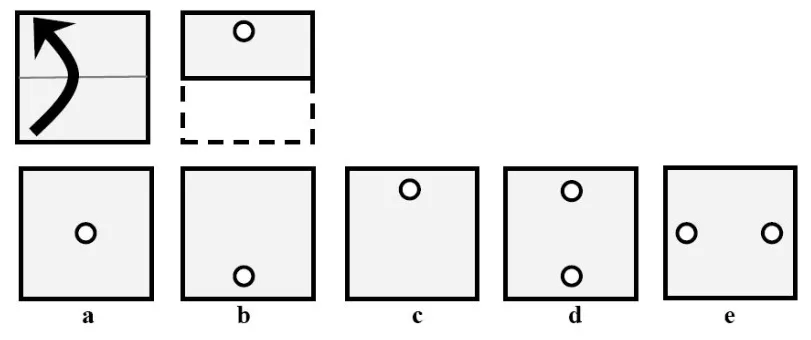
📄 Following Folds
Question: What would this folded paper look like when opened?
Answer: A – it is a symmetrical reflection of the cut-out shapes.
Tip: Look for mirrored placement and distances from the fold line.
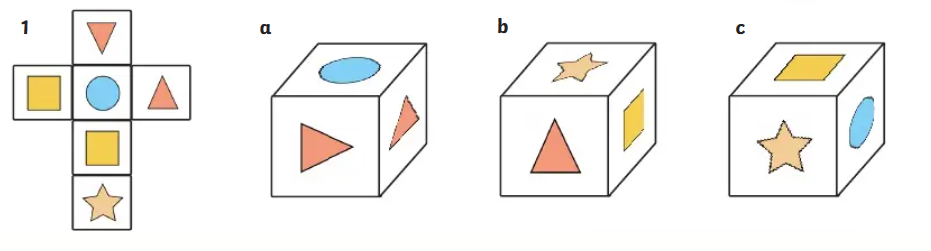
📐 Nets and Cubes
Question: Which cube can be made by this net?
Answer: Option A
Tip: Use real objects like dice or Rubik’s Cube to help visualisation. Eliminate “dud” cubes showing shapes not on the net.
Solving process
To tackle most non-verbal reasoning questions, follow this process:
🎯 5-Step Solving Method
1️⃣ Type
What type of question is it?
2️⃣ Analyse
Look at obvious qualities (shape, colour, pattern)
3️⃣ Compare
Find similarities and differences between shapes
4️⃣ Rule
Find a rule from these obvious qualities
5️⃣ Eliminate
Remove options that don’t follow the rule
Preparation strategies
📚 What Actually Works
✏️ Drawing
Drawing simplifies everything. When we picture many shapes in our heads, images become jumbled. Encourage your child to draw shapes out for clearer visualisation.
🎮 Make It Fun
Play Sudoku for logic and attention to detail. Lego builds shape visualisation skills. Jigsaw puzzles develop spatial awareness.
🔄 Consistency
A little bit every day goes a long way. Repetition makes these exercises second nature. Much easier than cramming into long last-minute sessions.
⏸️ Study Breaks
Break every 30 minutes improves productivity. Children come back refreshed and ready for challenges. Reward hard work afterwards.
💡 Remember
Don’t be disheartened if it takes time. Non-verbal reasoning isn’t taught in the national curriculum, so your child is learning completely new skills. Practice makes perfect, and the more questions completed, the faster they become.
What progress looks like
📈 Progress Indicators
👁️ Early Stages
Starts noticing patterns and describing what they see in shapes and sequences
🔍 Building Skills
Identifies simple rotations and reflections, spots obvious patterns
🎯 Developing Strategy
Uses the 5-step process for complex patterns and transformations
⚡ Exam Ready
Tackles unfamiliar question types confidently, works efficiently under time pressure
How our Cambridge tutors help
Non-verbal reasoning requires a different teaching approach than traditional school subjects. Our tutors understand that parents often feel completely lost trying to help with these visual puzzle questions.
Hugh recently completed a DPhil in Surgical Sciences at the University of Oxford and holds a First-Class MSci in Theoretical Physics from Imperial College London. With over a decade of tutoring experience, Hugh has a unique ability to break down spatial reasoning concepts and help children visualise pattern transformations systematically.
Mark achieved a Double First in History from Cambridge and has over 3,000 hours of tutoring experience. He’s guided students through entrance exams for leading schools including Eton, Harrow, Winchester, and St Paul’s. Mark excels at helping children approach visual reasoning with confidence and logical thinking.
Wynn holds a First Class degree in Human, Social and Political Sciences from Cambridge and works extensively with 11+ entrance exams. He helps students develop the 5-step solving process, making complex visual relationships clear and manageable.
Our tutors don’t just teach non-verbal reasoning techniques. They help children develop the spatial thinking and logical reasoning skills that serve them well across all subjects.
Ready to master visual patterns?
Our Cambridge-educated tutors specialise in making non-verbal reasoning accessible for children starting from scratch. We understand the time pressure families face and know exactly how to build both visual reasoning skills and exam confidence efficiently.
Every consultation begins with understanding exactly where your child stands with pattern recognition, then creating a focused plan that makes the best use of your preparation time.
Book Your Free Strategy Session
Discover exactly how to help your child master visual patterns, with a clear action plan you can start using immediately.
📚 Explore More 11+ Guides
🎯 COMPLETE 11+ GUIDE
Need Help with 11+ Exam Prep for 2025? Here’s How to Start Strong