The Secret to Using an Oxbridge University Admissions Consultant: The Greenhill Academics Framework

Russell Greenhill
By Russell Greenhill
Founder & CEO @ Greenhill Academics
Oxford Master’s Graduate • 4+ Years Tutoring Experience

How difficult is it to get into Oxford and Cambridge?

Every applicant to Oxford or Cambridge feels fear and uncertainty about whether or not they will get accepted. As the founder of Greenhill Academics, I was in your shoes in 2018 when I was applying to study the MSc. Financial Economics course at Oxford. I saw that just 13% of applicants get in and considered whether I was worthy of even trying. I did not know it back then, but I followed a plan that I now built a framework around that can help you improve your chances of getting into these top universities in the UK.

Russell Greenhill at Oxford

Russell’s Oxford Journey

Russell Greenhill is the founder of Greenhill Academics and an Oxford Master’s graduate in Financial Economics. After experiencing the uncertainty of applying to Oxbridge firsthand in 2018, he developed the PROGRESS framework that has now helped over 200 students achieve their dreams of studying at Oxford and Cambridge. His personal journey from uncertain applicant to successful graduate to trusted admissions consultant gives him unique insight into what it truly takes to succeed.

So is it hard to get into Oxford or Cambridge University?

In 2024, 14% of applicants to Oxford got accepted to study for an undergraduate degree. The most competitive courses were Economics and Management, Computer Science, and Mathematics and Computer Science. In Economics and Management just 5% of applicants got accepted. Other notoriously competitive courses are Law, Medicine, Maths and Physics.

Oxford Admissions Data (2020-2024)

YearApplicationsOffersStudents AdmittedAcceptance Rate
202423,0613,7933,24514.1%
202323,2113,7213,21913.9%
202223,8193,6453,27113.7%
202124,3383,5553,29813.5%
202023,4143,9323,69515.8%
Oxford Acceptance Rate Trend (2020-2024)
16%
15%
14%
13%
15.8%
13.5%
13.7%
13.9%
14.1%
2020
2021
2022
2023
2024

Clear Downward Trend: Despite a slight recovery since 2021, Oxford’s acceptance rate has declined from 15.8% to 14.1% over five years. This 1.7 percentage point drop means significantly more qualified applicants are being rejected each year.

Our framework that we use as admissions consultants

At Greenhill Academics, we have the PROGRESS programme that ensures you hit every point after a gap year, to increase your chances of getting accepted. This is shared here for the first time, and will ensure you don’t miss any part of your application out.

The PROGRESS Framework

P

Profile

Identify your academic strengths, values, skills, and the story behind your gap year.

R

Research

Explore courses, universities, entry requirements, deadlines, and funding options.

O

Outreach

Reach out to potential referees, mentors, or universities (especially for PhD applicants).

G

Gather Evidence

Collect transcripts, certificates, written work, or examples from your gap year.

R

Report

Write your personal statement or research proposal, tying your gap year into your academic goals.

E

Engage

Engage in preparation: reading, subject review, skills brushing-up, and academic mindset reset.

S

Sit Tests

Prepare for and complete any required admissions tests (LNAT, TSA, etc.) with focused practice.

S

Simulate Interviews

Do mock interviews and speak confidently about your experience, growth, and goals.

Ready to Apply the PROGRESS Framework?

Get personalised guidance from an Oxford graduate who’s helped 200+ students achieve Oxbridge success.

Book Your Free Strategy Session

Are College Admissions Consultants Worth it?

Russell Greenhill

“You must hit every requirement of the application. There are no shortcuts. The role of the consultant, in the United Kingdom, is to make sure nothing is missed that could strengthen the application.”

Russell Greenhill, Oxford Graduate & Founder of Greenhill Academics

The role of the admissions consultant is to improve your chances of getting into Oxford or Cambridge. We do this by guiding you through the process that we’ve seen many times before. We guide you through each step of the admissions process using the PROGRESS framework, from building your profile to simulating mock interviews with graduates who have been through the course to which you want to apply.

Which courses give you the best chance of success at Oxford or Cambridge

Given your profile, research all available options to reach where you want to go. More often than not, applicants are drawn to one course that they’ve come across randomly, but haven’t even considered similar, sometimes better suited courses.

Imagine you wanted to study Economics at Cambridge. I would ask whether you’re interested in business, politics, law, or philosophy. Here are some courses that may be a fit:

From 1 Course to 5 Options

Philosophy, Politics and Economics (PPE)

Oxford University

Economics and Management

Oxford University

Land Economy

Cambridge University

History and Economics

Oxford University

Human, Social, and Political Science (HSPS)

Cambridge University

We’ve suddenly gone from one course to five and your options are wide open. Once we have your profile, we tell you which courses you could be best fit for in our research report.

How to prepare for the Oxford or Cambridge interview

Student preparing for Oxford Cambridge interview

Some people say that the Oxford or Cambridge interviews are very nerve-wracking. They are pivotal to whether you get accepted or not because they play a differentiating factor in your application. They are famous for their idiosyncrasies. The interviewers rarely ask you about your goals or why you want to study at the university, rather they are based around the topic you are specialised in, going into depth on

Interview Success Strategy

We set you up with someone who has done your exact course or something very similar to what you are applying for. Practise with real graduates who understand exactly what interviewers are looking for.

We set you up with someone who has done your exact course or something very similar to what you are applying for. You will practise speaking confidently about technical topics and build your fluency in English if it isn’t your native language. You will finish with your tutor, ready to perform at your best.

When to seek a University Admissions Consultant

If you still feel lost in your application or you think you’d like to increase your chances of getting in, we are now accepting applications to apply for the 2026 intake through UCAS.

If you are scared about applying, even after using this framework, you should seek professional assistance. We take time to understand who you are and your motivations, and find a course most suited to you.

If you require help ensuring you hit all of these points, you can reach out to us for a free consultation with me here.

Ready to Start Your Oxbridge Journey?

FREE CONSULTATION WITH RUSSELL

Get personalised guidance from an Oxford graduate. Discover which courses fit your profile and create your winning application strategy.

Book Your Free Consultation

Does taking a Gap Year affect your chance of getting into Oxford or Cambridge?

Russell Greenhill

By Russell Greenhill
Founder & CEO @ Greenhill Academics
Oxford Master’s Graduate • 4+ Years Tutoring Experience

Is it acceptable to take a gap year if you want to go to Oxbridge?

If you have taken a gap year or are planning on taking one, you’re probably feeling uncertain about how universities will treat your application. You know that there is a well-trodden path that takes undergraduates directly from school to their first-choice university, which you have now stepped off, and there is no clear path back.

You want to increase your chances of going to Oxford or Cambridge. To help inform you, Lucy has offered to tell you about her journey to study Theology at Cambridge after taking a gap year. She goes into detail about which of her fears were real, and which turned out to be overthought. She tells you what she did to give her the edge in her application to increase her odds of success.

Lucy’s story about getting into Cambridge to study Theology after her gap year

Lucy is a Greenhill Academics tutor for exams and university admissions to Oxford and Cambridge Universities. She ranked consistently high at school, however, in her final year she had extenuating circumstances that forced her to take a gap year because she achieved lower grades than she was capable of the first time. It was a tumultuous time that forced her to take some time off with the intention of coming back after one year with her results from resitting her exams.

There were some key things that Lucy did during her gap year to get her into Cambridge. These things led to her retaking her exams to achieve A*AA and an A* on her EPQ. She felt very lost, and she reveals the secret that helped her gain a place at Cambridge to study Theology, Religion, and Philosophy of Religion.

“When I was applying to Cambridge after my gap year, I thought there was absolutely no chance of getting in. I was competing against applicants who are legitimate geniuses who have never missed a grade in their life. I had no resources and had to find everything myself.” Lucy, Greenhill Academics Tutor.

You will find the resources in this blog to avoid being as lost as Lucy was in your undergraduate application to Oxford and Cambridge and increase your odds of succeeding in gaining your place after taking your gap year.

Work Directly with Lucy

Get personalised guidance from someone who successfully navigated the gap year to Cambridge journey herself.

Book Your Free Consultation Today!

What are the key things you need to address to get accepted to Oxford and Cambridge after a gap year?

You need to know the following information

  1. Is it acceptable to apply to Oxbridge Programmes after a gap year? 
  2. How do I frame my profile to include my non-academic experiences that may not be directly relevant to the subject?
  3. Who should I have as my reference on my Oxbridge application?
  4. Can I reapply if I’ve already been rejected?

We provide evidenced, informed advice guided by official Oxford and Cambridge policy to help you avoid the discomfort of rejection from these target institutions.

Do Oxbridge universities penalise you for taking a gap year?

The universities give clear policies on undergraduate entry after a gap year and the answer is a clear no. Oxford and Cambridge do not penalise you for taking a gap year.

Firstly, they define two relevant terms: deferred entry and mature student.

  • Deferred entry means that you have applied to the university, gotten accepted, and asked to defer the place one year before you are expected to start attending your course.
  • Mature student means that you are older than 21 years old when you start your course.

In both cases, the university does not discriminate against applicants who wish to defer or are joining after a period away from formal education. One or both of these may apply to you for your application. It’s reassuring to know that the universities explicitly say that they will not disadvantage your application if either applies.

Further, the universities explicitly state that they do not bias against taking a gap year before undergraduate study. In all cases, the application process is exactly the same, gap year or not. The application process goes through the same channels, work has to be submitted, tests completed, and interviews attended.

Some sources suggest that applicants should frame personal statements and interviews around their experience. This makes sense since a strong applicant is aware of how the experience frames their motivation for the course and adds to their expertise.

Feeling Overwhelmed by Your Application?

You’re not alone. Many gap year students feel uncertain about their chances. Our Oxford and Cambridge graduates know exactly how to position your gap year as a strength, not a weakness.

How to include your gap year in your application to Oxford and Cambridge

If you’re anything like Lucy, you are a bit nervous about how to explain why you took a gap year. However, the first thing you should do is own your decision to take a gap year. Lucy did several things really well that enabled her to succeed in her application to Cambridge:

  1. She had a clear reason to take a gap year
  2. She stayed productive
  3. She framed everything clearly on her application
  4. She achieved everything needed for her course
  5. She performed well in her interview

At each stage of the application she either included a bit about what she did on her gap year and how it helped her prepare for the course or was prepared to talk about it. For example, she spent much of the time preparing for her exam resits, which were a natural preparation for her personal statement and interview.

It’s important to frame your experiences as preparing you for the course. It is often a positive thing that you have a bit more exposure prior to the course and it can therefore make you a better candidate.

In all cases for undergraduates, the application process is exactly the same whether or not you have taken a gap year. The applicant must submit the required work, complete entrance tests, and attend interviews, just like everyone else.

Ready to Transform Your Gap Year Into Your Greatest Asset?

Our Oxford and Cambridge graduates know exactly how to position your gap year experience for maximum impact. Get a personalized strategy that turns uncertainty into confidence.

Get Your Personalized Oxbridge Strategy

Who should you have as a reference if you have done a gap year?

We recommend that you get a referee who has seen you study at school, wherever possible. If you have lost connection with your school after several years or if you think that this reference is not relevant anymore, it is also acceptable to use a reference from an employer.

Under no circumstances should you get family members or friends to be your reference as this will almost certainly lead to a rejection.

Can you reapply after a gap year after getting rejected previously?

The official Cambridge policy states that you can reapply the following year, however they suggest not applying more than three times.

Further, Oxford states in its official policy that it welcomes applications after a previous rejection and that it takes each application on its own merit. Every applicant must go through the same process again, including the submission of correct tests and written work. Oxford suggests requesting and actioning any feedback given from previous applications.

So does taking a gap year affect your chances of going to Oxford or Cambridge?

Our evidence shows that there is no bias against those who have taken gap years. As part of our ongoing research, we collect profiles of successful applicants to Oxford and Cambridge. For transparency, the majority of successful applicants have flawless profiles, straight from school. However, there are profiles that suggest that the Oxford and Cambridge policies are accurate.

Lucy, who studied Theology, Religion and Philosophy of Religion at Cambridge, is an example of someone who got accepted after applying in her gap year.

“At no point during my application did I feel penalised because I had taken a gap year. It was never a disadvantage, at least not one I encountered.”
— Lucy, Cambridge Theology Graduate (2023)

Lucy had personal reasons to take a gap year, during which she retook her A-Levels getting disappointing results her first time. She applied through the normal UCAS channel during her gap year with her new predicted grades and got accepted.

To put her grades in context, she ended up with 10 As and A*s at GCSE, and A*AA at A levels, with an EPQ grade of A*. 

You can see that there are no exceptions (or ones that we’ve seen) to grade misses. In the interactions I’ve had with graduates from these institutions, I’ve never met anyone who didn’t meet the grade requirements for their course and was an ‘exception’. You must be academically capable.

L

Success Story: Lucy’s Journey

“The gap year was a really good way of me working out what I wanted to do, what uni I wanted to go to, and having time for self development and reflection.”

Want to follow Lucy’s path to Cambridge success?

Start Your Success Story

How to increase your chances of getting into Oxford and Cambridge

We’ve learned that the process is fully achievable based on the university policy and Lucy’s first-hand evidence. The next step is to create an action plan designed for those who are returning to university after a gap year.

At Greenhill Academics, we have a repeatable and proven programme that has led to many applicants increasing their chances of getting into Oxford and Cambridge. We call this the PROGRESS programme, which ensures you hit every point in your application to increase your chances of getting accepted. This is shared here for the first time.

Transform Your Gap Year Into Oxbridge Success

FREE STRATEGY SESSION

Discover exactly how to position your gap year as a competitive advantage, with a clear action plan you can start using immediately.

Book Your Free Oxbridge Strategy Call
PERSONAL STATEMENTS

Master Your Application

INTERVIEW PREP

Ace Your Interview

ADMISSIONS TESTS

Test Strategies

11+ Non-Verbal Reasoning: Pattern Recognition Guide

🔍 The Subject That Baffles Every Parent

You’ve been confidently helping with maths and English homework all year. Then you open an 11+ practice paper and see “non-verbal reasoning” for the first time. Strange shapes, rotating patterns, and sequences that make no sense at all.

You stare at the page feeling completely lost. How are you supposed to help your child with something that looks like an alien puzzle?

This frustration hits every parent preparing for the 11+. Non-verbal reasoning feels impossible because it’s unlike anything you remember from school, and your child has never seen it either.

The good news? Non-verbal reasoning follows logical rules once you understand the patterns. Children often find it easier than parents expect because they approach visual puzzles without overthinking the complexity.

What is non-verbal reasoning?

Non-verbal reasoning involves analysing visual information and solving problems using shapes, diagrams and pictures. This is different from verbal reasoning, which involves analysing written information.

Non-verbal reasoning tests several skills:

🎯 Key Skills Tested

🧠
Logic & Problem-Solving

Working through visual problems step-by-step

📐
Spatial Awareness

Understanding how shapes move and transform

🔄
Pattern Recognition

Spotting logical sequences and rules

Non-verbal reasoning questions can be confusing to those who have never come across them before. Getting familiar with basic problem-solving and question types will help your child tackle non-verbal reasoning successfully.

Which exams test it?

Non-verbal reasoning is common in school entrance exams. These exam boards all include non-verbal reasoning:

📋 Main Exam Providers

🎯 GL Assessment

Used by most UK grammar schools

Paper-based test. Schools choose whether to include non-verbal reasoning in a specific paper or combined with other subjects.

🎓 ISEB Common Pre-Test

Common exam for 11+ or 13+ independent school entry

25-minute non-verbal reasoning section. Computer-based and adaptive (questions become more challenging based on performance).

💻 CAT4

Independent school entrance exam or Year 7 streaming test

Tests figure classification, analysis, recognition, and matrices. Usually computer-based, non-adaptive questions.

🔍 Cambridge Select Insight

Used by some independent schools for shortlisting

Each question contains 8 pictures and one missing picture. Children select from four options to complete the set.

Question types

Non-verbal reasoning questions fall into two main categories: interpreting shapes and manipulating 2D and 3D shapes.

📝 Interpreting Shapes

🔗 Pairing Shapes

Two pairs of images (one complete, one incomplete). Figure out the rule that changes the first image into the second, then apply it to complete the missing pair.

🔢 Sequences

Incomplete sequence of images. Choose the option that completes the gap in the sequence.

⬜ Matrices

Grid with one piece missing. Select the image that correctly completes the matrix based on the pattern.

🔐 Find a Code

Images linked to two-letter or three-letter codes. Each letter represents one feature. Work out what each letter represents.

❌ Odd One Out

Find the image that doesn’t fit with the rest of the group.

👥 Match to Group

Choose the option which has the most in common with a group or pair of images.

🔄 Manipulating 2D Shapes

🔍 Parts Within Shapes

Find an image hidden within a complex shape. Three types: which shape is hidden, which is not in the group, which group contains the hidden shape.

🧩 Shape Logic

Three types: combining shapes, forming a shape, forming a silhouette.

🔄 Rotations and Reflections

Work out what a shape would look like if rotated or reflected. Check all elements have been transformed the same way.

📄 Following Folds

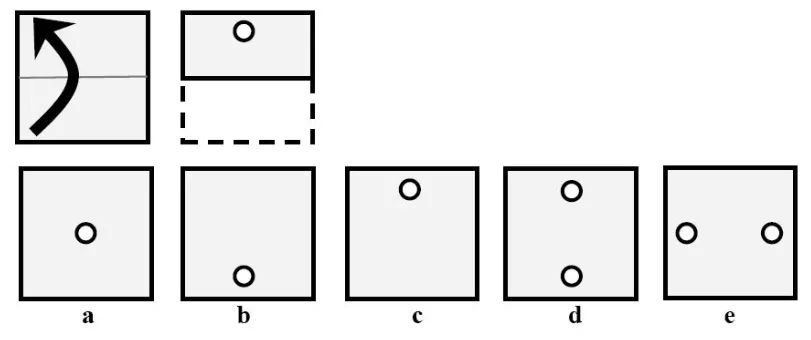
Paper folded with shapes cut out. Choose what the paper looks like when unfolded.

📦 Manipulating 3D Shapes

📐 Nets and Cubes

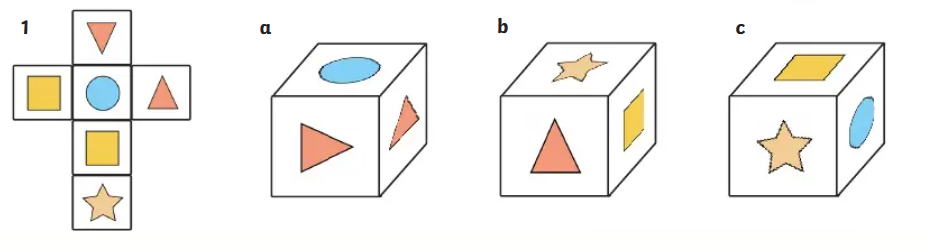
2D net shown, work out what it looks like folded into a cube.

🔄 Rotating 3D Shapes

Choose which image shows the rotation of a 3D shape.

🧱 Combining 3D Shapes

Select blocks that combine to make a 3D shape. Three types: fully visible, partially hidden, obscured.

🔍 3D Shapes From Above

Choose the 2D plan showing what the 3D shape looks like from above.

Example questions

🎯 Worked Examples

🔢 Sequences

Question: Which pattern completes the sequence?

Answer: Option C – the shape rotates one-fifth clockwise each time.

Tip: Focus on one feature at a time: shading, direction, or orientation.

📄 Following Folds

Question: What would this folded paper look like when opened?

Answer: A – it is a symmetrical reflection of the cut-out shapes.

Tip: Look for mirrored placement and distances from the fold line.

📐 Nets and Cubes

Question: Which cube can be made by this net?

Answer: Option A

Tip: Use real objects like dice or Rubik’s Cube to help visualisation. Eliminate “dud” cubes showing shapes not on the net.

Solving process

To tackle most non-verbal reasoning questions, follow this process:

🎯 5-Step Solving Method

1️⃣ Type

What type of question is it?

2️⃣ Analyse

Look at obvious qualities (shape, colour, pattern)

3️⃣ Compare

Find similarities and differences between shapes

4️⃣ Rule

Find a rule from these obvious qualities

5️⃣ Eliminate

Remove options that don’t follow the rule

Preparation strategies

📚 What Actually Works

✏️ Drawing

Drawing simplifies everything. When we picture many shapes in our heads, images become jumbled. Encourage your child to draw shapes out for clearer visualisation.

🎮 Make It Fun

Play Sudoku for logic and attention to detail. Lego builds shape visualisation skills. Jigsaw puzzles develop spatial awareness.

🔄 Consistency

A little bit every day goes a long way. Repetition makes these exercises second nature. Much easier than cramming into long last-minute sessions.

⏸️ Study Breaks

Break every 30 minutes improves productivity. Children come back refreshed and ready for challenges. Reward hard work afterwards.

💡 Remember

Don’t be disheartened if it takes time. Non-verbal reasoning isn’t taught in the national curriculum, so your child is learning completely new skills. Practice makes perfect, and the more questions completed, the faster they become.

What progress looks like

📈 Progress Indicators

👁️ Early Stages

Starts noticing patterns and describing what they see in shapes and sequences

🔍 Building Skills

Identifies simple rotations and reflections, spots obvious patterns

🎯 Developing Strategy

Uses the 5-step process for complex patterns and transformations

⚡ Exam Ready

Tackles unfamiliar question types confidently, works efficiently under time pressure

How our Cambridge tutors help

Non-verbal reasoning requires a different teaching approach than traditional school subjects. Our tutors understand that parents often feel completely lost trying to help with these visual puzzle questions.

Hugh recently completed a DPhil in Surgical Sciences at the University of Oxford and holds a First-Class MSci in Theoretical Physics from Imperial College London. With over a decade of tutoring experience, Hugh has a unique ability to break down spatial reasoning concepts and help children visualise pattern transformations systematically.

Mark achieved a Double First in History from Cambridge and has over 3,000 hours of tutoring experience. He’s guided students through entrance exams for leading schools including Eton, Harrow, Winchester, and St Paul’s. Mark excels at helping children approach visual reasoning with confidence and logical thinking.

Wynn holds a First Class degree in Human, Social and Political Sciences from Cambridge and works extensively with 11+ entrance exams. He helps students develop the 5-step solving process, making complex visual relationships clear and manageable.

Our tutors don’t just teach non-verbal reasoning techniques. They help children develop the spatial thinking and logical reasoning skills that serve them well across all subjects.

Ready to master visual patterns?

Our Cambridge-educated tutors specialise in making non-verbal reasoning accessible for children starting from scratch. We understand the time pressure families face and know exactly how to build both visual reasoning skills and exam confidence efficiently.

Every consultation begins with understanding exactly where your child stands with pattern recognition, then creating a focused plan that makes the best use of your preparation time.

Book Your Free Strategy Session

Discover exactly how to help your child master visual patterns, with a clear action plan you can start using immediately.

Get Your Child’s Personalised Plan

📚 Explore More 11+ Guides

🧩
VERBAL REASONING

Made Simple

Made Simple

11+ Verbal Reasoning Made Simple

🧩 The Moment Every Parent Dreads

You’ve been helping your child with maths and English for months, feeling confident about their 11+ preparation. Then you open a practice paper and see “verbal reasoning” for the first time. The questions look like puzzles written in code.

Your heart sinks as you realise your child has never encountered anything like this at school, and neither have you.

This moment of panic hits thousands of parents every year. You’re not behind, and your child isn’t at a disadvantage. Verbal reasoning feels foreign because it genuinely is new territory for most families.

The good news? Children often pick up verbal reasoning faster than parents expect, precisely because they approach it with fresh eyes rather than overthinking the logic.

What is verbal reasoning?

Verbal reasoning tests your child’s ability to reason and solve problems using written information. Unlike English comprehension, which focuses on understanding stories and texts, verbal reasoning tests logical thinking with words, letters, and language patterns.

The skills involved in verbal reasoning include:

🎯 Key Skills Tested

📚
Vocabulary Knowledge

Understanding word meanings and relationships

🔤
Pattern Recognition

Spotting logical sequences in letters and words

🧠
Logic & Problem-Solving

Working through problems step-by-step

🔍
Attention to Detail

Spotting crucial differences and connections

Don’t be fooled by the word ‘verbal’. Verbal reasoning can also involve solving problems with letters and numbers! However, for most questions, your child will need to show they understand the meanings of words and relationships between them.

Having a wide vocabulary is useful for understanding these questions, but logical thinking skills are often more important than knowing lots of words.

Which 11+ exams test verbal reasoning?

Many grammar schools and independent schools include verbal reasoning as part of their entrance exams. The specific format depends on the exam provider your target schools use:

📋 Main 11+ Exam Providers

🎯 GL Assessment

Used by most grammar schools in England

Paper-based, multiple-choice format. Schools choose whether to include verbal reasoning.

💻 CAT4

Online cognitive abilities test

Used by some independent schools. Includes verbal classification and verbal analogies sections.

🎓 ISEB Common Pre-Test

Online adaptive test for independent schools

Includes a 25-minute verbal reasoning section.

🔍 Cambridge Select Insight

Online entrance exam for independent schools

Includes verbal reasoning questions like sentence shuffling and anagram solving.

Important: Check your target schools’ specific requirements. Some schools test verbal reasoning, others don’t. Some belong to consortiums using the same test, whilst others have unique exams.

Common types of verbal reasoning questions

Verbal reasoning questions come in several main categories. Understanding these types helps your child recognise what each question is asking for:

📝 Complete Question Type Guide

📖 Vocabulary Questions

Synonyms: Identifying words that mean the same thing as each other

Antonyms: Identifying words that mean the exact opposite of each other

Homonyms: Identifying words that have the same spelling or pronunciation, but different meanings

Odd ones out: Identifying which word(s) do not share the same connection as others in a group

Spot the connection: Working out the connection between two words, and applying the same connection to another pair of words

🔍 Finding Words

Jumbled words: Rearranging groups of mixed up letters to create correctly spelled words

Jumbled sentences: Re-ordering words in a sentence so that it makes sense

🔨 Building Words

Joining words: Choosing two words which can be joined together to create a new word

Morphing words: Changing one letter at a time from two words to create a new word

Transferring letters: Adding one letter to one word to create a new word

Missing letters: Finding the letter or string of letters that are missing from one or two words

🔐 Codes and Sequences

Codes: Solving codes using letters, numbers and/or symbols

Sequences: Completing sequences using letters, numbers and/or symbols

🧠 Logic Questions

Statement logic: Finding an answer option that is definitely true based on given information

Deductions: Using information in a set of statements to work out the correct answer

Number/letter logic: Working out which number or letter is being described in a statement

This might seem overwhelming, but don’t worry. Most question types use the same logical thinking skills. Once your child understands the underlying patterns, they can adapt to any format they encounter.

Verbal reasoning example questions

Here are examples of common verbal reasoning question types with tips on how to approach them:

🎯 Example Questions & Techniques

🔗 Word Analogies

Question: Big is to small as hot is to ____

Options: A) warm B) cold C) fire D) sun

Answer: B) cold

Top tip: Identify the relationship first (big/small are opposites), then apply the same relationship to the second pair.

🎲 Scrambled Words

Question: Unscramble: TAC (clue: furry pet)

Answer: CAT

Top tip: Use the clue to help work out the word. Check that your answer uses exactly the same letters as given.

❌ Odd One Out

Question: Which doesn’t belong: dog, cat, rabbit, table

Answer: table

Top tip: Work out what connects most of the words (animals), then identify which one doesn’t fit the pattern.

🔤 Letter Sequences

Question: A, C, E, G, what comes next?

Answer: I

Top tip: Look for the pattern (skipping one letter each time: A skip B, C skip D, E skip F, G skip H, I).

How to prepare for 11+ verbal reasoning

Verbal reasoning can be tricky because children attending primary schools aren’t taught how to answer these types of questions. However, getting started early and building your child’s familiarity with verbal reasoning can help significantly.

📚 Preparation Strategies That Work

📖 Read Widely for Vocabulary

Reading regularly is the best way to boost verbal reasoning skills. It increases word recognition speed and helps with time management in exams. Encourage reading across different genres and authors to widen vocabulary.

🧩 Practice with Puzzles & Games

Reasoning questions require pattern spotting and logical problem-solving. Crosswords, word games, and logic puzzles help develop attention to detail and sustained thinking skills.

⏰ Little and Often Learning

Child psychologists recommend regular 20-30 minute study sessions for 10-11 year olds. Our brains encode new information more effectively when dealing with smaller chunks over time.

📝 Develop Exam Skills

Once your child feels confident with question types, practice tests help build confidence under exam conditions. They’re also great for highlighting knowledge gaps that need further work.

How does progress look like?

Many parents expect verbal reasoning to “click” immediately, then worry when their child still finds questions challenging after a few weeks. Real progress looks different than you might imagine.

📈 Signs Your Child Is Making Progress

🗣️ Early Stages

Starts talking through their thinking out loud and asking about question types

👀 Building Understanding

Notices when words don’t fit patterns and starts making connections

🎯 Developing Strategy

Develops systematic approaches to different question types

⚡ Exam Readiness

Builds speed whilst maintaining accuracy under time pressure

Speed comes later. Understanding comes first. A child who works through reasoning questions slowly but correctly is much closer to exam success than one who rushes through and gets lots wrong.

How our Cambridge tutors approach verbal reasoning

Verbal reasoning requires a different teaching approach than traditional school subjects. Our tutors understand that parents often feel lost trying to help with these unfamiliar question types.

Wynn holds a First Class degree in Human, Social and Political Sciences from Cambridge and works extensively with 11+ entrance exams. He breaks down verbal reasoning into manageable patterns that children can recognise and apply, helping students master both the logical thinking and the time management needed for exam success.

Mark achieved a Double First in History from Cambridge and has over 3,000 hours of tutoring experience. He’s guided students through entrance exams for leading schools including Eton, Harrow, Winchester, and St Paul’s. Mark specialises in building confidence alongside technique, helping children approach unfamiliar question types calmly.

Olivia studied History of Art at St John’s College, Cambridge, and has extensive experience with 11+ preparation. She focuses on developing the analytical thinking skills that verbal reasoning tests, helping students see the logical patterns rather than memorising question types.

Our tutors don’t just teach verbal reasoning techniques. They help children develop the calm, methodical thinking that serves them well in any challenging situation.

Ready to turn verbal reasoning from mystery to mastery?

Our Cambridge-educated tutors specialise in making verbal reasoning accessible for children who are starting from scratch. We understand the time pressure families face and know exactly how to build both skills and confidence efficiently.

Every consultation begins with understanding exactly where your child stands with verbal reasoning, then creating a focused plan that makes the best use of your preparation time.

Book Your Free Verbal Reasoning Strategy Session

Discover exactly how to help your child master verbal reasoning, with a clear action plan you can start using immediately.

Get Your Child’s Personalised Plan

📚 Explore More 11+ Guides

🎯 COMPLETE 11+ GUIDE

Need Help with 11+ Exam Prep for 2025? Here’s How to Start Strong

🔢
MATHEMATICS

Problem-Solving Techniques

📝
ENGLISH

Reading & Writing Skills

🔍
NON-VERBAL REASONING

Pattern Recognition Guide

Does taking a gap year affect your chance of getting into Oxford or Cambridge? Yes, unless you use this proven framework

In the thousands of conversations I have had with Oxbridge students and graduates, I have learned that there is an absence of resources for those applying to Oxbridge after taking some time out from academic studies.

“When I was applying to Cambridge after my gap year, I thought there was absolutely no chance of getting in. I was competing against applicants who are legitimate geniuses who have never missed a grade in their life. I had no resources and had to find everything myself.”

This is a sentiment felt by many applicants who face the inevitable uncertainty and insecurity of applying to Oxbridge; any holes in an application will be scrutinised and benchmarked against the best and brightest in the world. But I don’t think you have to feel this way.

To normalise this uncertainty, we found that more than 50% of Oxbridge students experience some kind of imposter syndrome. That’s within the university population of accepted students. Can you imagine what is felt by those who are applying? Of course there is uncertainty, but the key is to find ways to control your fate by learning about the Oxbridge admissions system and what you can do to increase your odds of success and avoid rejection.

That’s why you’re here. That’s why you’ll read to the end and learn about the proven Greenhill Academics application framework for those applying after a gap year.

It’s worth it, I promise.

So are you in the right place?

This blog aims to help Oxford and Cambridge undergraduate, graduate, and post-graduate applicants who have spent at least one year out of academic study. We use the official university policies and publications as well as candidate evidence to help you decide, prepare, and apply successfully to your courses of choice.

As a company we service high-achieving applicants from all backgrounds, including those who have gone into the workforce straight out of school or undergraduate degrees. We are privy to seeing what gets through. We share these insights, building a framework around what successful applicants do, informing your application to grant you an edge against other applicants who haven’t been as lucky to find this article.

The problems of applying after a gap year

When you’re on the academic track, the path is well-trodden. You go from Sixth Form, to university, to a masters, to a graduate job or PhD–simple. There is infrastructure built around this pathway and therefore there are frameworks to follow because it’s uniform. Everyone is in a very similar position moving to the next step and therefore the frameworks are easy to make.

Those who take a left turn to do something ‘alternative’ have exited the academic path and feel like it’s harder to get back on track because there is little clarity on how to proceed. For such a high stakes decision, one needs clear understanding and certainty, which are not provided by existing frameworks from the usual resources.

Despite many finding themselves in the second category, there is little to inform or guide them. This is perhaps due to the idiosyncratic nature of those who take this path, but ironically, those are the candidates that are most likely to succeed: the ones who are strong academically and who think differently.

There are some important questions that the frameworks for the primary pathway do not answer:

  1. Is it acceptable to apply to Oxbridge Programmes after a gap year?
  2. How do I frame my profile to include my non-academic experiences that may not be directly relevant to the subject?
  3. Who should I have as my reference on my Oxbridge application?
  4. Can I reapply if I’ve already been rejected?

We provide evidenced, informed advice guided by official Oxford and Cambridge policy to help you avoid the discomfort of rejection from these target institutions.

Oxford and Cambridge official guidance on gap years

The scenarios that usually stump applicants are either applying for an undergraduate or graduate degree. The former has more official policy provided by the universities than the latter because it is generally accepted that graduates undertake employment immediately after studying. 

The reasons are financial, demographic, and practical. Undergraduate courses are specifically designed to be accessible for domestic school leavers with student loans are widely available whereas graduate courses are between 3 and 10 times more expensive and aimed at mature students. The ratio of domestic to international students changes at graduate level; international students use a student visa as a legitimate pathway to enter the United Kingdom. Finally, the courses are used to retrain to target specific industries after graduating from a different course. Very few people know what they want to do at 18, whereas more people have direction after 23. 

For these reasons, the universities give official guidance to undergraduate applicants, whereas the graduate course entry policies are offered on the course pages. These can be found on the masters course pages for Oxford and Cambridge.

The Oxford and Cambridge give clear policies on undergraduate entry after a gap year. Firstly, they define two relevant terms: deferred entry and mature student.

Deferred entry means that you have applied to the university, gotten accepted, and asked to defer the place one year before you are expected to start attending your course.

Mature student means that you are older than 21 years old when you start your course.

In both cases, the university does not discriminate against applicants who wish to defer or are joining after a period away from formal education. One or both of these may apply to you for your application.
It’s reassuring to know that the universities explicitly say that they do not bias against your application if either of these apply.

Further, public information from the universities explicitly states that they do not bias against taking a gap year before undergraduate study. 

In all cases, the application process is exactly the same, gap year or not. The application process goes through the same channels, work has to be submitted, tests completed, and interviews attended. 

Some sources suggest that personal statements and interviews should and will be framed around the experience of the applicant. This makes sense since a strong applicant is aware of how the experience frames their motivation for the course and adds to their expertise.

It is our view that gap year applicants are often stronger than non gap year applicants because they have had time to prove their productivity by pursuing the subject outside of the classroom. Similar to wider reading, practical experience on external courses or work experience can be framed as preparation for the undergraduate course.

We see no bias from official university policy against those who are applying with the intention of taking a gap year or who are applying after a gap year. We suggest that the applicant understand the reason for taking the gap year and be able to communicate this when prompted. If this is difficult, a consultant can help you determine the narrative that suits your situation best and help you communicate it.

Official policy from Oxford and Cambridge on applying after a rejection

There are many reasons for taking a gap year, one of which is a previous rejection from Oxford or Cambridge. After the rejection, the applicant can often feel lost, so take some time out to continue their development after school, and strategise a new path. Many question whether they can reapply after the heavy disappointment, and the answer is a resounding yes. There is hope–you can reapply.

The official Cambridge policy states that you can reapply the following year, however they suggest not applying more than three times.

Further, Oxford states in its official policy that it welcomes applications after a previous rejection and that it takes each application on its own merit. Every application made must go through the standard process, including the submission of correct tests and written work. Oxford suggests requesting and actioning any feedback given from previous applications.

Our evidence shows that there is no bias against those who have taken gap years

As part of our ongoing research, we collect profiles of successful applicants to Oxford and Cambridge. For transparency, the majority of successful applicants have flawless profiles, straight from school. However, there are profiles that suggest that the Oxford and Cambridge policies are accurate.

Lucy, who studied Theology, Religion and Philosophy of Religion at Cambridge, is an example of someone who got accepted after applying in her gap year.

Lucy had personal reasons to take a gap year, during which she retook her A-Levels getting disappointing results her first time. She applied through the normal UCAS channel during her gap year with her new predicted grades and got accepted.

To put her grades in context, she ended up with 10 As and A*s at GCSE, and A*AA at A levels, with an EPQ grade of A*. 

You can see that there are no exceptions (or ones that we’ve seen) to grade misses. In the interactions I’ve had with graduates from these institutions, I’ve never met anyone who didn’t meet the grade requirements for their course and was an ‘exception’. You must be academically capable.

From Lucy and these interactions we learn that it is evidently possible to enter a course at Oxbridge after a gap year. The caveat is that you must go through the expected channels and meet every requirement. It cannot be understated how competitive these courses are. You cannot assume the universities will make any exceptions for you on grades.

To summarise, Lucy did several things right to achieve her place at Cambridge.

  1. She had a clear reason to take a gap year
  2. She stayed productive
  3. She framed everything clearly on her application
  4. She achieved everything needed for her course
  5. She performed well in her interview

So we’ve learned that Oxbridge universities do not bias against gap year applicants and we have a clear example of someone who achieved their place after a gap year. How can this help you?

How to apply to Oxford or Cambridge after a gap year

You must hit every part of the requirement for the application. There are no shortcuts. For some, the weakness is actually having a competitive profile and for others it’s being able to communicate your background, motivations, and expertise. The role of a consultant, in the United Kingdom, is to make sure nothing is missed.

Russell,
Founder and CEO of Greenhill Academics

We’ve learned that the process is fully achievable based on the university policy and first hand evidence. The next step is to create an action plan designed for those who are returning to university after a gap year.

At Greenhill Academics, we have the PROGRESS programme that ensures you hit every point after a gap year, to increase your chances of getting accepted. This is shared here for the first time, and will ensure you don’t miss any part of your application out.

LetterStageWhat it Means
PProfileIdentify your academic strengths, values, skills, and the story behind your gap year.
RResearchExplore courses, universities, entry requirements, deadlines, and funding options.
OOutreachReach out to potential referees, mentors, or universities (especially for PhD applicants).
GGather EvidenceCollect transcripts, certificates, written work, or examples from your gap year.
RReportWrite your personal statement or research proposal, tying your gap year into your academic goals.
EEngageEngage in preparation: reading, subject review, skills brushing-up, and academic mindset reset.
SSit TestsPrepare for and complete any required admissions tests (LNAT, TSA, etc.) with focused practice.
SSimulate InterviewsDo mock interviews and speak confidently about your experience and technical ability.

Profile

The purpose of writing out your profile on paper is that you have to know where you are to know where you’re going. I know this sounds simple, but it’s effective. 

You should write everything that could possibly be relevant from your background on paper. This includes grades, schools, competitions, scholarships, sport, music, acting, clubs, leadership positions, work experience, volunteering, side hustles, and charity work (I could go on, but leaving it here for ideas). 

Further, you should write about what you are trying to achieve and why you want to do it. 

Finally, you should go deeper into the things from your past that show strengths and experience in the course you’re applying to.

You’ll notice, as we have, that there will likely be things from your gap year that you are able to talk about at length–include these. It’s absolute gold. Be proud of what you’ve done. Show it off.

Research

Given your profile, research all available options to reach where you want to go. More often than not, applicants are drawn to one course that they’ve come across randomly, but haven’t even considered similar, sometimes better suited courses. 

Imagine you wanted to study Economics at Cambridge. I would ask whether you’re interested in business, politics, law, or philosophy. Here are some courses that may be a fit:

We’ve suddenly gone from one course to six and your options are wide open. Once we have your profile, we tell you which courses you could be best fit for in your research report.

Outreach

Reconnect with significant people who could help your application. There is usually a strong preference for academic references, especially for undergraduate applications, but for graduate applications, you could reach out to previous academic or professional mentors. If you are applying to a PhD, you should seek out potential supervisors.

Gather Evidence

This is an administrative task, however, it’s as important as any. You should put all the documents together, whenever needed. This could include transcripts, written work, or CV. If the documents are asked for in your application, make sure they are there. If they’re not then it’s an avoidable mistake.

Report

Write your personal statement or research proposal, tying your gap year into your academic goals. There are wide resources available on how to write UCAS personal statements. Please be aware this is changing this year (for courses starting in 2026). For graduate applications, it’s essential that you research the course and write specifically about the question that is asked rather than writing generically about the subject.

At Greenhill Academics, we provide resources and regular feedback on personal statements and research proposals.

Engage

You must prepare for the subject tests and potential interviews by building a reading list and actively engaging with it. We suggest conversing with academic mentors to brainstorm problems to tackle work that you will encounter in the first year of your course. Regularly in interviews, technical problems are taken from first year content. Candidates are asked to talk about their reading and demonstrate their understanding of it.

Sit Tests

You must understand what extra tests are required and prepare for them. You should perform well on the test. It’s not clear how heavily tests are weighted when applying to Oxbridge, however, you cannot assume that any part of the application is redundant or that any exception will be made for a slip-up.

Simulate Interviews

Interviews at Oxford and Cambridge are famous for their way of filtering through candidates. From our research, we’ve found that they are designed to see who is intellectually curious and engaged with the subjects by answering questions not only technically correctly but enthusiastically. The best way to prepare for these is to refresh yourself of the required content and discuss it with informed academics who are in a position to give constructive feedback to you.

Final Thoughts

Our mnemonic uses a bottom-up approach that finds a course suited to your specific profile. We understand who you are and your motivations, and find a course most suited to you in the research stage. It is foolish to find a random course that you have no explicable experience in. The application will force you to explain the subject and your understanding in depth; failure to do that will result in rejection.

If you require help ensuring you hit all of these points, you can reach out to us for a free consultation with me here.

How to Prepare Your Child for 11+ Private School Interviews?

You’ve just found out your child has an interview for a private school. Cue the slight panic. Are they going to freeze? Say something weird? Nod silently for 20 minutes while the teacher stares them down?

Let me stop you right there. These interviews aren’t meant to be intimidating. The school isn’t trying to trap your child or make them prove they’re the next Einstein. What they’re really hoping to see is… a child. A curious, thoughtful, chatty (or not-so-chatty) child who might be fun to teach.

Quick Guide: What to Expect in 11+ Interviews (Spoiler: It’s Pretty Normal!)

Interview ComponentTypical QuestionsWhat They Want to See
Academic Interest“What’s your favourite subject and why?”Genuine curiosity about learning
Personal Character“Tell me about a time you helped someone”Kindness and empathy
School Fit“What activities would you like to try here?”Enthusiasm for school activities
Communication“Describe a book you’ve enjoyed recently”Clear expression of ideas

What These Schools Actually Want

Look, I’ve spoken to loads of teachers from these places. They’ve seen every type of kid you can imagine, and they can smell fake enthusiasm from three miles away.

That child who gets genuinely excited talking about their pet lizard? Way more memorable than the one who drones on about “pursuing academic excellence” like some sort of tiny robot.

They want kids who seem… well, like kids. Happy ones who ask questions, who admit when they don’t know stuff, who might actually contribute something interesting to class discussions rather than just sitting there looking perfect.

How to Prepare Without Creating Pressure

Stop with the mock interviews. Seriously. Just stop.

Instead, start having proper conversations at home. You know when you ask “How was school?” and get “Fine” back? Try this instead: “What was the weirdest thing that happened today?” or “What made you laugh?” These questions get them thinking and explaining without it feeling like homework. That’s exactly what they need for interviews – the ability to reflect and chat naturally.

Read stuff together and talk about it like normal people. “God, that character was annoying, wasn’t he?” is infinitely better preparation than “What themes did the author explore?” Your child needs to practice having opinions and explaining them without sounding like they swallowed a textbook.

Get them talking to adults more. Not formal practice; just life. Let them order their own food sometimes. Get them to thank the delivery driver. These tiny interactions build confidence that makes interviews feel less alien.

Common Questions and How to Help

You don’t need to rehearse answers like a script. Schools are looking for real children who can think, reflect, and speak in their own words. Regular chats at home do more good than mock interviews.

If your child enjoys history, ask what draws them in. Is it the stories, the drama, or the strange facts? If they like science, maybe it’s the surprise of experiments or the satisfaction of solving problems. These kinds of details make answers feel honest and memorable.

When it comes to books, pick something they genuinely enjoyed. It doesn’t need to be impressive. A graphic novel or sports biography is fine. Help them explain why they liked it, even if it’s just a funny moment or a character they related to.

Explore the school’s website together. Look for clubs or subjects that spark curiosity. Even if they’ve never tried something like debating or drama, a real interest in giving it a go is what schools are hoping to see.

If they’re asked about handling disagreements, remind them it’s not about giving the perfect answer. It’s about showing they can stay calm and fair when things get tricky.

What to Avoid?

Over-coaching is a common mistake. When children sound too polished, it feels false. It’s better for them to speak naturally, even if they pause or stumble.

Putting pressure on the interview turns it into a test. That only adds stress. Keep the tone light. It’s just a conversation.

Achievements are great, but they aren’t everything. Schools want to know what your child genuinely enjoys, not just what looks good on paper.

And finally, don’t leave preparation too late. Good communication comes from everyday conversations. The more they practice talking to adults, the more confident they’ll become.

Interview Day: Keep It Simple

Start the day like any other. Let them eat their usual breakfast and wear clothes they already feel good in. Something smart is fine, but don’t dress them like they’re off to a wedding.

Arrive a little early, but not so early that you’re sitting around getting nervous. A short walk or a stop at a nearby café is a good way to keep things relaxed.

Before they go in, remind them of something important. These teachers have chosen to work with children because they actually enjoy their company. And if your child doesn’t know the answer to a question, it’s perfectly fine to say, “I don’t know, but I’d like to find out.” That honesty often impresses more than a guess.

How Our Tutors Build Interview Confidence

Some kids need extra support to feel comfortable chatting to adults. That’s completely normal! Not everyone’s a natural performer, and that’s fine.

Wynn gets this. He’s worked with confident kids who need to learn when to stop talking, and shy ones who need encouragement to start. His approach is about building genuine conversation skills, not interview performance.

Lucy understands that different children build confidence in different ways. She’s particularly good with anxious kids who need to understand that interviews are just teachers wanting to get to know them, not scary tests to pass or fail.

Experience the Greenhill Academics Difference

We’re not about teaching your child to say the “right” things in interviews. We help them become genuinely confident talking to adults about things that matter to them. That confidence shows up everywhere: in interviews, sure, but also in class discussions, with new teachers, when they need to ask for help. It’s a life skill, not just an interview trick.

What Families Say About Greenhill Academics
“We can’t thank you and Greenhill academics enough. Hayden had not been well enough to access education for three years, which was a huge loss to him. The tuition you provide for him and Alex is amazing. His lessons are his favourite time in his week.” – Katherine Susie Flanagan

“Excellent tutors, high quality tuition, and responsive admin. My son is not in school much due to health issues, and the English and Maths tutors are giving him a chance of getting GCSEs. He always seems more confident after a lesson. I highly recommend Greenhill Academic Consulting!” – Penny Joelson

“Skilled tutor who quickly built knowledge and confidence. Friendly and encouraging. A very positive experience. Would recommend.” – Katie Macdonald

Read more family success stories →

Look, if your child needs help feeling more confident talking, we can help with that. Book your free consultation today and see how our experienced tutors can help your child prepare effectively for interview success.

We also offer these Subjects

We offer these Levels

FAQs

 My child lacks confidence—how will tutoring help?

Many students struggle with confidence, especially if they’ve had a bad experience in school or feel overwhelmed by the subject. Our tutoring approach helps students build confidence by breaking down difficult topics, reinforcing understanding, and celebrating progress.

 My child is already working hard—why are they still struggling?

Studying isn’t just about memorising facts; your child must learn how to apply knowledge to unfamiliar contexts, especially in exams. Many students put in hours of revision but struggle with exam technique, structuring answers, or understanding mark schemes. A tutor can help identify and address these specific challenges.

How do I know if the tutoring is working?

We track progress through regular assessments, exam-style questions, and feedback from both the student and tutor. You’ll receive updates on improvements, areas of focus, and strategies for further progress.

 Which exam boards do you cover?

We tutor for AQA, OCR, Edexcel, WJEC and CIE exam boards. We also cover the International Baccalaureate (IB)

 How do online tutoring sessions work?

We set up a learning space which is joined at the time of a session. In the learning space, students are on video call with our tutors and use an interactive whiteboard with resources. Parents and students are often surprised how easy it is!

 How often should my child have tutoring sessions?

This depends on their current level and goals. Some students benefit from weekly sessions for consistent progress, while others may prefer more intensive lessons closer to exams. We can recommend a schedule based on your child’s needs.

 What if my child has a busy schedule?

We offer flexible scheduling, including evening and weekend sessions, to fit around your child’s commitments. Tutoring is designed to be productive and efficient, so even one hour a week can make a significant difference when supported with independent study.


 Why are Greenhill Academics tutors considered the best you can find?

We select tutors with exceptional academic backgrounds, proven experience in helping students reach their goals, and in-depth knowledge of exam board requirements.


 How do I get started?

Getting started is easy! Simply contact us to book a quick consultation, and we’ll select a tutor from our team who is the best match for your child


What Grades Do You Need for 13+ Private School Entry?

13+ entry to prestigious private schools represents one of the most competitive educational pathways in the UK. Unlike 11+ entry which focuses primarily on entrance tests, 13+ applications require a careful balance of academic grades, entrance exam performance, and school assessments that many families find overwhelming to navigate.

This guide reveals the grade requirements and application strategies that consistently help families secure places at leading independent schools.

Understanding 13+ Entry Requirements

13+ entry differs significantly from other school transitions because it occurs after two years of secondary education, giving schools substantial academic data to evaluate alongside entrance assessments.

Key Components of 13+ Applications

Current School Reports: Year 7 and Year 8 academic performance across all subjects
Entrance Examinations: School-specific tests in core subjects
Common Entrance: Standardised examinations taken by many applicants
Interviews: Academic discussions and personal suitability assessment
References: Detailed reports from current schools about academic and personal development

Grade Requirements by School Tier

Top Tier Schools (Eton, Harrow, Winchester, Westminster):

Highly Selective Schools (Marlborough, Charterhouse, Rugby, Sherborne):

Selective Independent Schools:

Subject-Specific Grade Expectations

Core Academic Subjects

English Language and Literature:

Mathematics:

Sciences (Biology, Chemistry, Physics):

Modern Foreign Languages

Expectations Vary by School Focus:

Humanities and Creative Subjects

History and Geography:

Art, Music, Drama:

Grade Trajectories and Academic Progress

What Schools Really Value

Private schools understand that Year 7 and 8 represent significant developmental periods where academic performance can vary considerably. They focus on trends and potential rather than isolated grades.

Upward Trajectory: Consistent improvement across subjects demonstrates motivation and adaptability Academic Resilience: Recovery from temporary setbacks shows character and determination
Subject Passion: Exceptional performance in specific areas can compensate for weaker performance elsewhere

Understanding Grade Contexts

School Setting: Independent prep schools often have higher grade distributions than state schools Teaching Standards: Schools evaluate grades relative to the teaching quality and academic standards of your current school
Peer Comparison: Performance relative to classmates provides important context for absolute grades

Entrance Examination Performance

Common Entrance Requirements

Many independent schools require Common Entrance examinations alongside school grades, creating a dual assessment system.

Grade Boundaries: Typically 60-70% for competitive schools, 70%+ for the most selective
Subject Coverage: English, Mathematics, Science, and often Latin, French, Geography, History
Preparation Timeline: Usually requires 12-18 months of structured preparation

School-Specific Entrance Tests

Scholarship Examinations: Often more challenging than standard entrance requirements
Subject-Specific Tests: Some schools test particular strengths or interests
Creative Assessments: Art, music, or drama portfolios and practical examinations

The Scholarship Route

Academic Scholarship Requirements

Grade Expectations: Typically A* across most subjects with exceptional performance in scholarship areas Examination Performance: Top 10-20% of candidates in competitive scholarship assessments
Personal Qualities: Leadership potential, intellectual curiosity, and character development

Specialist Scholarships

Music Scholarships: Grade 6+ instrumental ability with ensemble experience
Art Scholarships: Portfolio demonstrating technical skill and creative development
Sports Scholarships: County-level performance with potential for further development
All-Rounder Awards: Strong performance across multiple areas

Application Timeline and Strategy

Year 7: Foundation Building

Academic Focus: Establishing strong foundations across all subjects
Extracurricular Development: Exploring interests and developing talents
School Research: Identifying target schools and understanding their specific requirements

Year 8: Intensive Preparation

Grade Optimisation: Focusing on achieving target grades across all subjects
Entrance Exam Preparation: Systematic preparation for required examinations
Interview Preparation: Developing confidence in academic discussions and personal presentation

Application Year: Strategic Execution

Final Grade Push: Maintaining academic standards whilst managing examination preparation
Assessment Performance: Demonstrating abilities under examination conditions
Interview Excellence: Articulating genuine interest and academic potential

Common Application Mistakes

Focusing Only on Entrance Exams

Many families concentrate heavily on entrance examination preparation whilst neglecting current school performance. Private schools want evidence of consistent academic achievement alongside examination capability.

Neglecting Personal Development

Academic grades alone rarely secure places at competitive schools. Character development, leadership potential, and contribution to school community matter significantly.

Applying Too Narrowly

Focusing only on the most prestigious schools without considering excellent alternatives can leave families without suitable options if applications are unsuccessful.

Starting Preparation Too Late

Beginning serious preparation in Year 8 often leaves insufficient time for grade improvement and comprehensive examination readiness.

Supporting Your Child’s Academic Development

Creating Academic Success

Consistent Study Habits: Establishing regular homework routines and independent learning
Reading Culture: Encouraging wide reading beyond curriculum requirements
Intellectual Curiosity: Supporting exploration of subjects and ideas beyond school expectations

Managing Pressure and Expectations

Balanced Approach: Maintaining perspective about academic achievement and personal well-being Growth Mindset: Focusing on improvement and learning rather than fixed ability
Resilience Building: Teaching children to learn from setbacks and maintain motivation

Understanding Different School Cultures

Traditional Academic Schools

Emphasis: Classical education, intellectual rigour, university preparation
Grade Expectations: Consistently high performance across traditional academic subjects
Personal Qualities: Intellectual curiosity, academic independence, scholarly potential

Progressive Independent Schools

Emphasis: Innovative teaching, creative thinking, personal development
Grade Expectations: Strong performance with evidence of creative and critical thinking
Personal Qualities: Adaptability, creativity, collaborative skills

Specialist Schools

Music and Arts Schools: Exceptional creative talent alongside solid academic performance
Sports-Focused Schools: Athletic excellence combined with academic competence
International Schools: Cultural adaptability and linguistic ability

Financial Considerations and Bursary Applications

Bursary Requirements

Academic Standards: Usually require above-average academic performance
Financial Assessment: Detailed evaluation of family financial circumstances
Personal Qualities: Character and potential for contribution to school community

Scholarship vs Bursary Applications

Scholarships: Merit-based awards requiring exceptional academic or specialist performance
Bursaries: Need-based support requiring demonstration of financial necessity
Combined Awards: Some schools offer packages combining merit recognition with financial support

Preparing for Success

Academic Preparation Strategies

Current School Excellence: Maintaining high standards in all subjects throughout Years 7 and 8
Independent Learning: Developing research skills and intellectual independence
Subject Passion: Cultivating genuine interests and expertise in chosen areas

Personal Development Focus

Leadership Opportunities: Taking on responsibilities within current school environment
Community Contribution: Demonstrating service and citizenship through volunteering
Character Development: Building resilience, integrity, and social awareness

Interview and Assessment Preparation

Academic Discussions: Practising articulation of ideas and intellectual curiosity
Personal Presentation: Developing confidence and authenticity in formal situations
Cultural Awareness: Understanding current affairs and engaging with broader ideas

How Specialist Support Transforms Course Selection

Finlay’s Recent Success – Oxford Medicine Student Currently studying Medicine at Oxford after achieving a First Class BA in Medical Sciences and placing 12th in his year, Finlay represents recent academic excellence. His 10 As at GCSE and 4 As at A Level demonstrate the sustained high performance that 13+ applications require.

Finlay helps students understand what top-level academic performance actually involves, sharing strategies for achieving consistent excellence across multiple subjects whilst maintaining personal well-being.

Ioanna’s Academic Development – Cambridge Graduate
With her BA in Psychological and Behavioural Sciences from Cambridge, where she ranked 5th in her year and won academic prizes, Ioanna understands what sustained academic excellence looks like. Her tutoring experience across multiple age groups provides insight into educational transitions.

Ioanna focuses on helping students develop effective study strategies and academic confidence, ensuring they can perform consistently across all subjects whilst managing the pressures of competitive applications.

Experience the Greenhill Academics Difference

13+ applications require balancing current academic excellence with entrance examination preparation whilst developing the personal qualities that distinguish successful candidates. Our tutors understand how to achieve this balance whilst maintaining students’ wellbeing and enthusiasm for learning.

We don’t just focus on achieving target grades – we develop the intellectual curiosity, analytical thinking, and academic confidence that serve students throughout their independent school careers. Our approach ensures 13+ preparation enhances students’ overall educational development.

Ready to give your child the comprehensive preparation that 13+ success requires whilst fostering genuine academic development?

Book your free consultation today and discover how our experienced tutors can help your family navigate 13+ applications with confidence and strategic insight.

Contact us for immediate support – our team responds within 5 minutes because your child’s independent school ambitions deserve expert guidance.

We also offer these Subjects

We offer these Levels

FAQs

 My child lacks confidence—how will tutoring help?

Many students struggle with confidence, especially if they’ve had a bad experience in school or feel overwhelmed by the subject. Our tutoring approach helps students build confidence by breaking down difficult topics, reinforcing understanding, and celebrating progress.

 My child is already working hard—why are they still struggling?

Studying isn’t just about memorising facts; your child must learn how to apply knowledge to unfamiliar contexts, especially in exams. Many students put in hours of revision but struggle with exam technique, structuring answers, or understanding mark schemes. A tutor can help identify and address these specific challenges.

How do I know if the tutoring is working?

We track progress through regular assessments, exam-style questions, and feedback from both the student and tutor. You’ll receive updates on improvements, areas of focus, and strategies for further progress.

 Which exam boards do you cover?

We tutor for AQA, OCR, Edexcel, WJEC and CIE exam boards. We also cover the International Baccalaureate (IB)

 How do online tutoring sessions work?

We set up a learning space which is joined at the time of a session. In the learning space, students are on video call with our tutors and use an interactive whiteboard with resources. Parents and students are often surprised how easy it is!

 How often should my child have tutoring sessions?

This depends on their current level and goals. Some students benefit from weekly sessions for consistent progress, while others may prefer more intensive lessons closer to exams. We can recommend a schedule based on your child’s needs.

 What if my child has a busy schedule?

We offer flexible scheduling, including evening and weekend sessions, to fit around your child’s commitments. Tutoring is designed to be productive and efficient, so even one hour a week can make a significant difference when supported with independent study.


 Why are Greenhill Academics tutors considered the best you can find?

We select tutors with exceptional academic backgrounds, proven experience in helping students reach their goals, and in-depth knowledge of exam board requirements.


 How do I get started?

Getting started is easy! Simply contact us to book a quick consultation, and we’ll select a tutor from our team who is the best match for your child


Need Help with 11+ Exam Prep for 2025? Here’s How to Start Strong

📚 The Reality Check Every Parent Needs

The 11+ isn’t just another school test. Grammar schools design it to identify children working at the top ability range in their year group. Even children working above expected standard can find it challenging.

You’ve probably just discovered that your child needs to take the 11+ for their target grammar school. Maybe you’ve been comparing notes with other parents and realised some families started preparing two years ago. Perhaps you’ve looked at sample papers and thought “my child hasn’t learned half of this.”

Here’s what many parents don’t realise: the timing of when you start matters less than how you prepare. The families who succeed aren’t necessarily the ones who started earliest – they’re the ones who prepared most effectively.

How difficult is the 11+ exam?

The 11+ is intentionally challenging, but understanding the difficulty level helps set realistic expectations and preparation goals.

Designed for top performers: The exam aims to identify children working at the highest ability range in their year group. Even children achieving “Greater Depth” at school can find sections challenging.

Beyond current curriculum: Questions often test Year 6 content that hasn’t been taught yet, assessing how well children apply problem-solving skills to unfamiliar situations.

Individual variation: Different children find different sections more challenging. Strong readers might excel at English but struggle with Non-Verbal Reasoning, whilst mathematically minded children might find the reverse.

Preparation makes a difference: The “little and often” approach with quality practice materials can make the exam feel significantly more manageable.

What makes a good 11+ score?

Score requirements vary significantly between schools and depend on factors beyond your child’s performance.

School-specific standards: Each grammar school sets its own pass mark based on the number of places available and the strength of that year’s applicants.

Standardised Age Scores: Scores are typically given as SAS (Standardised Age Scores), with 100 representing average performance for the age group.

Competitive variation: Popular schools in areas with many applicants often require higher scores than schools with fewer applicants relative to places.

Multiple factors: Some schools consider additional factors beyond test scores, such as catchment area priority or sibling connections.

Rather than focusing on specific score targets, concentrate on helping your child perform to their personal best through thorough preparation.

⚠️ The Challenge Most Parents Underestimate

If your child attends a state primary school, they likely haven’t encountered verbal or non-verbal reasoning. These subjects form a significant portion of most 11+ exams but aren’t part of the national curriculum. This is where focused preparation becomes essential.

Is it too late to start 11+ prep?

This worry keeps many parents awake at night. You hear stories of families starting 11+ prep in Year 4, hiring tutors for years, and you wonder if your child can possibly compete.

The truth is more encouraging than you might think. Grammar schools aren’t looking for children who’ve memorised the most practice papers. They want to identify genuine academic potential and problem-solving ability.

What matters is understanding exactly what your child will face and preparing them systematically. A focused, well-structured approach starting now can be far more effective than years of unfocused preparation.

📅 11+ Exam Timeline by Birth Year

Autumn 2025

Born: 1st Sept 2014 – 31st Aug 2015

Currently in Year 5

Autumn 2026

Born: 1st Sept 2015 – 31st Aug 2016

Currently in Year 4

Autumn 2027

Born: 1st Sept 2016 – 31st Aug 2017

Currently in Year 3

Autumn 2028

Born: 1st Sept 2017 – 31st Aug 2018

Currently in Year 2

What’s on the 11+ exam?

Understanding the 11+ format is crucial for effective preparation. The exam isn’t like typical school tests – it’s designed to assess both knowledge and academic potential under time pressure.

📚 The Four 11+ Subject Areas

📖
English

Reading comprehension, spelling, punctuation and grammar. Some schools include creative writing.

🔢
Mathematics

Key Stage 2 concepts applied in unfamiliar contexts. Tests problem-solving, not just computation.

🧩
Verbal Reasoning

Logical thinking using words. Not taught in most primary schools.

🔍
Non-Verbal Reasoning

Pattern recognition using shapes. Not taught in primary schools.

Important: Not all schools test all subjects. Your child’s specific exam depends on their target grammar schools. Some schools belong to consortiums using the same test, whilst others have unique requirements.

What format is the 11+ exam?

Understanding the exam format helps remove anxiety and allows for better preparation. Most 11+ exams use a standardised approach that’s quite different from typical school tests.

📝 Typical 11+ Exam Structure

📄 Paper 1: English & Maths

Duration: Typically 45-60 minutes

Questions: Multiple choice format

Format: Usually A-E options

🧩 Paper 2: Reasoning

Duration: Typically 45-60 minutes

Content: Verbal & Non-verbal sections

Format: Multiple choice

📋 What Your Child Actually Sees

Question Booklet: Contains all questions and instructions

Answer Sheet: Separate “bubble sheet” for shading answers

Practice Questions: Warm-up questions to get comfortable

Clear Instructions: Whether to choose one or two answers per question

Paper-based testing: Many grammar schools use standardised tests, with some using GL Assessment formats. Your child receives a question booklet and separate answer sheets.

Multiple-choice format: For each question, your child shades the correct option on their answer sheet. It’s crucial they read questions carefully, as some require one answer whilst others need two.

Optical Mark Recognition (OMR): Technology scans your child’s answer sheets after the exam, so clear, accurate shading is essential. Messy or unclear marking can cost marks even if the answer is correct.

Creative writing exception: If the exam includes creative writing, your child will write longer responses in the question booklet. These are marked by teachers rather than machines.

How long is the 11+ exam?

Timing varies between schools, but most follow a similar structure that’s manageable for Year 6 children.

Individual papers: Each paper typically lasts 45-60 minutes, including a few minutes for practice questions that help children settle into the exam format.

Total exam time: Most grammar schools set two or three papers, usually taken on the same day with short breaks between them. Some schools spread papers across different days.

Question approach: Tests are designed to assess both knowledge and ability to work efficiently under time pressure.

The timing is designed to test both knowledge and ability to work efficiently under mild pressure – similar to what children will experience in secondary school.

Who can take the 11+ exam?

Eligibility isn’t just about age – location and school-specific requirements matter significantly.

Age requirements: Children take the exam in Year 6 when they’re 10 or 11 years old, applying for Year 7 entry the following September.

Catchment areas: Many grammar schools have strict geographical requirements. Even if your child passes the exam, they may not be offered a place if you live outside the catchment area.

Registration requirements: You must register your child for each school’s exam. Registration periods vary – some open and close in Year 5, others not until the summer before the exam.

Multiple applications: If schools belong to the same consortium, one registration may cover multiple schools. For schools outside consortiums, separate registrations are required.

How do I register for the 11+ exam?

Registration is often more complex than parents expect, with strict deadlines that vary significantly between schools.

📋 11+ Registration Timeline

Year 5
Spring Term – Early Registration Opens

Some grammar schools open registration early in Year 5. Check target schools immediately.

Summer
Summer Term – Main Registration Period

Most schools open registration. Complete forms with child’s details, current school, and contact information.

Sept
September Year 6 – Exam Month

11+ exams typically take place. Registration deadlines have already passed – no late applications accepted.

Oct
October – Results & Applications

Receive 11+ results. If eligible, complete secondary school application by local authority deadline.

Supplementary Information Forms (SIF): Most schools require detailed registration forms including your child’s personal details, current school, and your contact information.

School-specific deadlines: Mark registration deadlines in your calendar immediately. Missing a deadline typically means missing that year’s opportunity entirely.

Consortium advantages: Schools in the same consortium often share registration processes, simplifying applications to multiple schools.

Documentation: Have your child’s birth certificate, proof of address, and current school details ready when completing registration forms.

When do 11+ results come out?

Results timing is designed to fit within the secondary school application process, but can feel nerve-wracking for families.

October release: Results typically arrive in October of Year 6, before secondary school application deadlines.

Email notification: Most schools email results directly to parents rather than posting letters, allowing for faster communication.

Eligibility vs. scores: You’ll usually receive an “eligible” or “not eligible” result rather than detailed score breakdowns, though this varies by school.

Next steps: If your child achieves an eligible score, you can then include that grammar school on your secondary school application form through your local authority.

How is the 11+ exam marked?

Understanding the marking process helps explain why preparation strategies matter and why some children perform differently than expected.

Raw scoring: Your child first receives marks for correct answers in each subject section, with different sections scored separately.

Age standardisation: Raw scores are then adjusted based on your child’s exact age (measured in years and months) to ensure fairness between children born at different times in the school year.

Standardised Age Score (SAS): The final score used for comparison is age-adjusted, meaning younger children in the year aren’t disadvantaged compared to older peers.

School-specific weighting: Some schools give different subjects varying importance (such as prioritising English), whilst others average across all sections.

Each school’s admissions policy explains their specific marking approach, making it worth checking the details for your target schools.

How do we prepare effectively?

Effective 11+ preparation isn’t about cramming – it’s about building skills systematically whilst addressing knowledge gaps efficiently. Here’s what actually works:

Start with Diagnostic Assessment

Before diving into practice papers, understand exactly where your child stands. Which areas need the most work? Are they comfortable with time pressure? Do they understand question formats?

A proper assessment reveals whether your child needs foundational work in reasoning skills or just familiarity with exam techniques. This prevents wasted time on areas they’ve already mastered.

Focus on Understanding, Not Memorisation

The 11+ tests problem-solving ability. Children who’ve memorised question types often struggle when faced with unfamiliar formats. Instead, focus on developing underlying skills:

Build Exam Confidence Gradually

Many capable children underperform because they’re overwhelmed by exam conditions. Regular practice with timed papers helps, but the key is building confidence in their problem-solving approach.

Children who feel confident in their method can tackle unfamiliar questions calmly. Those who’ve only memorised patterns panic when they see something new.

What do successful 11+ students do differently?

Successful 11+ candidates share certain preparation characteristics. Understanding these patterns can transform your approach:

🎯 Success Patterns We See Repeatedly

Consistent Practice Schedule: Successful students practice “little and often” rather than intensive cramming sessions. Regular short sessions prove more effective than weekend marathons.

Active Problem-Solving: They don’t just complete practice papers – they analyse their mistakes, understand why they got questions wrong, and learn from the experience.

Subject Integration: Top performers see connections between different areas. Their English comprehension skills help with verbal reasoning, mathematical logic supports non-verbal reasoning.

Calm Under Pressure: They’ve practised enough timed papers to feel comfortable with exam conditions, but they’re not anxious about perfect performance.

Can late starters still succeed?

This question reflects every parent’s deepest worry about 11+ preparation. The answer depends on understanding what early starters actually achieve – and what they often miss.

Families who start very early often spend considerable time on general enrichment rather than focused exam preparation. They might read widely, practice basic reasoning, and build confidence – all valuable, but not necessarily exam-specific.

In contrast, focused preparation starting now can be remarkably efficient. Your child has more mature problem-solving skills than younger children. They can grasp concepts more quickly and sustain concentration for longer periods.

The key advantage of starting now is precision. You know exactly when the exam is, which schools you’re targeting, and what specific skills need development. This clarity allows for highly targeted preparation.

How our tutors help with 11+ prep

Intensive 11+ preparation requires expertise that goes beyond standard tutoring. Our tutors understand both the academic content and the psychology of high-stakes testing.

Mark achieved a Double First in History from the University of Cambridge and has over 3,000 hours of tutoring experience. He’s supported students through entrance exams for leading schools including Eton, Harrow, Winchester, and St Paul’s. Mark specialises in building both academic skills and exam confidence systematically.

Olivia studied History of Art at St John’s College, Cambridge, graduating with a 2:1 and achieving a First in her dissertation. She has extensive experience with 11+ preparation and understands how to help students develop the analytical thinking skills that grammar schools value.

Wynn holds a First Class degree in Human, Social and Political Sciences from Cambridge. He works extensively with 11+ and 13+ entrance exams, helping students master both verbal reasoning and mathematical problem-solving with his patient, adaptable approach.

Our tutors focus on developing understanding rather than teaching to the test. They help students build genuine problem-solving confidence that serves them well beyond the 11+ exam.

Your 11+ preparation action plan

Start with School Research – Identify your target grammar schools and their specific 11+ requirements. Different schools test different combinations of subjects, and some belong to consortiums with shared exams.

Get Diagnostic Assessment – Understand your child’s current level across all tested areas. This prevents wasted time on areas they’ve mastered and identifies priority development areas.

Create a Realistic Timeline – Most 11+ exams take place in September of Year 6. Work backwards to create a preparation schedule that builds skills progressively without overwhelming your child.

Focus on Reasoning Skills Early – If your child hasn’t encountered verbal or non-verbal reasoning, start here. These skills take time to develop and form a significant portion of most tests.

Practice Under Exam Conditions – Once foundational skills are solid, regular timed practice helps build the fluency and confidence needed for exam success.

The 11+ journey doesn’t have to feel overwhelming. With the right approach and expert support, your child can develop both the skills and confidence needed for grammar school success.

Experience the Greenhill Academics Difference

Our 11+ tutors don’t just teach exam technique – they develop the analytical thinking and problem-solving confidence that grammar schools actually value. We understand the pressure families face and provide both academic excellence and genuine support throughout the preparation journey.

We specialise in helping students who need to prepare efficiently and effectively, building the skills that matter most for 11+ success whilst keeping the experience positive and confidence-building.

Start Your Child’s 11+ Success Journey

Connect with our Cambridge-educated tutors who understand exactly how to prepare your child for 11+ success, regardless of when you start.

Book Your Free Consultation

We Also Offer These Subjects
We Offer These Levels

11+ Preparation FAQs

When should we start 11+ preparation?

Most families begin focused preparation in Year 4 or early Year 5, but effective preparation can start later with the right approach. The key is understanding your child’s current level and creating a realistic timeline.

Does my child’s primary school teach 11+ content?

Primary schools cover English and maths content that appears in 11+ exams, but verbal reasoning and non-verbal reasoning aren’t part of the national curriculum. These subjects require separate preparation.

How many hours per week should my child practise?

Quality matters more than quantity. Regular, focused practice sessions are more effective than longer, less frequent sessions. Consistency and understanding trump cramming every time.

Which grammar schools should we target?

Consider schools within reasonable distance, check their specific 11+ requirements, and research their teaching approach. Some schools use consortium tests, whilst others have unique exams.

What if my child finds the practice papers too difficult?

This is normal. The 11+ is designed to be challenging and tests content beyond current school year. Start with easier materials and build confidence gradually before moving to full exam papers.

Can children retake the 11+ if they don’t pass?

Most grammar schools only allow one attempt per year. However, if your child is applying to different schools with separate tests, they may have multiple opportunities. Check individual school policies.

How do we know if our preparation is working?

Regular progress monitoring through practice papers and diagnostic assessments helps track improvement. Look for increasing accuracy, better time management, and growing confidence with unfamiliar question types.

Should we get professional 11+ tutoring support?

Professional tutoring can accelerate progress significantly, especially for reasoning subjects not taught at school. Book a consultation to discuss your child’s specific needs and timeline.


UCAS Personal Statement Guide: How to Avoid the Generic Mistakes Everyone Makes

“I’ve always been passionate about Psychology because I find the human mind fascinating. Through my A-level studies, I have developed analytical skills that will help me succeed at university…”

If your child’s personal statement opens like this, they’ve fallen into the same trap as thousands of other students. These phrases appear in countless applications every year, making it nearly impossible for admissions tutors to distinguish one candidate from another.

The issue isn’t that your child lacks genuine enthusiasm or interesting experiences. The problem is they’re expressing their interests using the same template language that appears in personal statement guides across the internet.

This guide will show you exactly how to help your child avoid these generic mistakes and create a personal statement that stands out for all the right reasons.

What’s a personal statement?

An undergraduate personal statement is a chance to get noticed for the unique talents and experiences you have. It’s an important part of the application process as it’s an opportunity to talk about yourself and your passions, outside of your grades.  

In this article, we’re going to talk you through how to write an undergraduate personal statement that stands out, without leaving you feeling overwhelmed.

How to Help Your Child Find Their Unique Angle

The key to standing out isn’t having extraordinary experiences – it’s writing about ordinary experiences in a thoughtful, specific way. Before your child starts writing, they need to spend time thinking about what makes their interest in their chosen subject genuine and personal.

Here are a few questions you can answer to help you get started:

  1. Why have you chosen this course?
  2. What excites you about the subject?
  3. Is my previous or current study relevant to the course?
  4. Have you got any work experience that might help you?
  5. What life experiences have you had that you could talk about?
  6. What achievements are you proud of?
  7. What skills do you have that make you perfect for the course?
  8. What plans and ambitions do you have for your future career?

Getting your child to think through these questions will help them move beyond generic template answers to authentic, personal responses that admissions tutors will remember.

Find Their Defining Moment

Instead of starting with “I’ve always been passionate about…”, help your child identify when their interest became real and personal. Ask them when this subject stopped being just a school lesson and became something they actually cared about. Was there a specific moment, experience, or realisation that sparked their genuine interest?

This could be a family member’s illness that sparked interest in medicine, a documentary that raised questions about environmental issues, or even a school project that revealed unexpected connections between subjects. The answer doesn’t need to be dramatic – it needs to be authentic and specific to your child.

Get Specific About Their Interest

Generic statements say “I find [subject] fascinating.” Strong statements explain exactly what aspect interests them and why. Help your child pinpoint what particular questions or problems within their subject genuinely intrigue them.

Instead of “I find Psychology interesting,” they might write “I’m intrigued by how the same traumatic event affects people so differently – why some develop resilience while others struggle to recover.” This specificity immediately distinguishes them from students writing general enthusiasm statements.

Use Personal Examples Effectively

Template statements list activities generically: “Through my work experience, I developed communication skills.” Compelling statements explore specific examples that reveal insight and character. Guide your child to choose one meaningful experience rather than listing multiple generic activities, then explain what they learned about themselves or their subject through this experience.

Instead of “My volunteering taught me about helping people,” they could write “Working with elderly residents showed me how important maintaining dignity is in care – something that influenced my reading about person-centred approaches in healthcare.”

Make Unexpected Connections

Weak statements make obvious links: “My Biology A-level prepared me for Medicine.” Strong statements explore surprising connections that demonstrate original thinking. Encourage your child to consider how their different A-level subjects connect to their chosen course in unexpected ways, or what skills from part-time work, hobbies, or responsibilities apply to their academic interests.

Examples might include linking baking to Chemistry through understanding molecular structures, connecting football coaching to Mathematics through performance statistics, or relating theatre experience to Psychology through understanding character motivation.

Write in Their Natural Voice

Generic statements sound formal because students think they need “university language,” but the most memorable statements sound like your child genuinely explaining why they’re excited about their subject.

UCAS specifically advises students to “be yourself” and avoid trying to sound like someone else in their personal statement guidance. Their official resources emphasise that admissions tutors can easily identify when students are using unnatural, overly formal language that doesn’t match their authentic voice.

This is why encouraging natural language works so effectively – it creates statements that sound genuine rather than manufactured, immediately making them more engaging for admissions tutors to read.

Connect to Future Study

Template conclusions repeat earlier enthusiasm. Strong endings look forward to specific aspects of university study that build on established interests. Help your child research specific modules or research areas at their target universities, then connect these future opportunities to their defining moment and personal interests.

What to Avoid?

Starting with quotes or clichés like “As Einstein said…” or “From a young age…” immediately signals generic content to admissions tutors.

UCAS explicitly warns against using quotes in their official personal statement guidance, stating that admissions tutors see these openings repeatedly and they waste precious character space that could be used for personal content. Their similarity detection system also flags statements that share common phrases or structures with previous submissions.

This is why avoiding clichéd openings is so important – it prevents your child’s statement from being immediately categorised as generic before admissions tutors have even learned anything meaningful about them as an individual applicant.

How Greenhill Tutors Help Students Sound Like Themselves

Writing an authentic personal statement requires more than following a template – it needs genuine reflection and skilled guidance to help students articulate their unique perspective effectively.

Louis combines his Oxford First Class degree in Philosophy and French with extensive experience helping students discover their authentic voice. Understanding both the academic demands of competitive university applications and the personal challenge of authentic self-expression, he guides families through the process of transforming generic drafts into compelling personal narratives.

His approach focuses on drawing out students’ genuine experiences and insights rather than imposing formulaic structures, ensuring each statement reflects the individual student while meeting university expectations.

Francesca’s Communication Excellence – Oxford Graduate
With her 2:1 in English from Christ Church, Oxford, and professional experience as a writer and editor since 2017, Francesca understands exactly how to communicate complex ideas clearly and compellingly. Her academic background and writing expertise provide unique insight into what makes university applications stand out.

Francesca specialises in helping students express their thoughts authentically and persuasively, teaching them to write responses that demonstrate genuine intellectual engagement whilst maintaining their own voice and personality.

Experience the Greenhill Academics Difference

If your child’s personal statement currently sounds like it could belong to any applicant, you’re not stuck with generic content. With the right approach, you can help them discover and express what makes their application genuinely distinctive.

Contact Greenhill Academics today for a free consultation to discuss your child’s personal statement. We’ll review their draft, help them find their voice, and make sure their statement stands out without sounding like everyone else’s.

Whether your child needs help finding their unique angle or wants to ensure their statement demonstrates genuine voice rather than template language, we’re here to provide the support that creates memorable applications universities notice for all the right reasons.

We also offer these Subjects

We offer these Levels

FAQs

 My child lacks confidence—how will tutoring help?

Many students struggle with confidence, especially if they’ve had a bad experience in school or feel overwhelmed by the subject. Our tutoring approach helps students build confidence by breaking down difficult topics, reinforcing understanding, and celebrating progress.

 My child is already working hard—why are they still struggling?

Studying isn’t just about memorising facts; your child must learn how to apply knowledge to unfamiliar contexts, especially in exams. Many students put in hours of revision but struggle with exam technique, structuring answers, or understanding mark schemes. A tutor can help identify and address these specific challenges.

How do I know if the tutoring is working?

We track progress through regular assessments, exam-style questions, and feedback from both the student and tutor. You’ll receive updates on improvements, areas of focus, and strategies for further progress.

 Which exam boards do you cover?

We tutor for AQA, OCR, Edexcel, WJEC and CIE exam boards. We also cover the International Baccalaureate (IB)

 How do online tutoring sessions work?

We set up a learning space which is joined at the time of a session. In the learning space, students are on video call with our tutors and use an interactive whiteboard with resources. Parents and students are often surprised how easy it is!

 How often should my child have tutoring sessions?

This depends on their current level and goals. Some students benefit from weekly sessions for consistent progress, while others may prefer more intensive lessons closer to exams. We can recommend a schedule based on your child’s needs.

 What if my child has a busy schedule?

We offer flexible scheduling, including evening and weekend sessions, to fit around your child’s commitments. Tutoring is designed to be productive and efficient, so even one hour a week can make a significant difference when supported with independent study.


 Why are Greenhill Academics tutors considered the best you can find?

We select tutors with exceptional academic backgrounds, proven experience in helping students reach their goals, and in-depth knowledge of exam board requirements.


 How do I get started?

Getting started is easy! Simply contact us to book a quick consultation, and we’ll select a tutor from our team who is the best match for your child


UCAS Changes: How to Turn Uncertainty Into Your Application Advantage

🚨 Major UCAS Announcement – July 2024

Personal statements for 2026 entry will replace the traditional essay format with THREE SPECIFIC QUESTIONS

📱 The Questions Everyone’s Asking:

  • Has anyone heard about these UCAS changes for 2026?
  • Are we preparing our kids for the wrong thing?
  • Should we be changing our A-Level strategy?
  • Will this make universities more or less competitive?

Parents who’ve been planning their child’s university path suddenly feel like the goalposts have moved. Here’s what’s actually happening: these changes aren’t something to fear – they’re a chance for families who understand them early to get ahead.

What Exactly Is Changing for 2026 Applications?

Starting September 2025, students applying for 2026 university entry will face a completely new personal statement format. Instead of writing one 4,000-character essay, they’ll answer three specific questions.

UCAS designed this change to make the process “easier and more structured” and to help students avoid the daunting blank page. The three questions provide scaffolding to ensure students include exactly what universities want to see.

1
Why do you want to study this course or subject?

Focus areas: Your motivations and inspirations, knowledge of the subject area through super-curricular activities, and how the course fits your future plans or career goals.

2
How have your qualifications and studies helped you prepare?

Focus areas: How your formal education relates to your chosen course, relevant transferable skills you’ve developed, and educational achievements beyond grades (competitions, leadership roles, etc.).

3
What else have you done to prepare outside education?

Focus areas: Work experience and volunteering, personal life experiences or responsibilities, hobbies and extracurricular activities, and achievements outside formal education.

Students still have 4,000 characters total, with a minimum of 350 characters per question. They can distribute the remaining characters however works best for their story.

Are We Helping Our Child Prepare for the Wrong Thing?

This worry makes complete sense. You’ve been encouraging your child to read widely, develop deep subject knowledge, and build interesting personal stories. Now you’re wondering if all that work is suddenly useless.

Actually, it’s the opposite. Everything you’ve been doing to help your child develop real academic interests matters more than ever. The new format doesn’t change what universities want – it just gives clearer structure for showing it.

Your child still needs authentic passion for their subject, solid academic preparation, and worthwhile experiences outside the classroom. The three questions just provide a better framework for presenting these qualities.

Families who grasp this early can start building more targeted experiences that directly answer each question, putting their children ahead of those who don’t adapt.

Will This Make Applications More or Less Competitive?

Common Parent Worry

Many families fear the structured format will make it harder for their child to stand out, especially if they’ve been building unique personal statement stories.

This change is designed to level the playing field, particularly for students who don’t have access to professional writing support. But this creates an interesting situation for well-prepared families.

While the format is more structured, what universities want to see remains exactly the same. They still want passion, academic preparation, and relevant experiences. Families who help their children develop these authentically will still have real advantages.

The key difference is that exceptional applications now need to excel within a more standardised framework. This actually rewards substance over style – which benefits students with real interests and experiences over those relying purely on clever writing.

For competitive courses at top universities, the bar stays just as high. The three questions simply provide clearer guidance on how to meet that bar.

How Do We Turn This Into Our Advantage?

Smart families are already adapting their university preparation to work with the new format. Here’s how you can build targeted preparation for each question:

Question 1: Building Real Academic Passion

Help your child identify what actually motivates them. Has a particular book, expert, or moment sparked their interest? Encourage super-curricular activities – research beyond the classroom that shows curiosity about their chosen field.

The most compelling responses come from students who can explain specific aspects of their subject that fascinate them and connect their course choice to clear future plans, whether career-focused or broader life goals.

Question 2: Academic Achievement That Matters

Look beyond grades to educational accomplishments that actually mean something. Could your child compete in subject competitions, take on leadership roles, or pursue additional qualifications outside school? Universities want to see how formal education has developed transferable skills that matter.

Help your child reflect on how their studies connect to university-level work. Which subjects are developing critical thinking, research abilities, or analytical skills that will transfer to their chosen course?

Question 3: Experiences That Actually Prepare Them

This is where well-prepared families can gain the biggest advantage. Help your child seek worthwhile experiences – work placements, volunteering opportunities, or personal responsibilities that develop qualities relevant to their intended course.

The key is reflection. Any experience included should demonstrate skills, knowledge, or personal qualities that universities value. Even personal challenges or family responsibilities can be powerful if they’ve developed resilience, empathy, or maturity.

What Universities Actually Want to See

Understanding what admissions tutors look for can help transform your approach to the new format. Helen Bousfield-Myatt, HE Admissions Team Leader at Hartpury University and College, explains: “When we consider an application we want to understand why someone has applied for the course, what interests them about it, and what inspires them to pursue education and a career in this area. An applicant is more than a set of qualifications; of equal importance is what they do outside of their studies. We use the personal statement to understand this.”

This shows that the core requirements haven’t changed with the new format. Universities still want to see real passion, relevant preparation, and evidence of potential. The three questions just provide clearer structure for showing these qualities.

What About Oxbridge and Competitive Courses?

The most selective universities will still expect exceptional applications, regardless of format changes. But the structured questions actually provide clearer guidance on what they’re looking for.

For Oxbridge applications, the academic focus remains paramount. The three questions help students allocate their content more effectively – Question 1 for demonstrating deep subject knowledge and intellectual curiosity, Question 2 for showcasing academic achievement beyond grades, and Question 3 for relevant experiences.

Competitive courses in subjects like Medicine, Law, and Engineering will continue to place heavy emphasis on relevant work experience and demonstrated commitment. Question 3 provides a dedicated space to showcase these experiences, while Question 1 allows students to demonstrate real understanding of what their chosen career involves.

Should We Change Our A-Level Strategy?

The core principles of A-Level selection remain unchanged. Your child should choose subjects they’re genuinely interested in and that meet university entry requirements for their intended courses.

However, the new format does emphasise the importance of being able to articulate how your studies prepare you for university-level work. This means encouraging your child to engage deeply with their A-Level subjects rather than just achieving high grades.

Help them understand how their subjects develop critical thinking, research skills, and academic rigour that will transfer to university study. This understanding will be crucial for answering Question 2 effectively.

What Really Makes Applications Successful

Successful university applicants share common qualities that matter regardless of format changes. Research from admissions offices consistently shows these characteristics distinguish the strongest candidates.

Real Subject Engagement: Students who show authentic intellectual curiosity through independent reading, research, and exploration consistently impress admissions tutors. This depth of engagement matters more than perfect application technique.

Relevant Experience: The most compelling applications showcase experiences that directly relate to the intended course of study. Students who can explain how their activities prepared them for university-level work stand out regardless of application format.

Early Preparation: Families who understand changing requirements early gain real advantages. Students with time to build relevant experiences and develop authentic interests consistently outperform those who rely on last-minute application tactics.

The pattern is clear: students who focus on building real academic interests and relevant experiences adapt successfully to any application format, while those who rely purely on application technique struggle with changes.

How Our University Admissions Consultants Navigate UCAS Reforms

Major application reforms require expert guidance to transform potential disruption into real advantage. Our admissions consultants specialise in helping families adapt their university preparation to changing requirements.

Ryan holds a high 2:1 degree in History and Modern Languages from Jesus College, Oxford, where he achieved First Class marks in both his bridge essay and extended thesis. He understands how universities evaluate applications and helps families build compelling stories within any format requirements.

Francesca studied English at Christ Church, Oxford, graduating with a 2:1 and earning a scholarship for academic excellence. She has extensive experience helping students craft personal statements and understands how to adapt application approaches to new requirements while maintaining authenticity.

Both consultants emphasise that successful university preparation involves developing real academic interests and building relevant experiences, regardless of application format. They help families create plans that position students for success under the new UCAS system.

Your 2026 Application Action Plan

Start Building Question-Specific Experience Now – Help your child identify gaps in their preparation for each of the three questions. Which areas need strengthening before they apply?

Document Academic Development – Encourage your child to keep a record of how their studies are developing university-relevant skills. This preparation will be crucial for Question 2.

Seek Smart Experiences – Look for opportunities that directly relate to your child’s intended course. Quality and relevance matter more than impressive-sounding activities.

Build Subject Knowledge Gradually – Help your child develop real knowledge beyond A-Level requirements. This foundation will make Question 1 compelling and authentic.

Connect Academic and Personal Learning – Encourage your child to reflect on how their formal education and personal experiences work together to prepare them for university study.

The 2026 UCAS changes aren’t something to fear – they’re a chance for well-prepared families to get ahead through early understanding and targeted preparation.

Experience the Greenhill Academics Difference

Our university admissions consultants don’t just help with applications – they help families develop plans that position students for success regardless of changing requirements. We understand both traditional and reformed application systems and know how to help your child build the strongest possible foundation.

We specialise in transforming uncertainty about admissions changes into real advantage. Our consultants help families adapt their preparation approach to maximise their child’s chances under the new UCAS system.

Turn UCAS Changes Into Your Family’s Advantage

Connect with our admissions experts who understand exactly how to help your child succeed under the new 2026 application system.

Book Your Free Consultation

We Also Offer These Subjects
We Offer These Levels

2026 UCAS Changes FAQs

Do these changes affect my child if they’re applying in 2025?

No. The new format only applies to students starting university in 2026, which means applications submitted from September 2025 onwards. 2025 entry applications still use the current personal statement format.

Will universities prefer the new format over the old one?

Universities helped design the new format to make applications clearer and fairer. They’re supportive of the changes and will evaluate all 2026 applications using the same three-question structure.

Should we change our A-Level subject choices because of this?

No. The core requirements for university courses remain the same. Choose A-Levels based on your child’s interests and university entry requirements, not application format changes.

Will this make it harder to get into competitive universities?

The entry standards for competitive courses remain unchanged. The new format provides clearer guidance on how to present your application effectively, which can actually help well-prepared students.

How should we start preparing for the new format?

Focus on building genuine academic interests, relevant experiences, and the ability to articulate how your child’s preparation connects to their university goals. The substance matters more than the format.

What if my child’s interests change between now and 2026?

The new format is actually more flexible for students with evolving interests. The three questions allow them to explain their current passion and how their journey led them there.

Do we need professional help to navigate these changes?

While not essential, expert guidance can help families adapt their preparation strategy to maximise competitive advantage under the new system. Book a free consultation to discuss your family’s specific situation.

Will other aspects of UCAS applications change for 2026?

Currently, only the personal statement format is changing for 2026 entry. Other parts of the application process remain the same, though UCAS continues to evaluate potential improvements.