

Your child writes plenty about each text, but handles them one at a time, so the answer reads like two essays side by side rather than one comparison. A useful way to compare two texts is to hold them together rather than cover them in turn. This is a writing habit they can practise.
What is going wrong
- A useful way to approach a comparative task is to hold the two texts together rather than write about them one at a time.
- One shape is to write all about one text, then all about the other, so it reads like two essays.
- One useful habit is to compare in the same breath, bringing both texts into the same point with a link word.
- Small link words like ‘similarly’, ‘whereas’ and ‘by contrast’ do a lot of the work.
- You can try this at home in about ten minutes with one marked answer.
Two essays or one comparison
Picture an answer that spends the first half on one text and the second half on the other. Each half may be full of good points. But the two halves never meet, so the writing describes both texts instead of holding them together.
This is different from whole-essay craft, like building an argument or picking quotations, which we cover in how to get an A in A-level English. Here the question is narrower: are the two texts being held together, or just covered one after the other?
How to compare two texts together
Here is the same set of points, written two ways. On the left, the texts sit in separate blocks. On the right, each point holds both texts together, joined by a link word.
Same ideas, same texts. The right-hand version makes the relationship between the texts explicit. The left-hand version keeps them separate, one then the other.
The link words that join the two texts
A handful of small words do the joining. They let your child move from one text to the other inside the same sentence.
- To show the texts agreesimilarly, in the same way, likewise
- To show they differwhereas, by contrast, unlike, while
- To name them togetherboth texts, the two writers, each one
The useful habit is to reach for one of these when a point needs an explicit comparison, so the relationship between the two texts stays clear.
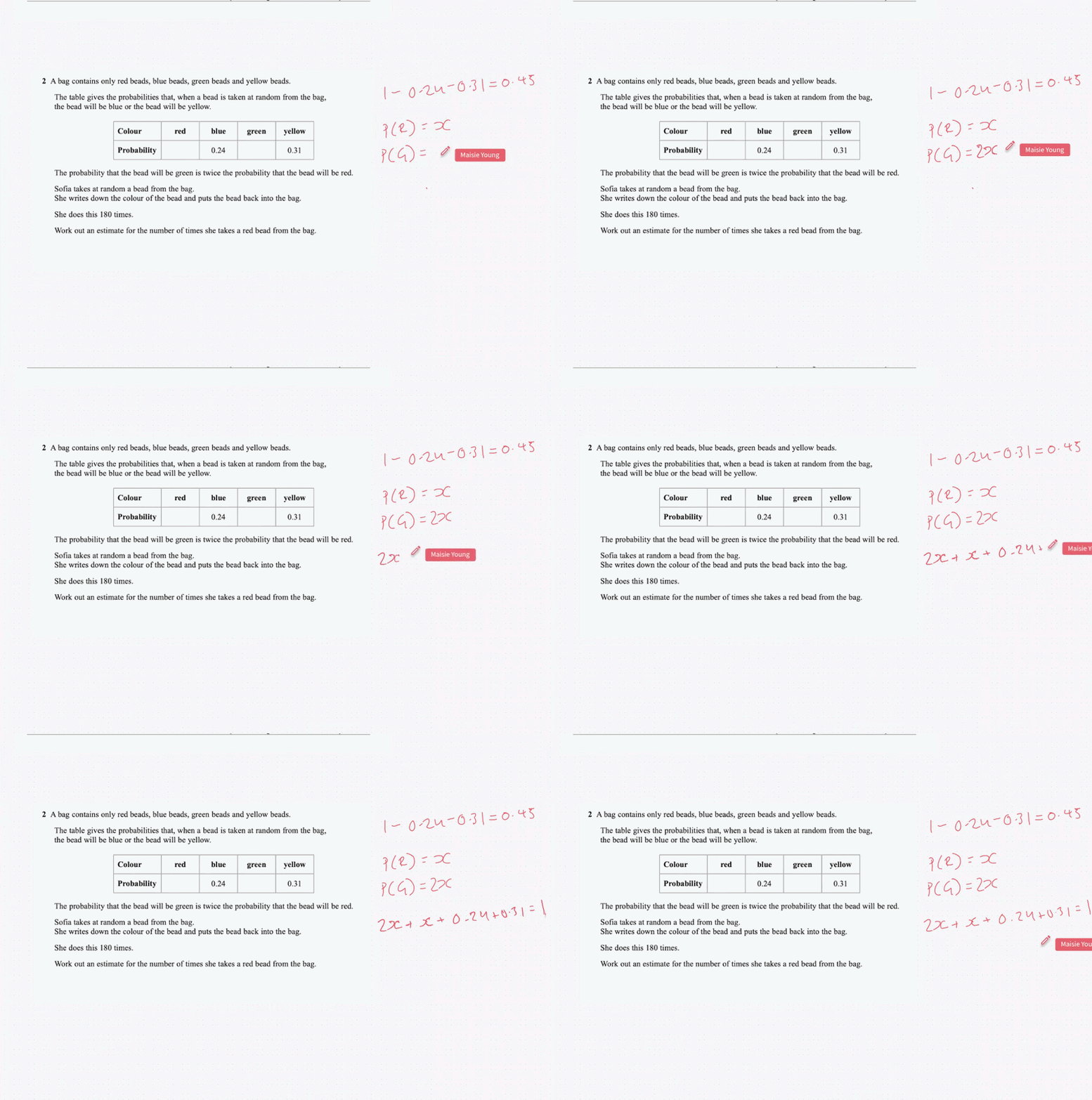
This clip shows a maths lesson recorded in Pencil Spaces, the online classroom used by Greenhill Academics.
Not sure if your child is comparing or just covering?
Send us how your child’s A-level English answers read. A tutor can look and tell you where the two texts drift apart.
Ask about a tutorTry this at home: ten minutes joining two points
This takes about ten minutes. You need one of your child’s already-marked A-level English comparative answers and a highlighter.
- Find a block (2 minutes). Find a place where your child writes about one text for a while, then the other, without linking them.
- Pick one point from each (3 minutes). Highlight one thing they say about the first text and one about the second that are really about the same idea.
- Join them with a link word (3 minutes). Rewrite the two as one sentence using ‘similarly’, ‘whereas’, ‘in the same way’ or ‘by contrast’, so both texts sit together.
- Read it back (2 minutes). Ask whether the new sentence compares the two texts, or still describes them one after the other.
What should you look for?
You are looking for whether your child can hold both texts in the same sentence, or keeps drifting back to one at a time. It does not grade your child, and it does not cover the whole essay or context. It only shows whether the two texts are being compared or just covered. A tutor can take the same answer and build the comparison out with your child, point by point.
Want a tutor to practise this with your child?
Tell us the texts and the exam board. A tutor can work through one answer and join the two texts together.
Send an enquiryHow a tutor works on it
In a lesson, a tutor sits with your child on a real answer. They find a point that stays on one text, then rewrite it so it holds both, out loud, with a link word in the middle.
They do it point by point, so your child can see the difference between covering the two texts and comparing them. The tutor works through the answer with your child, joining the two texts each time.
The tutors who can help
These tutors teach A-level English. Availability can be confirmed when you enquire.

Francesca studied English at Christ Church, Oxford, and teaches A-level English Literature. She has tutored English since 2017.
Questions parents ask us about A-level English
My child writes loads about both texts. Why is that not enough?
Covering both texts and comparing them are two different things. A useful next step is to bring the two texts into the same point rather than discuss them in separate blocks.
Is this the same as essay structure?
No. Essay structure is how the whole answer is organised. This is the narrower habit of making the relationship between the two texts clear within the comparison.
How do I tell at home if this is the problem?
Take one marked comparative answer. The ten-minute try above shows whether your child can join two points into one comparing sentence, or keeps them apart.
Which texts does this work for?
This approach can be used with comparative tasks involving poems, plays or novels. The exact comparison still depends on the texts and the question your child has been given.
Do you tutor A-level English for students outside the UK?
Yes. We tutor A-level English online for UK and international families, including students in Dubai and beyond. A tutor can work from the texts, course and question your child has been given.

Want a tutor to work on A-level English with your child?
Tell us the texts and the exam board, and we can talk about a tutor who fits.
Send an enquiry