

Your child sat an A Level maths test, worked hard, and lost more marks than you both expected. You may not know why. A wrong answer can come from many places, and the score on its own does not tell you which. An A Level maths tutor in Bahrain starts with your child’s marked work, finds where the marks were lost, and works on those parts. This page shows how that starts. It does not promise a grade.
How a tutor starts
- We start with work your child has already done: marked papers, class tests, homework and the teacher’s comments.
- A marked paper shows where the marks were lost. It does not, on its own, show why.
- So the tutor watches your child work through a question, because that shows what a finished script cannot.
- Then we work on the parts that need it, whether that is a topic, a method, or the way time runs out near the end.
What can your child’s last marked maths paper tell you?
The best place to start is work your child has already done: marked papers, class tests, homework and the teacher’s written comments. It does not need to be tidy, and even part of a paper helps.
A Level maths is a popular subject. It is the most popular A Level subject in England, where 107,300 students got a result in it in summer 2026.
It also helps to know which course your child is on, because that sets which papers or units they sit. The British School of Bahrain and Capital School Bahrain offer maths through the Pearson International A Level. St Christopher’s School offers A Level maths and the International Baccalaureate. The IB is its own qualification, not an A Level, so the tutor works from whichever one your child’s school follows.
A tutor reads the marked work with your child on a shared screen. Not to mark it again, but to see the pattern in it: which questions lost marks, and what the working shows about how each answer was reached.
If you are still choosing subjects, schools or tutoring in general, our guide A Level Tutoring in Bahrain: A Parent’s Guide covers the wider picture for families in Bahrain.
What a marked paper can show, and what it cannot
A marked paper is a good start, but it is easy to read too much into it. The score tells you how many marks were lost. It does not, on its own, tell you why they were lost, and the why is what a tutor needs.
The same wrong answer can come from very different places. Your child may know the method well but make one slip. They may have the wrong method. They may have run out of time and rushed the last part. They may have read the question wrong. A finished script cannot always tell these apart, so a tutor does not guess. They read the working line by line, and where the working runs out, they find out more before deciding anything.
This matters because the fix is different each time. A slip and a shaky method look the same on the page, one lost mark, but they need different work. So the tutor is careful not to treat a low score as one single problem.
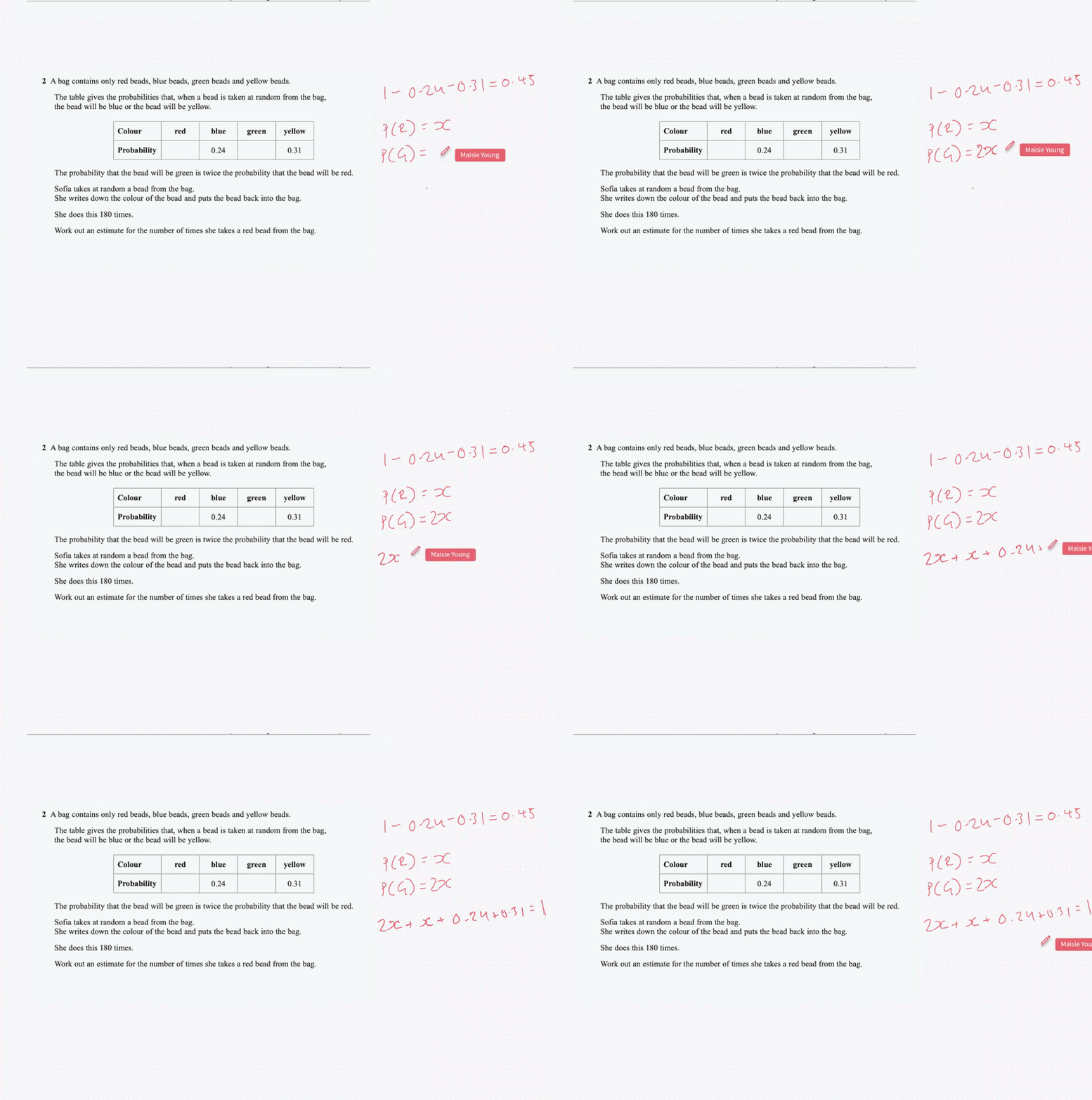
This clip shows a maths lesson recorded in Pencil Spaces, the online classroom used by Greenhill Academics.
Worried about the marks your child lost on their last test?
Tell us how the test went and which questions caused concern. A tutor can look at the working with your child.
Ask about a tutorHow an A Level maths tutor in Bahrain works through a question
Because a script cannot tell the whole story, the tutor asks your child to work through a question again, out loud, on the shared whiteboard. Watching the attempt shows things a finished answer hides.
You can see where your child slows down, which step they are unsure about, and whether they reach for the right method quickly or search for one. A child who says the first line with confidence and then slips on the arithmetic needs different help from a child who is not sure where to begin. Neither of those shows up in the mark alone. So the lesson is not only about getting the right answer. It is about seeing how your child gets there, because that is what tells the tutor what to work on.
The tutor does not decide the cause from one question. They look at a few, from different topics, so the pattern is real and not a one-off.
Why might your child have lost marks?
Here are some of the reasons a grade can come back lower than a child’s ability. These are simple illustrations, not real students and not real exam questions.
- A secure method, one small slip. Your child knows exactly what to do, then drops a minus sign or writes the limits the wrong way round. The method is right, so the marks lost feel small each time, but they add up across a paper.
- The right idea, the wrong method. The question needs one approach and your child reaches for another. The working looks neat and confident, but it was never going to reach the answer. This one hides well on a script.
- A topic that is not yet solid. One part of the course has a gap in it. Your child copes on easy questions and comes unstuck when that topic is tested in a harder way.
- Time runs out near the end. The early questions are fine, then the last few are rushed or left blank. That can point to pace and the order the paper is done in, rather than weak maths. It is worth checking, not assuming.
A real grade can have more than one of these behind it. That is why the tutor looks before deciding, rather than assuming every low grade has the same cause.
Try this with one marked question at home
You can try this at home in about ten minutes. You only need one question your child has already had marked, and a pen.
- Pick one question (1 minute). Choose a single question on a marked paper where your child lost marks. Just one, not the whole paper.
- Ask them to do it again (4 minutes). Cover the marked answer. Ask your child to work through that one question again on a fresh sheet, out loud if they can.
- Watch how they work (3 minutes). Notice where they slow down, which method they reach for, and the step where they get stuck or change their mind.
- Note what you saw (2 minutes). Write down the step that caused trouble. That is the part worth looking at, not the final answer.
What should you look for?
You are looking for the moment the question becomes hard, not whether the final answer is right. One question cannot tell you your child’s overall maths level or predict a grade. It only shows one place to start.
A tutor can take that same question, work through the step your child got stuck on, and check whether the same thing happens on similar questions.
How can tutoring help with the mistakes in your child’s maths work?
Once the tutor can see where the marks are going, the lessons work on those parts and leave alone the parts that are already fine. If it is a topic, they go back over it until it is solid. If it is a method, they practise choosing the right one. If it is careless slips, they work on setting the maths out clearly so the slips have fewer places to hide. If it is time, they practise sections against the clock.
None of this is a fixed script, and it is not a promise of a certain grade. It is ordinary, careful work on the parts that need it, checked against fresh questions so both of you can see what has changed.
If your child has just come up from GCSE and that jump is where the trouble began, our article The step up from GCSE to A Level maths looks at that step in maths.
Want a tutor to work on the parts that need it?
Tell us the topics or papers your child finds hardest. A tutor can start there.
Send an enquiryKarol and Martin teach maths at A Level

Karol studied Natural Sciences at the University of Cambridge. He teaches Maths and Further Maths at A Level, and also Chemistry, and works with students from GCSE up to A Level.

Martin is reading for a PhD in Applied Maths and Theoretical Physics at the University of Cambridge, after a Master’s with distinction at the University of Oxford and a first-class degree from the University of Bath. He teaches A Level Maths, Further Maths and IB Maths.
Would you like Karol or Martin to look at your child’s work?
Their profiles are linked above. You can name either of them when you send the form.
Ask about a tutorQuestions parents ask about a disappointing maths grade
My child understands the work at home but the grade is still low. Why?
It can have several causes. Sometimes the maths is understood but small slips cost marks. Sometimes one topic is weaker than the rest. A tutor looks at the marked work to see which, rather than assuming.
We are not sure which topics are the problem. Is that ok?
Yes. You do not need to work that out first. A tutor looks at your child’s work and how they answer questions, and finds where the marks are going from there.
My child is on the Pearson International A Level. Can you help with that?
Yes. The tutor works from whichever course your child’s school follows, including the Pearson International A Level and the IB. They check which papers or units your child sits and work to those.
Can a tutor really tell why marks were lost?
Not from the score alone, which is why we do not guess. The tutor reads the working and asks your child to redo a question or two, out loud. That shows the reason far better than a finished answer does.
Will one term of tutoring fix the grade?
We cannot promise a grade or a timescale. What we can do is find where the marks are going and work on those parts steadily, then check the change against fresh questions so you can see the progress for yourself.
Want help understanding where your child lost marks?
Tell us which maths course your child is studying and what happened in their latest test. We can discuss tutoring support.
Send an enquiry