

Your child knows the simple harmonic motion equations in A-level Physics. They can find the period and the frequency. But then a question says ‘show that this is simple harmonic motion’, and they stop. So they are left unsure what the question wants them to prove.
The short answer
- A ‘show that’ question is not asking for numbers. Instead, it is asking for a proof.
- To show simple harmonic motion, you show acceleration is proportional to the negative of displacement.
- That is three short steps: find the restoring force, turn it into acceleration, then state the condition.
- There is a short proof task at the end you can try at home this week.
Where the simple harmonic motion proof goes wrong
One thing to check is whether your child knows the equations but stalls the moment the word ‘show’ appears. The trouble is that word ‘show’. A ‘show that’ question wants a proof, not a calculation. So the child starts working out a period or a speed, when the question is really asking them to prove the motion is simple harmonic motion in the first place. The fix is to treat it as a short proof.
Show it is simple harmonic motion in three steps
The thing you have to show is always the same: the acceleration is proportional to the displacement and points back towards the middle. But how you get there depends on the system. So here is the route for a mass on a spring, which is the one students meet first.
Find the restoring force
Work out the force that pulls the object back to the middle. For a spring, that force is F = minus k x, where x is how far it has moved from the middle.
Turn the force into acceleration
Use F = m a. Then dividing by the mass gives a = minus (k over m) times x. The minus sign means the acceleration points back towards the middle, opposite to the displacement.
State the condition
Acceleration is proportional to displacement and in the opposite direction. That is the test for simple harmonic motion. The number in front, k over m, is omega squared.
Once your child can reach a = minus (omega squared) x, they have shown it. The period and frequency come after, not before. A pendulum reaches the same condition, but only for small swings, so the route there has an extra step.
How we teach the proof
We get the child to spot the word ‘show’ and stop reaching for the calculator. Then we run the three steps: force, then acceleration, then the condition. So we keep the numbers out until the proof is done. It is a Greenhill way of separating the proof from the arithmetic, so each part can be checked on its own.
Greenhill tutor
Hugh, Physics tutor
Hugh holds a First-Class MSci in Theoretical Physics from Imperial College London and teaches A-level Physics with Greenhill.
Stuck on ‘show that’ questions?
Tell us where your child’s simple harmonic motion answers break down. A tutor can look at one and see if it is the proof or the equations.
Ask about a tutorA mass on a spring, worked through
The motion and letters below are made up to show the method. They are not taken from any pupil’s work.
The question
A mass m sits on a spring with spring constant k. It is pulled a distance x from the middle and let go. Show that it moves with simple harmonic motion.
The proof
The spring pulls it back with force F = minus k x. Then using F = m a gives a = minus (k over m) times x. So the acceleration is proportional to the displacement and points the opposite way. That is the condition for simple harmonic motion, with omega squared equal to k over m. No numbers were needed.
Try this at home this week
This takes about seven minutes. It shows you whether your child can write the proof, not just use the equations.
What you need. Paper, a pen, and one ‘show that it is simple harmonic motion’ part from a past paper or revision guide.
The task. Ask your child to answer it writing only the proof, not any numbers. They should reach the line a = minus (omega squared) x and then stop.
- Read the question and underline the word ‘show’.
- Write down the restoring force that pulls the object back to the middle.
- Use F = m a to turn that force into acceleration.
- Show the acceleration is proportional to the negative of the displacement.
- Write one sentence saying this is the condition for simple harmonic motion.
What to watch. Watch where they stop. When they reach for a period or a speed straight away, the word ‘show’ is the part to practise. But if they get the force and then stall at the acceleration step, that is the step to work on.
What it cannot tell you. This short task does not tell you whether your child can handle energy in simple harmonic motion, damping, or resonance. It checks the basic proof only.
Where a tutor takes it next. That is where a tutor picks it up: first the proof, then building up to the harder parts of the topic.
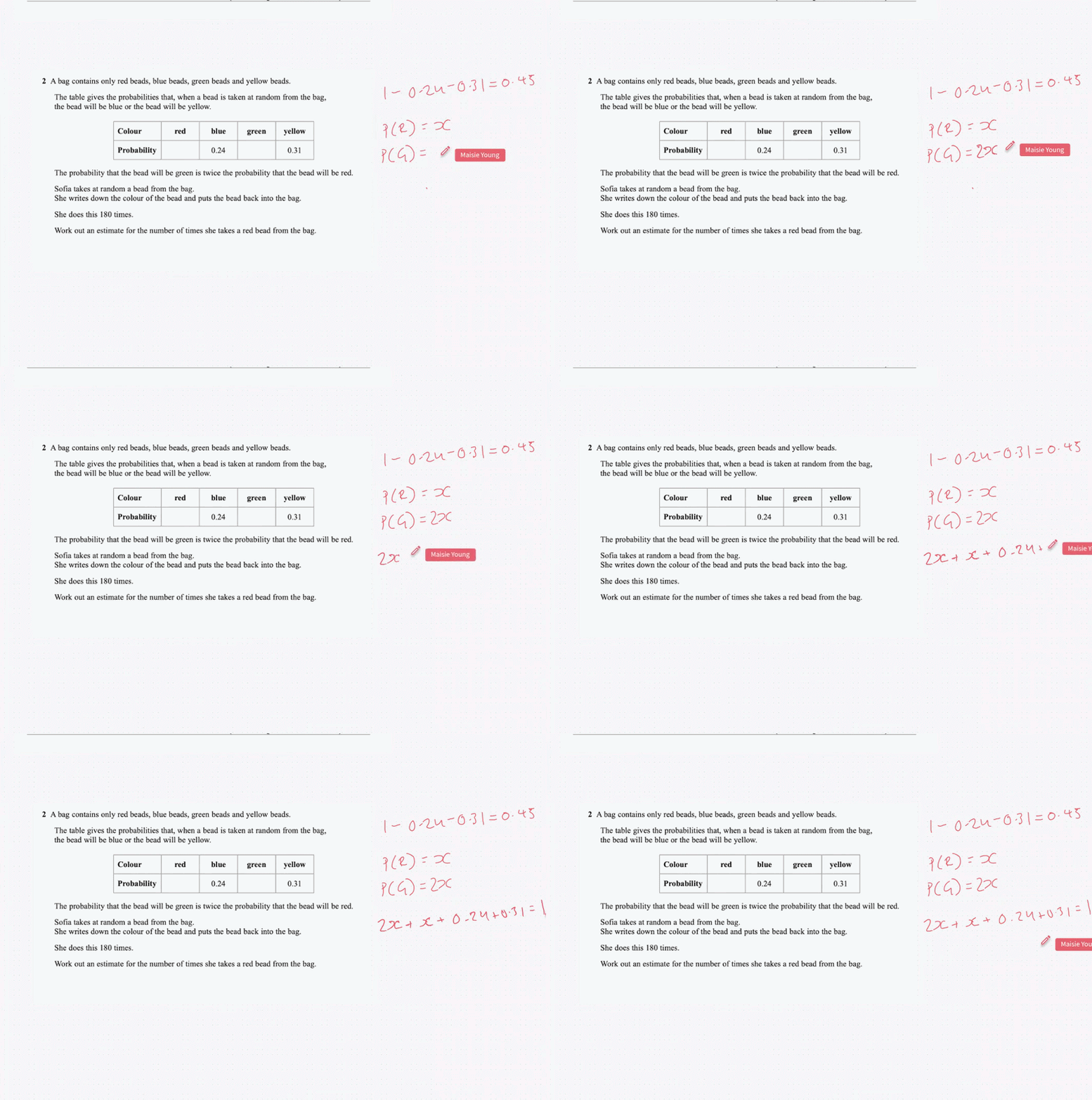
This clip shows a maths lesson recorded in Pencil Spaces, the online classroom used by Greenhill Academics.
Our A-level Physics tutors

Ashruf studied Engineering at Clare College, University of Cambridge. He teaches Maths and Physics at GCSE and A level with Greenhill.

Hugh holds a First-Class MSci in Theoretical Physics from Imperial College London and a DPhil from the University of Oxford. He teaches Physics up to university entrance.
Questions parents ask us
What does a ‘show that it is simple harmonic motion’ question want?
It wants a proof, not a number. Your child has to show the acceleration is proportional to the displacement and points back to the middle. Once they reach a = minus (omega squared) x, they have shown it.
Why does my child freeze on these when they know the equations?
Knowing the equations and proving the motion are two different jobs. The equations give a period or a frequency. But the word ‘show’ asks for the proof first, which is a different skill from putting numbers into a formula.
Is this an A-level Physics topic?
Yes. Simple harmonic motion sits in the mechanics part of A-level Physics, and ‘show that’ questions come up on springs and pendulums. The same idea works across the exam boards: show the acceleration is proportional to the negative of the displacement.
Do you tutor A-level Physics online?
Yes. We tutor A-level Physics online for UK and international families. Tell us the exam board and where your child gets stuck, and we can talk through the help they need.
How quickly can this improve?
It depends on the child and the exam board. The proof is short, but using it without hesitating takes practice on real questions. A tutor can show you what that practice looks like.
Want a tutor to work on A-level Physics with your child?
Tell us the exam board and where your child gets stuck, and we can talk through the help they need.
Send an enquiry