

Your child reads a ‘show that’ question, then stops at the first line, not sure what to write. One thing worth checking is whether the sticking point is choosing that first move, rather than the steps once a method is going.
The honest version
- A ‘show that’ question gives the target, but not the route to it.
- The first line is where it stalls, and that is the part to check.
- The fix is a habit: read what you are given, then pick a first move that fits.
- There is a short task at the end you can try at home this week.
Why ‘show that’ questions are hard to start
A child who stalls here can be good at the steps once they start. The sticking point is the first line. A ‘show that’ question gives you a target and asks you to reach it, but not the route. One thing to check is whether your child can name a sensible first move from what the question gives them. If they cannot start, that opening step is worth practising separately from the rest of the solution.
Finding the first move
A ‘show that’ question looks blank until you spot the first line. Here is how to find it from what the question gives you.
Read it twice. What are you given, and what do you have to show?
Match it to a tool you know: a formula, an identity, or a definition that fits what you are given.
Write that first line. Then work, step by step, towards the thing you have to show.
There is no single move that fits every ‘show that’ question. The skill is reading what you are given, then picking a first step that fits.
How we teach the first move on ‘show that’
We take the panic out of the first line. We get the child to read what they are given and what they must show, then name the tool that fits: a formula, an identity, or a definition. That becomes the first line. Then they work towards the target one step at a time. It is a Greenhill way of turning a blank page into a clear opening move.
Greenhill tutor
Martin, Maths tutor
Martin specialises in A-level Mathematics and Further Mathematics and is studying for a PhD in Applied Mathematics and Theoretical Physics at the University of Cambridge. He teaches A-level Maths with Greenhill.
Blank page on ‘show that’?
Tell us where your child’s proofs stall. A tutor can look at one and show how to find the first move.
Ask about a tutorTwo ‘show that’ questions, two first moves
These questions are made up to show the method. They are not from a real pupil’s paper.
A sequences example
Show that the sum of the first n terms of 2, 5, 8, 11, … is n(3n+1)/2. The first move is to write the sum formula for an arithmetic sequence, S = n/2 times (2a + (n-1)d), with a = 2 and d = 3. Put those in, tidy up, and you reach n(3n+1)/2. The hard part was starting, and the given sequence told you which formula to write.
A trig example
Show that (sin x + cos x)² = 1 + 2 sin x cos x. Here the squared bracket is the signal. The first move is to expand it: (sin x + cos x)² = sin²x + 2 sin x cos x + cos²x. Then the identity sin²x + cos²x = 1 turns that into 1 + 2 sin x cos x. A different question, a different first move, both found by reading what you are given.
Try this at home this week
This takes about eight minutes. It shows you whether your child can find the first move, which is the part they get stuck on.
What you need. Paper, a pen, and three ‘show that’ questions from a past paper or textbook. One on sequences, one on trig, and one on coordinate geometry works well.
The task. Ask your child not to solve them. For each question, write only the first line: the formula, identity or definition they would start with, and one sentence on why.
- Read the question twice. Underline what you are given and what you must show.
- Name the tool it points to: a formula, an identity, or a definition.
- Write only that first line.
- In one sentence, say why that is the right place to start.
- Move on. Do not finish the proof, just find the opening move for all three.
What to watch. Watch whether your child can name a sensible first move. If they stare at a blank page, finding the opening is the part to practise.
What it cannot tell you. This short task does not cover finishing a proof, the full method for each topic, or the harder multi-step questions. It checks the first-move step only.
Where a tutor takes it next. That is where a tutor picks it up: finding the opening move first, then building the full proof around it.
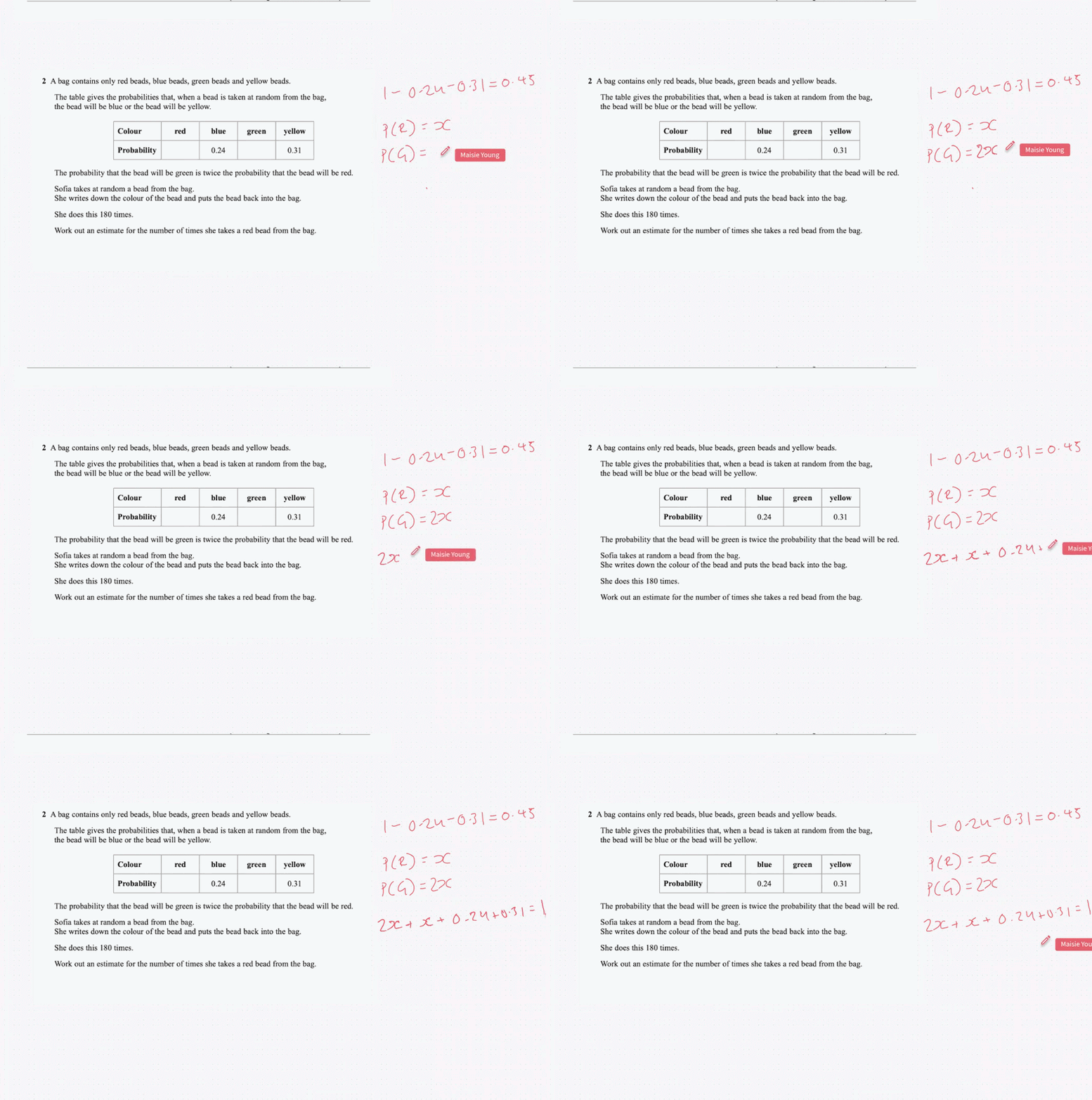
This clip shows a maths lesson recorded in Pencil Spaces, the online classroom used by Greenhill Academics.
Our A-level Maths tutors

Martin specialises in A-level Mathematics and Further Mathematics and is studying for a PhD in Applied Mathematics and Theoretical Physics at the University of Cambridge. He teaches A-level Maths with Greenhill.

Ramsay is in his third year reading Mathematics at the University of Oxford, with a Distinction in Prelims. He teaches A-level Maths with Greenhill.
What parents ask us
Why does my child freeze on ‘show that’ questions?
A ‘show that’ question gives the target but not the route, so the first line is the hard part. One thing to check is whether your child can name a sensible first move from what they are given. Once the opening is clear, the working that follows is the part to carry out step by step.
Is there one trick that works every time?
No. There is no single move that fits every ‘show that’ question. The skill is reading what you are given and picking a first step that fits, a formula, an identity, or a definition.
What kind of first moves come up?
It depends on the topic. A sequence points to a sum formula, a squared sine or cosine points to a trig identity, and two parallel vectors point to a scalar-multiple check. The same read-the-question habit sits behind choosing the right method in other questions.
Do you tutor A-level Maths online?
Yes. We tutor A-level Maths online for UK and international families. Finding the first move is one of the habits behind a strong A-level Maths grade. Tell us where your child gets stuck, and we can talk through the help they need.
How quickly can this improve?
It depends on the child. Finding the first move is a habit, and it builds with practice on real questions. A tutor can show you what that looks like.
Want a tutor to work on A-level Maths with your child?
Tell us where your child gets stuck, and we can talk through the help they need.
Send an enquiry