
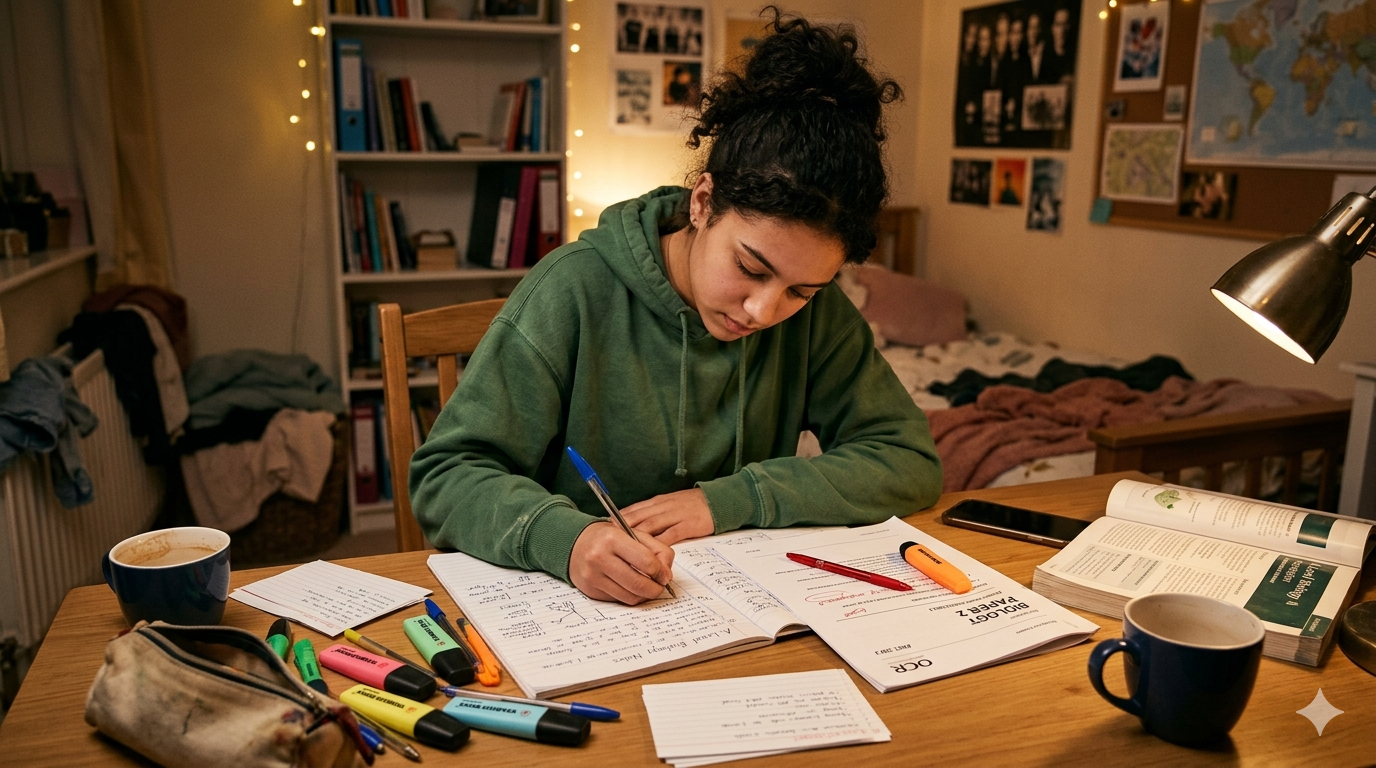

Thirty days before GCSE exams is not the time to start from scratch. It is the time to stop revising everything and start revising strategically. The students who gain the most ground in the final month are not the ones who put in the most hours. They are the ones who spend those hours on the right things.
This guide covers how to use the next 30 days to make the biggest possible difference to your child’s grades, subject by subject, week by week, without burning out before the first exam.
The most important shift in the final month
Stop revising everything equally. Find the subjects sitting just below target and put the time there. A 6 that becomes a 7 is worth more than a 9 that stays a 9.
GCSEs in 30 Days, Need Targeted Support?
Our GCSE tutors can work with your child in the final weeks to close the specific gaps costing the most marks.
What should your child do in week one of GCSE revision?
The first week of the final month should not be spent doing more revision. It should be spent working out where revision is most needed. Go through your child’s mock results or any recent past paper scores and write down the subjects and topics where marks are being lost most consistently. Cross-reference this against the exam timetable. The topics that appear in upcoming exams and show the biggest gaps go to the top of the list.
This sounds simple and it is often skipped entirely. Students who go into the final month without a clear picture of where their time is best spent tend to revise what they already know well, because it feels productive and is not stressful. The marks they need are almost never there.
Use past papers to diagnose, not just practise
In week one, your child should sit one past paper per subject they are most concerned about, not under strict timed conditions, but with the mark scheme open afterwards. The goal is not to simulate exam conditions yet. It is to find out exactly which question types and which topics are costing marks. That list becomes the revision plan for weeks two and three.
Which GCSE revision methods work best in weeks two and three?
This is the core of the final month. Work through the priority topics identified in week one, one subject at a time. The method matters here. Reading notes is the least effective form of revision. Active recall, writing out key facts from memory, answering practice questions without looking at notes first, explaining a topic out loud, is significantly more effective and retains material better under exam conditions.
For Maths: practise questions, not theory
In Maths, the only revision that matters in the final month is working through questions. Reading a method from a textbook without then doing ten questions using that method is almost useless under exam pressure. Your child should be doing topic-sorted past paper questions, marking them against the mark scheme, and identifying the specific steps they are consistently getting wrong. Each error is information. Acting on it is revision.
For English: practise answering, not reading
In English Language and English Literature, re-reading texts is not revision. Writing practice answers to past paper questions, language analysis, essay questions, creative writing, and then comparing them against mark schemes and examiner reports is revision. One well-marked practice answer per week per subject does more for grades than an hour of re-reading notes.
For sciences: terminology and mark scheme language
In Biology, Chemistry, and Physics, the most common reason students lose marks in the final weeks is imprecise terminology rather than wrong answers. The mark scheme expects specific words. “The enzyme changes shape” is not the same as “the enzyme undergoes a conformational change.” Your child should be revising key definitions by testing themselves, not reading them, and practising longer explain and describe questions with the mark scheme alongside to check every word.
How should your child use the final week before GCSE exams?
The final week before exams begin should include at least one full timed past paper per subject, under realistic exam conditions. No notes, no phone, timed strictly. The purpose is not to learn new material, it is to build the stamina and pacing that stops students running out of time in the real exam, and to identify any final gaps that still need attention before the paper.
After each timed paper, mark it quickly and note where time was lost and where marks were dropped. Do not spend hours on detailed analysis at this stage. Make a short list of anything that still needs attention and address those points the following morning. Then move on. Dwelling on performance in a practice paper in the final week creates anxiety that is more harmful than any content gap.
How much revision per day in the final month
Two to four hours of focused, active revision per day is the right range for most Year 11 students. Beyond four or five hours, quality drops significantly and retention falls. A student doing three focused hours of active revision will outperform one doing six hours of passive re-reading. If your child is regularly revising for more than five hours a day, the priority is not more time, it is a better method.
Is your child’s revision producing results?
A specialist tutor can go through past papers with your child, identify the specific marks being lost, and make the final 30 days count.
Book a LessonWhat can parents do to help with GCSE revision at home?
The most useful thing parents can do is manage the home environment, not the revision schedule. A calm household, food available without effort, and a genuine willingness to listen without adding anxiety to an already pressured period makes a real difference to how a student performs over 30 days of intensive preparation.
If your child is willing, testing them verbally on key facts or asking them to explain a topic to you is one of the most effective revision techniques available. Explaining something out loud forces active recall in a way that simply reading does not. You do not need to know the subject, asking “what happens during photosynthesis?” and listening while your child explains it is enough.
Meet some of our GCSE tutors

Ejaz
Ejaz is reading for an MSci in Mathematics at Imperial College London, where he achieved 8 Grade 9s at GCSE. With over 100 hours of tutoring experience across GCSE and A Level Maths, he specialises in helping students understand what examiners are looking for and how to present working that earns every available mark. In the final weeks before an exam, Ejaz works through past papers with students and identifies the specific habits costing marks.

Martin
Martin holds an MSc in Mathematical Sciences from Oxford (Distinction) and is completing a PhD at Cambridge. During a teaching placement he raised a Year 12 group’s pass rate by 54 percentage points. Martin is particularly effective at diagnosing whether a student’s errors come from weak foundations or exam technique, and adjusting the approach accordingly, exactly the skill that matters most in the final month before exams.

Naomi
Naomi read Politics, Philosophy, and Economics at Oxford (Exeter College), graduating with a 2:1 and winning the Sir Arthur Benson Memorial Prize. She achieved seven Grade 9s at GCSE and over 60 hours of tutoring experience across GCSE English and humanities. Naomi specialises in helping students develop the analytical habits that move answers from descriptive to perceptive, one of her students raised their predicted English grade from a 6 to a 9.
Make the final 30 days count
The students who close the biggest gaps in the final month are the ones who revise with a clear plan, use active methods, and get specific feedback on where their marks are going. If your child needs support in the run-up to their exams, get in touch and we will match them with a specialist GCSE tutor quickly, we typically turn around matches within 48 hours.
Expert GCSE Tutoring with Greenhill Academics
TARGETED SUPPORT IN THE FINAL WEEKS BEFORE GCSE EXAMS
Our Oxford and Cambridge graduate tutors identify the specific gaps costing your child marks and build a plan around the time available. Matches made within 48 hours.
Book a LessonFrequently asked questions
