
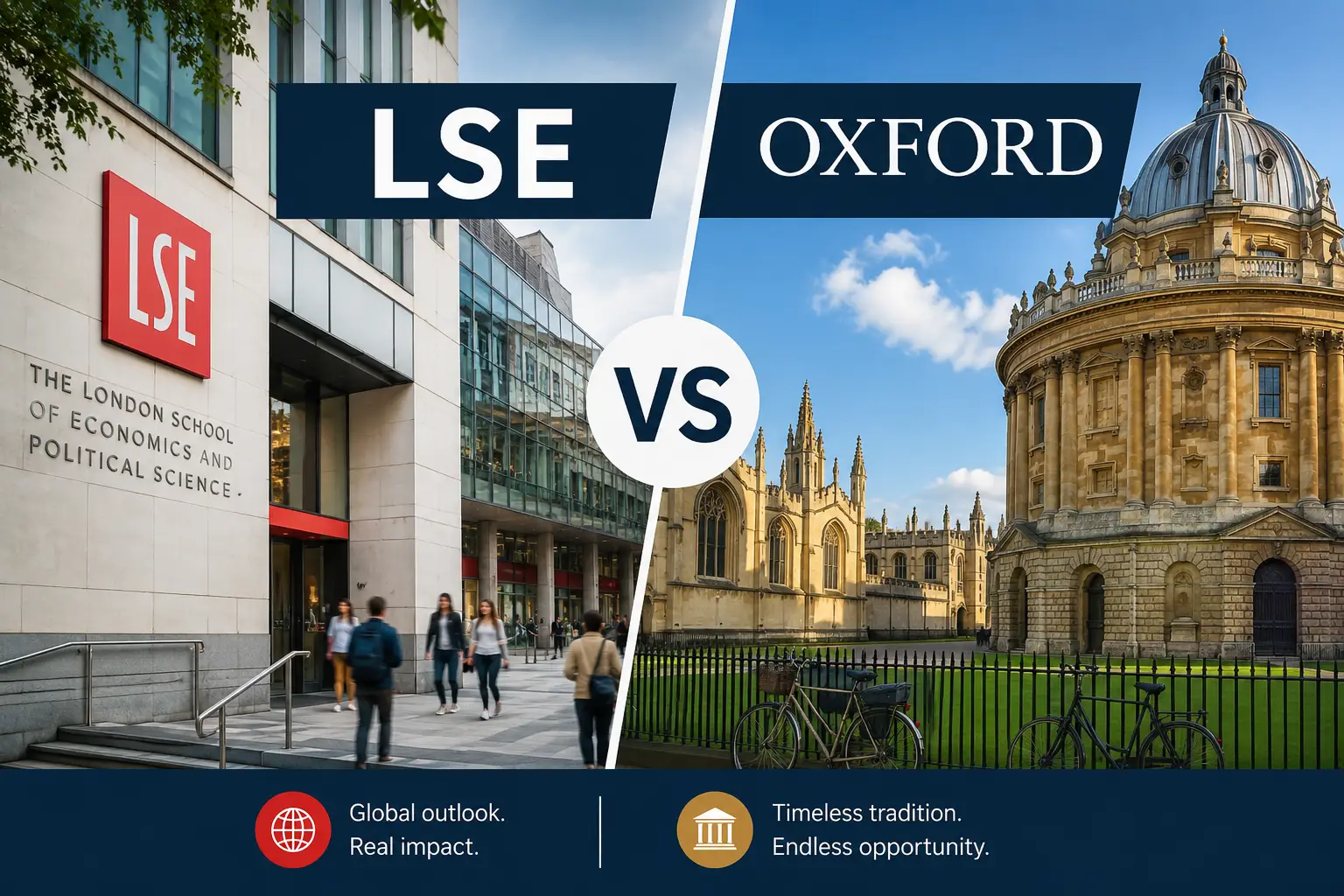

LSE vs Oxford is the comparison that comes up most often for parents of children targeting economics, politics, or social sciences. Both universities consistently rank in the global top ten for these subjects. However, they offer very different academic experiences. Oxford runs the centuries-old tutorial system with a small-college community. In contrast, LSE is a specialist social sciences university embedded in central London with lecture-and-seminar teaching and no interviews at all. Therefore, the right choice depends on how your child wants to learn, not which name carries more weight.
This guide compares LSE vs Oxford across the four major courses where families weigh up the two universities. Specifically, we cover Economics versus PPE, Law, History, and International Relations. Whether your child is targeting a quantitative economics path, a humanities degree with social science depth, or one of the top international relations programmes in the world, the comparison below should help.
What actually separates LSE and Oxford
LSE has no undergraduate interviews and weights the personal statement and admissions test heavily. Oxford always interviews and uses tutorials of one to three students. The application process is fundamentally different, even when the grades look similar.
Choosing between LSE vs Oxford?
Our Oxford and Cambridge-educated consultants support families across the full LSE and Oxford application: admissions tests, personal statements, and interview preparation.
LSE Economics vs Oxford PPE
The most common LSE vs Oxford comparison is between LSE BSc Economics and Oxford BA Philosophy, Politics and Economics (PPE). However, these are very different degrees serving different academic interests. Therefore, the right choice turns on whether your child wants a pure quantitative economics training or a broader liberal arts approach.
LSE BSc Economics
LSE BSc Economics is a three-year quantitative degree focused entirely on economics. The standard offer is A*AA at A Level with A* in Mathematics. Specifically, Further Mathematics is desirable and an essay-based subject as the third choice is preferred. Importantly, LSE has introduced the TMUA (Test of Mathematics for University Admission) as mandatory for several Economics programmes from 2026 entry, including BSc Economics, BSc Econometrics and Mathematical Economics, and Mathematics and Economics. Notably, LSE does not interview any undergraduate applicants. As a result, the personal statement and TMUA score carry significant weight.
Oxford BA Philosophy, Politics and Economics
Oxford PPE is a three-year liberal arts degree covering all three disciplines from Year 1. The standard offer is AAA at A Level, with no compulsory subjects but Mathematics strongly advised given the quantitative content in economics. For 2026 entry, applicants sit the TSA (Thinking Skills Assessment). Importantly, from 2027 entry, the TSA will be replaced by the TARA (Test of Academic Reasoning for Admissions). Oxford always interviews shortlisted candidates, typically with two interviews covering different aspects of the course.
Which degree suits your child?
LSE Economics suits students who already know they want quantitative economics and finance careers. The course is mathematically rigorous from Year 1 and prepares students directly for postgraduate economics or careers in investment banking, consulting, and research. In contrast, Oxford PPE suits students drawn to interdisciplinary thinking. Specifically, the three subjects interact constantly: a student might write a Philosophy essay on Mill in the morning and a Politics essay on democratic theory in the afternoon. Furthermore, PPE students can drop one of the three subjects after Year 1 and specialise more deeply in the remaining two.
Need help choosing LSE vs Oxford?
Tell us the course, the year group, and your child’s strengths. We will help you weigh the trade-offs.
LSE vs Oxford for Law
Law at LSE and Oxford produces some of the most highly regarded legal graduates in the UK. However, the two courses take very different approaches to legal education. Notably, LSE Law focuses on law in its social and economic context. In contrast, Oxford Jurisprudence treats law as a rigorous intellectual discipline with strong analytical and philosophical foundations.
Course structure and entry requirements
LSE LLB is a three-year qualifying law degree. The standard offer is A*AA at A Level, and all applicants sit the LNAT. Specifically, LSE does not interview law applicants. The course includes core legal subjects alongside optional modules that draw on LSE’s wider social science strengths, including law and economics, criminology, and international law. Furthermore, LSE Law graduates feed strongly into commercial firms and the Bar.
Oxford Jurisprudence (BA Law) is a three-year qualifying law degree. The standard offer is AAA at A Level, and all applicants sit the LNAT in October. Importantly, Oxford always interviews shortlisted candidates with two interviews per applicant. The course is taught through weekly tutorials in pairs or threes, alongside lectures. Specifically, Oxford Law is widely considered the most academically rigorous law undergraduate degree in the UK. As a result, it suits students drawn to deep doctrinal analysis and jurisprudential debate.
LSE vs Oxford for History
History at LSE and Oxford represents two genuinely different approaches to the discipline. Oxford History is one of the largest history departments in the world, covering everything from ancient civilisations to contemporary politics. In contrast, LSE History focuses on the modern period and international history specifically.
Course structure and entry requirements
LSE BSc International History is a three-year degree focused on the period from around 1500 to the present, with strong emphasis on international and global perspectives. The standard offer is A*AA at A Level. Specifically, LSE History does not require History at A Level, though it is recommended. LSE does not interview, and there is no admissions test for History.
Oxford BA History is a three-year degree covering British, European, and world history from the ancient period to the present. The standard offer is AAA at A Level with History required. Notably, Oxford History does not require an admissions test for 2026 entry. Instead, applicants submit two pieces of marked written work. Furthermore, Oxford always interviews shortlisted candidates. The course is taught through weekly tutorials and lectures, with significant emphasis on independent reading and essay writing.
LSE vs Oxford for International Relations
LSE BSc International Relations is consistently ranked among the top IR programmes in the world. Oxford does not offer a standalone International Relations undergraduate degree. However, Oxford students can study international relations within History and Politics, PPE, or History. Therefore, this comparison is somewhat asymmetric.
LSE BSc International Relations
LSE International Relations is a three-year degree covering IR theory, international history, comparative politics, and international political economy. The standard offer is A*AA at A Level. Specifically, no admissions test is required, and LSE does not interview. As a result, the personal statement carries significant weight in the selection process. Furthermore, the LSE IR department is widely regarded as the leading undergraduate IR programme in the UK and the natural choice for students targeting careers in diplomacy, international organisations, or international policy work.
Oxford alternatives
Oxford students interested in international relations typically choose History and Politics, PPE, or History. Specifically, History and Politics combines the strengths of both disciplines and includes optional papers in international history and political theory. PPE includes politics as one of the three core disciplines with options in international politics. Importantly, these Oxford degrees offer the tutorial system and college community that LSE cannot match. However, they do not offer the same depth of pure IR training that LSE provides.
LSE vs Oxford: how do you actually decide?
The answer turns on three practical questions about your child’s preferences. Specifically, both universities produce graduates who go on to top careers and postgraduate programmes. The right choice is the one that fits your child’s learning style and academic interests, not the one with the higher reputation in a given year’s ranking.
Interviews and application demands
The single biggest practical difference is interviews. Oxford always interviews shortlisted candidates. In contrast, LSE does not interview any undergraduate applicants. As a result, the LSE application turns entirely on grades, the admissions test (where required), and the personal statement. Specifically, students who interview poorly under pressure may find LSE a more comfortable application process. Furthermore, students who excel at thinking aloud and engaging in academic debate often shine at Oxford interviews and should not avoid the format.
Teaching style
Oxford tutorials with one to three students suit learners who thrive on close intellectual engagement and weekly written feedback. Specifically, tutorials demand real preparation each week and reward independent thinking. In contrast, LSE seminars with 12 to 20 students suit students who prefer a balance of group discussion and independent work. Furthermore, the lecture-and-seminar format at LSE feels closer to a traditional research university. The tutorial format at Oxford is unique and not for every student.
Location and atmosphere
Oxford is a small university town. LSE is in the heart of central London on Houghton Street. Specifically, LSE students are minutes from Westminster, the City, Parliament, the major think tanks, and the cultural institutions of London. For students drawn to politics, policy, finance, or international affairs, the location offers extensive professional networking opportunities during term time. In contrast, Oxford’s small-town setting creates a more focused academic community. Therefore, the lifestyle preference often matters as much as the academic differences.
When should your child start preparing for LSE or Oxford?
The earlier your child builds the application, the smoother Year 13 becomes. In general, most families benefit from starting in Year 12. Specifically, the right moment is once your child has chosen the course they want to read and has settled into A Level or IB. A consultant at this stage can shape the personal statement, run admissions test diagnostics, and prepare interview technique well before the UCAS deadline.
Year 13 students can still apply successfully to LSE or Oxford with a focused block of preparation across the summer and autumn term. Indeed, eight to twelve weeks of intensive work covers the admissions test, personal statement, and interview practice. The key is choosing a consultant who knows both universities and the specific course inside out. Our guides on how to get into Oxford or Cambridge, Oxford TSA preparation, and UCL, LSE and Imperial vs Oxbridge are useful companions.
Expert LSE and Oxford admissions support
TARGETED SUPPORT FROM OXFORD AND CAMBRIDGE GRADUATES
Our consultants help families weigh up LSE vs Oxford realistically. We then build the application strategy around your child’s strengths.
Part of our university comparison series
This post is part of a series for parents weighing up the UK’s top universities. Each guide compares two or more institutions directly, written from real admissions experience.
Other guides in the series:
→ How to Get Into Oxford or Cambridge
→ UCL, LSE and Imperial vs Oxbridge
→ Oxford TSA Preparation
→ All Admissions Consulting
Frequently asked questions about LSE vs Oxford
