
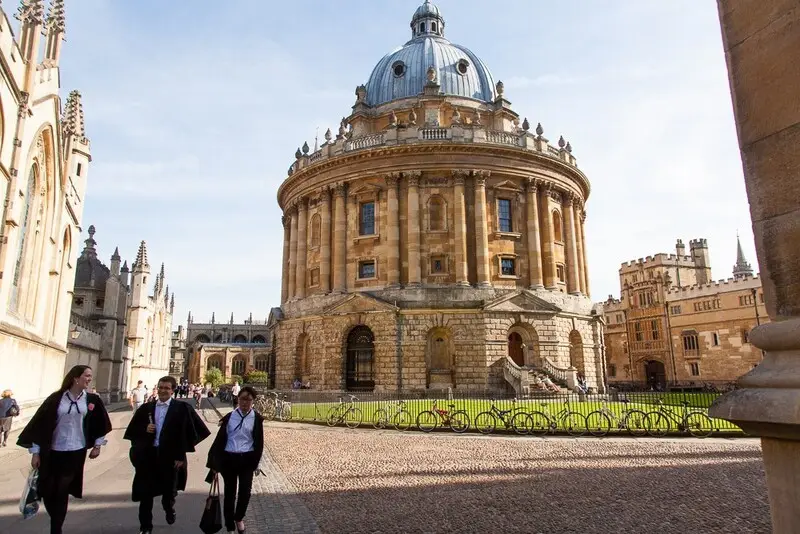

Most parents asking how to get into Oxford or Cambridge have already heard the headline numbers. Around one in five UK applicants gets in. The grades demanded are high. The process feels mysterious. However, the families who succeed do not treat Oxbridge as a lottery. They work backwards from the offer holders. They know what each course actually rewards, where the technique gaps usually sit, and which steps cannot be left until Year 13. This guide explains how that preparation looks in practice.
This guide on how to get into Oxford or Cambridge is written for parents whose children are realistic candidates. Specifically, we cover the academic grades, the admissions tests by course, the personal statement, written work submissions, the interview, and what genuinely separates successful candidates. Whether your child is targeting Medicine, Law, Engineering, Maths, English, or one of Cambridge’s natural sciences, the principles below apply.
What actually gets your child into Oxbridge
Top grades are the entry ticket, not the differentiator. The offer comes down to admissions test performance, written work and personal statement quality, and interview technique under pressure.
Want to get your child into Oxford or Cambridge?
Our Oxford and Cambridge-educated tutors support families across the full Oxbridge application: admissions tests, written work, personal statements, and interview preparation.
What grades does your child actually need for Oxford or Cambridge?
The academic threshold for Oxford and Cambridge varies by course. However, certain patterns hold across both universities. Specifically, most subjects require A*A*A or higher at A Level, or a strong IB Diploma score with high HL grades. Notably, hitting the grade boundary is necessary but not sufficient. The application turns on what your child does beyond the grades.
A Level offers by course
Cambridge Medicine typically requires A*A*A with specific science subjects. Cambridge Engineering needs A*A*A with Maths and Physics. Oxford PPE asks for AAA. Furthermore, Maths at either university now requires A*A*A with A* in Maths and Further Maths. English Literature at Oxford generally requires AAA. Notably, some colleges flex slightly above or below the standard offer based on the strength of the application. Therefore, your child should always check the specific course page on each university’s website rather than relying on a general grade table.
IB Diploma offers by course
IB Diploma offers typically range from 40 to 42 points overall, with 776 or 777 at Higher Level. Specifically, Cambridge Engineering demands 41 to 42 with 7,7,6 at HL including Maths and Physics. Oxford Medicine asks for 39 to 40 points with 766 at HL. Furthermore, the subject combinations matter as much as the total score. As a result, IB students should choose HL subjects that align with their intended course from the start of Year 12. Indeed, switching HL subjects in Year 13 is rarely possible.
Want a tutor matched to your child’s Oxbridge target?
Tell us the course, the year group, and the predicted grades. We will match them with a tutor who has supported similar applications successfully.
Which admissions tests does your child sit for Oxford or Cambridge?
Most Oxbridge courses now require an admissions test sat in October of the application year. Specifically, the test is often the single biggest differentiator between candidates with identical grades. Notably, the testing landscape changed significantly in 2024 and 2025, so older preparation materials may no longer match the current format.
Oxford admissions tests
Oxford runs several tests depending on the course. The MAT is required for Maths, Computer Science, and joint courses. Furthermore, the LNAT tests Law applicants. The HAT is required for History. Modern Languages requires the MLAT. Notably, Oxford has consolidated several previous tests under the new TSA framework for PPE, Economics and Management, and Philosophy and Linguistics. Medicine applicants sit the UCAT. Therefore, your child should identify the relevant test as soon as they have settled on a course, ideally by the end of Year 12.
Cambridge admissions tests
Cambridge has restructured its admissions testing under the ESAT and TMUA. Specifically, the ESAT is now required for Engineering, Natural Sciences, Veterinary Medicine, and Chemical Engineering, replacing several older tests. The TMUA is required for Maths, Economics, and Computer Science. Furthermore, Medicine applicants sit the UCAT. English candidates sometimes face course-specific written work submissions and at-interview assessments. As a result, the test calendar matters: ESAT and TMUA registration opens early and closes well before the UCAS deadline.
How to write a personal statement that helps your child get into Oxbridge
The personal statement matters more for Oxbridge than for most other UK universities. Specifically, tutors at both Oxford and Cambridge often read the statement closely before the interview. Notably, the new UCAS format introduced in 2025 splits the statement into three questions, replacing the old single 4,000-character box.
The new three-question format
The 2025 UCAS personal statement asks three questions. Specifically, your child must explain why they want to study the course, how their qualifications and studies have prepared them, and what other relevant skills and experiences they bring. Each section has a 350-word recommended length, totalling roughly the same as the old format. Furthermore, Oxbridge tutors expect 80 percent of the content to address academic interest in the subject. Indeed, generic personal stories that worked at less competitive universities will weaken an Oxbridge application.
Demonstrating academic depth
Top-band Oxbridge personal statements show genuine academic engagement beyond the school curriculum. Specifically, that means specific books, lectures, podcasts, journal articles, and intellectual debates your child has wrestled with. For example, a History candidate might discuss how reading E.H. Carr’s “What is History?” changed how they think about historical evidence. In contrast, a candidate who only references their A Level textbook will struggle to compete. Therefore, your child should start a reading log in Year 12 and add three or four books or articles each term across the application year.
How to prepare your child for the Oxbridge interview
The Oxbridge interview is unlike any other university interview your child will sit. Specifically, tutors are not testing what your child knows. Instead, they are testing how your child thinks under pressure. Notably, the interview format mimics the supervision or tutorial system, where students engage in detailed academic conversation with tutors. As a result, the interview is essentially an audition for that style of learning.
What tutors look for in the interview
Oxbridge interviewers look for three things consistently. First, intellectual flexibility: can your child handle being challenged, change their mind under good arguments, and entertain unfamiliar ideas? Second, technical fluency: can your child apply their A Level or IB knowledge to unfamiliar problems? Furthermore, the third is genuine curiosity. Notably, tutors can tell within minutes whether a candidate is going through the motions or genuinely loves the subject. Therefore, the best preparation is to read widely and discuss what you read with someone who pushes back.
Mock interview practice
Mock interviews with experienced Oxbridge tutors are the single highest-leverage preparation technique. Specifically, a tutor who attended Oxford or Cambridge knows what to ask, how to push, and what good answers sound like. Indeed, many students walk into their first mock having never been asked to think aloud about an unfamiliar problem. The shock of the first session is itself the lesson. Furthermore, three to five mock interviews across the four weeks before the real interview is the standard for serious candidates. Your child should record each one and review the recording with the tutor.
Which Oxbridge tutors help students get into Oxford or Cambridge?
The right tutor knows the Oxbridge admissions process from the inside. They have walked the path themselves, supported students through it, and know exactly what each course actually rewards. Below are three Greenhill tutors who work with families across Oxbridge applications.

Laurie
Laurie holds a Double First in English Language and Literature from The Queen’s College, Oxford. He won the J.A. Scott Prize for the highest finals mark in English or History at his college. Notably, Laurie has 500+ hours of tutoring experience and has supported students into Oxford, Cambridge, Johns Hopkins, and Stanford. He covers the ELAT, personal statements, written work submissions, and interview preparation for humanities applicants.

Martin
Martin is reading for a PhD in Applied Maths and Theoretical Physics at the University of Cambridge. Before that, he earned a Distinction MSc at Oxford and a First Class BSc at Bath. He was awarded the highest AS Level Physics mark in the country in 2017. Martin supports Cambridge Engineering, Natural Sciences, and Maths applicants, including the ESAT, TMUA, and STEP. He brings direct insight into what Cambridge tutors look for at interview.

Kian
Kian graduated from Brasenose College, Oxford with a 2:1 in Classics. His background combines ancient history, classical languages, and humanities essay technique. Crucially, he brings a deep understanding of how to construct argument and engage with primary sources. Kian supports applicants to History, Classics, English, and joint humanities courses at competitive UK universities, including personal statements and interview preparation.
When should your child start preparing for Oxford or Cambridge?
The earlier your child builds the right habits, the smoother the application year becomes. In general, most families benefit from starting in Year 12. Specifically, the right moment is once your child has settled into A Level or IB courses and chosen the subject they want to read at university. A tutor at this stage helps with reading lists, admissions test diagnostics, and the early shape of the personal statement. Furthermore, they avoid the panic of starting test preparation in September of Year 13.
Year 13 students can still get into Oxford or Cambridge with focused tutoring across the summer and autumn term. Indeed, eight to twelve weeks of intensive preparation across the personal statement, admissions test, and interview is often enough to lift an application from borderline to competitive. The key is choosing a tutor who knows the specific course inside out. For families thinking ahead to specific course requirements, our guides on Oxford TSA preparation, UCAT scores for UK medical schools, and UCL vs LSE vs Imperial vs Oxbridge are useful companions.
Expert Oxbridge admissions support with Greenhill Academics
TARGETED SUPPORT FROM OXFORD AND CAMBRIDGE GRADUATES
Our Oxbridge tutors identify the gaps in your child’s application early. They then close them well before the UCAS deadline.
Part of our Oxbridge admissions series
This post is part of a series for parents whose children are applying to Oxford or Cambridge. Each guide covers a specific stage of the application process, written by Oxbridge graduates who have walked the path themselves.
Other guides in the series:
→ Oxford TSA Preparation
→ UCL vs LSE vs Imperial vs Oxbridge
→ UCAT Scores for UK Medical Schools
→ All Admissions Consulting
Frequently asked questions about how to get into Oxford or Cambridge
