
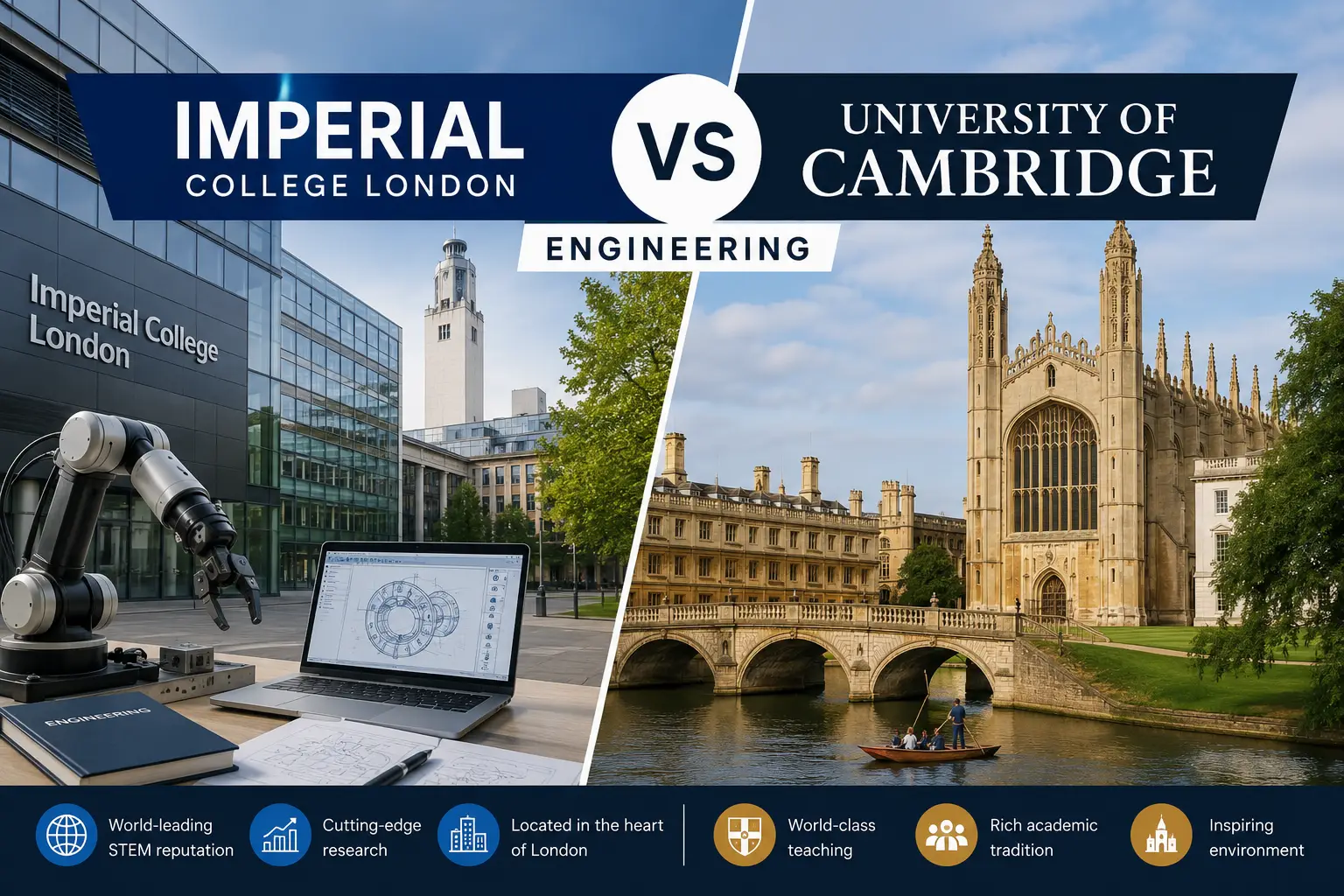

Imperial vs Cambridge for engineering is a comparison where both universities are genuinely world-class. Imperial College London is widely regarded as the leading specialist science and engineering university in the UK. Cambridge offers one of the broadest, most academically rigorous engineering degrees in the world. However, the way each university teaches engineering is fundamentally different. Imperial students choose their engineering discipline from Year 1. In contrast, Cambridge students study general engineering for two years before specialising. Therefore, the right choice depends as much on how your child wants to learn engineering as on which institution they prefer.
This guide compares Imperial vs Cambridge for engineering applicants directly. Specifically, we cover entry requirements, the ESAT admissions test, course structure, teaching style, and how to decide which suits your child. Whether your child is targeting Mechanical, Aeronautical, Electrical, Chemical, or a more specialist engineering discipline, the comparison below applies.
What actually separates Imperial and Cambridge for engineering
Imperial admits students into a specific engineering department from Year 1. Cambridge teaches general engineering for two years, with specialisation from Year 3. The grades and the ESAT are similar, but the experience is very different.
Choosing Imperial vs Cambridge for Engineering?
Our Oxbridge-educated consultants support engineering families across both applications: ESAT preparation, personal statements, and Cambridge interviews.
Entry requirements for Imperial vs Cambridge for Engineering
Both universities ask for top A Level grades with Mathematics and Physics required. However, the specific standard offers differ slightly. Therefore, your child’s predicted grades should inform which is the more realistic target.
Imperial Engineering entry requirements
Imperial Engineering courses typically require A*A*A at A Level with A* in both Mathematics and Physics. Specifically, some courses such as Aeronautical Engineering ask for A* in Mathematics and an A in Further Mathematics if available. The four-year MEng is the standard route, leading to Chartered Engineer accreditation. Notably, every Imperial Engineering MEng graduate also receives the Associateship of the City and Guilds of London Institute (ACGI), an additional professional qualification awarded alongside the degree.
Cambridge Engineering entry requirements
Cambridge Engineering Tripos typically requires A*A*A at A Level, with A* in Mathematics and Physics expected. Further Mathematics is strongly recommended where the school offers it. The four-year course leads to both a BA (with Honours) after Year 3 and an MEng after Year 4. Importantly, the MEng degree carries professional accreditation as fully satisfying the educational base for Chartered Engineer status. As a result, the qualification is academically and professionally equivalent to Imperial’s MEng.
Want help with the Imperial vs Cambridge engineering decision?
Tell us your child’s engineering interest, predicted grades, and target. We will help you weigh both applications realistically.
The ESAT admissions test for Imperial vs Cambridge
Both Imperial and Cambridge require the ESAT (Engineering and Science Admissions Test) for engineering applicants. The test was introduced in 2024 and replaced Cambridge’s previous tests (NSAA and ENGAA). Importantly, the ESAT is the same test for both universities. Therefore, applicants targeting both Imperial and Cambridge only sit the test once.
ESAT format and content
The ESAT is a computer-based test delivered at Pearson VUE test centres. Specifically, the test has five modules: Mathematics 1, Mathematics 2, Physics, Chemistry, and Biology. Every applicant takes Mathematics 1 plus one or two additional modules depending on the course. For example, Mechanical Engineering applicants typically take Mathematics 1, Mathematics 2, and Physics. Each module lasts 40 minutes and contains 27 multiple-choice questions. As a result, the full test takes around two hours for most engineering applicants.
Test dates and sittings
Cambridge applicants must sit the ESAT in the October sitting. The 2025 October test dates were 9th and 10th October. Notably, the January sitting is not available for Cambridge applicants. In contrast, Imperial applicants can choose either the October or January sitting. However, applicants targeting both Imperial and Cambridge must take the October sitting to meet the Cambridge requirement. Furthermore, your child can only sit the ESAT once per admissions cycle. As a result, the first score is the one that counts for every university the applicant applies to.
Course structure: Imperial vs Cambridge for Engineering
This is where Imperial and Cambridge diverge most clearly. Specifically, the two universities have made fundamentally different choices about how to teach engineering at undergraduate level. Therefore, your child’s preferred learning approach should drive the decision.
Imperial: specialise from Year 1
Imperial admits students directly into a specific engineering department. Specifically, applicants apply for Mechanical Engineering, Aeronautical Engineering, Chemical Engineering, Civil Engineering, Electrical and Electronic Engineering, Computing (Software Engineering), Bioengineering, Earth Science and Engineering, or Materials. Furthermore, the curriculum from Year 1 focuses on the chosen discipline. For example, Mechanical Engineering students at Imperial begin solid mechanics, thermofluids, and mechatronics from the first term. As a result, Imperial graduates have spent four years deeply embedded in their chosen specialism.
Cambridge: general engineering, then specialise
Cambridge Engineering takes the opposite approach. The first two years of the Engineering Tripos cover mechanical engineering, structural engineering, materials, electrical engineering, and information engineering as one general course for every student. Importantly, all engineering students take the same papers and supervisions during this period. Specialisation begins in Year 3 across nine engineering areas: Aerospace and Aerothermal Engineering, Bioengineering, Civil and Structural Engineering, Electrical and Electronic Engineering, Energy and Environmental Engineering, Information and Computer Engineering, Instrumentation and Control, Manufacturing Engineering, and Mechanical Engineering. As a result, Cambridge graduates have broad foundational knowledge across engineering disciplines before specialising.
Which structure suits your child?
Imperial suits students who already know their engineering specialism. For example, a student passionate about aircraft and aerodynamics gains four years of focused aeronautical study at Imperial. In contrast, Cambridge suits students drawn to engineering broadly but unsure which area excites them most. Specifically, the two-year general course gives every student exposure to all the major engineering disciplines before committing. Furthermore, students who want broader theoretical and mathematical foundations often prefer Cambridge. Indeed, Cambridge graduates frequently report that the breadth helped them adapt to multidisciplinary engineering challenges later in their careers.
Teaching style: Imperial vs Cambridge for Engineering
Both universities deliver intensive engineering education. However, the day-to-day experience differs significantly. Therefore, the teaching style is often the deciding factor for students who could realistically gain offers from either.
Cambridge supervisions
Cambridge teaches through a combination of lectures, practicals, and supervisions. Specifically, supervisions are small-group teaching sessions with one to three students and an academic or postgraduate researcher. These typically run once or twice a week per subject. Notably, supervisions involve discussing problem sets the student has prepared in advance, with detailed back-and-forth on the underlying engineering concepts. As a result, Cambridge engineers develop deep mathematical and theoretical understanding through this format. Furthermore, the collegiate system means most supervisions happen within the student’s college, creating a tight-knit academic community.
Imperial lectures and group projects
Imperial delivers engineering through lectures, laboratory sessions, tutorials, and group projects. Specifically, tutorials at Imperial typically involve smaller groups of around eight to ten students with a tutor, focused on problem-solving and concept review. Furthermore, group projects feature heavily across the four years, including a major design project and an individual research project in the final year. As a result, Imperial engineers develop strong practical and collaborative skills alongside academic rigour. The London location also creates extensive industry exposure through visiting lecturers, internships, and industrial partnerships.
Career outcomes: Imperial vs Cambridge for Engineering
Both Imperial and Cambridge engineers go on to top careers in industry, research, finance, and consulting. Specifically, the differences in graduate outcomes are minimal. Both universities feed strongly into companies like Rolls-Royce, BAE Systems, Arup, McKinsey, and the major tech firms. Furthermore, both produce significant numbers of graduates who pursue postgraduate research and academic careers. Therefore, career outcomes should not be the deciding factor between the two.
Where the courses lead
Imperial engineers typically benefit from being in London during term time. As a result, internship and networking opportunities are extensive across both engineering firms and the financial sector. Cambridge engineers benefit from the strong alumni network and the academic depth that produces excellent candidates for research-focused careers and competitive postgraduate programmes. Specifically, Cambridge graduates are also overrepresented in management consulting and investment banking despite the broader academic focus. In contrast, Imperial graduates concentrate more heavily in engineering and technology roles directly. Therefore, both routes lead to top careers, but the typical paths differ slightly.
When should your child start preparing for Imperial or Cambridge Engineering?
The earlier your child commits to the application, the smoother Year 13 becomes. In general, most engineering families benefit from starting in Year 12. Specifically, the right moment is once your child has chosen Mathematics, Physics, and Further Mathematics (where offered) at A Level and has seen the first set of teacher feedback. A consultant at this stage can run ESAT diagnostics, shape the personal statement, and prepare for the Cambridge interview well before the October test sitting.
Year 13 students can still apply successfully to Imperial and Cambridge for engineering with a focused block of preparation across the summer and autumn term. Indeed, eight to twelve weeks of intensive work covers the ESAT, personal statement, and Cambridge interview practice. The key is choosing a consultant who knows both universities and the specific engineering discipline inside out. Our guides on how to get into Oxford or Cambridge and UCL, LSE and Imperial vs Oxbridge are useful companions for engineering families.
Expert Imperial and Cambridge engineering support
TARGETED SUPPORT FROM OXBRIDGE GRADUATES
Our consultants help engineering families weigh Imperial vs Cambridge realistically. We then build the ESAT and application strategy around your child’s strengths.
Part of our university comparison series
This post is part of a series for parents weighing up the UK’s top universities. Each guide compares two or more institutions directly, written from real admissions experience.
Other guides in the series:
→ How to Get Into Oxford or Cambridge
→ UCL, LSE and Imperial vs Oxbridge
→ Oxford TSA Preparation
→ All Admissions Consulting
Frequently asked questions about Imperial vs Cambridge for Engineering
