
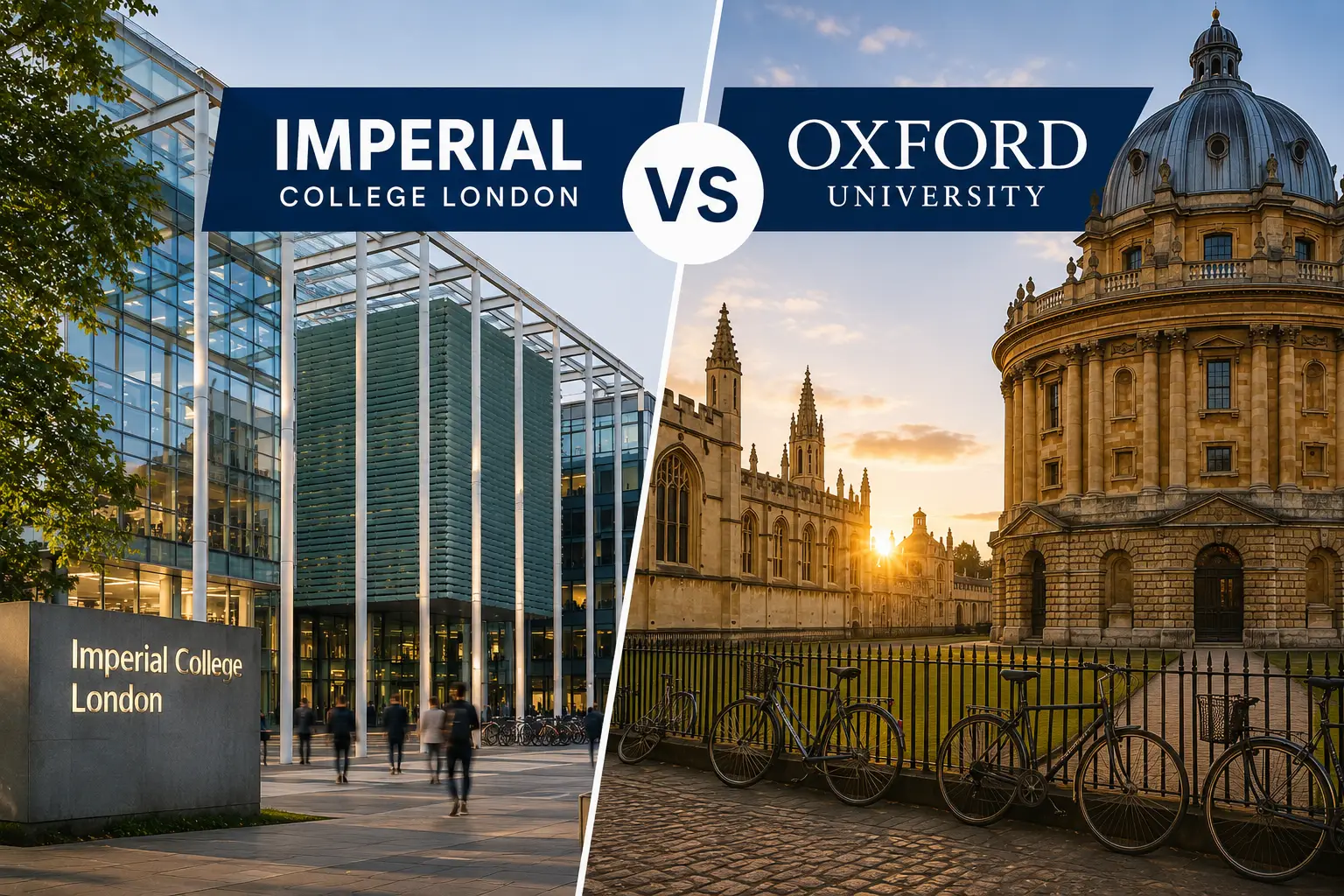

Imperial vs Oxford is the comparison families bring up most often when their child is targeting engineering, the physical sciences, or medicine. Both universities sit in the global top ten. However, the experience of studying at each is fundamentally different. Oxford is a full multidisciplinary university with the centuries-old tutorial system, college community, and broad academic culture spanning arts, humanities, sciences, and medicine. In contrast, Imperial is a STEM-focused specialist institution in central London with larger lectures, group projects, and extensive industrial links. Therefore, choosing Imperial vs Oxford depends on how your child wants to learn, not which name carries more weight.
This guide compares Imperial vs Oxford across the courses where they genuinely overlap. Specifically, we cover Engineering, Mathematics, Physics, Medicine, and Computer Science. Whether your child is targeting research-track science, a London-based engineering education, or a traditional Oxford undergraduate experience, the comparison below should help.
What actually separates Imperial and Oxford
Oxford offers tutorials of one to three students plus the collegiate system. Imperial offers lectures, tutorials of around ten students, and group projects with strong industry links. Oxford always interviews; Imperial interviews only for selected courses.
Choosing Imperial vs Oxford?
Our Oxford and Cambridge-educated consultants support families across both applications: admissions tests, personal statements, and Oxford interview preparation.
Imperial vs Oxford for Engineering
Engineering is the most common comparison families weigh up between Imperial and Oxford. Notably, both universities offer four-year MEng programmes leading to Chartered Engineer accreditation. However, the structure differs significantly. Therefore, the right choice depends on whether your child wants broad foundational engineering or focused specialism from Year 1.
Oxford Engineering Science
Oxford Engineering Science is a four-year MEng programme. The standard offer is A*A*A at A Level with A* in Mathematics and Physics. Specifically, the first two years cover general engineering across mechanical, electrical, civil, chemical, and information disciplines. Specialisation across areas including biomedical, chemical, civil, electrical, information, and mechanical engineering begins from Year 3. Importantly, from 2027 entry, applicants sit the ESAT (Engineering and Science Admissions Test) in the October sitting. The ESAT replaces the previous Physics Aptitude Test (PAT) for engineering applicants. Oxford always interviews shortlisted candidates with typically two college-based interviews.
Imperial Engineering departments
Imperial admits students directly into a specific engineering department from Year 1. Specifically, applicants apply for Mechanical Engineering, Aeronautical Engineering, Chemical Engineering, Civil Engineering, Electrical and Electronic Engineering, Bioengineering, Earth Science and Engineering, Computing, or Materials. The standard offer is typically A*A*A at A Level with A* in Mathematics or Physics depending on the course. Furthermore, all Imperial Engineering applicants sit the ESAT, with most courses requiring the October sitting if also applying to Cambridge. Notably, most Imperial Engineering departments do not interview, though some Business School courses such as Economics, Finance and Data Science do.
Which structure suits your child?
Oxford’s broad first two years suit students who want exposure across engineering disciplines before specialising. The tutorial system gives every student close engagement with academic engineers through weekly small-group teaching. In contrast, Imperial suits students who already know their engineering specialism and want to dive in immediately. For example, a student passionate about aircraft and aerodynamics gains four years of focused aeronautical study at Imperial. Furthermore, Imperial’s London location creates extensive industry exposure during term time, including internships, visiting lecturers, and industrial design projects.
Need help choosing Imperial vs Oxford?
Tell us your child’s course, predicted grades, and target. We will help you weigh both applications realistically.
Imperial vs Oxford for Mathematics
Both universities have world-class mathematics departments. However, the teaching style and curriculum focus differ significantly. Therefore, the right choice depends on your child’s learning preferences and academic interests.
Oxford Mathematics
Oxford Mathematics is a three-year BA or four-year MMath programme. The standard offer is A*A*A at A Level with A* in Mathematics and Further Mathematics where offered. Specifically, applicants sit the MAT (Mathematics Admissions Test) for 2026 entry. From 2027 entry, Oxford has confirmed it will adopt the TMUA. Importantly, every shortlisted applicant attends college-based interviews, typically with mathematical problem-solving challenges set live during the interview. As a result, Oxford Maths interviews are widely considered among the most demanding in UK undergraduate admissions.
Imperial Mathematics
Imperial Mathematics is a three-year BSc or four-year MSci programme. The standard offer is A*A*A at A Level with A* in Mathematics and Further Mathematics where offered. Specifically, the TMUA is mandatory for all Imperial Maths applicants. Furthermore, Imperial Mathematics has joint honours options including Mathematics with Computing, Mathematics with Statistics, and Mathematics with Applied Mathematics. Imperial does not interview Mathematics applicants. As a result, the TMUA score and personal statement carry significant weight in the selection process.
Imperial vs Oxford for Physics
Physics is another area where Imperial and Oxford both rank in the global top ten. However, the courses approach physics in different ways. Oxford Physics is a three-year BA or four-year MPhys with strong emphasis on theoretical and mathematical foundations. In contrast, Imperial Physics is heavily experimental with extensive laboratory work alongside theoretical training.
Course structure and entry requirements
Oxford Physics requires A*A*A at A Level with A* in Mathematics and Physics. Specifically, applicants sit the PAT (Physics Aptitude Test) for 2026 entry. Importantly, from 2027 entry Oxford has replaced the PAT with the ESAT for Physics and Physics & Philosophy applicants. Oxford always interviews shortlisted candidates with college-based interviews focused on physics problem-solving and conceptual understanding.
Imperial Physics offers a three-year BSc or four-year MSci with the standard offer of A*A*A at A Level including Mathematics and Physics. Notably, Imperial Physics does not require an admissions test for most pathways, though this varies by year and course variant. Furthermore, the Imperial Physics department has extensive research links across condensed matter, theoretical physics, particle physics, and quantum technologies. As a result, students with clear research interests often find Imperial’s research-led teaching style particularly engaging from Year 2 onwards.
Imperial vs Oxford for Medicine
Both Imperial and Oxford run six-year medical degrees that lead to qualifying as a doctor. However, the structures differ. Therefore, your child’s preferred learning environment matters as much as the grades.
Course structure and entry requirements
Oxford Medicine (BM BCh) is a six-year course split into three pre-clinical years at Oxford and three clinical years primarily at the John Radcliffe Hospital. The standard offer is A*AA at A Level with A* in Chemistry and either Biology, Physics, or Mathematics. Specifically, applicants sit the UCAT. Importantly, Oxford always interviews shortlisted candidates with two college-based interviews. Furthermore, from 2027 entry, Oxford has introduced the ESAT for Biomedical Sciences applicants but Medicine continues to use the UCAT alone.
Imperial Medicine (MBBS BSc) is a six-year integrated course based at the South Kensington campus and partner hospitals. The standard offer is A*AA at A Level with A* in Chemistry and A in Biology. Specifically, all applicants sit the UCAT. Imperial interviews shortlisted candidates using Multiple Mini Interviews (MMI), a format that differs significantly from Oxford’s traditional panel interview. As a result, the application experience varies considerably between the two routes. Furthermore, Imperial’s London location creates extensive clinical exposure across major teaching hospitals from early in the course.
Imperial vs Oxford for Computer Science
Computer Science at Imperial and Oxford is among the most competitive comparisons in UK undergraduate admissions. Both produce graduates who feed strongly into top technology firms, quantitative finance, and postgraduate research. However, the courses differ in scope and structure.
Course structure and entry requirements
Oxford Computer Science is a three-year BA or four-year MCompSci. The standard offer is A*AA at A Level with A* in Mathematics. Specifically, applicants sit the MAT for 2026 entry. Importantly, Oxford always interviews shortlisted candidates with two interviews focused on mathematical and logical reasoning. Notably, Oxford CS is one of the most selective courses in the UK, with offer rates often below 10 percent.
Imperial Computing offers a four-year MEng with several variant programmes including Computing with Management and Finance, Computing with Mathematics, and Software Engineering. The standard offer is A*A*A at A Level with A* in Mathematics. Specifically, applicants sit the TMUA. Furthermore, some Imperial Computing variants conduct interviews, while others rely entirely on grades, TMUA, and personal statement. As a result, your child should check the specific Imperial Computing variant before assuming the application process.
Imperial vs Oxford: how do you actually decide?
The answer turns on three practical questions about your child’s preferences and goals. Both universities produce world-class graduates, and the differences in academic outcomes are minimal. Therefore, the right choice usually comes down to fit, not prestige.
Tutorial system vs lecture-based teaching
Oxford’s tutorial system is unique. Specifically, every student attends weekly tutorials with one or two other students and an academic, focused on essays or problem sets prepared the previous week. This format demands real preparation and rewards intellectual engagement. In contrast, Imperial teaches through lectures, tutorials in groups of around eight to ten students, and extensive laboratory or project work. Furthermore, the collegiate system at Oxford creates a small-community feel within a larger university. Imperial has no equivalent structure, though departments often feel close-knit due to shared facilities and projects.
Interview comfort
Oxford always interviews shortlisted applicants for every course. In contrast, Imperial interviews only for selected programmes such as Medicine, Economics, Finance and Data Science, and some Computing variants. Specifically, Oxford interviews are intensive academic discussions designed to mimic the tutorial format. As a result, students who excel at thinking aloud under pressure often shine at Oxford interviews. Furthermore, students who interview poorly may find Imperial’s lower interview burden more comfortable for most engineering and science courses.
Location and academic culture
Oxford is a small university town built around the academic year. The pace is intense within the 8-week terms, then everything slows in vacations. In contrast, Imperial sits in central London with the South Kensington campus minutes from museums, the financial district, and major technology firms. Specifically, students who want internships during term, regular access to the City, or significant social life outside the university often prefer Imperial. Oxford offers a more contained academic experience with fewer outside distractions. Therefore, the lifestyle preference often matters as much as the academic differences.
When should your child start preparing for Imperial or Oxford?
The earlier your child commits to the application, the smoother Year 13 becomes. In general, most families benefit from starting in Year 12. Specifically, the right moment is once your child has chosen the course they want to read and has seen the first set of teacher feedback at A Level. A consultant at this stage can run admissions test diagnostics, shape the personal statement, and prepare for the Oxford interview well before the October test sitting.
Year 13 students can still apply successfully to Imperial or Oxford with a focused block of preparation across the summer and autumn term. Indeed, eight to twelve weeks of intensive work covers the admissions test, personal statement, and Oxford interview practice. The key is choosing a consultant who knows both universities and the specific course inside out. Our guides on how to get into Oxford or Cambridge, Imperial vs Cambridge for Engineering, and LSE vs Oxford are useful companions.
Expert Imperial and Oxford admissions support
TARGETED SUPPORT FROM OXFORD AND CAMBRIDGE GRADUATES
Our consultants help families weigh Imperial vs Oxford realistically. We then build the application strategy around your child’s strengths.
Part of our university comparison series
This post is part of a series for parents weighing up the UK’s top universities. Each guide compares two or more institutions directly, written from real admissions experience.
Other guides in the series:
→ Imperial vs Cambridge for Engineering
→ LSE vs Oxford
→ How to Get Into Oxford or Cambridge
→ All Admissions Consulting
Frequently asked questions about Imperial vs Oxford
