

The one-minute version
- A good GCSE grade can drop at A Level, because the course asks for more than the same maths done faster.
- Across our own maths lessons, markers of confusion appear about twice as often around word problems. That is one hidden source of difficulty the corpus reveals, and it is only one of several possible causes.
- Give your child the same skill twice tonight, once as a bare calculation and once inside a sentence. Which one breaks tells you where to look first.
- Foundations, method choice and multi-step working are other possible causes, and each needs different work.
- Our UK-based tutors teach the exact board your child sits, online, at times that fit the Singapore school day.
Your child did well at GCSE, but the A Level Maths grade has dropped
Your child earned a strong maths grade at GCSE, chose A Level Maths with confidence, and the first assessments have come back lower than anyone expected. The work is still going in. So it is often the point where a parent starts looking for an A Level Maths tutor in Singapore, whether their child is at Tanglin Trust School, Dulwich College Singapore, UWCSEA or elsewhere in Singapore.
Here is the first thing to hold on to. A dropped grade does not mean the GCSE result was false, and it does not mean your child cannot do A Level Maths. The course changes shape at the step up, and finding which part of the change is causing trouble matters more than more practice.
Your child can do the maths until the question is worded differently
One change is easy to miss. At A Level, your child often has to decide which method a question requires, and wording and context can make that decision harder, even when the underlying maths is familiar. The skill has not changed, but the way in has.
Our own lesson data puts a number on this. Across Greenhill’s maths lesson corpus, markers of confusion appear about twice as often around word problems: 6.8 per 1,000 exchanges, compared with 3.4 elsewhere in the maths lessons. That is one hidden source of difficulty the corpus reveals. It cannot explain why any one student’s grade dropped, and it is not the whole story of the step up, but it names a gap that often goes unnoticed: the translation from words to maths is a skill of its own.
Can your child solve the maths before it is put into words?
You can test this at home in ten minutes. Choose one skill your child was solid on at GCSE. Give them a bare version first, just the calculation. Then give them the same skill wrapped in an A Level-style sentence, and watch what happens.
Set up the two-question test tonight
Outcome one
Both versions go fine. The wording is probably not the problem. Look at method choice and multi-step working instead.
Outcome two
The bare version works, the worded one breaks. Here the translation may be the gap, because the maths is there and the way in is not.
Outcome three
Both versions struggle. The foundation itself may need attention before either version will come right.
Each outcome points to different work, and any of them can sit behind the same dropped grade.
Our tutors teach the translation directly when the check points there. Murray, one of the A Level Maths tutors below, put the habit like this:
How an A Level Maths tutor puts it
“Okay, so let’s go chronologically through the sentences, and let’s make sure that what we’re writing down, how we translate these words into algebra, is completely correct.
”
Murray, A Level Maths tutor
It is the habit he builds for word problems: turn the sentences into algebra one line at a time, and check each line is right before moving on.
Run the two-question test this week
Try the bare-then-worded pair on one skill this week, and keep both attempts. Which version broke, and how, gives a tutor a concrete place to start, and it saves the first lesson from guesswork.
Worded A Level Maths questions may not be the only problem
The two-question test checks one possible cause, and it is worth being clear about the rest. Some students carry an unnoticed foundation gap out of GCSE, and A Level puts weight on it. Some know the methods they have practised but struggle to choose which one a new question requires. Others can begin familiar questions but lose marks across longer, multi-step problems, where one early slip travels through the lines that follow.
Each of those needs different work, which is why the first job is telling them apart rather than buying more practice papers. Practice aimed at the wrong cause rehearses the problem instead of fixing it.
Three different problems can cause the same A Level Maths grade drop
Aiden’s name is invented and his story blends several students we have taught. So do Priya’s and Wen’s below. The teaching approach in each story is real.
Aiden could not choose where to start
Aiden could use the techniques he had practised but struggled to choose one in an unfamiliar question. His tutor made method choice a separate first step: read the question, name the topic it belongs to, and name the tool it is asking for, before touching the algebra. Choosing became a routine he could follow, and starting began to feel less like the hardest part.
Priya knew the method the wording was hiding
Priya could differentiate a curve confidently, but she did not always recognise the same method inside a tangent-and-normal question. Her tutor worked through the wording with her the way Murray describes, sentence by sentence into algebra, and questions in that clothing began to look familiar.
Wen lost marks across the longer problems
Wen handled single-step questions cleanly and dropped marks on the six-mark problems, where a small early slip carried through the later lines. His tutor used written steps to show where each method mark came from and where an early error affected the working that followed. The habit felt slow at first, and the marks in longer problems depend on it.
Did your child solve the bare maths question but struggle with the worded one?
An A Level Maths tutor can review both attempts from the two-question test and help identify whether translation, foundations, method choice or working habits should come first. Tell us which board your child sits.
Book a LessonWill an A Level Maths tutor in Singapore help if my child did well at GCSE?
Yes, and a strong GCSE is a good starting point rather than a reason to wait. The tutor’s first job is the one this page describes: finding which part of the step up is causing trouble, because the work needed for a translation gap is different from the work needed for a foundation gap or a working habit.
So the first lesson usually starts with a recent paper or test. The tutor watches how your child reads a question, chooses a method and builds the working, then agrees a focused plan with your child, so everyone knows what the coming lessons will cover and why.
Our tutors teach the exact board your child’s school uses, including the international specifications common in Singapore. You receive a written report after every lesson, and follow-up practice is added to the shared board. Homework reminders are sent by email.
Inside a lesson
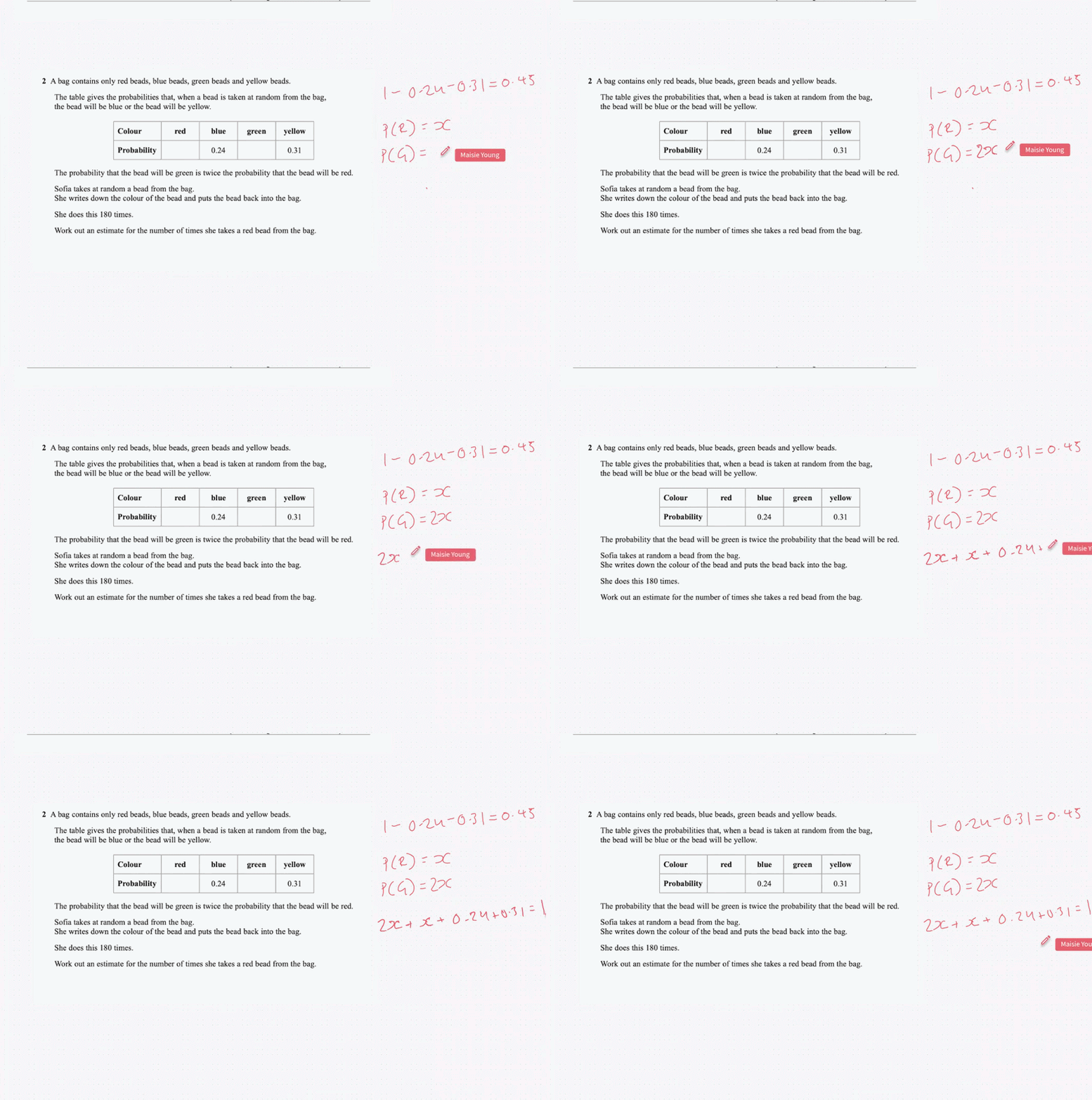
This clip is from a real Greenhill Academics maths lesson, recorded live on the same shared board your child would use, with the question and the working side by side.
Meet the A Level Maths tutors
UK-based A Level Maths tutors, teaching online across Singapore

Karol · Natural Sciences, Cambridge
Karol read Natural Sciences at Cambridge and is completing a PGCE in Science there. He teaches A Level Maths and Further Maths alongside Chemistry, and can support students who need to revisit foundations before moving on.

Liza · Mathematics and Philosophy, Yale
Liza read Mathematics and Philosophy at Yale and later took a master’s at the LSE as a Chevening Scholar, and teaches Maths from secondary to university level, helping students work out what a question is asking before the algebra begins.
Murray · Materials Science, Oxford
Murray is in the final year of an MEng at Trinity College, Oxford, after A*s in Maths, Chemistry and Physics. He teaches A Level Maths, Chemistry and Physics, and his teaching includes translating words into algebra and checking each line before moving on.
What Singapore parents ask about A Level Maths
How do I find a good A Level Maths tutor in Singapore?
Look for a tutor who teaches your child’s exact exam board and who works from your child’s own papers rather than generic worksheets. At Greenhill Academics we match each student with a specialist and teach online, which works well for families in Singapore.
My child got a top grade at GCSE. Why are they struggling now?
The step up changes the course’s shape: more method choice, more context around the questions, and longer multi-step problems. A strong GCSE shows your child has learned much of the foundation, but it does not rule out a specific gap, and the new demands are skills in their own right, which can be taught directly.
Which exam boards do you cover?
Our tutors teach the UK and international A Level specifications used by schools in Singapore. Tell us which board your child’s school follows and we will match them with a tutor who teaches that exact specification and its past papers.
Are your A Level Maths tutors based in Singapore?
No. Our tutors are based in the UK and teach online, so your child learns from a specialist while staying at home in Singapore. Lessons can be arranged around the Singapore school day.
Can you also help with Further Maths?
Yes. Several of our tutors teach A Level Further Maths alongside Maths, including at the same lesson where that helps. Tell us what your child studies and we will match them with a tutor who covers both.
Find out why your child’s A Level Maths grade dropped
Share a recent paper, or what happened in the two-question test, and tell us your child’s exam board. We will match them with an A Level Maths tutor who can identify the cause and start there.
Book a Lesson