

The short version
- LSE does not interview undergraduate applicants, so the personal statement matters.
- Students now answer three questions within a 4,000-character limit.
- Strong answers show what the student has done to explore the subject.
- The best statements are developed over the summer, not rushed before the January 2027 deadline.
The boys at a top London school had all A* predictions. LSE still said no
Several boys from the same year group at a top London private school applied to LSE, all predicted A* across their A Levels. They did not get offers. The difference was the personal statement.
It breaks the rule most families trust: good grades open doors. At the most competitive courses, nearly every applicant arrives with good grades. The grades get your child considered, but they do not separate them from the thousands of applicants with the same results. The statement is what separates them.
Every student is judged through the same UCAS form. That form has recently changed, but much of the advice online is still based on the old personal statement.
LSE has no interviews, so the personal statement is all they see
Oxford and Cambridge interview their applicants, but LSE does not. Their own guidance says it plainly: the School does not interview for places, so the statement is an applicant’s only opportunity to show they are a good fit, and the quality of the statement is very important in their selection.
Your child will not get the chance to explain themselves in person, recover from a weak sentence, or answer a follow up question. Whatever the statement says is all they will ever hear from your child. For a strong student, that can be an advantage. A personal statement can be reviewed, improved and rewritten until every sentence earns its place.
Your child may be following personal statement advice that is now outdated
For 2026 entry onwards, the single UCAS essay was replaced by three questions:
- Why do you want to study this course?
- How have your studies prepared you?
- What have you done outside education to prepare?
Students still have 4,000 characters in total, but their answer is now split across the three sections.
UCAS made the change partly because 83% of students said the old process was stressful, and many were not sure they had covered the right things. The three questions tell your child what to cover. What they do not do is make the answers good. An older sibling’s statement or a school template from a few years ago was written for a different format. Following it too closely can leave your child answering the wrong question.
One mistake has not changed: telling instead of showing. “I have always been passionate about economics” tells LSE very little. Discussing a specific book, entering an essay competition or researching a real question shows where that interest comes from.
One personal statement has to work for five different courses
Many families come to us stuck on the same problem. Your child applies to five courses, and they are rarely identical. One choice might be Economics with Economic History at LSE. Another might be pure Economics at UCL. One statement has to serve all of them, and it goes to every university unchanged.
The fix is to focus on what the courses have in common. The statement should be built around the main subject, with examples that are relevant across the whole application. Every course on the list shares a core subject, so the statement should be anchored in that subject, with evidence chosen so that each admissions reader finds something that fits their course. This needs to be decided before the writing begins. Otherwise, the statement can end up sounding too narrow for some courses and too general for all of them.
What the first session actually does
We will call the student Kerem, a Year 12 student applying for economics courses, including LSE. During a session in July, he and his consultant Kevin opened the three UCAS questions on the shared board and started with the first one.
Kerem already knew the first rule. He said it himself: he was not going to write that he loves economics, because you have to show it instead. So Kevin asked him a different question:
If you had to answer this question, why you want to study this course or field, what would you tell your parents or your friends?
”
Kevin, admissions consultant, Oxford
The answer came out naturally. Kerem talked about why supermarkets put sweets beside the tills, why buffets make some foods easier to reach than others, and how a currency crisis had affected a country his family knows well. These were real examples of his interest in economics, explained in his own words. Those answers became bullet points on the shared board, which would later become the first draft. Kevin told him not to worry about polished sentences yet. The priority was to find the strongest ideas and have a complete draft by the end of the summer.
Two other moments from the session are worth sharing. Kerem wanted to include an impressive event he had attended through his school’s Economics Society. They decided to leave it out because it read as privilege rather than evidence, and the official guidance warns that knowing clever people does not prove you are too. Removing ideas can feel like losing useful material. Then Kevin asked whether he was trying to cover too many topics at once. Kerem laughed and said one hundred percent. In reality, choosing fewer, stronger examples gives the statement more focus and allows the student to explain each one properly.
Kerem is real, and so is every detail above apart from his name.
Year 13 starts, and the personal statement is still not written
Kerem’s aim is to have a full draft ready by 1 September. Once Year 13 begins, schoolwork, predicted grades and university deadlines quickly take over.
A strong personal statement usually takes several hours of focused work and more than one draft. Starting over the summer gives the student time to develop their ideas, receive feedback and improve the writing properly.
For LSE, applications are submitted by the January 2027 deadline. Count backwards from there, through mock exams and predicted grades, and the summer is not early, it is exactly on time.
Students who wait until the first week of Year 13 often have to complete the whole process in a few days. That rush is where many of the most common personal statement mistakes begin.
One thing to try this week
Ask your child to answer the first UCAS question out loud: why do you want to study this course? Do not judge the answer. Just listen to how it begins. If they start with “I have always been passionate about…”, that is the first sentence to change. A stronger answer usually begins with something specific they have read, studied, watched or worked out. That is where a good personal statement starts, and where a consultant would begin with them.
Send us the draft. We will tell you where it stands.
Russell speaks with every family first. Send us your child’s course list and current draft, and we will match a consultant who has written this exact application before.
Book a Profiling CallFrom first ideas to final draft
The process starts with a profiling call. The consultant asks your child about their subject, interests and experiences to find the strongest ideas for the statement.
After the call, you receive a written report explaining what they already have, what is missing and what they should work on next.
The drafting then happens live on a shared online board. They begin with bullet points, organise the structure and then work on the sentences.
Your child writes the statement themselves. The consultant asks questions, challenges vague points and helps them choose examples that support the course application.
You receive a report after every session, so you can see what was covered, what still needs work and how the statement is progressing.
Inside a session
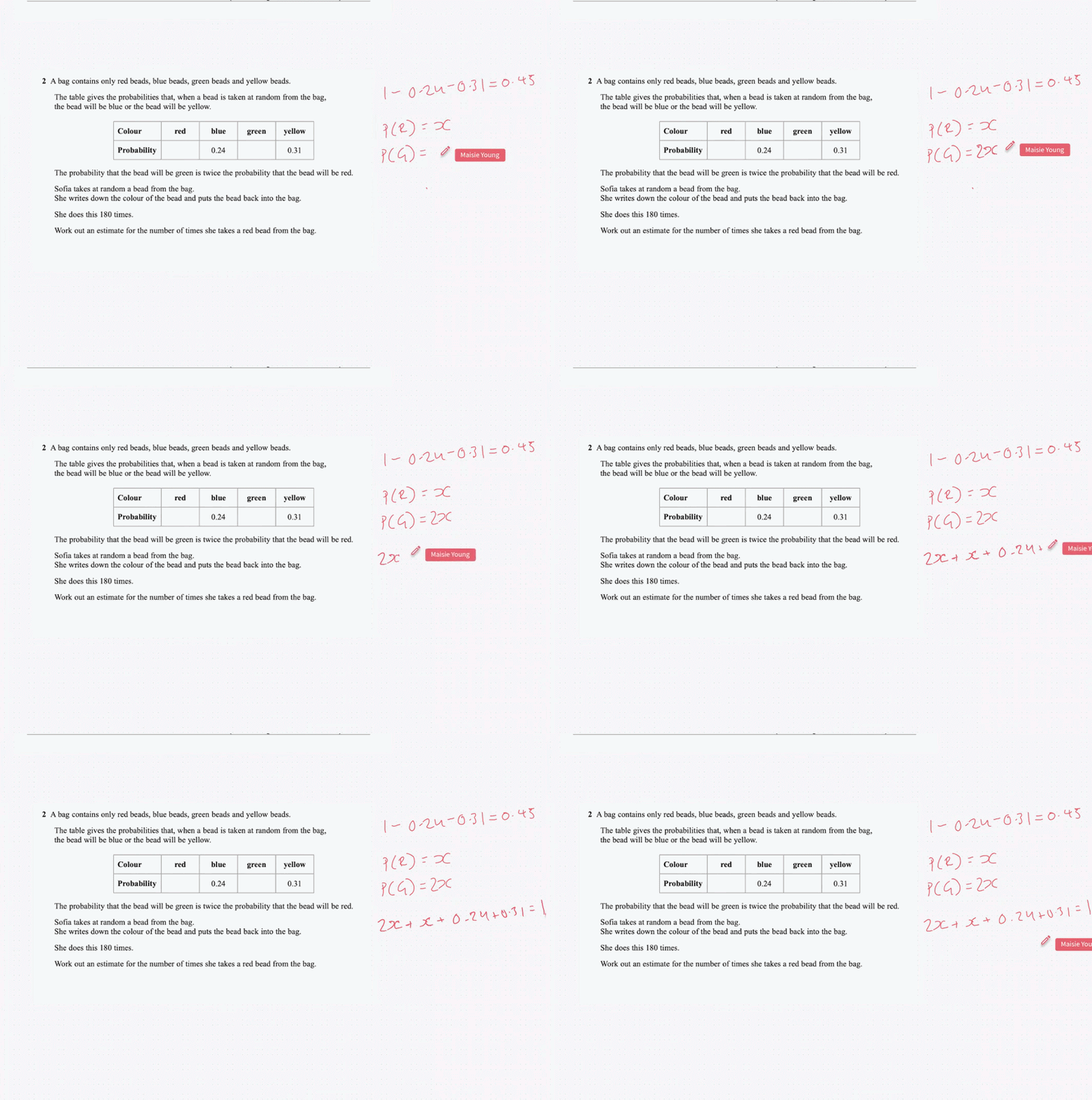
A real Greenhill Academics session on our shared online board. Statement sessions work the same way: the questions go up, and the ideas get written down together.
Meet our personal statement consultants
Consultants who have written winning applications themselves
Kevin · Economics and admissions, Oxford
The consultant in the session above. Holds an MSc in Financial Economics from Oxford with Distinction, and more than ten of his mentees have won places at universities including Oxford and LSE.

Kian · Classics, Oxford
Supports personal statements, entrance tests and interviews across the humanities. A writer himself, he is quick to spot the sentence in a draft that actually sounds like the student.

Naomi · Politics, Philosophy and Economics, Oxford
Read PPE at Oxford, where she won her college’s prize for the best overall student in Philosophy. She supports applicants aiming at politics and economics courses.
Questions parents ask about the personal statement
My child’s grades are excellent. Why would they need help with the statement?
Because at the most competitive courses, excellent grades are normal. Every serious LSE applicant has them, so the statement is where the choice between those applicants gets made. Strong students often find this the hardest part, because nothing at school teaches it.
One statement has to work for five different courses. How does that work?
You write to the overlap. Every course on the list shares a core subject, so the statement is anchored there, and the evidence is chosen so each admissions reader finds something relevant. A consultant maps that overlap with your child before any writing starts.
Do you write the statement for my child?
No. The ideas and the words are your child’s, and universities are good at spotting when they are not. The consultant asks the questions that pull the ideas out, shapes the structure, and challenges every weak sentence, which is the same way a good editor works with a writer.
How many hours does a good statement actually take?
Around five to ten hours of working time with a consultant, across two or three drafts, spread over at least four weeks. The gaps between drafts matter as much as the drafts, because your child keeps thinking between sessions.
When should we start?
The summer before Year 13 is the right time, with a full draft ready by early September. LSE applications go in by the January 2027 deadline, and a statement always reads better after it has been rewritten twice with time to rest in between.
Help your child write a statement that earns the offer
Tell us the course list and the deadline you are working to, and we will match an admissions consultant who can start this week.
Book a Profiling Call