

TL;DR
- Your child may understand the topic but still lose marks because their explanation is too vague or incomplete.
- These marks often disappear one or two at a time across short written questions.
- A five-minute check at home can show whether your child can explain an answer clearly.
- More revision will not help if the real problem is how the answer is written.
The effort is there, but the grades say otherwise
Your child is already putting in the effort. They revise in the evenings, work through past papers at weekends and make notes, but the marks are still not improving.
When you look through the paper, there may not be one obvious weak topic. The calculations may be correct, but marks are still lost on questions that ask your child to explain, describe or justify an answer.
Your child may say, “I knew that.”
They may be right. But in A Level Physics, knowing the answer is not enough. They also need to explain it clearly and include every point the examiner is looking for.
That is a different skill. If this is where the marks are being lost, more revision alone will not solve the problem.
Incomplete answers are costing them marks
A Level Physics is not only about getting the calculation right. Many questions ask students to explain, describe or justify their answer, and the marks depend on what they actually write down.
An examiner can only award marks for the points included in the answer. They cannot give credit for something the student understood but did not state clearly.
This is why a student can know the physics and still lose marks. If an important step, reason or conclusion is missing, the examiner cannot fill it in for them.
One of our physics tutors, Hugh, explained this to a student during a recent session:
Examiners cannot give you points for implied understanding, only for explicit understanding.
”
Hugh, A Level Physics tutor, Oxford
Hugh advised the student not to assume that any part of the answer was clear without saying it.
Students who understand a topic well often leave out important steps because the connection feels obvious to them. They write part of the explanation and assume the examiner will understand the rest.
A teacher in class may recognise what the student means and ask them to finish the point. An examiner can only mark what has been written.
This is not about intelligence or the school a student attends. It is a habit of writing incomplete answers, and it can be changed with practice.
Three questions from one session show the same problem
Here is what this looks like in practice. We will call the student Joel, a Year 12 student working through a past paper with Hugh during a Saturday session. Three questions from that session show the pattern clearly.
Question one · the dripping tap
The question: water drips from a tap at a constant rate. Explain how you can tell the droplets are accelerating.
Joel wrote: the gaps between the droplets get bigger as they fall.
What the full answer needs: the gaps get bigger while the time between drops stays the same. That second half is the proof. Joel got away with it because the question was only worth one mark. On a two mark version, half the idea would only get half the marks.
Question two · the trolley on the truck
The question: a truck accelerates and a trolley on its flatbed stays where it is. Explain this using one of Newton’s laws. Two marks.
Joel’s first answer described the situation correctly, with no resultant force on the trolley, but never named the law. One mark. His second try named Newton’s second law, but dropped the situation. One mark again.
Two marks means two jobs: name the law, and say why it applies here. Joel understood the physics on the first try. But the examiner could only give him half the marks, twice, because each answer only did one of the two jobs.
The same gap, heard out loud
Question three · say it out loud
The task: Hugh asked Joel to explain the photoelectric effect as if Hugh had never studied physics.
What happened: Joel had revised the topic all week and every fact was there, all four key observations. But the explanation came out as a pile of facts in no clear order. Hugh’s fix was simple. Find the one sentence the whole idea rests on, say that first, then add the details one at a time.
Why it matters: a six mark explain question is marked the same way. If the facts come out in no clear order, the answer scores badly, even when every fact is right.
More revision will not fix an incomplete answer
The revision was not wasted. It helped your child understand the physics.
But reading the notes again will not fix an incomplete written answer. The problem is not always missing knowledge. It may be that your child is leaving out an important step, reason or conclusion.
The fix is to practise writing full answers and checking that every part of the question has been answered.
Exam data backs this up. 44,957 students sat A Level Physics in summer 2025, and 31.9% of entries were awarded an A* or A. Two in three physics students finish below an A, and in our experience a good share of them understand more physics than their grade shows. For those students the writing is what lets them down, and writing can be taught. Our guide on how to get an A in A Level Physics covers what the top grades ask for across the whole course.
Try this at dinner tonight
You do not need to mark the answer or know any physics. Just listen.
Your one move this week
At dinner, ask your child to explain one physics topic they have revised as if you had never studied it. Can they explain it clearly, one step at a time? Or do they list the right facts without showing how they connect? You will usually hear the difference within a few minutes. This is also what our tutors listen for in a first physics session.
Did the explanation come out as a list of facts? That is the gap.
Russell speaks with every family first. Tell us what your child struggled to explain and what they scored in their last mock, and we will match an Oxford or Cambridge physics tutor who trains exactly this.
Book a LessonThe September mock sets the predicted grades
For many Year 13 students the September mock is not a practice run. It is the exam that sets the predicted grades that go on the UCAS form, which means the universities your child can apply to are being decided before autumn half term. That is true at fee paying schools like Charterhouse and Brighton College, and at state sixth forms, and parents are often told it late, or not at all.
The good news is that a writing habit changes much faster than a knowledge gap. There is no new content to learn. In weekly sessions over the summer, your child can practise turning half answers into full ones on real past paper questions, and that usually shows in the first mock. If your child also needs a higher grade in that mock, our piece on going from a predicted B to an A shows what that looks like from the first session on.
What the first session checks for
The first session is not a lecture and it is not a run through the topics. Your child and the tutor work through real exam questions on a shared online board, and the tutor listens the way you did at dinner. Where does the explanation skip a step? Which half of the two mark answer keeps going missing? Then they fix answers together, line by line, until your child can see what a full answer looks like and write one on their own.
The feedback is honest and direct. Hugh tells his students that if he is not criticising them, he is not doing his job. He means it kindly, because finding the problems is what the sessions are for. The same student heard this from him in the same session: “This is what I specialise in, exam technique. So I’ve got you.”
You get a full written report after every session, homework reminders by email, and a WhatsApp group where sessions are booked and work is shared, so you always know what each session covered and whether it is working.
Inside a session
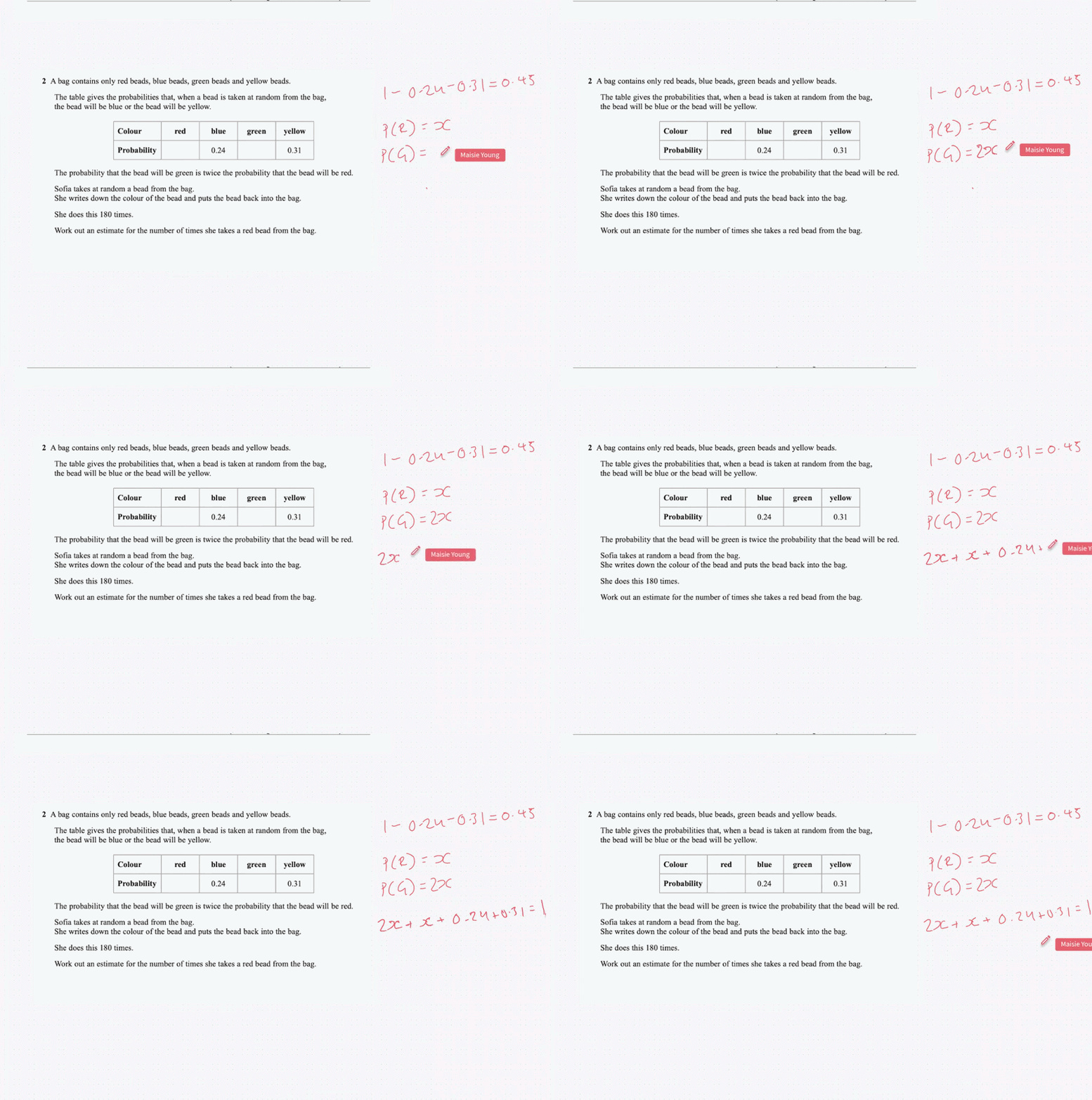
A real Greenhill Academics session, recorded live on our online board: tutor and student thinking on the same page at the same time.
The tutors your child would work with
Who teaches exam writing, not just physics
Hugh · Maths and Physics, Oxford
He taught the session above and specialises in exam technique. More than 20 of his recent students exceeded their predicted grades or won places at leading universities.

Jasper · Maths, Physics and Computer Science, Cambridge
Took the top possible grade in Physics at St Paul’s School before Computer Science at Cambridge. Calm and structured, he breaks long answers into steps a student can repeat on their own.

Liza · Maths and Physics, Yale
Nearly a decade of tutoring across the UK and US, with years of experience supporting students with ADHD and learning differences. Builds answers from the logic up, so they hold under exam questioning.
What A Level Physics parents want to know
My child revises for hours. How can the problem not be the physics?
Because revision builds knowledge, and these marks are being lost in the writing, not the knowledge. You can see it in the paper itself: if the lost marks sit on short explain questions rather than whole topics, the physics is there and the writing is the gap. The dinner table test above will usually confirm it in minutes.
Their teacher says they are doing fine in class. Why do the marks not show it?
Class rewards implied understanding. A teacher hears a half answer, sees the thinking behind it, and moves on. An examiner is not allowed to do that, so the same answer scores well in class and badly in the exam. That difference is exactly what we teach.
The September mock sets the predicted grades. Is there enough time?
Usually, yes. A writing habit changes faster than a knowledge gap because nothing new has to be learned. Weekly sessions over the summer, all on real past paper questions, tend to show in the first mock. The later the work starts, the more it competes with everything else in the autumn.
Questions about how the tutoring works
How will I know the sessions are actually working?
You get a full written report after every session, so you know what was covered and what improved. Homework arrives with email reminders, and the WhatsApp group keeps booking and progress in one place you can see. Improvement shows first in homework answers, then in the next mock.
Will it be the same tutor all the way to the exam?
Yes, that is the point of matching carefully at the start. Your child works with one tutor who learns exactly how they think and write, through to the exam. If the fit is not right after the trial session, we change the tutor, not the plan.
Help your child write answers that earn the marks
Tell us the exam board and what the last paper looked like, and we will match a physics tutor who can start this week.
Book a Lesson