

Summary of this blog
- Forgetting the formula may not be the real problem.
- Your child may know the Science but not know how to start the question.
- Give them one question with the formula printed at the top.
- If they are still stuck, they need help applying the formula, not memorising it.
- Fix the method first, then work on recall.
They can do the homework, then leave the exam question blank
Your child reaches a question in a practice paper and says the sentence every parent has heard: “I can’t remember the formula.” The pen stops and the marks are lost before they have even tried the question.
The usual response is to revise the formulas again. You buy flashcards, print a formula sheet and ask them to learn the list. Then the same thing happens in the next paper.
That may be because the formula was never the main problem. Schoolwork often gives students more clues about which method to use. In an exam, they have to recognise the type of question, choose the right information and decide how to begin. Your child may know the Science but still be unable to find that first step. Until that is fixed, learning the formulas again may not change the result.
Same science, two different games
School homework
The formula was taught that week, so it is still fresh, and the question also makes it clear which method to use.
The 13+ Science paper
Topics are mixed together. Your child has to recognise what the question is testing, recall the right formula and work out how to use it.
That difference is often why they can complete the homework but get stuck in the exam.
Is it the formula, or do they not know how to start?
There are two reasons your child may get stuck, and each needs a different solution. If they cannot remember the formula, they need a short, regular recall routine. If they remember the formula but do not know how to start, they need to learn how to recognise what the question is asking and choose the right method. Repeating flashcards will not fix that. Do not guess which problem they have. Test it.
Choose one question from a past paper, write the formula at the top of the page and give both to your child. Then watch how they approach the question rather than counting the score.
The five minute check 🔍 one question · formula printed at the top
Still stuck
Remembering the formula is not the problem. Your child needs help recognising how to start the question and which operation to use. Leave the flashcards aside for now and work on the method below.
Solves it
Recall is probably the gap. A few minutes of regular formula practice can help rebuild it.
Five minutes now can stop your child spending weeks practising the wrong thing.
They know the topic but cannot start the question
Try this when your child knows the topic but cannot remember the formula.
A gravitational field exerts a force of 10 newtons on every kilogram. An object has a mass of 5 kilograms. What force acts on it?
Your child may not remember the formula, but the question still gives them two useful clues:
- newtons per kilogram
- kilograms
Say the units aloud: Newtons per kilogram multiplied by kilograms leaves newtons.
The units show that the numbers need to be multiplied: 10 × 5 = 50 newtons
Your child has found the answer without having to recall the formula first.
The units check in three steps
Step 1
Find the units the question gave you. They are printed on the page, so nothing needs to be remembered.
Step 2
Say them out loud. Newtons per kilogram, times kilograms, leaves newtons on its own.
Step 3
Let the units choose the operation. Ten times five then gives fifty newtons.
The formula can go missing under pressure. The units printed in the question can still help your child find a way to begin.
The same first step, taught in a real session
In some questions where you maybe don’t remember the formula, this is called dimensional analysis. It’s to check the units work.
”
Gonzalo, Science tutor, Oxford
Said mid-session during a real 13+ Science session, at the moment a formula went missing.
Hana used to stop as soon as she reached a question that needed a formula she could not remember. Instead of asking her to learn the whole formula list again, her tutor showed her how to use the units in the question to work out where to begin. Within a few weeks, she was attempting questions she would previously have skipped. Hana is not her real name, and her story is drawn from a few students we’ve taught, but she really did get stuck like this and the fix really worked.
Your child can build two smaller habits alongside this. For numerical questions, they should check whether the answer needs a unit, because missing units can cost easy marks. And at the end of every calculation, your child checks whether the number makes sense, because a tiny force on a heavy object should not produce a massive acceleration.
The one question that replaces the formula
When your child gets stuck on Science homework because they cannot remember a formula, do not give it to them straight away. Ask your child what units the question gave them and what unit the answer needs, then stay quiet and let them work it out. It may feel slow at first, but with practice, the units can help them find a way into the question instead of leaving the page blank.
They can answer once the formula is in front of them
Start here if your child could answer the question once the formula was provided. That suggests they understand how to use it but are struggling to remember it.
The fix can be simple: spend five minutes on formula recall most days. Ask your child to say or write the formula from memory rather than reading it repeatedly.
Keep the sessions short and regular. A small routine they can maintain is more useful than a long session they quickly stop doing.
They should still practise using the units in the question. Knowing both methods gives them another way to begin if a formula is difficult to recall in the exam.
They have learnt the formulas but still skip unfamiliar questions
Your child can recite the formula list and still leave an unfamiliar question blank. That is the point at which parents realise that remembering the formula was only half the problem.
The paper expects the other half. Science is one of the three compulsory papers, and Common Entrance at 13+ is used by more than one hundred independent senior schools. The papers test how pupils use their knowledge as well as whether they can recall it, so a child who can work out how to start an unfamiliar question tends to do well. A child sitting St Paul’s at 13+, or the pre-tests used by Eton, Harrow, Winchester and Westminster, often meets the same kind of thinking.
Waiting has a price here, and it builds. Each paper your child sits with only one route into a question can teach them that Science questions are skippable. A question skipped in September is a topic avoided by January, and the fix takes longer the later it starts. Our tutors build the deeper skill by teaching problem solving rather than pattern spotting, one question type at a time.
Find out which gap is holding your child back
Russell speaks with every family first. Tell us what you saw in the five minute check, and we will match an Oxford or Cambridge tutor who has fixed both versions before.
Book a LessonWill tutoring help if the formula isn’t given in the exam?
The units check may help with one type of question. Other questions need their own first step.
A tutor works through the exact papers your child is preparing for and watches what your child does when they first read a question. That shows whether the problem is recalling the formula or choosing the method, because the two can look identical at home. The tutor then teaches a repeatable first step for that question type, so your child always has somewhere to begin.
You receive a written report after every session, so you can see what the tutor found, what still needs work and how your child is progressing.
On the shared board
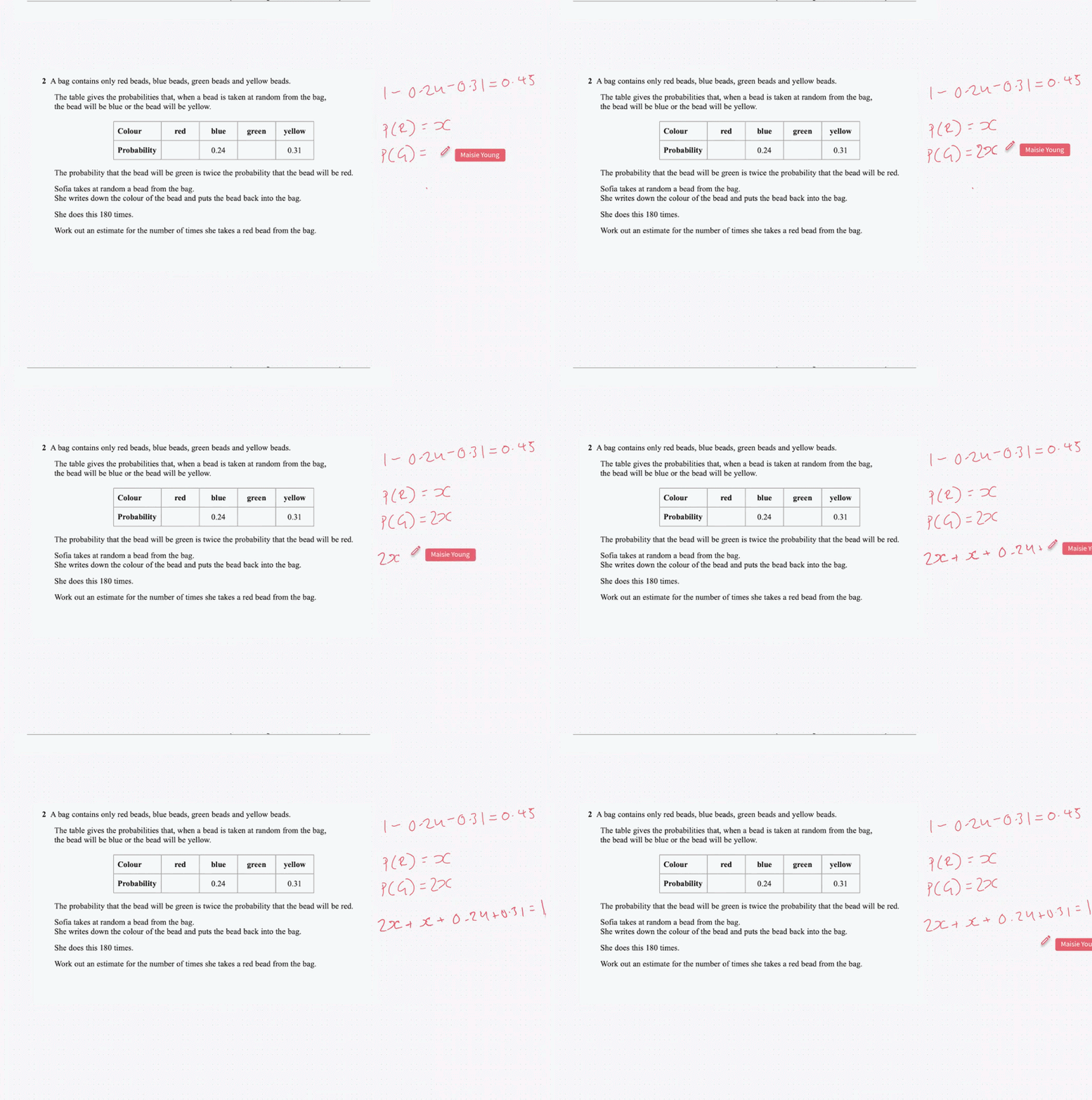
A real Greenhill Academics session, recorded live. The session shown is maths, and a 13+ Science session runs on the same shared board, with the tutor thinking on the page next to your child.
Who would teach your child this way
Matched to the schools you are aiming for
Gonzalo · Science, Oxford
Holds an Oxford First in Chemistry and is starting a Cambridge PhD. The featured line above came from one of his real sessions.

Murray · Chemistry, Physics and Maths, Oxford
Teaches Chemistry and Physics alongside Maths, from KS3 through A Level, with a Silver Cambridge Chemistry Award and a British Physics Olympiad Bronze behind him.

Charlotte · Biology, Chemistry and Physics, Oxford
Teaches all three sciences and builds confidence in reasoning through discussion-based learning, drawing on four years in the Oxbridge tutorial system.
Your questions about the 13+, answered
Should we drill formulas with flashcards?
Drill them only after the check, and only if it pointed at the memory. Flashcards fix recall, but many children who get stuck are not short on recall. They are short on a first step, and drilling does not teach that.
Is the 13+ harder than the 11+?
The 13+ asks for more depth rather than more speed. The papers contain real science and real reasoning, so a child who only pattern-matches usually comes unstuck around now.
When should we start preparing for the 13+?
A year gives you room to build habits rather than cram content. Shorter runs can still work, but then the sessions focus first on the checks that earn the most marks.
Do you prepare for a specific school’s paper?
Yes, we do. Name the schools when you book, and we will match your child with a tutor who knows those papers. Common Entrance and a school’s own scholarship paper ask for different things.
What if my child still goes blank in the real exam?
Going blank usually fades once a child owns a reliable first step. The units check gives them something to do in the first ten seconds of a Science question, and having a first step is what stops the panic.
A forgotten formula does not have to mean a blank answer
Tell us which schools your child is applying to and what happened during the five-minute check. We will match them with a tutor who can work on the exact problem the check revealed.
Book a Lesson