
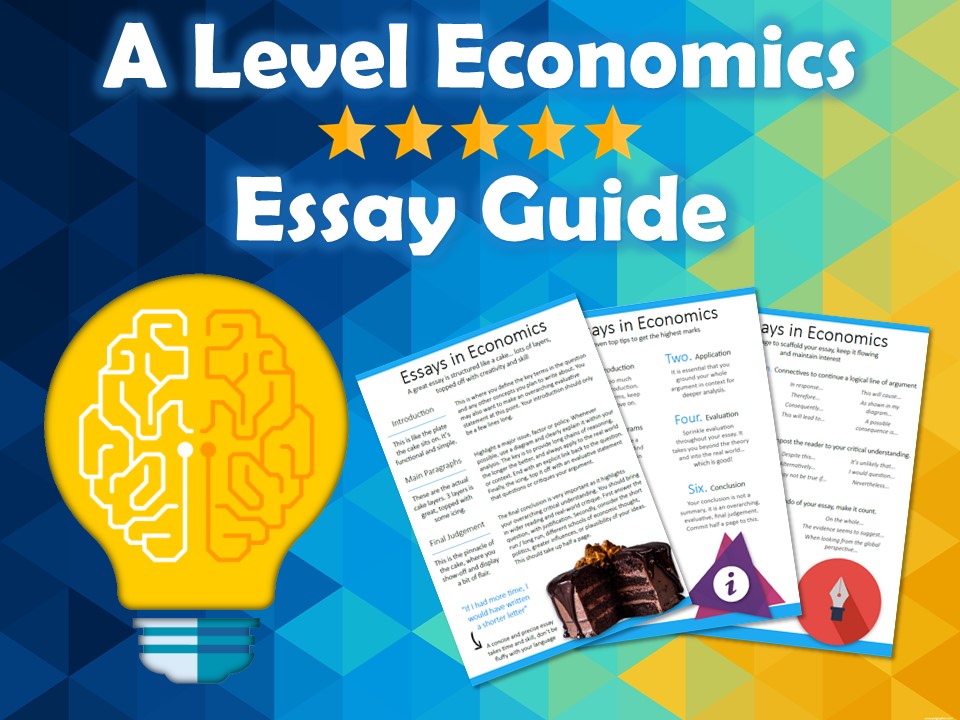

A Level Economics essays reward a specific type of thinking: structured argument, supported by evidence, critically evaluated. Students who write everything they know about a topic rarely score well. Students who select the most relevant points, develop them logically, and evaluate them against counter-arguments consistently reach the top grade bands.
This post covers the essay structure that A Level Economics examiners reward, the evaluation techniques that earn marks in the top band, and the most common mistakes that keep students in the middle grades.
What separates A and A* Economics essays
A-grade essays make points and support them with evidence. A*-grade essays make points, support them with evidence, and evaluate them, considering the conditions under which the point holds, where it does not, and what the net effect is likely to be. Evaluation is not optional at the top end. It is the distinguishing feature.
Want Your Child to Write Better Economics Essays?
Our Economics tutors work with students on structure, evaluation, and the specific habits that push essays into the top grade band.
What does a high-scoring A Level Economics essay structure look like?
The structure that consistently earns marks in A Level Economics essays follows a clear pattern. Start with a focused introduction that defines key terms and signals your argument. Then develop two or three points, each with its own analysis and supporting evidence. Evaluate each point, or include a dedicated evaluation section. Close with a conclusion that directly addresses the question with a supported judgement.
The introduction should be short, two or three sentences at most. Define the key economic terms in the question, identify the main factors you will consider, and signal your overall argument. Do not spend half a page on background context. The examiner wants to see economic thinking, not a description of the scenario.
How to develop a point using the PEEL framework
Each main point in an Economics essay should follow a clear development sequence: make the Point, Explain the mechanism, provide Evidence, and Link back to the question. The explanation is where most marks are available. Specifically, marks come not from stating the point, but from explaining precisely why and how it works using economic concepts, diagrams where relevant, and logical chains of cause and effect.
A weak point says: “Higher interest rates reduce consumer spending.” A developed point says: “Higher interest rates increase the cost of borrowing, reducing disposable income for households with mortgages and discouraging credit-financed consumption. This leads to a fall in aggregate demand, shifting the AD curve leftward and reducing real GDP in the short run.” The second version earns analysis marks. The first earns a knowledge mark at best.
How to use diagrams effectively
Diagrams in A Level Economics essays earn marks only when they are fully labelled, explained in the text, and directly relevant to the point being made. An unlabelled diagram earns no marks. Similarly, a diagram drawn but not referenced in the writing earns no marks. The approach that works is straightforward: draw the diagram, label all axes, curves, and equilibrium points, then explicitly reference it in the text. For example: “As shown in the diagram, the increase in aggregate demand shifts AD from AD1 to AD2, raising the price level from P1 to P2.”
How do you write evaluation that earns top-band marks?
Evaluation is the element that most A Level Economics students underdo. Many students think evaluation means saying “on the other hand” and then restating the opposite point. However, this earns limited marks. True evaluation at the top band means assessing the significance, reliability, or limitations of the point just made. In practice, that means considering the conditions under which it holds, where it might not, and what the overall effect is likely to be in context.
Four evaluation techniques that work in A Level Economics
The first is conditionality. For example: “This effect depends on the price elasticity of demand. If demand is inelastic, the fall in price will reduce total revenue rather than increasing it.” The second is magnitude. For instance: “While unemployment may rise in the short run, the magnitude depends on the size of the fiscal multiplier, which varies with the state of the economy.” The third is time horizon: “In the short run, the policy may reduce inflation. However, over the long run, supply-side effects may dominate.” The fourth is stakeholder perspective: “While consumers benefit from lower prices, domestic producers face reduced revenue and potential job losses.” Any of these, applied directly to the point just made, earns evaluation marks.
How to write a conclusion that earns marks
The conclusion should directly answer the question asked, give a supported overall judgement, and avoid introducing new points. “In conclusion, there are advantages and disadvantages” earns no marks. A stronger conclusion sounds like this: “Overall, the policy is more likely to reduce inflation than GDP growth in the short run, provided the central bank acts credibly and inflation expectations are well anchored. However, the long-run impact depends on how aggregate supply responds to the reduction in demand.” That earns marks at the evaluation level.
What are the most common A Level Economics essay mistakes?
Writing too much rather than developing enough
Writing everything you know rather than selecting the most relevant points is the most consistent source of lost marks. A 25-mark essay with six underdeveloped points scores lower than one with three fully developed, evaluated points. In other words, quality over quantity is not a cliché in Economics essays. It is exactly how the mark scheme is designed.
Not answering the specific question asked
Not answering the specific question is the second most common error. Economics questions are worded carefully. For example, a question asking whether a minimum wage “always” reduces employment is different from one asking whether it “tends to” reduce employment. Students who write a general essay about minimum wages, rather than addressing the specific claim, lose marks in the conclusion and often in the analysis sections too.
Saving evaluation for the final paragraph
Weak or absent evaluation is the third common mistake. Many students save evaluation for the final paragraph. However, the structure that earns more marks is to evaluate each point as you make it, immediately after developing the analysis. This approach demonstrates that your thinking is genuinely evaluative rather than an afterthought.
Stuck in the B range in A Level Economics essays?
A specialist tutor can mark your child’s essays against the mark scheme and identify exactly what needs to change to reach the top band.
Book a LessonWhich tutors can help your child write better Economics essays?

Kevin
Kevin holds an MSc in Financial Economics from Oxford (Distinction, Dean’s List) and a First in Economics from Erasmus University (top 1% of 2,500 students), with a GMAT of 740 (98th percentile). He tutors A Level Economics alongside Maths and Statistics, and builds the structured, analytical approach to essay writing that the A Level mark scheme rewards, clear argument development, precise use of economic concepts, and evaluation that genuinely assesses significance rather than simply restating counter-arguments.

Naomi
Naomi read Politics, Philosophy, and Economics at Oxford (Exeter College), winning the Sir Arthur Benson Memorial Prize. She tutors A Level Economics alongside History and Politics, and brings a precise understanding of how essay arguments need to be structured to earn top marks. Naomi is particularly effective at helping students move from descriptive to analytical writing, the shift that most consistently separates B-grade from A-grade Economics essays.
Expert A Level Economics Tutoring with Greenhill Academics
ESSAY STRUCTURE, EVALUATION, AND EXAM TECHNIQUE FOR A LEVEL ECONOMICS
Our tutors work through past essays with students, mark them against the scheme, and identify the specific structural and evaluative habits that are holding the grade back. Matches made within 48 hours.
Book a LessonFrequently asked questions
