
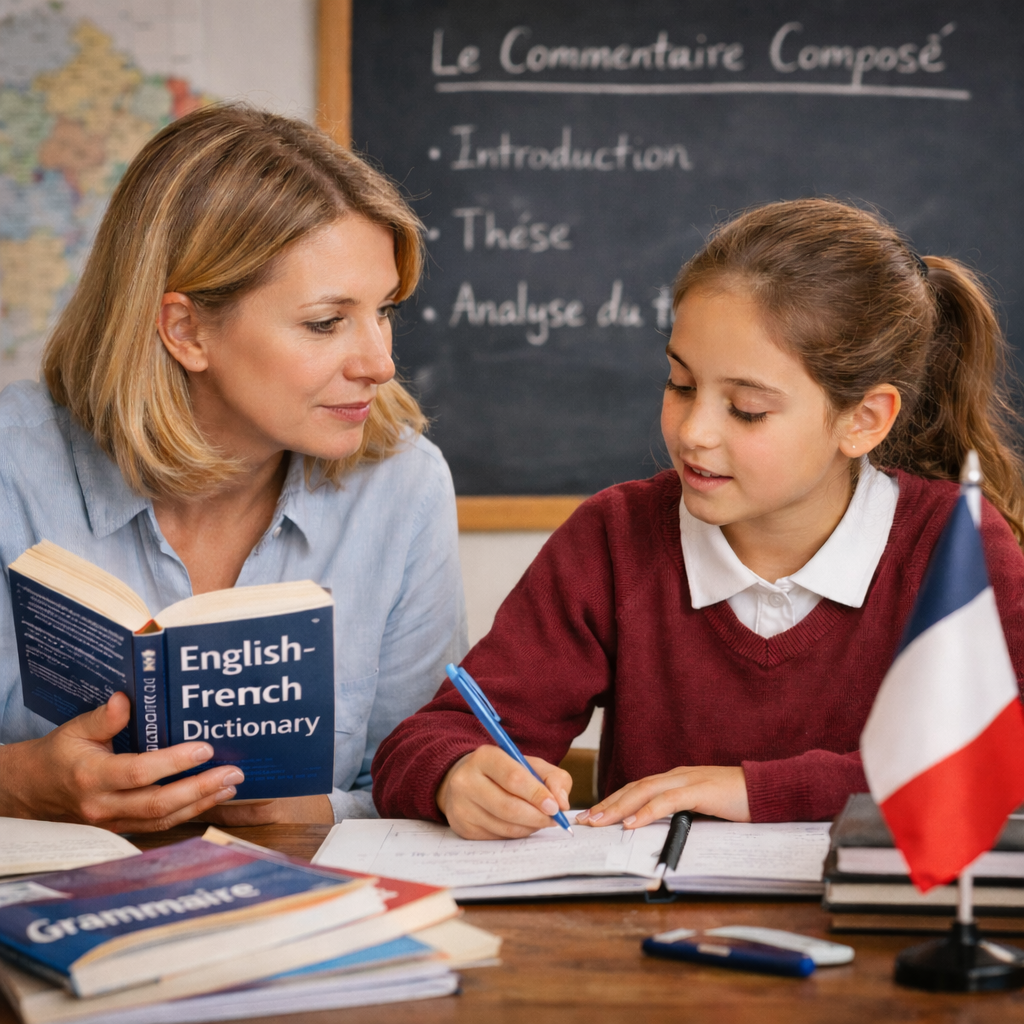

Your child can revise French vocabulary for hours and still come home with a 6. Indeed, that is the part of GCSE French tutoring most parents in the UAE find hardest to make sense of. At Dubai College, GEMS Wellington, Brighton College Dubai, Cranleigh Abu Dhabi, or Repton Dubai, French is not a subject you can simply memorise your way through. It is a system. The tenses look alike, the agreements shift with gender, and a handful of small words decide whether a sentence reads as fluent or clumsy. After all, your child knows the words. The marks still stall, and it is hard to say exactly why. So this guide takes a different route. It follows one real pupil through a full stretch of GCSE French tutoring with a tutor at Greenhill Academics, drawn from our own lesson records, to show what actually moves a grade.
On this page
- A real year of GCSE French, lesson by lesson
- The three skills that lift a French grade
- Why French rewards system over memory
- What the first lesson looks like
- When to bring in a GCSE French tutor
- Exam boards and official resources
- Three French tutors we’d recommend for UAE families
- Questions UAE parents ask about GCSE French
The short version
A top grade in GCSE French rewards keeping the tenses apart under pressure, the discipline of self-checking for agreement slips, and control of the small structural words. Vocabulary alone will not get a child there.
GCSE French tutoring that moves the grade
UK-based Oxbridge tutors for UAE families, teaching every tense and exam skill a top grade needs.
A real year of GCSE French, lesson by lesson
What follows is the genuine path of a GCSE French pupil we worked with at Greenhill Academics. His name and a few details have been changed for privacy, so we will call him Theo. Every struggle and breakthrough below is real, taken straight from our lesson records across many months of work. The arc matters precisely because it is so typical. Theo did not lack effort or vocabulary. He lacked the specific habits that the French exam rewards, and those habits are exactly what a tutor builds. The same pattern applies to most UAE families whose child is stuck a grade or two below where they should be.
The tense that looks like two others
Theo could form the conditional perfectly when asked to do it on its own. Specifically, he knew the endings and could conjugate regular and irregular verbs without hesitation. Then his tutor introduced “Si” clauses, the sentences that hinge on the conditional and the imperfect working together, and the wheels came off. He confused the conditional with the future, then with the imperfect, the moment all three appeared in the same exercise. In fact, this is one of the most common sticking points in GCSE French, and it is invisible in isolated practice. For example, a child can drill each tense alone and look completely secure, then fall apart when the exam asks them to choose between three tenses that rhyme.
So his tutor stopped drilling the tenses separately and started drilling the choice between them. Instead, they worked through translation tasks that forced a decision: is this a future fact, a hypothetical, or a description of the past? Over several sessions Theo learned to read the signal in the sentence rather than reach for the tense he had practised most recently. As a result, by the end he could write a “Si” clause and pick the right tense on purpose. That is a skill no amount of vocabulary revision produces.
Careless slips on grammar he already knew
Meanwhile, the second pattern was more frustrating, because it had nothing to do with knowledge. Theo’s translations kept showing the same small errors: a wrong past participle ending here, an adjective that did not agree with a feminine noun there. However, his tutor knew he understood these rules, because he could explain them on request. The problem was that he did not check. He wrote at speed, trusted his first instinct, and lost marks on points he could have corrected in seconds.
Crucially, the fix was not more grammar. It was a habit. His tutor built a short self-check routine into every written task, so that reviewing his own work became automatic rather than an afterthought. Indeed, when prompted, Theo corrected his own mistakes almost every time, which proved the knowledge was there all along. Therefore, learning to catch those slips without prompting became one of the real goals of his GCSE French tutoring. It is precisely the kind of exam discipline a class of thirty rarely has time to build.
The small words that carry the weight
The third area, however, surprised even Theo. He was strong on verbs and weaker on the small connecting words that hold French together. The difference between à and de, the pronouns y and en, the structure of ne…plus. On the surface these look minor next to a full tense system, yet they are where marks quietly leak away. In practice, a pupil who handles them well sounds fluent. A pupil who guesses at them sounds like a learner, and the examiner notices.
So his tutor worked through targeted exercises on à versus de, then on y and en, until Theo’s intuition matched his knowledge. By the final sessions he was handling these structures in translation and speaking without stopping to think. The grade at the end of the course is between Theo and the exam board. However, the journey is what a tutor makes possible: from stuck at a comfortable but capped level, to handling the full machinery of GCSE French. It is open to any UAE family willing to commit to the weekly work.
If your child is sitting GCSE French in the UAE and the marks are not lifting the way they should, the right tutor can find the gap and close it. Book a free consultation.
The three skills that lift a French grade
Theo’s year points to three skills that separate a capped grade from a top one. Indeed, they recur across most of the GCSE French pupils we have taught, and they are worth naming because school teaching rarely has room to develop all three to depth.
First, keeping the tenses distinct under pressure. Knowing how to form the future, conditional, and imperfect is not the same as choosing correctly between them in a live sentence. Importantly, the exam tests the choice, not the recall. A pupil aiming for a top grade has to read the signal in a sentence and pick the right tense on purpose, especially in “Si” clauses where the tenses sit side by side.
Second, the discipline of self-checking. Most marks lost in GCSE French writing are not lost to ignorance. They go on careless agreement and participle slips on rules the pupil already knows. The fix is a habit of reviewing every written answer for those specific errors. In practice, build the habit and the marks come back without learning a single new rule.
Third, control of the small structural words. The difference between à and de, the pronouns y and en, the negatives beyond ne…pas. These carry far more weight than their size suggests. Specifically, handle them with confidence and a piece of writing reads as fluent. Guess at them and it reads as a learner’s work, which caps the mark.
Build the skills the exam rewards
A specialist tutor drills each of these three areas in turn, until the right choice becomes instinctive.
Why French rewards system over memory
Many subjects reward sheer recall. Typically, you learn the content, reproduce it, and gain the marks. French works on a different logic, which is why a child who revises hard can still feel stuck. Specifically, the vocabulary is the easy part. The marks live in how that vocabulary is assembled: the right tense, the correct agreement, the well-chosen connecting word. Because of this, a pupil can know more French words than ever and still plateau, because the words are not the bottleneck.
This is also precisely why one-to-one tutoring suits French so well. A tutor watches your child actually build a sentence and spots the exact moment the wrong tense slips in or the agreement is missed. In a class, by contrast, that moment passes unseen. In a session, it becomes the thing you work on next. For a pupil whose grade has stalled despite real effort, that targeted attention is usually what unlocks the next band.
What the first lesson looks like
To begin with, the first session is a diagnostic, not a lecture. The tutor gets your child speaking, writing, and translating early, because that is how the real gaps show. Within a lesson it usually becomes clear whether the weakness sits in the tense system, in agreement and accuracy, in the small structural words, or in a particular topic of vocabulary. Nothing is assumed from the grade alone.
From there, the tutor agrees a short list of priorities with your child and, where helpful, with you. Maybe it is distinguishing the future from the conditional. Maybe it is a self-check routine to stop careless slips. Above all, the plan is specific, it is built from what the diagnostic shows, and it adapts as your child improves. That is the difference between tutoring and simply doing more French.
When to bring in a GCSE French tutor
Year 10 is the most common starting point. It gives a tutor a full year to build the tense system, embed the self-checking habit, and develop confidence with the structural words. For a pupil targeting a top grade, this is the timeline that compounds. The instinct for choosing the right tense needs months of repeated use before it becomes automatic.
That said, useful work happens at any stage. A Year 11 pupil with mocks approaching can rebuild a specific weakness, say the future-conditional-imperfect tangle, in a focused block of sessions. A Year 9 pupil moving up can start ahead, securing the core tenses before the pressure of formal preparation begins. The earlier the start, the more the skills compound. The later the start, the more focused the work needs to be.
Exam boards and official resources
The official sources for GCSE French specifications and past papers are the exam boards themselves. Most British curriculum schools in the UAE follow AQA or Edexcel for French. AQA’s current GCSE French specification 8652 is the most widely sat across UK schools. Edexcel’s GCSE French is also common, particularly at international schools. Therefore, check which board your child’s school uses before buying any revision material, because the assessment structure differs between them. For a fuller breakdown of what each board expects, our guides to the AQA GCSE specifications and the Edexcel GCSE specifications are a useful place to start.
GCSE French official exam board pages
Head to the official source for your child’s exam board.
Three French tutors we’d recommend for UAE families

Mimi
Mimi read Modern Languages (French and Spanish) at the University of Oxford and is completing an MSc in Behavioural Science at the London School of Economics. She was awarded the Ramón J. Silva Prize for the highest mark in Spanish speaking across the university, alongside a Distinction in Speaking. Mimi teaches French at GCSE and A Level. Her feel for how a language fits together is exactly what helps a pupil keep the tenses apart, because that instinct also tightens up the small structural words that lift a French grade.

Louis
Louis read Philosophy and French at the University of Oxford, graduating with a First Class degree, and previously achieved 40 out of 45 in the International Baccalaureate with a Higher Level 7 in French. He teaches French at GCSE and A Level and is patient with exactly the work that moves a grade: untangling the tenses pupils confuse, fixing careless slips, and building the self-checking habit the exam rewards.

George
George read Modern Languages (Spanish and Portuguese) at the University of Oxford with a First Class degree and speaks five languages fluently, including French. He teaches French at GCSE and A Level and was twice recognised as a top language student in the UK. His grounding in how languages work lets him explain grammar, vocabulary, and exam technique with unusual clarity and a focus on building real confidence.
In short, these are three of our French tutors. We match each family with a tutor based on the exam board, current grade, and the specific gaps your child needs to close. This applies whether they are sitting AQA, Edexcel, or another board at their UAE school.
Ready to move your child’s French grade?
If your child is putting in the work but the marks are stuck a grade or two below where they should be, the right tutor can identify the real gap and close it. Get in touch and we will match your UAE family with a specialist French tutor for a free consultation.
A top grade in GCSE French is closer than it feels for UAE families
START YOUR CHILD’S PATH TO A TOP GRADE
Our UK-based Oxbridge tutors give UAE families the tense control, accuracy, and structural confidence that separate a capped grade from a top one. The focused coaching a class of thirty cannot give your child.
More GCSE resources from our blog
Worth reading next
Questions UAE parents ask about GCSE French
About grades and the subject
About working with a UK-based tutor in the UAE
