

Maybe your child can do maths questions at home, then loses marks in a test that does not seem to match what they can do. Or maybe a mock came back lower than expected, and no one is sure why. A GCSE maths tutor in Bahrain can help when the problem is not the maths itself, but what happens to your child in the exam. This page explains why a capable child can do worse in the exam than at home, and what a tutor does about it. It does not promise a grade.
What to know first
- A child can know the maths and still lose marks because of what happens under exam pressure.
- It can look like a blank page, re-reading the same line, or skipping a question they can do at home.
- A tutor works on the exam itself: sitting questions under the clock, and talking through the moment your child stalls.
- We also check that it really is nerves, and not a gap in the maths hiding underneath.
What it looks like when the exam goes worse than home
It is not always dramatic. Your child sits down, reads the first question, and the method they knew last night will not come. So they read it again. Then again. The clock keeps going, and now they are behind, which makes the next question harder to think about.
You see it later in the paper, not in the person. A question they can do at home is left blank. An easy first step is missed. The last few questions are rushed because time ran out early. From the mark alone, this looks like weak maths. It can be something else, and that difference matters, because the fix is different.
Maths is one of the biggest exams a child will sit. In England, 876,955 students entered GCSE maths in summer 2026, the largest rise in entries of any subject, up 2.4%. That is an England figure for GCSE entries, and it does not describe Bahrain or the international GCSE.
If you want the specific slips that lose marks on the paper, our guide to the mistakes GCSE maths students make in exams looks at those in detail. This article is about the step before that: why a child who can do the maths does not show it on the day.
Why a child who knows the maths still goes blank in the exam
Here are some of the reasons a capable child does worse than they should in a maths exam. These are general examples, not real children and not actual exam papers.
- Nerves get in the way. Under pressure, a method your child knows can be hard to reach, even though it is still there. It can feel like their mind has gone blank.
- The wording looks unfamiliar. The maths is one they know, dressed up in a longer question they have not seen before. They stall on the wrapping, not the maths.
- The blank page starts a spiral. One hard question early on shakes their confidence, and every question after it feels harder than it really is.
- Timing was never practised. They revised by understanding topics, not by sitting questions against a clock, so the exam is the first time they feel that pressure.
A real result can have more than one of these behind it. So a tutor looks at what actually happens in the exam, rather than assuming every low mark means weak maths.
How a GCSE maths tutor in Bahrain builds exam confidence
The work starts with the exam itself, not just the topics. A tutor sits your child down with real questions under timed conditions, on a shared screen, and watches what happens at the moment they stall.
That moment is the useful part. Your child talks through what they are thinking as they reach it, so the tutor can see whether it is nerves, unfamiliar wording, or a real gap in the maths. Then they practise that same kind of question again, calmly, until the panic has less room. The more familiar a timed question feels, the less alarming the real exam can seem.
Schools in Bahrain sit different maths qualifications. St Christopher’s School enters its students for the Edexcel International GCSE in maths, while the British School of Bahrain offers GCSE and IGCSE pathways. A tutor works from the exact qualification and papers your child sits, not a general version of the exam.
None of this is a fixed script, and it is not a promise of a grade. It is steady practice under real conditions, checked against fresh questions so you can both see what has changed.
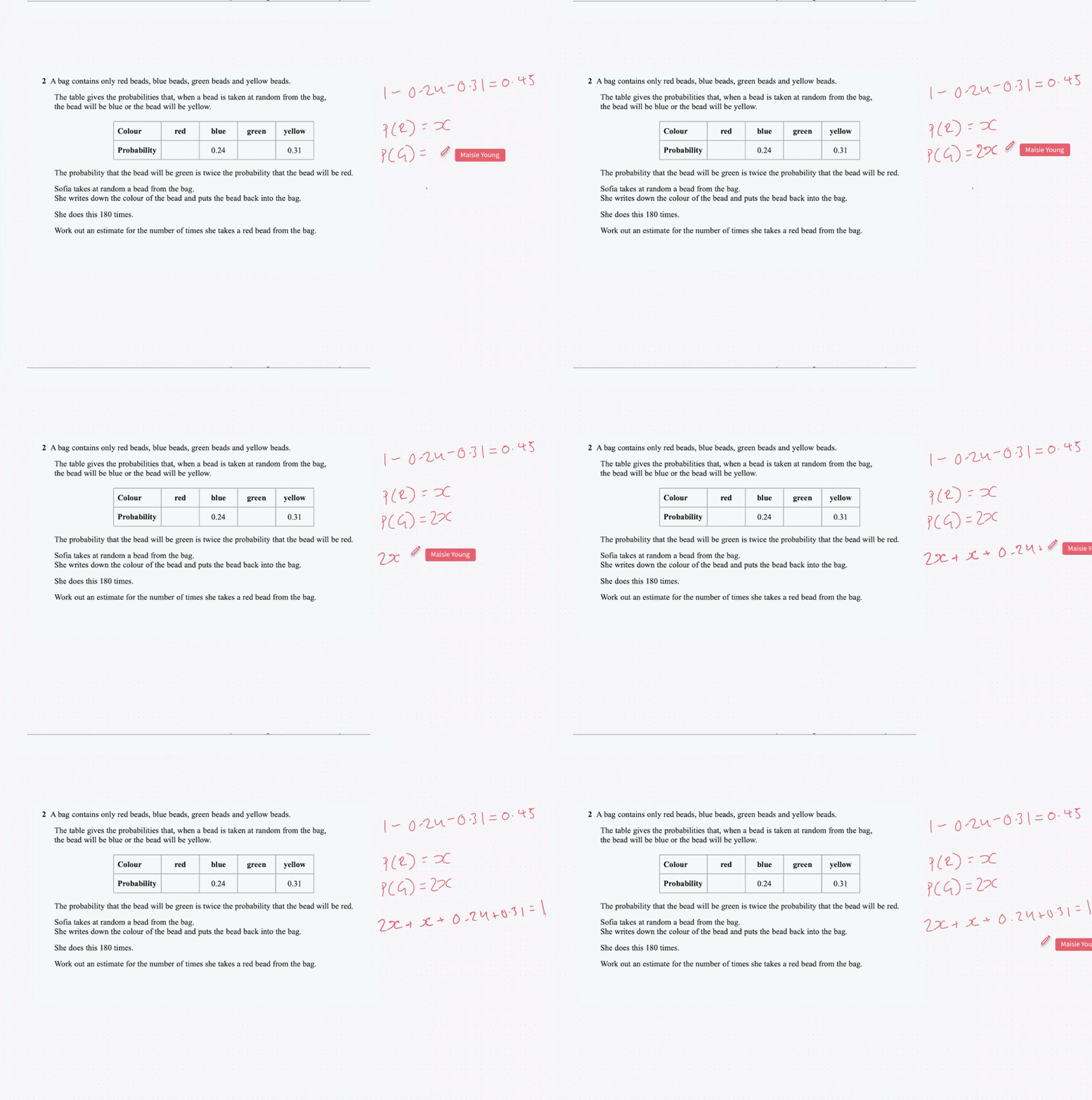
This clip shows a maths lesson recorded in Pencil Spaces, the online classroom used by Greenhill Academics.
Worried your child goes blank in maths exams?
Tell us what happens in the exam and what your child can do at home. A tutor can work on both.
Ask about a tutorTry one timed question at home to spot the gap
You can try this at home in about ten minutes. You need one maths question your child can already do, a timer, and a pen.
- Pick a question they can do (1 minute). Choose a topic your child is comfortable with when they are relaxed. Not a hard one.
- Sit it like the exam (3 minutes). Set a timer, take away notes and help, and let them work with the clock in view.
- Watch for the stall (2 minutes). Notice where they slow down, re-read, or want to give up, even on a question you know they can do.
- Talk it through after (3 minutes). Ask what went through their head at the moment they got stuck. Listen more than you correct.
What should you look for?
You are looking for the gap between what your child can do relaxed and what happens under the timer. If the maths is fine at home but stalls with the clock on, the exam is the thing to work on. One question cannot tell you their overall level or predict a grade. It only shows whether nerves, and not the maths, got in the way this time.
A tutor can take that same question, sit it again under timed conditions, and check whether the same thing happens on similar ones.
Want a tutor to practise exam conditions with your child?
Tell us the topics or papers your child finds hardest under pressure. A tutor can start there.
Send an enquiryWhat changes once the panic settles
Timed practice gives your child a chance to practise what to do when they stall: start with the first step, leave a hard question and return to it, and keep enough time to check. The aim is to make those decisions easier to use under exam conditions, without promising a particular result.
If you are weighing up wider support for your child in Bahrain, our guide to IGCSE tutoring in Bahrain covers the bigger picture for families here. For maths, the day-to-day work is simple and steady: real questions, real conditions, and practice at staying calm under the clock.
Your one move this week
You do not need a big plan. This week, ask your child one question: which maths topic do they least want to see in the exam? Not to fix it tonight, just to name it, and write it down. Keep it for a first lesson. It gives a tutor a clear place to start, and it tells you where the worry sits.
Clemie, Morgan and Murray teach maths
If you would like a tutor to work on the exam with your child, here are three who teach maths. You can ask for any of them by name when you get in touch.

Clemie studied Psychological and Behavioural Sciences at the University of Cambridge, with A*s in Maths, Chemistry and Biology at A Level. She teaches GCSE and A Level Maths, and also Biology, Chemistry and Psychology.

Morgan is studying for a Master’s in Chemistry at the University of Oxford. He teaches Maths, Chemistry and Biology from KS3 up to A Level.

Murray is in his final year of a Master’s in Materials Science at the University of Oxford. He teaches Maths, Chemistry and Physics at GCSE and A Level.
Would you like Clemie, Morgan or Murray to work with your child?
Their profiles are linked above. You can name any of them when you send the form.
Ask about a tutorQuestions parents ask us about maths exam nerves
My child understands maths at home but does badly in tests. Why?
It can be nerves rather than the maths. Under exam pressure, a method your child knows can be hard to reach, so marks are lost on questions they can do at home. A tutor looks at what happens in the exam to see whether that is what is going on.
Is this just nerves, or is there a real gap in the maths?
It can be either, and sometimes both. That is why a tutor does not assume. They sit timed questions with your child and watch the moment they stall, which shows whether it is nerves or a topic that needs more work.
Can a tutor help with nerves, or only with the maths?
Both. A tutor practises real questions under the clock so the exam feels familiar, and works on the maths behind any question your child gets stuck on. The aim is a child who stays calm enough to use what they know.
My child sits the international GCSE (IGCSE). Can you help with that?
Yes. A tutor works from whichever board your child’s school in Bahrain follows, including the English GCSE and the international GCSE. They check which papers your child sits and practise with those.
How soon before the exams should we start?
Starting earlier gives more time for repeated timed practice, which is what exam confidence is built on. That said, there is useful work to do at any point, even close to the exams, once we can see where it goes wrong under exam conditions.
Want help with maths exam nerves?
Tell us what happens to your child in the exam and what they can do at home. We can talk about how a tutor might help.
Send an enquiry