
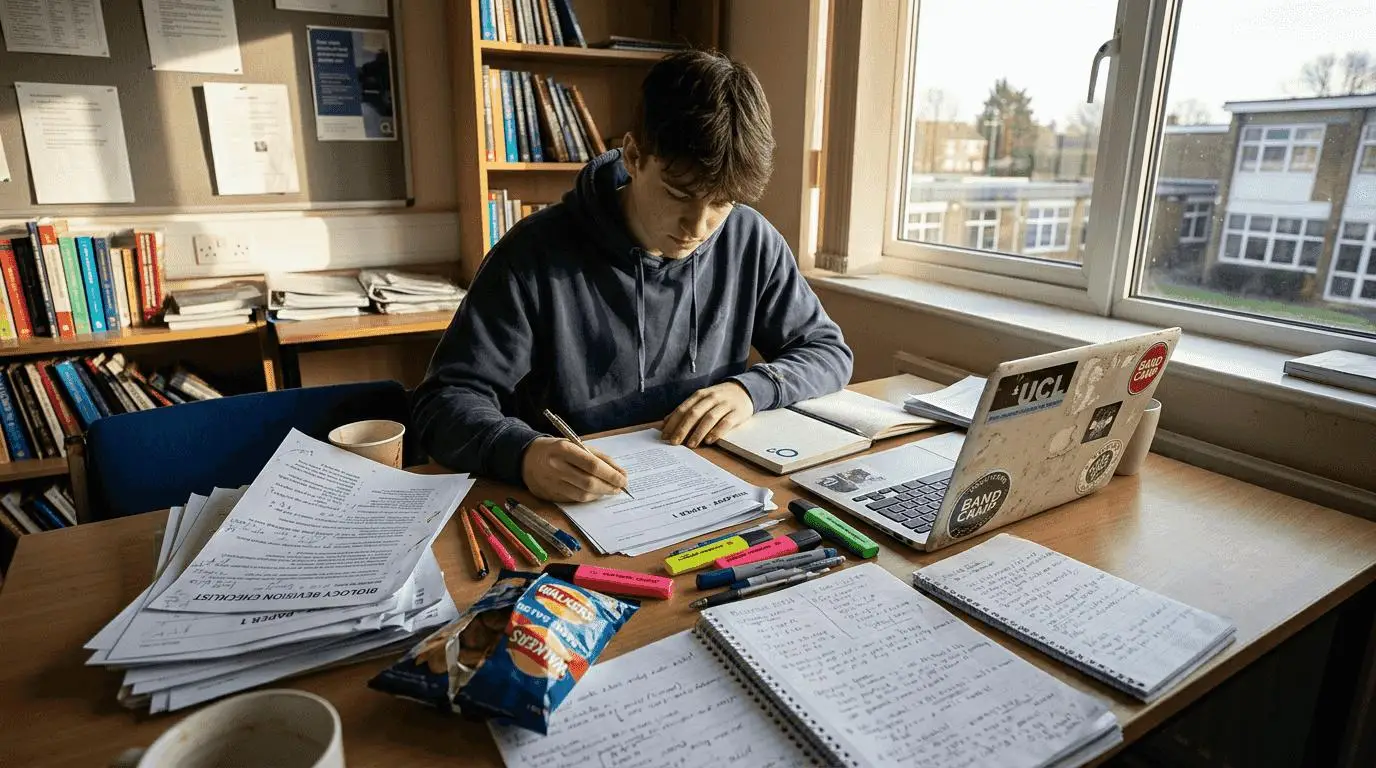

Getting your child to revise for IB is harder than getting them to revise for any other curriculum. The reason is simple: six subjects, Internal Assessments running in parallel, an Extended Essay to finish, plus Theory of Knowledge. The workload feels endless, and many IB students freeze rather than start. However, the right revision approach makes the Diploma manageable. Below are the strategies our Oxford and Cambridge tutors recommend, drawn from their own IB experience and from working with hundreds of families.
This guide is for parents of DP1 and DP2 students who want their child to revise for IB properly. We cover what makes IB revision different, where most students go wrong, and the practical strategies that consistently produce results.
Why IB revision needs a different approach
Most IB students fail to revise effectively because they apply A Level or GCSE habits to a curriculum twice as wide. Six subjects, Internal Assessments, Extended Essay, and TOK all run in parallel. The fix is structural: realistic timetabling, active recall, and early start.
Need help getting your child to revise for IB?
Our Oxford and Cambridge tutors have walked the IB themselves. They build personalised revision plans, mark IAs and Extended Essays, and give your child the structure the Diploma demands.
Why IB revision is different from GCSEs and A Levels
The single biggest difference is breadth. A Level students focus on three subjects. IB students balance six. As a result, the volume of content is roughly double. In addition, the IB includes major components A Level students do not face: the Extended Essay (EE), Theory of Knowledge (TOK), Creativity, Activity, Service (CAS), and Internal Assessments (IAs) for every subject.
This changes the strategy entirely. Revision plans that work for A Levels do not work for IB. Specifically, an IB student needs to start earlier, manage time across more subjects, and treat IAs and the Extended Essay as part of the revision workload rather than separate from it. For broader revision frameworks that translate well across qualifications, our A Level revision strategies guide covers techniques worth adapting.
How to actually get your child to start revising for IB
Starting is the hardest part. Many IB students delay revising because the task feels overwhelming. By contrast, students who break the workload into structured, time-bound sessions find it easier to begin. Below are the four habits that consistently get IB students revising.
Build a realistic timetable around six subjects
Your child should treat every subject as having its own weekly time block, with separate sessions for HL and SL where applicable. For example, HL subjects need roughly twice the revision time of SL subjects. A working framework: 90 minutes per HL subject per week, 45 minutes per SL subject. As a result, your child has clear targets without burning out. Importantly, the timetable should be written down where they can see it, and reviewed weekly.
Break the Internal Assessment burden into chunks
Internal Assessments run alongside revision and account for 20-25% of most subjects’ final mark. Many students treat them as one giant task. By contrast, top-band IB students split each IA into stages: planning, data collection, analysis, evaluation, and final write-up. Each stage gets its own week. Therefore, the IA never becomes the panic project that takes a fortnight out of revision time.
Use active recall, not re-reading
Active recall is the single most evidence-backed revision technique. Specifically, your child should close the book and try to recall content from memory, then check their notes for what they missed. By contrast, passive re-reading produces the illusion of learning without retention. For IB content-heavy subjects like Biology and History, active recall in short, repeated bursts produces dramatic improvements within weeks.
Test under exam conditions early
Most IB students wait until the final two months before attempting full papers under timed conditions. This is a mistake. Instead, your child should sit at least one full paper per subject by January of DP2. The first attempt is often a shock. However, that shock is what drives focused revision in the months that follow. Without it, weaknesses go unnoticed until they cost marks in the real exam.
Which strategies work best to revise for IB?
Once your child is revising consistently, the question becomes how to revise efficiently. The IB curriculum rewards specific techniques. Below are the four that produce the strongest results across HL and SL subjects.
Use past papers from the IB store
The official IB store sells past papers and mark schemes. Many parents and students rely on free third-party sites that may have outdated or incomplete papers. By contrast, the official papers carry the exact format and rigour of the real exam. Your child should sit at least three past papers per subject before the real assessments. Each paper should be marked against the official scheme, with weaknesses logged for targeted re-work.
The Pomodoro technique for HL subjects
HL subjects demand sustained concentration. The Pomodoro technique (25 minutes of focused work, 5 minutes break) prevents burnout while maintaining intensity. For example, an HL Mathematics session might consist of three Pomodoros: one on a past paper question, one on marking, and one on re-working the questions that lost marks. Importantly, the breaks are essential, not optional. Skipping them is what makes long study sessions unproductive.
Spaced repetition for content-heavy subjects
For subjects with heavy content loads (Biology, History, Psychology, Economics), spaced repetition is the most efficient way to retain information. Apps like Anki or Quizlet let your child review the same material at increasing intervals. As a result, content is reinforced before it fades from memory. Our IB Biology grade guide covers how spaced repetition works in practice for a content-heavy subject.
Mark scheme drills for SL and HL
IB mark schemes are specific. They reward particular keywords, structures, and content points. Your child should practise writing answers to the mark scheme, beyond simply answering the question. For example, an HL Maths question worth 6 marks usually requires specific working at specific stages. Therefore, drilling against mark schemes turns a B-grade answer into a 7 by aligning the response with what examiners reward. Our guides on IB Maths AA and IB Chemistry cover this in subject-specific detail.
Struggling to get your child started on IB revision?
A tutor who has done the IB can build a personalised revision plan, mark IAs question by question, and give your child the structure the Diploma demands.
Book a LessonDon’t forget the IB-specific assessments
When parents ask how to help their child revise for IB, the conversation often focuses on the six subjects. However, the IB Diploma also includes major non-subject components. These contribute significantly to the final grade and need their own revision time.
Extended Essay revision (often overlooked)
The Extended Essay is a 4,000-word independent research project worth up to 3 bonus points (combined with TOK). Most students treat it as one large deadline rather than a piece of work that needs ongoing development. By contrast, top-band IB students revise their Extended Essay in stages: research, draft, redraft, final polish. Each stage benefits from feedback. Therefore, having a tutor or supervisor review the essay between stages typically lifts the grade by one band.
TOK essay technique
The Theory of Knowledge essay is unlike any other piece of work in the IB. It rewards philosophical reasoning, structured argument, and engagement with knowledge questions. Many students struggle because they have never written this kind of essay before. As a result, even strong subject performers can lose marks in TOK. Your child should write at least two practice TOK essays before the final, with each one marked against the criteria.
Internal Assessments across all six subjects
Each subject has its own IA, ranging from a Biology lab report to a Maths Exploration to a Language and Literature Higher Level essay. These are worth 20-25% of the final grade and often determine whether a student lands at a 6 or a 7. Importantly, IAs should be drafted, marked, and redrafted at least once. Most students submit a first draft. By contrast, top-band students submit work that has already been through two or three rounds of refinement.
Final exam papers
The final exams sit on top of all the above. Specifically, your child needs to maintain subject knowledge alongside finishing IAs, the Extended Essay, and TOK. Therefore, the revision schedule needs to allocate time across all components from DP1 onwards, rather than only in the last few months.
Common reasons IB students struggle to revise
If your child is struggling to revise for IB, they are not alone. The most common blockers fall into four patterns. Each one has a specific fix.
The volume is overwhelming
Six subjects plus IAs plus the Extended Essay plus TOK adds up to a workload most students cannot picture starting. The fix is structural. Break the workload into small, manageable weekly chunks. By contrast, students who try to tackle everything at once usually freeze and do nothing.
Six subjects feels impossible to balance
Many IB students focus on their strongest or favourite subjects, neglecting weaker ones. As a result, weaker subjects drop further behind. The fix is to allocate revision time inversely to confidence: more time on weaker subjects, less on stronger ones. Specifically, every weekly timetable should include time for the subject your child least wants to revise.
School pressure plus extracurriculars
IB students often carry heavy commitments outside school, including CAS activities, sports, and music. By contrast, A Level students typically have more flexibility. The fix is to be realistic about the time available. Therefore, the weekly revision plan should account for real-world commitments rather than assume an idealised week.
Procrastination as avoidance
If revision feels overwhelming, students avoid it. The fix is to start with the smallest possible action: ten minutes on one subject. As a result, the activation barrier drops, and longer sessions follow naturally. Importantly, this technique works because momentum is what most struggling students lack.
Expert IB tutoring with Greenhill Academics
PERSONALISED IB REVISION PLANS FROM OXBRIDGE TUTORS
Our tutors have walked the IB themselves. They build personalised plans, mark IAs and Extended Essays, and give your child the structure to revise effectively. Matches made within 48 hours.
Book a LessonPart of our revision strategies series
This post is part of a series for parents on getting children to revise effectively across different curricula. The principles overlap, but each curriculum has its own demands.
→ How to Get Your Child to Revise for GCSEs: Strategies Actually That Work
→ How to Get Your Child to Revise for A Levels: Strategies Actually That Work
Frequently asked questions about IB revision
Below are the questions we hear most often from parents whose children need to revise for IB effectively.
Common questions parents ask
