

If your child is strong on IB Biology content and still losing marks on Paper 2, you are not missing knowledge. You are missing the thing the markband was looking for, and it is more fixable than it feels.
The quick version for busy parents
- Your child is going to mark a real IB Biology extended response, with no biology needed.
- The answer that scored two is correct in every sentence. That is exactly why it scored two.
- The command term, not the content, is where Paper 2 marks are won and lost.
- The global average IB score is just over 30 points, and fewer than 5% of students worldwide score 40 or more.
- This is a skill, not a content hole, so it improves in weeks rather than terms.
She knows the IB Biology content, so why 2 out of 6?
I won’t explain the problem to you. I’ll let you find it, because once you have seen it you can’t stop seeing it, and you’ll spot it in your own child’s IB Biology work by the weekend. You need no biology for this. Only the markband, which is the point.
The question is a Paper 2 extended response worth six. “Evaluate the use of stem cells in treating human disease.” Here is Mariam’s answer, and it got two.
“Stem cells are unspecialised cells that can divide and differentiate into other cell types. They are found in embryos and in adult bone marrow. Embryonic stem cells are pluripotent, meaning they can become any cell type, while adult stem cells are multipotent. Scientists can grow them in culture. They have been used to treat leukaemia through bone marrow transplants, and research is being done into using them for Parkinson’s disease, spinal injuries and type 1 diabetes.”
Mariam is a made-up name and this answer blends several real IB scripts we have marked, but the scores are exactly what happens. Read it again. Everything is true. Nothing is sloppy. It is better written than most Diploma work, and her teacher would have been pleased to hear her say it in class. Now look at the command term. It says evaluate.
The marks went to the command term, not the biology she revised
IB marking lives and dies on command terms, and the IB publishes exactly what each one demands. Evaluate means make an appraisal by weighing up strengths and limitations, then reach a judgement. Not describe. Not list. Weigh, and land. Mariam described. So the markband couldn’t reward most of what she wrote, however true it was.
Six marks on offer, and her answer could only earn two
The examiner had six marks to give: some for benefits, some for limitations, some for a judgement that follows from both. Her answer has benefits only. So she picked up two marks for the benefit she mentioned in passing, and nothing for the rest. Not because it was wrong. Because the markband wasn’t buying description.
What the six marks were for
Benefits
The upside, with an example. Mariam had this. It scored.
Limitations
Ethical and practical objections. Missing, so zero.
A judgement
Which side wins, and why. Missing, so zero. The marker most IB students drop.
Same topic, same student. The marks live in the shape of the answer, not the facts.
This is not a rare stumble, and the numbers show how tight the top of the IB is. In the May 2025 session the global average Diploma score was 30.58 points, according to the IB’s own results release, and fewer than 5% of students worldwide scored 40 or more. A real share of the gap between a 5 and a 7 in IB Biology is technique: students who know plenty still leave marks on the table because they answer the topic instead of the command term.
What Lucy hopes a student will say
“I only got two out of six because obviously I didn’t answer the question. What did I do wrong?
”
Lucy, one of our tutors
Her point: the easiest student to help is the one who brings the exact question they got wrong, with the mark still on it.
She isn’t asking for the topic to be retaught. She wants the student to bring the exact question they lost marks on, with the score, so the two of them can work out what the markband wanted and they didn’t give. Most students bring a topic. The useful thing to bring is a failure.
The answer that got six knows less biology than hers
“Stem cells offer real clinical benefit: bone marrow transplants already treat leukaemia, and their ability to differentiate makes them promising for Parkinson’s and spinal injury. However, embryonic stem cells raise ethical objections, since obtaining them destroys the embryo. There are also practical limitations: cultured cells can be rejected by the immune system, and there is a risk of tumour formation. On balance, adult stem cells are the more defensible route at present, because they avoid the ethical problem while still offering established treatments, even though they are less versatile.”
Notice what is missing from the six-mark answer. It never defines a stem cell. There is no pluripotent, no multipotent. It holds less biology than the answer that scored two, and it scores three times as much, because it does what evaluate asked. Benefits, limitations, a judgement, a reason for the judgement. That is the whole trick, and it takes about ten minutes to teach.
Send us one Paper 2 answer
Send one Paper 2 answer and an examiner-minded tutor marks it with your child, live, so you both see where the six marks actually were. Russell speaks with every family before a tutor is matched.
Book a LessonInside a lesson
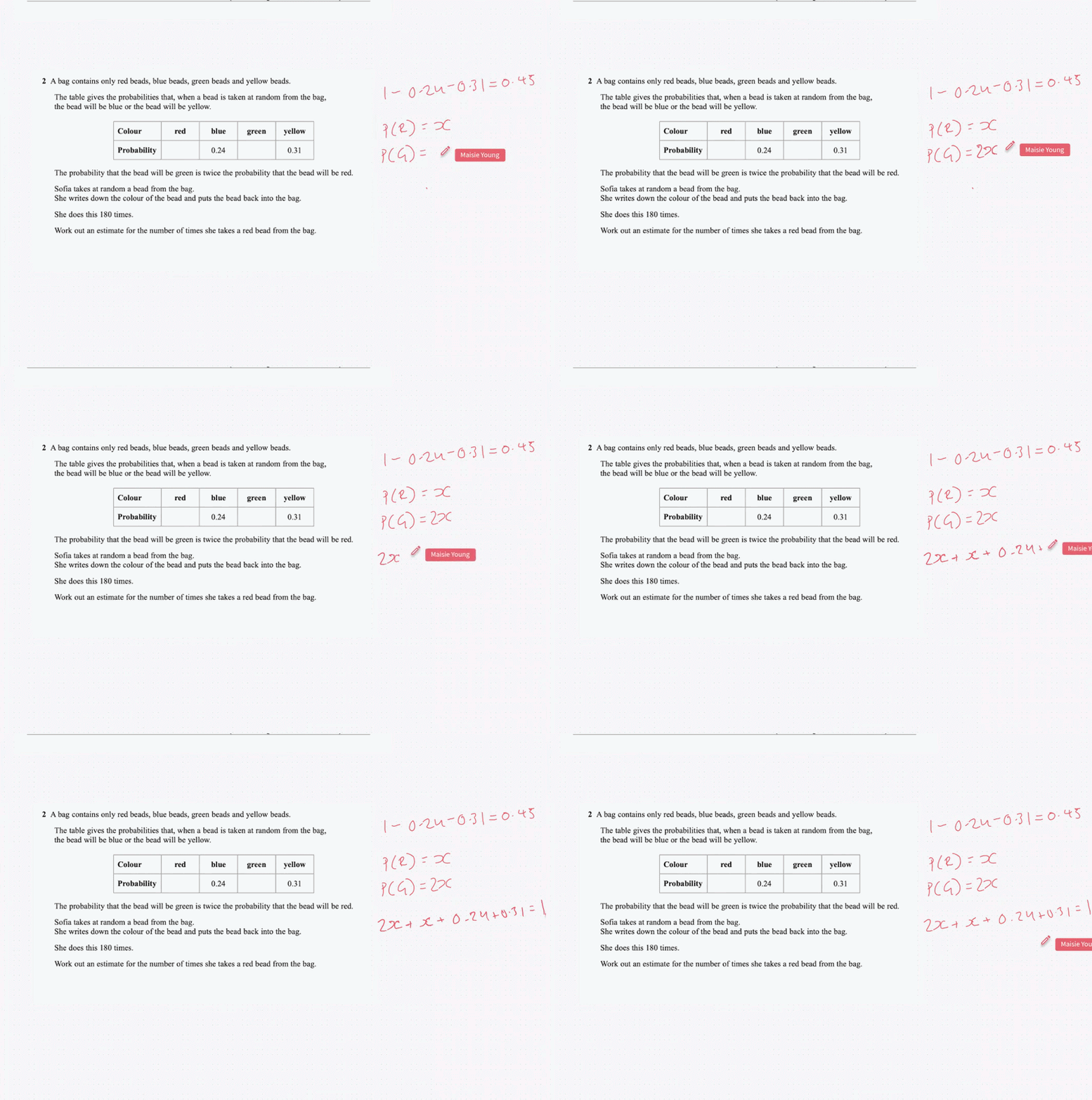
A real Greenhill Academics lesson, recorded live: tutor and student working on the same board at the same time. The same live, one-to-one setup runs in every IB Biology lesson.
Could she find her own lost marks tonight?
Find a Paper 2 extended response that disappointed you both. Don’t read the biology. Read the command term, then ask your child to find their own points against the real markband, out loud, one by one.
Most students find two or three, then go quiet, then say something like “oh”. That “oh” is worth more than a term of revision, because for the first time they can see the difference between what they wrote and what was being marked. Any good IB Biology tutor does this in the first hour, because it changes what all the later work is for. If your child wants the full picture of what a 7 demands across every component, our guide to how to get a 7 in IB Biology is worth ten minutes.
One command term drill to run at home
Print the IB command terms list, the official one, and stick it above your child’s desk. Then take one marked extended response and ask them to circle the command term before they read anything else. Half the lost marks start with a term read as “just write about this”, and that one habit catches them.
The gap between 2 and 6 isn’t more biology
Read the command term first, before the topic. Outline, describe, explain, evaluate, discuss and compare want six different things. IB defines each one exactly, and a student who treats them as one word meaning “write about this” loses marks they knew the biology for.
Give the extended responses your fresh brain. Plenty of students spend their best thinking on the short data questions and reach the long answers with nothing left. On Paper 2 the extended responses carry the grade, so give them the good half of your head.
Mark your own work against the real markband. Not your teacher’s tick. The actual IB markband, in your own handwriting, matched to your own points. It is uncomfortable for a fortnight, then it is the most useful thing your child does all year. It is the same skill that lifts the IA, which is why the students who master it tend to climb across every component, not just Paper 2.
Tutors who have fixed 2 out of 6 before
Who sits with your child on Paper 2

Charlotte · Biology, Oxford (First Class, Balliol)
A First-Class Oxford biologist who teaches IB Biology and Chemistry, shaped by four years in the Oxbridge tutorial system. Her lessons run on discussion, which is exactly the muscle an evaluate question tests.

Kriszta · Biology, Oxford (First Class)
A First-Class Oxford biologist, top 10 in a cohort of 120, now doing a PhD in cancer biology. She is blunt about what a sentence actually claims, which is the muscle an extended response tests.

Mirsab · Biology and Medicine, Cambridge
Reads Medicine at Cambridge with an A* in Biology, so she knows exactly which word a mark scheme is waiting for and where a strong answer leaves easy marks behind.
The questions you are asking yourself tonight
Everything she wrote was correct. How is that two out of six?
Correct and relevant aren’t the same in IB. The markband rewards the points the command term asks for, not everything true about the topic. Writing more doesn’t earn more, and sometimes it earns nothing.
Isn’t this just teaching to the test?
It’s teaching her to answer the command term in front of her, which is a skill IB rewards everywhere, including the IA and the Extended Essay. She still has to know the biology. She just has to aim it.
Why hasn’t her school flagged this?
Often they have, once, in passing. A full Diploma timetable leaves little room for sitting with one student while they mark their own extended response against the band and feel the penny drop. That is the bit that works, and it is the bit that takes time.
How long before we’d see a difference?
Faster than for a content gap. This is a technique, and techniques respond to practice. Most students improve their extended responses within a few weeks of marking their own work against the real band.
What should we bring to a first lesson?
A marked Paper 2, ideally one that upset her. We’ll take a single extended response and go through it with the real markband. That one conversation usually explains the whole grade.
Bring one marked Paper 2. One extended response usually explains the whole grade.
One real markband, one hour, and you’ll see where the marks went. Then you decide what happens next.
Book a Lesson