

What to look for first
- A child can hold an IB Physics topic securely and still lose marks when the question does not announce its own method.
- Missing content is only one of eight things that can produce the same low mark, and they need different work.
- There is a three-question check you can run at home on one recent topic.
- Keep the paper your child writes on, because the working shows a tutor more than the mark does.
Your child feels confident and the test marks say otherwise
Your child rates a topic as secure, and the test comes back with marks lost across questions they recognised. That mismatch is uncomfortable to read, because effort is clearly not the issue. Confidence is measured on the questions your child has already met, and a paper is set on questions they have not.
Theo shows the pattern. He is a composite, put together from moments in several Higher Level Physics lessons rather than one child, and the teaching described is real. He had rated himself as close to fully confident on kinematics. His tutor gave him a hard projectile question at the top of the difficulty range, and Theo reached for an equation he had rearranged himself and written out to save space. The physics he knew was fine. But the rearrangement carried a sign error, and he could not show the steps that had produced it.
Nothing in that lesson was a knowledge gap in the sense parents usually mean. Theo could state the equations and use them. What he could not do was pick between them under an unfamiliar question, and rereading the topic was unlikely to surface that.
The gaps stay hidden until the question looks unfamiliar
A familiar question carries its own instructions. Your child has seen its shape before, so the method comes with the recognition, and the answer can be right for the wrong reasons. But an unfamiliar question removes that help. It gives the same physics in a form that does not name the method, and your child has to choose the starting point themselves.
This is why a topic can feel secure at home and come apart in a test. School marks the answer, and the answer looks the same whether it came from understanding or from pattern matching. The choice of method, the assumption behind it and the working in between are where the difference lives, and none of the three shows up in a grade.
Families across Abu Dhabi will know IB schools such as Raha International School and The British International School Abu Dhabi. The Diploma course is the same wherever your child studies it.
Three questions can show you where the gap sits
You do not need to know Physics to run this, and you do not need to mark anything. Pick one topic your child studied recently, then ask for three things in order.
The three-question check
First
Ask them to explain the idea with no notes and no equations. Ask for words only. Listen for whether the explanation holds together or turns into a list of formulas.
Second
Give them a familiar calculation from the same topic. Something where the method is obvious from the question. This tells you the mechanics are in place.
Third
Give them an unfamiliar question on the same physics, without naming the method. A past paper question from a different context works well. Watch how they start.
A short check at home cannot diagnose a whole course, and it is not meant to. It gives you and a tutor one concrete thing to look at.
Eight problems can produce the same low Physics mark
What you saw during the check matters more than the mark that prompted it. Eight different problems produce marks lost on questions a child recognises, and they call for different work. Wait until the check has shown you something before deciding which one it is.
One low mark, eight possible causes
Content
The topic was genuinely not covered or has been forgotten. Your child cannot explain it and cannot do the familiar calculation either.
A common mistake
They hold a wrong version of the idea confidently. The explanation sounds fluent and one part of it is not true.
Concept
They can calculate and cannot explain. The second question goes well and the first one turns into formulas.
Method choice
They know the equations and cannot choose between them. They freeze on the third question, or try several in turn.
Linking topics
They hold each topic separately. A question that needs two ideas together stops them, even though both are secure alone.
Written working
Most of the work happens in their head. The page shows an answer and very few steps, so a slip has nowhere to be caught.
Multi-step answers
They start well and lose the sequence. The first two steps are right and the thread goes at step three or four.
Wording and pressure
They can do all of it, then not in the exam. Unfamiliar phrasing or the clock changes what they can reach.
Several of these can be true at once. The check is there to narrow the list, not to label your child.
Written working is the cause you can check at home
What tutors ask for most
Written working is the one on that list you can see for yourself, and you do not need any Physics to spot it. Across 108 Greenhill Academics lessons recorded in July 2026, tutors asked students to show their working 115 times in 51 of those lessons, and 29 of the 38 students received the prompt at least once. The corpus covers 11+ through to IB, so the habit is not particular to one subject or one age.
An aggregate figure describes our lessons as a whole. It says nothing about your child, and it is not a claim that working is your child’s problem.
Keep tonight’s working
Keep the page your child writes on during the third question, mistakes included. If you book a first lesson, attach that page to the booking form. Seeing the working helps a tutor find where the wrong turn started.
Is your child losing IB Physics marks even when they know the topic?
Tell us which level your child takes, Higher or Standard, and what the last paper looked like. We will match them with an IB Physics tutor who starts by testing what is actually secure.
Book a LessonA confident answer can start from the wrong assumption
The hardest gap to find is the one your child does not know is there. An answer can run cleanly from an assumption that does not hold, and it will look like a careless slip on the page. Marcus, a second composite drawn from Higher Level Physics lessons in the same way as Theo, worked through an estimate question this way. He used a formula that only holds over small distances, and he had not noticed that the question stretched past that. His arithmetic was sound and his reasoning had gone wrong two lines earlier.
Finding that takes someone tracing the working backwards rather than marking the answer. One of our Physics tutors describes the job plainly:
What the tutor is listening for
“I’m trying to find how you end up with this equation, and therefore, where the mistake has been made.
”
Hugh, IB Physics tutor
The question is not whether the answer is wrong. It is where the equation came from, which is the part a marked paper leaves out.
Two habits do a lot of the work here, and both came up in Theo’s and Marcus’s lessons. Writing the equations down before starting a question makes the choice visible, to your child as much as to the tutor. Using the numbers the question gives, rather than ones your child has just calculated, keeps one early slip from spreading through the rest of the answer. Neither habit is glamorous, and both can be built inside your child’s own past papers.
Will an IB Physics tutor help if school has already covered the topic?
Yes, where the problem sits in method choice, assumptions or working, because that is what the lessons can work on directly. A first lesson can start from a recent paper and one hard question rather than a fresh worksheet, so the tutor sees how your child begins when the method is not given. From there the plan follows your child’s own level and syllabus, at Higher or Standard, including the Internal Assessment when that is what needs the time.
You receive a written report after every lesson. When homework is set, a reminder goes out before the next lesson.
Inside a lesson
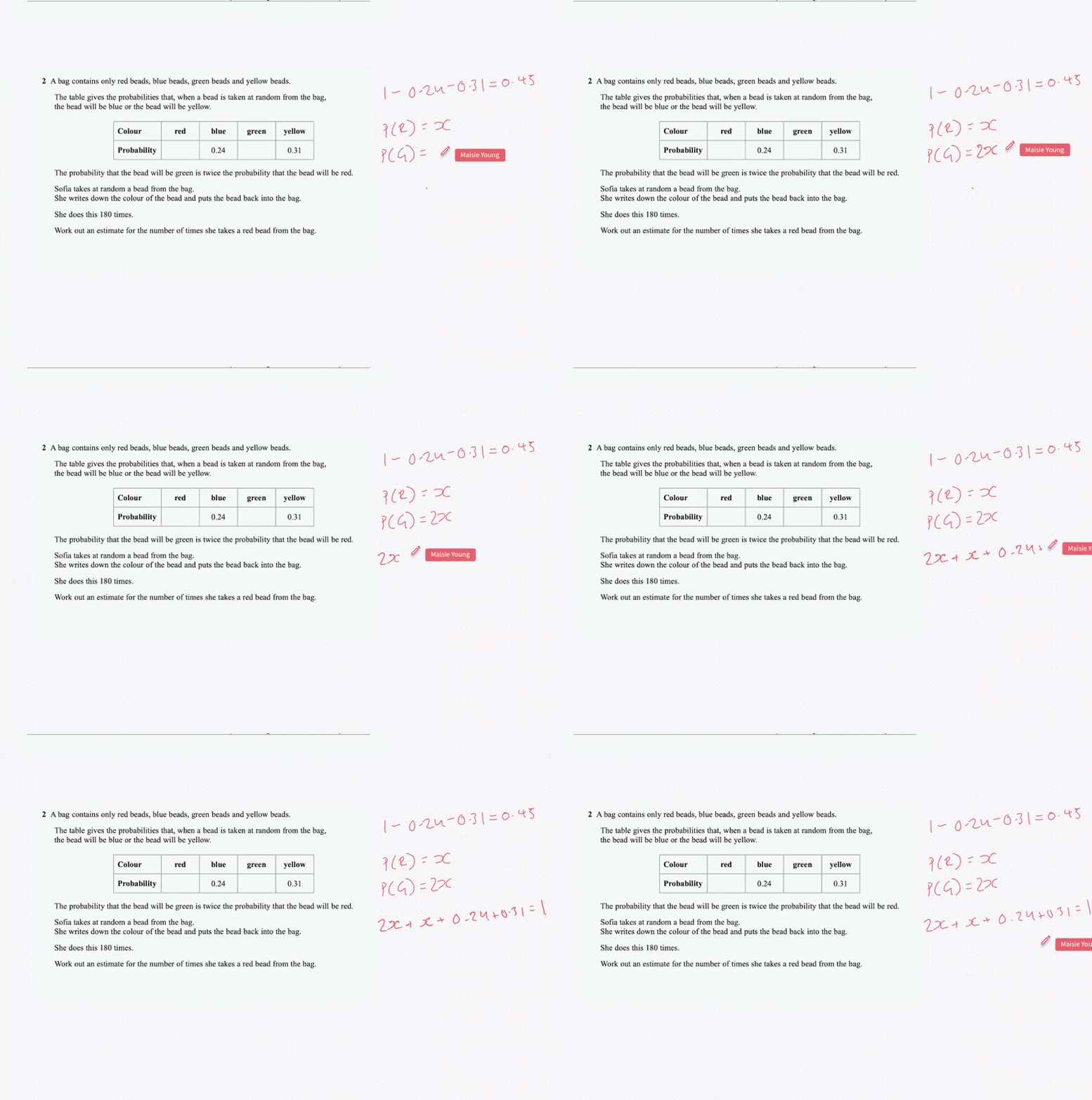
A Greenhill Academics lesson on the shared board. The clip shows a maths lesson, and Physics lessons use the same shared-board format, with the question, your child’s working and the tutor’s notes on one screen.
The tutors your child would work with
The IB Physics tutors who test confidence first
Hugh · Theoretical Physics, Imperial and Oxford
Hugh holds a First-Class MSci in Theoretical Physics from Imperial College London and has completed a DPhil at the University of Oxford. He teaches Maths and Physics at all levels, including IB Physics, with over a decade of tutoring experience. The line quoted above is his, and it is how he works: he traces where an equation came from rather than marking the answer.

Murray · Materials Science, Oxford
Murray teaches Maths, Chemistry and Physics, and is studying Materials Science at the University of Oxford, where he is on track for a First. He achieved A*A*A* at A Level in Maths, Chemistry and Physics. His teaching builds the foundations back up and works on a clear method for questions that do not announce their own.
What parents ask when the gaps are hard to find
How do I find a good IB Physics tutor in Abu Dhabi?
Ask how they would work out what is missing, and what they would do in the first lesson. A good tutor tests a topic your child believes is secure, uses an unfamiliar question to see how they start, and then works on the method rather than recovering the whole topic. Greenhill Academics tutors teach online and fit lesson times around the Abu Dhabi school day.
My child says the topic makes sense, so why do the marks come back low?
Understanding a topic and choosing a method are different skills. A question your child recognises supplies the method with it, and an unfamiliar one does not, so the same knowledge produces a different result. Looking at the working, rather than the mark, usually shows which of the two is missing.
Do you teach both Higher and Standard Level Physics?
Yes, and tutors work at both levels and adjust the depth and the practice to the course your child is sitting. The level is confirmed in the first lesson, so the work matches the papers your child will actually take.
Are your IB Physics tutors based in Abu Dhabi?
They are not, and we say so plainly. Both tutors on this page live and work in the UK, teaching on a shared online board at times that suit an Abu Dhabi school week.
Can a tutor help with the Physics Internal Assessment?
Yes, from choosing an investigation through handling uncertainties to structuring the write-up. The work stays entirely your child’s own, which is what the IB requires, and the tutor’s role is to question the design and the analysis.
Send us your child’s last IB Physics paper
Attach it to the booking form with your child’s level, and we will match them with an IB Physics tutor who tests what is secure before planning anything. Oxbridge-educated tutors, teaching online across Abu Dhabi.
Book a Lesson