

Your child knows the mole equations off by heart. Moles equals concentration times volume, the mole ratio, all of it. But a titration question appears and they stop. They do not know what the question has given them, what it wants, or what to work out first. The maths is not the problem. Knowing where to start in titration questions is.
The short version
- At A-level, titration questions are about the route, not just the equations.
- The fix is a fixed setup: given, wanted, equation, units, then calculate.
- The hard part is choosing what to work out first, not the sums themselves.
- There is a short task at the end you can try at home this week.
Where titration questions go wrong
A child who gets stuck here can still be good at Chemistry. They can rearrange the equations. The trouble is the start. A titration question gives them a volume here, a concentration there, and a reaction to read. They dive straight into numbers before they have worked out what the question is really asking. Two places are worth checking here. They pick the wrong number for the equation, and they forget to change the units. A volume in cubic centimetres has to become cubic decimetres before it goes into the sum. Get the setup right and the calculation is short.
The setup routine
Here is the routine we teach. Five steps, in order, before any sum.
Given
Write down every number the question gives you, with its units.
Wanted
Write down what the question is asking you to find.
Equation
Write the balanced equation and the mole ratio you need.
Units
Change the units so they match. Cubic centimetres become cubic decimetres.
Calculate
Now do the sum. The order is already set, so there is nothing to guess.
How we teach it
We get the child to say the routine out loud before they touch a number. Given, then wanted, then the equation and ratio, then units, then calculate. It is a Greenhill structure, not a trick. It just forces the thinking into the right order. The units step is the one we slow down on, because the volume must be converted from cubic centimetres to cubic decimetres before it is used in the calculation. Once the routine is steady, the same setup can be used as a starting point for back-titrations and longer multi-step questions.
Greenhill tutor
Karol, Chemistry tutor
Karol studied Natural Sciences at the University of Cambridge and teaches A-level Chemistry with Greenhill.
Is it the sums, or knowing where to start?
Tell us where your child’s titration answers break down. A tutor can look at one and see where the setup goes wrong.
Ask about a tutorA worked example
The numbers below are ones we made up to show the routine, not a real pupil’s paper.
A simple acid and alkali titration
A student finds that 25.0 cubic centimetres of sodium hydroxide is neutralised by 23.5 cubic centimetres of hydrochloric acid, and the acid is 0.100 moles per cubic decimetre. Find the concentration of the sodium hydroxide.
The routine in action
Given: both volumes and the acid concentration. Wanted: the concentration of the alkali. Equation: the acid and alkali react one to one. Units: change 23.5 and 25.0 cubic centimetres to 0.0235 and 0.0250 cubic decimetres. Calculate: moles of acid are 0.100 times 0.0235, which is 0.00235. The ratio is one to one, so moles of alkali are also 0.00235. Concentration is 0.00235 divided by 0.0250, which is 0.094 moles per cubic decimetre.
Try this at home this week
This takes about eight minutes. Give your child the setup below, but ask them not to solve it at first.
What you need. Paper, a pen, and the short titration below, which we have written out for you.
The question. A titration finds that 20.0 cubic centimetres of potassium hydroxide is neutralised by 18.0 cubic centimetres of sulfuric acid at 0.0500 moles per cubic decimetre. The acid reacts with the alkali in a one to two ratio. Find the concentration of the potassium hydroxide.
- First, label what the question has given you.
- Label what the question wants you to find.
- Write the equation and the mole ratio you need.
- Note which units you have to change.
- Then, and only then, do the calculation.
What to watch. Watch where the difficulty sits. Is it the calculation itself, or is it choosing what to do first? A child who can label all five steps but gets the sum wrong needs different help from one who cannot start at all.
What it cannot tell you. This only checks the setup routine on one short question. It does not tell you whether your child can handle a full practical method, or a longer question with two or three steps joined together.
Where a tutor takes it next. That is where a tutor picks it up: back-titrations, multi-step questions, and reading the practical method under exam time.
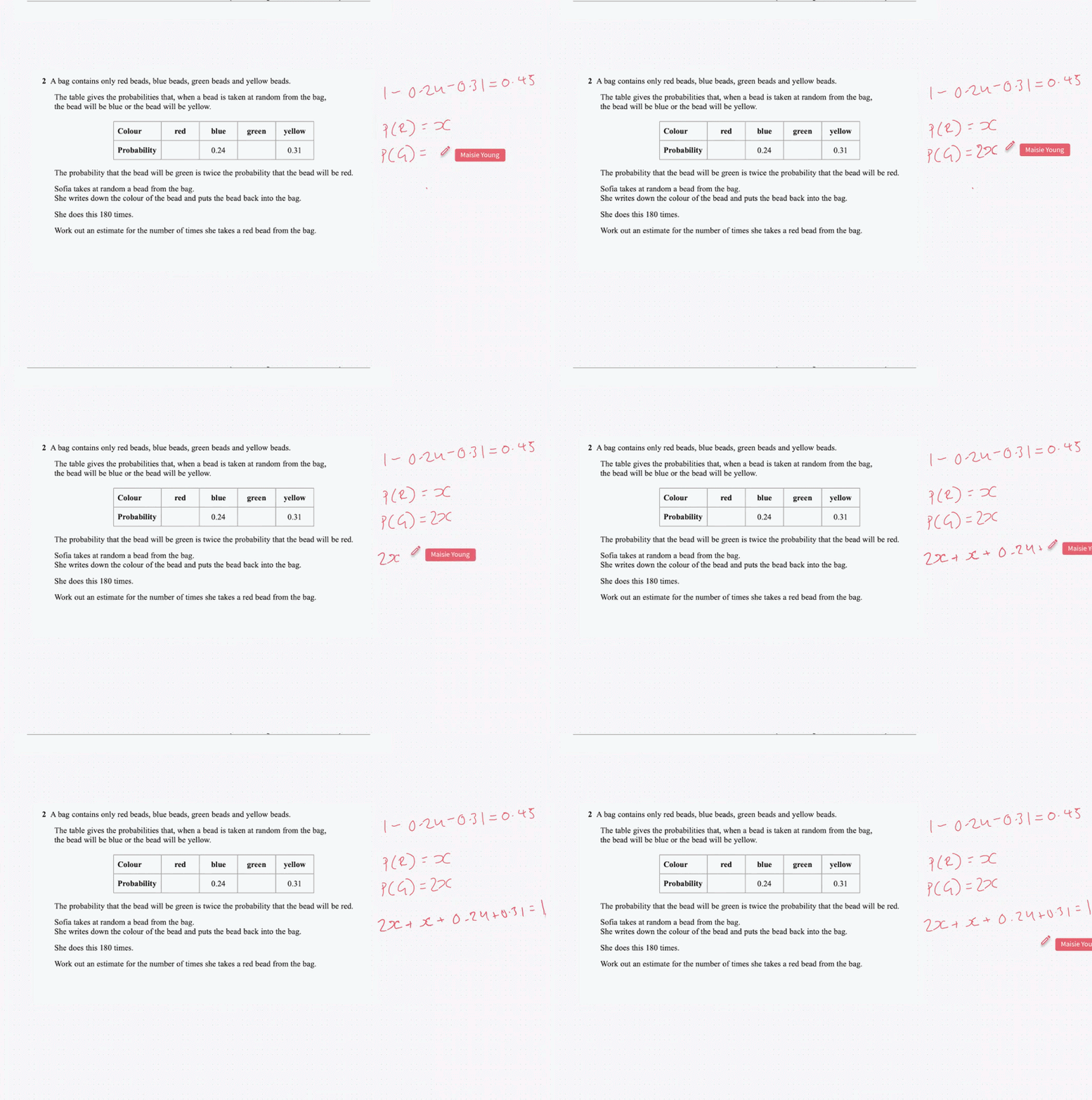
This clip shows a maths lesson recorded in Pencil Spaces, the online classroom used by Greenhill Academics.
Our A-level Chemistry tutors

Mirsab studied Natural Sciences at the University of Cambridge, holds an A* in A-level Chemistry, and tutors Chemistry at GCSE and A level.
Questions parents ask us
My child knows the equations but still cannot start a titration question. Why?
Knowing the equations and knowing the route are two different skills. Titration questions ask the child to pick the right numbers and the right order first. Once they have a fixed setup to follow, the routine gives them a clear way to decide what to do first.
What is the setup routine you teach?
Given, wanted, equation, units, calculate. The child writes what the question gives, what it wants, the balanced equation and ratio, then fixes the units, and only then does the sum.
Is this just A-level, or does it help at GCSE too?
The same routine helps with A-level Chemistry and with GCSE titration and mole questions. At A-level the questions get longer, with back-titrations and joined-up steps. The same setup can also be a useful starting point there.
Do you tutor A-level Chemistry online?
Yes. We tutor A-level Chemistry online for UK and international families. Tell us the exam board and where your child gets stuck, and we can talk through the help they need.
How quickly can this improve?
It depends on the child and the exam board. The routine itself is short, but using it reliably takes practice on real questions. A tutor can show you what that practice looks like.

Want a tutor to work on A-level Chemistry with your child?
Tell us the exam board and where your child gets stuck, and we can talk through the help they need.
Send an enquiry