

Your child can do the angles in GCSE Maths, and a bearings question can still come back wrong. The maths is not always the reason. Two things worth checking are whether they measured clockwise from north and whether they wrote three figures. A quick diagram can show which step is going wrong.
The gist
- Bearings have three rules: measure from north, turn clockwise, and always write three figures.
- Two useful things to check are the direction and whether three figures were written.
- A back bearing is the first bearing plus or minus 180.
- There is a short bearings task at the end you can try at home this week.
Where bearings go wrong
A child who gets bearings wrong can be fine at the rest of GCSE Maths. The angle work can be right, and the bearing still comes out wrong. One place to check is how the bearing itself is written down. A bearing is measured from north, turning clockwise, and written as three figures. Miss one of those and the answer can point the wrong way, even when the calculation is correct. Drawing a quick diagram helps show which step is going wrong.
The three rules for every bearing
A bearing is a direction, written as an angle. Three rules make it right every time. A quick diagram helps your child see them.
Start at the north line and measure from there, not from any other direction.
Turn clockwise, the same way the hands of a clock move.
Always write three figures. A bearing of 7 degrees is written 007.
Back bearings
The bearing of A from B is the bearing of B from A, plus or minus 180. Add 180 if the first bearing is under 180, and take 180 off if it is 180 or more.
Draw the north line first, then the angle. The diagram shows the way round before your child writes anything down.
How we teach bearings
We get the child to draw the north line and a clockwise arrow before any arithmetic. Then the three rules, in the same order every time. For a back bearing, we use the plus or minus 180 step with a diagram, so the direction is clear on the page. It is a Greenhill way of fixing the direction first, so the angle work becomes the easy part.
Greenhill tutor
Murray, Maths tutor
Murray teaches Maths, Chemistry and Physics with Greenhill, supporting students from 11+ through to A level.
Bearings still pointing the wrong way?
Tell us where your child’s bearings answers break down. A tutor can look at one and see if it is the direction or the figures.
Ask about a tutorA back bearing, worked through
The numbers here are made up to show the steps. They are not from a child’s own work.
The question
The bearing of B from A is 070 degrees. What is the bearing of A from B?
The answer
070 is under 180, so add 180. That gives 250 degrees. A quick diagram shows the line back from B to A pointing the opposite way, which matches 250 degrees.
Try this at home this week
This takes about eight minutes. It shows you whether the direction or the figures are the part your child needs to practise.
What you need. Paper, a pen, a protractor if you have one, and the three bearings below.
The task. Here are three bearings to turn into back bearings: 040 degrees, 115 degrees, and 300 degrees. For each one, your child draws a north line, marks the bearing, then works out the bearing back the other way.
- Draw a north line and mark the starting bearing, measured clockwise from north.
- Check it is written as three figures.
- For the back bearing, add 180 if the bearing is under 180, or take 180 off if it is 180 or more.
- Draw the return line and check it points the opposite way.
- Write the back bearing as three figures.
What to watch. Watch which part trips them up. If the direction or the three-figure rule is the slip, that is the bit to practise. If the plus or minus 180 step is the problem, that is a different fix.
What it cannot tell you. This short task does not cover bearings inside sine-rule or cosine-rule questions, or longer navigation problems. It checks the direction and the back-bearing step only.
Where a tutor takes it next. That is where a tutor picks it up: the rules first, then bearings inside bigger trigonometry questions.
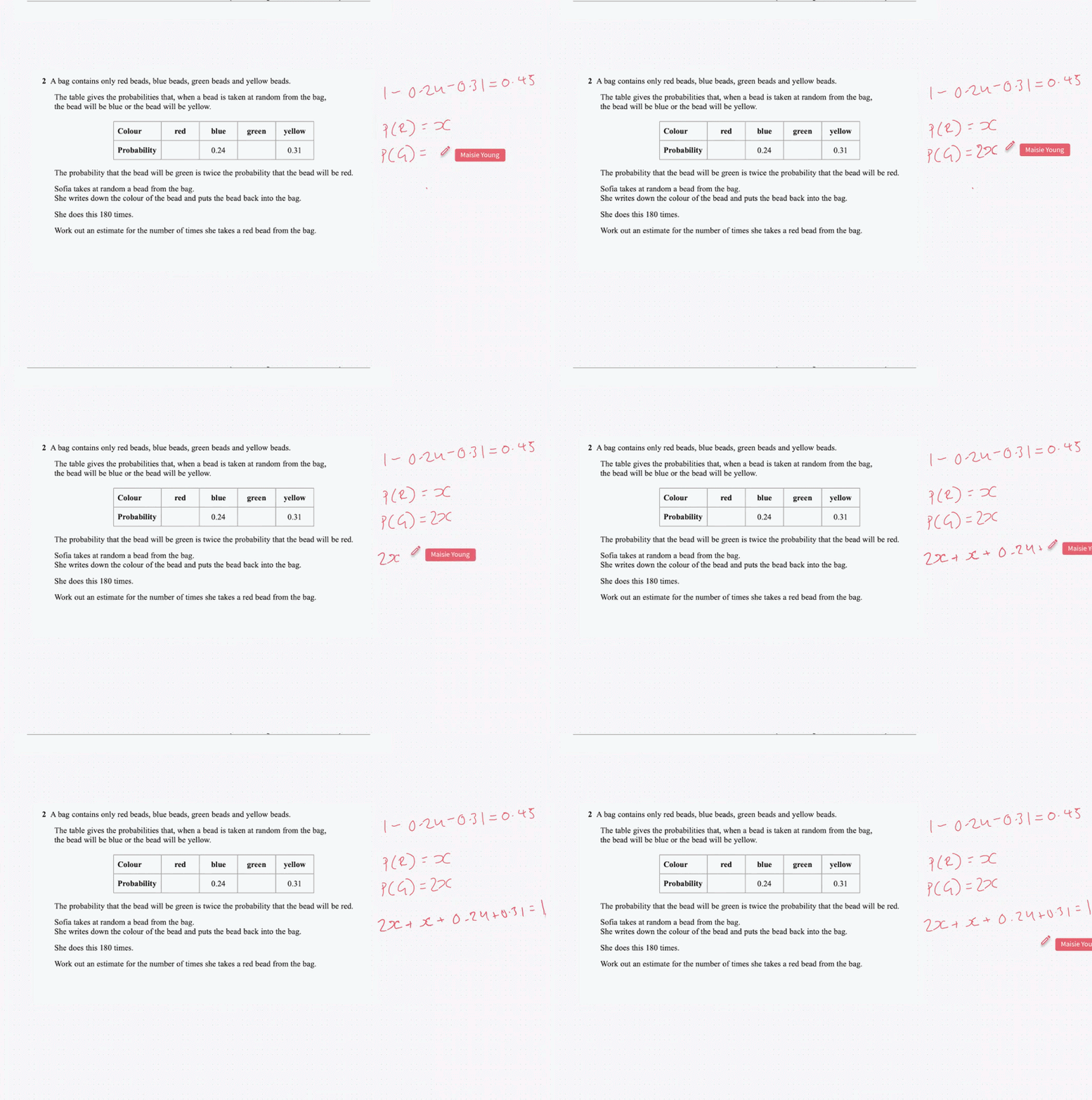
This clip shows a maths lesson recorded in Pencil Spaces, the online classroom used by Greenhill Academics.
Our GCSE Maths tutors

Murray teaches Maths, Chemistry and Physics with Greenhill, from 11+ through to GCSE and A level.

Holly teaches Maths with Greenhill, from KS2 and KS3 through 11+, GCSE and A level, including Further Maths.
Questions parents ask us
Why does my child keep getting bearings the wrong way round?
A bearing is measured from north, turning clockwise, and written as three figures. Miss the direction or a figure and the answer points the wrong way, even when the angle is right.
What is a back bearing?
It is the bearing in the opposite direction. You take the first bearing and add 180, or take 180 off if it is already 180 or more.
Is this a GCSE Maths topic?
Yes. Bearings sit in the geometry part of GCSE Maths, and they turn up with angles and the sine and cosine rules.
Do you tutor GCSE Maths online?
Yes. We tutor GCSE Maths online for UK and international families. Tell us the exam board and where your child gets stuck, and we can talk through the help they need.
How quickly can this improve?
It depends on the child. The rules are short, but using them without stopping to think takes practice on real questions. A tutor can show you what that looks like.
Want a tutor to work on GCSE Maths with your child?
Tell us the exam board and where your child gets stuck, and we can talk through the help they need.
Send an enquiry