

Your child does the whole sum right. Then they write the answer as 16 times 10 to the power 11 and move on. The maths is fine, but that is not standard form. One thing worth checking is whether the first number sits between 1 and 10.
What to check first
- Standard form is A times 10 to a power, where A is between 1 and 10.
- If the first number is 10 or more, or less than 1, it is not standard form yet.
- The fix is quick: move the point, then change the power to match.
- There is a short task at the end you can try at home this week.
Why an answer is not in standard form
A child who does this can be good at the maths. They work out the calculation and get the right value. One thing to check is the first part of the answer, the number before the times ten. In standard form that number has to be 1 or more but less than 10. If it is 16, or 0.4, the answer is not in standard form yet, even though the maths is right. Splitting the calculation from the way it is written makes it easier to see which part needs work.
The standard form check
Standard form is a number written as A times 10 to a power. The check is all about A. Here is the rule, three quick tests, and how to fix one.
A number is in standard form only when A is 1 or more and less than 10. The power of 10 is an integer, so it can be positive, zero or negative.
A is 16. That is too big. A has to be less than 10.
A is 0.4. That is too small. A has to be 1 or more.
A is 3.2. It sits between 1 and 10, so this one is fine.
Move the point so the first number is between 1 and 10.
Change the power to match. Make the first number smaller and the power goes up. Make it bigger and the power goes down.
The maths can be right and the answer still not be in standard form. The check is quick once it is a habit.
How we teach the standard form check
We split it in two. First the calculation, then the check. We get the child to work out the answer, then stop and look only at the first number. Is it 1 or more and less than 10? If not, they move the point and change the power to match. It is a Greenhill way of separating the sum from the way it is written, so each can be checked on its own.
Greenhill tutor
Maisie, Maths tutor
Maisie specialises in Maths and the Sciences and is a final-year Molecular Biochemistry MSci student at the University of Oxford. She teaches GCSE Maths with Greenhill.
Right answer, wrong form?
Tell us where your child’s standard form answers go wrong. A tutor can look at one and see if it is the maths or the writing.
Ask about a tutorTwo answers, put into standard form
These numbers are made up to show the check. They are not from a real pupil’s work.
Answer one: 16 × 10¹¹
The sum is right, but 16 is too big for standard form. Move the point one place to get 1.6, then add one to the power. So 16 × 10¹¹ becomes 1.6 × 10¹². Same value, now in standard form.
Answer two: 0.4 × 10⁶
Here 0.4 is too small. Move the point one place to get 4, then take one off the power. So 0.4 × 10⁶ becomes 4 × 10⁵. The value has not changed, but now it is written the right way.
Try this at home this week
This takes about eight minutes. It shows you whether your child spots when an answer is not in standard form.
What you need. Paper, a pen, and the four answers below, which we have written out for you.
The task. Give your child these four answers and ask one thing for each: is this in standard form, yes or no? If no, fix it. The four answers are 24 × 10³, 7.1 × 10⁵, 0.6 × 10⁹, and 150 × 10².
- Look only at the first number, the part before the times ten.
- Check it is 1 or more and less than 10.
- If it is, the answer is in standard form. Tick it.
- If it is not, move the point to make the first number between 1 and 10.
- Change the power to match, and write the fixed answer.
What to watch. Watch the first number each time. If your child ticks 24 × 10³ or 0.6 × 10⁹ as already fine, the check is the part to practise.
What it cannot tell you. This short task does not cover calculating with standard form, the laws of indices, or the full range of exam questions. It checks the is-it-standard-form step only.
Where a tutor takes it next. That is where a tutor picks it up: the check first, then using standard form in longer calculations.
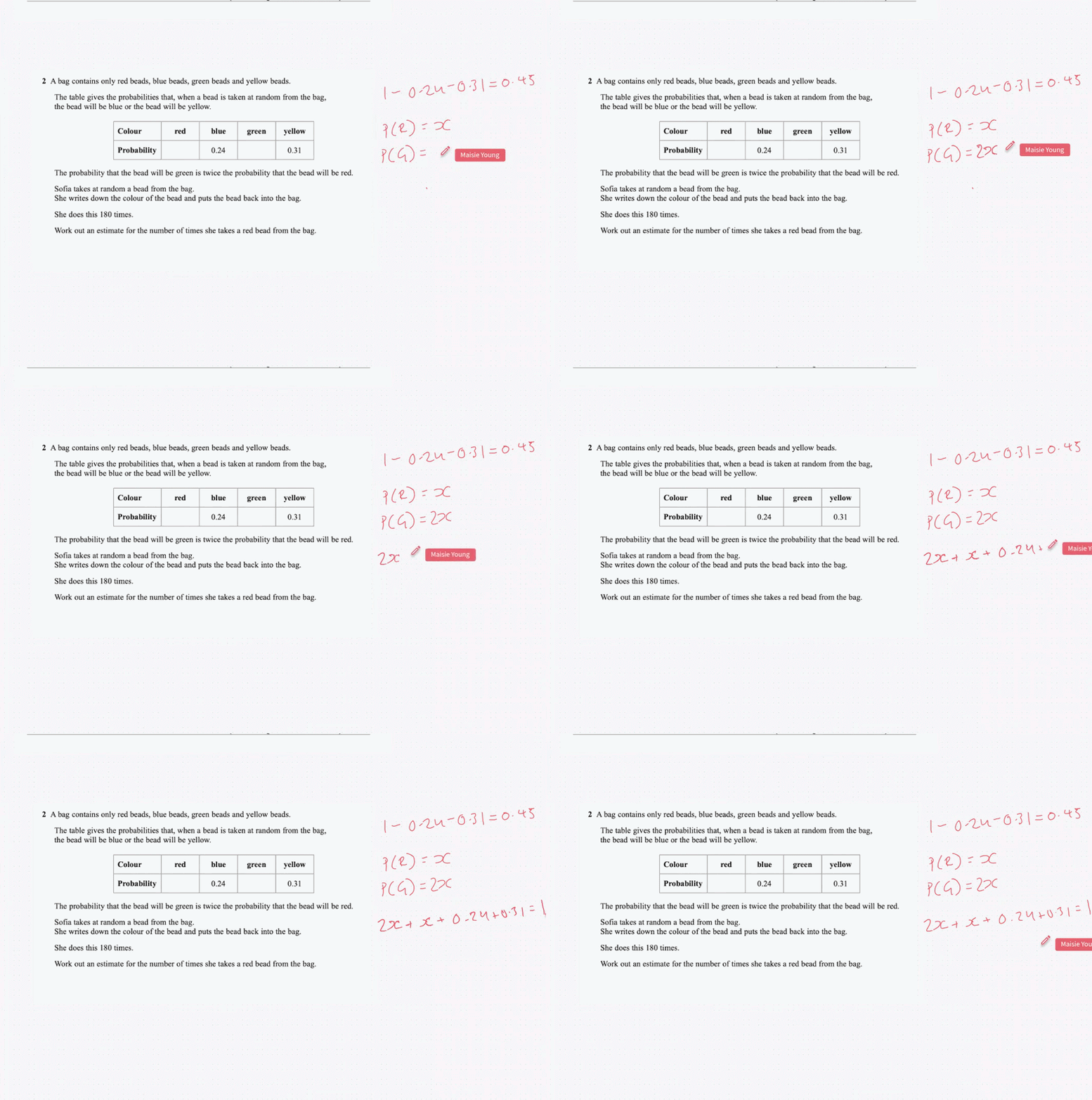
This clip shows a maths lesson recorded in Pencil Spaces, the online classroom used by Greenhill Academics.
Our GCSE Maths tutors

Maisie specialises in Maths and the Sciences and is a final-year Molecular Biochemistry MSci student at the University of Oxford. She teaches GCSE Maths with Greenhill.

Murray specialises in Maths, Chemistry and Physics, and supports students from 11+ through GCSE to A level. He teaches GCSE Maths with Greenhill.
Questions parents ask us
My child does the calculation right but the answer is marked wrong. Why?
The maths can be fine and the problem is the way the answer is written. If the question asks for standard form, the first number has to be between 1 and 10. An answer like 16 × 10¹¹ has the right value but is not yet in standard form. Writing it the right way is the part to check.
What exactly is standard form?
A number written as A times 10 to a power, where A is 1 or more and less than 10, and the power of 10 is an integer, so it can be positive, zero or negative. So 3.2 × 10⁵ is standard form, but 32 × 10⁴ is not, even though they are equal.
My child keeps writing the first number too big or too small. What helps?
A quick habit helps. After the sum, look only at the first number and ask if it is between 1 and 10. If not, move the point and change the power to match. The same careful-writing habit sits behind getting significant figures right.
Do you tutor GCSE Maths online?
Yes. We tutor GCSE Maths online for UK and international families. It is the same close attention to how an answer is written that we bring to writing units and powers carefully. Tell us where your child gets stuck, and we can talk through the help they need.
How quickly can this improve?
It depends on the child. The check itself is quick to learn, but using it without being reminded takes a little practice. A tutor can show you what that looks like.
Want a tutor to work on GCSE Maths with your child?
Tell us where your child gets stuck, and we can talk through the help they need.
Send an enquiry