

Getting a 7 in IB Physics is not about working harder. Indeed, by the time your child reaches Year 13, they have usually put in the hours. However, the students who land a 7 do something different. They handle data with confidence, they read command terms accurately, and they make their Internal Assessment count. Everything else flows from that.
This guide explains how to get a 7 in IB Physics under the new syllabus that first sat in May 2025. We cover the five-theme structure, the new Paper 1 and Paper 2 format, the Internal Assessment, and the difference between HL and SL. Whether your child is targeting medicine, engineering, or pure physics at university, the strategies below apply.
Where the 7 actually comes from
Most students at the 5-to-6 boundary know the content. What separates them from a 7 is exam technique. They handle Paper 1B data with confidence. They use command terms accurately on Paper 2. Most importantly, their Internal Assessment scores in the top band on data analysis and evaluation. In short, the lift comes from technique, not more content.
Want a 7 in IB Physics?
Our Oxford and Cambridge-educated tutors work with IB families across both HL and SL Physics. They focus on the exam technique, data fluency, and IA approach that earn the top grades. Sessions run online and adapt to your child’s school timetable.
What changed in the new IB Physics syllabus
The IB redesigned the Physics course for first assessment in May 2025. Therefore, your child’s exam sits under the new format, so the old advice from older guides no longer applies. In summary, three changes matter most.
Five themes replace the old topic list
The new IB Physics syllabus groups all content into five themes. These are Space, Time and Motion (Theme A); the Particulate Nature of Matter (Theme B); Wave Behaviour (Theme C); Fields (Theme D); and Nuclear and Quantum Physics (Theme E). Together these themes cover 24 compulsory topics. Your child’s school may teach the themes in a different order, but the content is fixed. There are no longer any optional pathways.
HL adds five additional subtopics
Higher Level students study everything an SL student covers. They also add five subtopics: Rigid Body Mechanics (A4), Special Relativity (A5), Thermodynamics (B4), Electromagnetic Induction (D4), and Quantum Physics (E2). The HL course also requires deeper conceptual treatment of the shared themes. In practice, HL students need around 240 teaching hours compared to 150 hours at SL, and they sit longer papers.
Paper 3 has been removed
The old Paper 3 (with options like Astrophysics, Engineering Physics, and Relativity) no longer exists. Consequently, all assessment now happens through two written papers and the Internal Assessment. This simplifies preparation, but it also means Paper 1 and Paper 2 carry more weight. As a result, every mark counts more than it did under the old format.
Want a tutor who knows the new IB Physics syllabus?
Tell us your child’s school, board, and current grade. We’ll match them with a tutor who has worked through the new format from day one.
How to get a 7 in IB Physics Paper 1
Paper 1 is now split into two booklets that students sit back-to-back. The first booklet, Paper 1A, is multiple choice. Meanwhile, Paper 1B is data-based. Together they account for 36 percent of the final grade. The skills they test are completely different, so your child needs to prepare for them separately.
Paper 1A: 25 questions at SL, 40 at HL
Paper 1A is multiple choice with no negative marking. Notably, the trick is pace. Top performers move through the easy questions in under 30 seconds each, banking marks before they slow down on the harder ones. In addition, calculators are now allowed in Paper 1, so quick numerical estimation matters as much as algebra. Your child should practise timed sets of past paper MCQs every week, then review every wrong answer. For example, the same question types recur with small variations year to year.
Paper 1B: data-based questions across all themes
Paper 1B is where many students lose marks they should have banked. Specifically, it is 20 marks of data-based questions that test graph reading, error analysis, and the ability to spot trends in unfamiliar contexts. The data can come from any of the five themes, so your child cannot revise it by topic. Instead, they need to drill the skills: reading axes carefully, identifying outliers, calculating gradients, propagating uncertainties, and writing concise explanations of what the data shows. Tutors at the top end of IB Physics teaching focus heavily on this section. Indeed, students who score 7s on Paper 2 often drop marks on Paper 1B without knowing why.
How to get a 7 in IB Physics Paper 2
Paper 2 is worth 44 percent of the grade. Specifically, SL students sit a 75-mark paper, while HL students sit a longer 90-mark version covering the additional subtopics. The questions move from short structured items to extended-response questions that often blend topics. As a result, your child cannot treat the themes as separate silos. For instance, examiners increasingly write questions that combine fields with quantum behaviour, or mechanics with energy conservation.
Build a topic mapping system
The most effective Paper 2 strategy is to build a mental map of which equations and concepts connect across themes. For example, a tutor can help your child see how the work-energy theorem in Theme A links to electric potential in Theme D. Once the map is in place, multi-topic questions become much less intimidating because your child can see the pattern. In contrast, without that map, every multi-topic question feels new.
Master the command terms
IB command terms are not interchangeable. For instance, “State” wants a single sentence. “Describe” wants two or three. In contrast, “Explain” demands a cause-and-effect chain with reasoning. “Outline” sits between describe and explain. Students who treat these as the same thing lose marks even when their physics is correct. Therefore, strong tutors drill command-term technique by reading mark schemes alongside model answers until your child can predict the marks before reading them.
How to get a 7 in IB Physics through the Internal Assessment
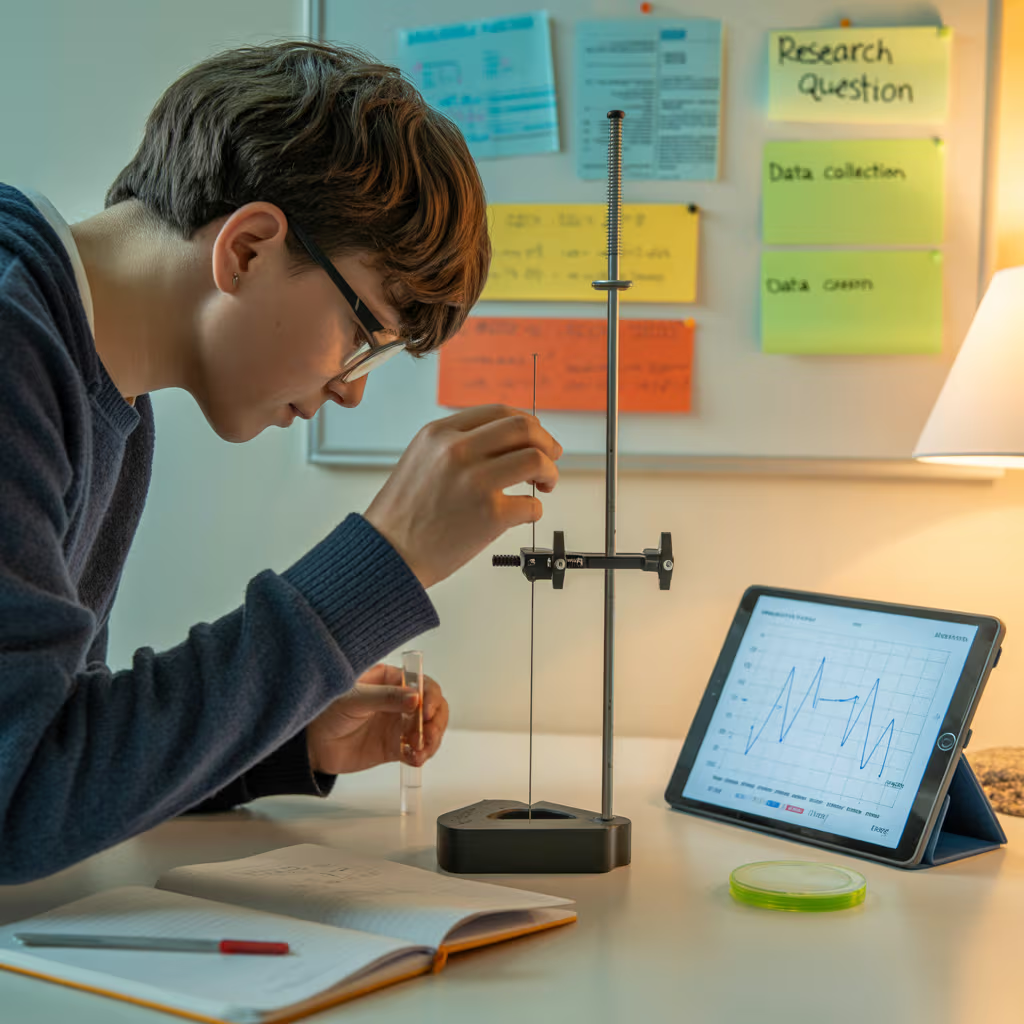
The Internal Assessment is worth 20 percent of the final IB Physics grade. Notably, that is a significant block of marks your child controls before they sit any external paper. Specifically, the IA is a student-designed scientific investigation of around 3,000 words, with roughly 10 hours of work. It is assessed on Research Design, Data Analysis, Conclusion, and Evaluation.
Choose a research question that earns marks
The most common IA mistake is choosing a topic that is too broad. In contrast, a 7-scoring IA has a tight research question with clearly defined dependent and independent variables and controlled conditions. Your child does not need an exotic experiment. Indeed, a well-executed investigation of a familiar phenomenon outperforms an ambitious one with messy data. Furthermore, tutors who have marked or moderated IAs spot a doomed research question quickly. They redirect your child before hours get wasted in the lab.
Data analysis and uncertainty propagation
Top-band IAs propagate uncertainties properly, justify graph choices, and use linear regression where appropriate (LINEST in Excel earns marks here). Specifically, your child should be comfortable converting non-linear relationships into straight lines so they can extract gradients with confidence intervals. Furthermore, the Evaluation section then needs specific, quantitative reflection on what went wrong and what improvement would change. In contrast, vague evaluations cap the grade.
Which Oxbridge tutors help students get a 7 in IB Physics?
The right tutor lifts an IB Physics grade band in a single term. They diagnose where marks are leaking, fix the technique, and model the kind of answer the examiner rewards. Below are three Greenhill tutors who work with IB families across HL and SL Physics.

Martin
Martin is reading for a PhD in Applied Maths and Theoretical Physics at the University of Cambridge. Before that, he earned a Distinction MSc at Oxford and a First Class BSc at Bath. At school, he was awarded the highest AS Level Physics mark in the country in 2017 and achieved A*A*A*A at A Level. Martin combines deep theoretical physics knowledge with structured, clear explanations. This works particularly well for IB Physics HL students tackling Special Relativity and Quantum Physics.

Hugh
Hugh recently completed a DPhil in Surgical Sciences at the University of Oxford and holds a First-Class MSci in Theoretical Physics from Imperial College London. He tutors IB Maths, Maths, Further Maths, and Physics at all levels, with over a decade of experience. Over 20 of his recent students have exceeded their predicted grades or secured places at leading universities. Hugh is particularly effective at reframing tough concepts from multiple angles, which makes him a strong fit for IB Physics students stuck at the 5-to-6 boundary.

Murray
Murray is in his final year of an MEng in Materials Science at the University of Oxford (Trinity College), on track for a First Class degree. He was awarded the Worshipful Company of Armourers and Brasiers Award for ranking first in his cohort. At A Level, he achieved A*A*A* in Maths, Chemistry, and Physics. Murray has 150+ hours of tutoring experience. He works particularly well with IB Physics students who are also preparing for the Physics Aptitude Test (PAT) and Oxbridge interviews.
When should your child start IB Physics tutoring?
The earlier your child builds the right habits, the smoother Year 13 becomes. In general, most families benefit from starting in Year 12 (DP1), once your child has settled into the course and seen the first set of teacher feedback. Specifically, a tutor at this stage diagnoses technique gaps before they harden. They plan the IA early and make sure your child enters mocks with confidence rather than anxiety.
Year 13 (DP2) students can still get a 7 in IB Physics with a focused block of weekly sessions. Eight to twelve weeks is often enough to move a 5 to a 6 or a 6 to a 7. The key is choosing a tutor who can mark IAs quickly. They should give specific feedback on Paper 2 essays and rebuild Paper 1B data technique under time pressure. For families thinking ahead to UK university applications, the same tutor often supports physics-related admissions tests like the PAT (Oxford) and ESAT (Cambridge), plus interview preparation. Our guides on how to get a 7 in IB Chemistry and how to get a 7 in IB Biology are useful companions. Each helps if your child takes more than one science.
Expert IB Physics tutoring with Greenhill Academics
TARGETED SUPPORT FROM OXFORD AND CAMBRIDGE GRADUATES
Our IB Physics tutors identify the technique gaps costing your child marks. They then close them before the next exam.
Part of our IB grade guides series
This post is part of a series for parents whose children sit the International Baccalaureate Diploma Programme. Each guide covers the technique that lifts a grade band, written by an Oxbridge tutor who has worked with IB students directly.
Other guides in the series:
→ IB Biology: How to Get a 7
→ IB Chemistry: How to Get a 7
→ IB Maths AA: How to Get a 7
→ All IB Tutoring
Frequently asked questions about getting a 7 in IB Physics
