

What you need to know
- Some students revise properly but still have a topic that is not secure.
- A topic that was covered quickly can look like one your child has forgotten. The tutor needs to check before deciding what to teach.
- Ask your child to explain a topic out loud. What happens next shows whether the topic itself is secure or the marks are being lost later.
- What looks like a Chemistry problem is sometimes a maths problem underneath.
- A tutor will usually check what is secure before adding more content.
They revise properly and the Chemistry grade stays put
Your child revises. You have watched them do it. They sit at the desk, work through the questions, and can talk you through a reaction mechanism over dinner. Then the paper comes back and the grade has not improved. Nothing you can see explains it, and neither can they. That is usually when you start wondering whether an A Level Chemistry tutor would help. More of the same revision may not be enough.
Here is the first thing to hold on to. A stuck grade does not automatically mean your child is lazy or bad at Chemistry. One topic may not be secure. It may have been covered quickly at school, forgotten over time, or not fully understood the first time. When that topic appears, your child may guess. On the paper, this can look like weak understanding. The fix for a missing idea and the fix for a shaky one are different.
They revise the topic, but the same questions still go wrong
Guessing can look like weak understanding. A student who has revised everything they were given can still meet an exam question about an idea that is not secure. They recognise the words, pick the answer that looks most likely, and move on. On the mark sheet, that can look just like weak Chemistry.
A tutor will often check what is secure before adding more content. More content may not help until the tutor knows which idea is not secure.
They seem to know the topic, so where are the marks going?
Pick one topic from a recent test where marks went missing. Do not ask your child to answer a question on it. Ask them to explain the idea out loud, as if you knew nothing about it.
Ask them to explain it tonight
The check
Ask your child to explain the idea in their own words. They should teach it to you, not answer a question on it.
Outcome one
They cannot explain the basic idea. The topic is not secure yet. Check their notes and specification before deciding whether it was missed or forgotten.
Outcome two
They can explain the idea but still lost marks. Look at application, calculations, precision and exam technique.
Both outcomes give you a clear place to start.
Once the tutor knows what needs work, they can teach the theory through a question. Jessica explained this while introducing exponential modelling:
From a real lesson
“I’ll teach you the theory through a question.
”
Jessica, A Level Chemistry tutor
Jessica said this in a July lesson while introducing exponential modelling. She starts with the question and explains the theory as they work through it.
Working through a question can show the tutor where your child gets stuck. The check at home gives you an earlier clue about which topics need attention.
Your homework this week
Run the check on one topic tonight. Try a second topic later in the week. If your child cannot explain either, you may have found topics that are not secure. Write down which topics they were, because that list gives the tutor a useful starting point.
Every test seems to go wrong for a different reason
Each name below is invented, and each story blends details from more than one student. The problems and the fixes are real.
Dara understood most topics but had missed one definition
Dara could balance equations and explain bonding without notes. On acids and bases, she went quiet. Her tutor asked her to define a conjugate acid. She could not. Her class had moved quickly through the topic, and the definition had not stuck. For two years she had been reading those questions, recognising the words, and picking the answer that looked most likely. Ten minutes on the definition changed it. Most of her Chemistry was secure. One definition was missing.
Femi did the Chemistry right and still lost the marks
Femi’s Chemistry was correct and his answers still came back marked down. His pH answers did not use the precision the question required. His tutor taught him a check that takes three seconds. In the question Femi was answering, a pH of 13 for the acid would have been a warning sign. A pH of 2.5 for the base would also have looked wrong. Femi fits outcome two. He understood the Chemistry but needed better checking habits.
Ines had a Chemistry grade and a maths problem
Ines came to us after a disappointing mock. She expected to relearn strong bases. Her tutor found that she understood the Chemistry well. What she could not do was rearrange the equation to get the value the question wanted. Some Chemistry marks are lost because the algebra underneath is weak. Ines’s tutor worked on rearranging equations inside Chemistry questions, so the maths was taught where she would meet it.
Does the same Chemistry grade mean they are falling behind?
A grade that has not improved does not automatically mean your child is falling behind. It means the reason needs to be identified before they spend more time repeating the same revision.
In the 2025 results, [X]% of A Level Chemistry entries received an A or A*. A total of [Y]% received a C or above. These figures cannot explain why one student’s grade is stuck, but they show that top grades are far from automatic.
The next step is finding what is holding your child back.
Did the check show that a topic is not secure?
Tell us which topics your child could not explain and which exam board they take. We will match them with a tutor who can start there.
Book a LessonWill an A Level Chemistry tutor help if school is already covering the course?
The lessons can still help because they do a different job. One-to-one lessons give the tutor time to look closely at your child’s work. The tutor first checks what your child understands. They may ask your child to talk through a question before answering it.
From there, the work goes where it is needed. If the topic is not secure, the tutor checks what your child understands. They can then explain the missing part or move into exam practice. If algebra is causing the problem, the tutor works on it inside Chemistry questions. The lessons follow your child’s specification and exam board. This keeps the work relevant to their exams.
You receive a written report after every lesson. The report shows what was covered and what still needs work. The tutor adds follow-up practice to the shared board. Homework reminders are sent by email.
Inside a lesson
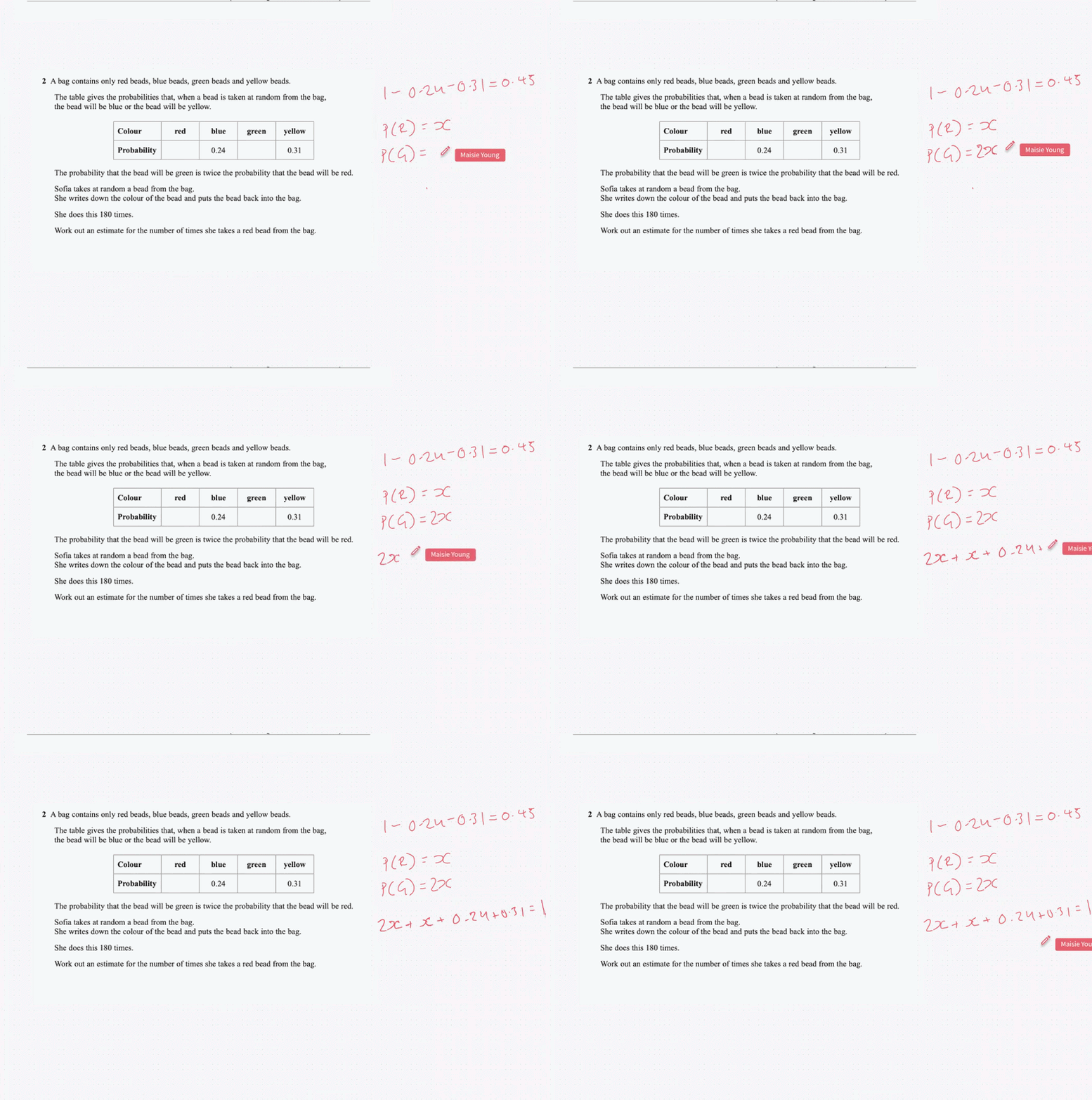
This clip is from a real Greenhill Academics lesson, recorded live. It shows a maths lesson on the same shared board your child would use in Chemistry, with the question and the working side by side.
Who your child would work with
The Chemistry tutors who check what is secure first

Karol · Chemistry, Cambridge
Karol read Natural Sciences at Cambridge and is completing a PGCE in Chemistry there. His teacher training helps him identify the topics that need clearer explanation or further practice. He teaches Chemistry, Maths and Further Maths.

Morgan · Chemistry, Oxford
Morgan is reading Chemistry at Oxford, where he won an academic scholarship after First Class results in his first year. He took A* Chemistry, Biology and Maths at A Level and nine grade 9s at GCSE. He is calm with students who have lost confidence, and he shows them the reasoning rather than the trick.
Jessica · Chemistry and Biology, Cambridge
Jessica is in her fourth year of Medicine at Cambridge, having taken A*A*A*A at A Level in Maths, Further Maths, Chemistry and Biology. She knows where the maths inside Chemistry catches students out, and she teaches the two together rather than treating them as separate subjects.
Questions parents ask about A Level Chemistry
How do I know if my child missed a topic at school?
Ask your child to explain the topic without notes. If they cannot explain the basic idea, the topic is not secure. Their notes and specification may help you see whether it was covered, forgotten or misunderstood.
My child says Chemistry is fine but the grade is not. Why?
Sometimes the Chemistry is secure, but the algebra underneath it is not. Rearranging equations can then cost marks, and because the subject is Chemistry, the maths is easy to miss.
How quickly can a tutor tell what is wrong?
A tutor can often tell within the first lesson. Asking a student to talk through a question can show whether they understand the method or are relying on a guess.
Is a tutor worth it if school is already covering the course?
One-to-one lessons give the tutor time to look closely at your child’s work. The value is not simply more content. It is finding the exact topic, calculation or exam habit holding the grade back.
How soon could we start?
We can often start within a few days. Book a short call, tell us which exam board your child sits, and we will arrange a first lesson at a time that works for you.
They are putting the work in. The next step is finding what is holding the grade back.
Tell us which exam board your child sits and what happened in the explain-it-out-loud check. We will match them with a tutor who can start with what you found.
Book a Lesson