

If your child is applying for Oxford Physics, you may be unsure what to prepare now that the admissions test has changed. This guide explains what the ESAT for Oxford Physics covers, the three required modules and an exercise to try at home. It covers 2027 entry, with the test taken in autumn 2026.
The essentials
- Every Oxford Physics applicant now sits the ESAT. It is the test that follows the PAT.
- Physics applicants take three set modules: Mathematics 1, Mathematics 2 and Physics. There is no choice to make.
- Each module is 27 multiple-choice questions in 40 minutes, on screen, with no calculator. You do not lose marks for a wrong answer.
- The test is sat from 12 to 16 October 2026, and the booking deadline is 28 September 2026 at 6pm UK time.
- Much of it builds on maths and physics your child has already studied. We show what each module covers below.
Your child now sits the ESAT, not the PAT
For years, Oxford Physics used the Physics Aptitude Test, the PAT. That is the previous test. Oxford Physics now states that everyone who applies for Physics or Physics and Philosophy, without exception, must take the Engineering and Science Admissions Test, the ESAT.
Oxford points applicants towards PAT resources for interview preparation. For the ESAT itself, use the current specification and official specimen materials.
The three modules Oxford Physics asks for
The ESAT is built from short modules, and Oxford Physics sets three of them. They are the same for every applicant, so your child does not pick and choose. Oxford’s Physics course page lists all three by name.
- Mathematics 1. The core maths module that every ESAT candidate takes.
- Mathematics 2. Additional mathematical topics, with Mathematics 1 knowledge also assumed.
- Physics. The physics module, which assumes the Mathematics 1 content.
Physics and Philosophy applicants sit the same three modules, so this guide applies to them too.
What the ESAT for Oxford Physics covers
Here is the useful part, which is what sits inside each module. The topics come from the official ESAT specification, and much of it builds on maths and physics your child has already studied. Mathematics 1 is assumed knowledge for both the Physics and the Mathematics 2 modules.
Mathematics 1
Units and conversions, working with numbers, ratios, algebra, geometry, and some statistics and probability. For example, your child might change one unit into another before they compare two values.
Mathematics 2
More algebra and functions, sequences and series, coordinate geometry, trigonometry, exponentials and logarithms, differentiation and integration, and reading graphs of functions. For example, your child might differentiate a function to find the slope of its graph.
Physics
Electricity, magnetic effects, mechanics, thermal physics, matter, waves, and radioactive processes. For example, your child might work out the current in a simple circuit.
These are the main areas, not a promise that every topic shows up in every sitting. The full list is in the official ESAT specification, which is worth reading with your child alongside the module guides. For a plain overview of the test itself, our guide to what the ESAT is and how to prepare is a good next read.
How the test is set out
The shape of the test is easy to picture. Each of the three modules has 27 multiple-choice questions and its own 40-minute limit, and time does not carry over from one module to the next. You can see the format on the official ESAT page.
That is 120 minutes of standard test time in total. Every module is on screen, with no calculator. Your child gets a separate score for each module, reported from 1 to 9, and there are no marks lost for a wrong answer and no single pass mark.
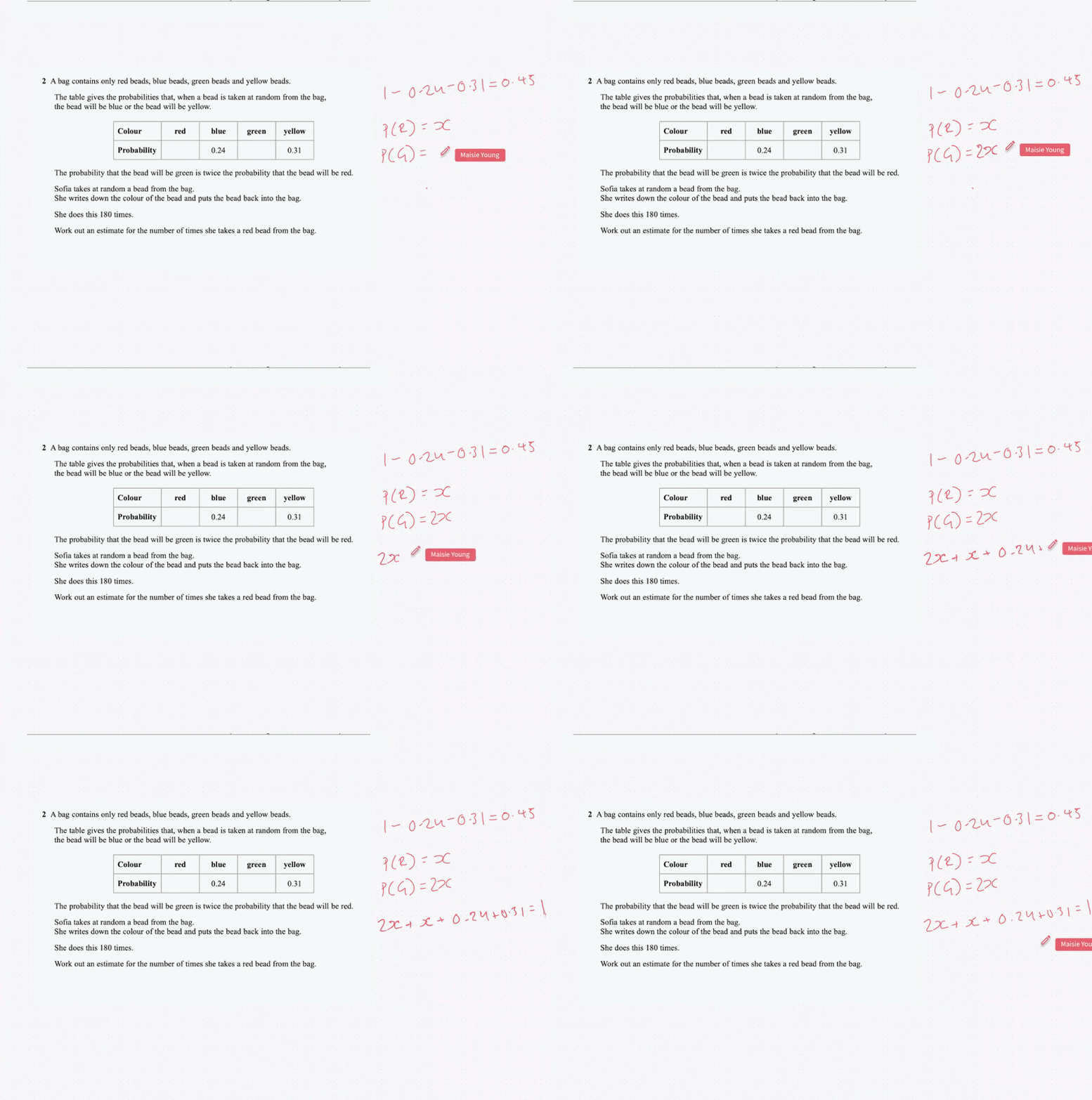
This clip shows a maths lesson recorded in Pencil Spaces, the online classroom used by Greenhill Academics.
Want help getting ready for the ESAT?
Send us your child’s course and the modules they need, and we can talk through where to start.
Send an enquiryThe dates that matter
A few dates are worth writing down. Your child books the test through the official UAT-UK system, not through us and not through Oxford.
- October 2026 booking deadline: 28 September 2026, 6pm UK time.
- Test window: 12 to 16 October 2026.
- Results: 16 November 2026.
Candidates sitting the test in China, Hong Kong or Macau take the ESAT on 12 or 13 October. January is not a backup sitting for a standard Oxford Physics application. You can check the timetable on the UAT-UK deadlines page.
Try this at home in eight minutes
You can do this in about eight minutes. It is our own short exercise, not a real ESAT question. You need paper, a pen and a timer, and no calculator. An object travels these total distances:
| Elapsed time | Total distance travelled |
|---|---|
| 0 seconds | 0 metres |
| 4 seconds | 8 metres |
| 8 seconds | 24 metres |
- Minutes 0 to 2: Find the distance travelled in each four-second interval.
- Minutes 2 to 4: Work out the average speed in each interval and across all eight seconds, with units.
- Minutes 4 to 6: Change the overall average into kilometres per hour, and explain the steps.
- Minutes 6 to 8: Check against the answers below, fix a step if needed, and save the working and one question for a tutor.
Answer check: the interval distances are 8 m and 16 m; the interval averages are 2 m/s and 4 m/s; the overall average is 3 m/s, which is 10.8 km/h.
What should you look for?
See whether your child uses the difference between readings, divides total distance by total time, and uses consistent units within calculations before converting correctly between m/s and km/h.
What this cannot tell you
This cannot show ESAT readiness, cover all three modules, explain why a topic is hard, or predict a score or an offer. The timings are for this exercise, not exam pacing, and two different interval averages do not mean the speed rose steadily.
A tutor can check the units, the ratios and the motion working, then choose what to practise next. This touches specification points M1.1, M1.2 and P3.1.
Physics and maths tutors who can help
The profiles below describe each tutor’s background and teaching scope. Tell us your child’s course and what they would like help with. You can also see our A-level physics tutors and our admissions consulting.

Lucas is completing a PhD in Aeronautical Engineering at the University of Oxford. He teaches Maths and Physics, and offers dedicated ESAT preparation across the maths and physics modules.

Murray is studying Materials Science at the University of Oxford (Trinity College). He teaches Maths, Chemistry and Physics, and supports students with Oxbridge admissions.

Hugh holds a DPhil in Surgical Sciences from the University of Oxford and a First-Class MSci in Theoretical Physics from Imperial College London. He teaches Maths, Further Maths and Physics up to university entrance.
Questions about Oxford Physics and the ESAT
Has my child wasted the time they spent on the PAT?
That depends on what they practised. Oxford points to PAT resources for interview preparation. For this test, use the current ESAT specification and official specimen materials.
Which ESAT modules does Oxford Physics need?
Three: Mathematics 1, Mathematics 2 and Physics. They are set for every Physics applicant, so there is no choice to make.
Is a calculator allowed in the ESAT?
No. The ESAT is sat on screen with no calculator. There are no marks lost for a wrong answer, so it is worth attempting every question.
When is the ESAT and how does my child book it?
The test is sat from 12 to 16 October 2026, and the booking deadline is 28 September 2026 at 6pm UK time. Booking is through the official UAT-UK system, not through us or Oxford. Candidates sitting in China, Hong Kong or Macau take the ESAT on 12 or 13 October.
Are there official materials to prepare with?
Yes. UAT-UK provides free preparation materials, including the specification, module guides and specimen tests. Use the specification to identify topics and the specimen tests to practise the test format.
Still unsure what the ESAT means for your child?
Tell us the course and where they are up to, and we can talk through how we would help them prepare.
Send an enquiry