

Maybe your child gets the science but keeps muddling two answers that look almost the same: m/s and m/s². The working is right, the quantity is wrong, and a mark your child understands is gone. In GCSE Science, m/s and m/s² are not the same thing: one is a speed, the other is an acceleration. Reading that difference is how your child tells the two apart.
The short answer
- m/s is the unit for speed (how fast) and velocity (how fast, and in which direction).
- m/s² is the unit for acceleration: how much the velocity changes each second.
- The two look almost identical on the page, which is where the mix-up can happen.
- Reading the unit first, and letting it tell you which quantity you are dealing with, is a useful check.
- Your child can check this on a GCSE Science paper they already have, in about ten minutes.
Where speed and acceleration get mixed up
It happens in the last line of the answer. Your child has done the calculation, and then has to write the unit. Speed and acceleration sit right next to each other in the topic, the symbols look alike, and the wrong one goes down. The science was fine. The unit was not.
It also happens the other way round. A question asks for acceleration, your child reads it quickly, works out a speed, and never notices the question wanted a change in velocity, not the velocity itself. Reading the unit is what catches both.
What m/s and m/s² each measure
Metres per second (m/s) is the unit for speed, and for velocity. Speed tells you how far something travels each second. Velocity is the same, with the direction added. A car at 20 metres per second covers 20 metres every second.
Metres per second squared (m/s²) is the unit for acceleration. It tells you how much the velocity changes each second. A car accelerating at 3 metres per second squared has its velocity change by 3 metres per second every second. So one unit is about how fast something is going; the other is about how quickly its velocity is changing. The “squared” is the clue.
A unit check: read the unit, find the quantity
Here is the habit, side by side. Before writing a final unit, your child reads it and names the quantity it belongs to. The panel below is the whole check.
The unit for speed and velocity. Speed answers “how fast?”; velocity adds the direction. If the question asks how fast something is going, the answer ends in metres per second.
The unit for acceleration. It answers “how quickly is the velocity changing?” If the question asks for acceleration, the answer is expressed in metres per second squared.
Read the unit, name the quantity, then check it against what the question asked. That is the whole habit.
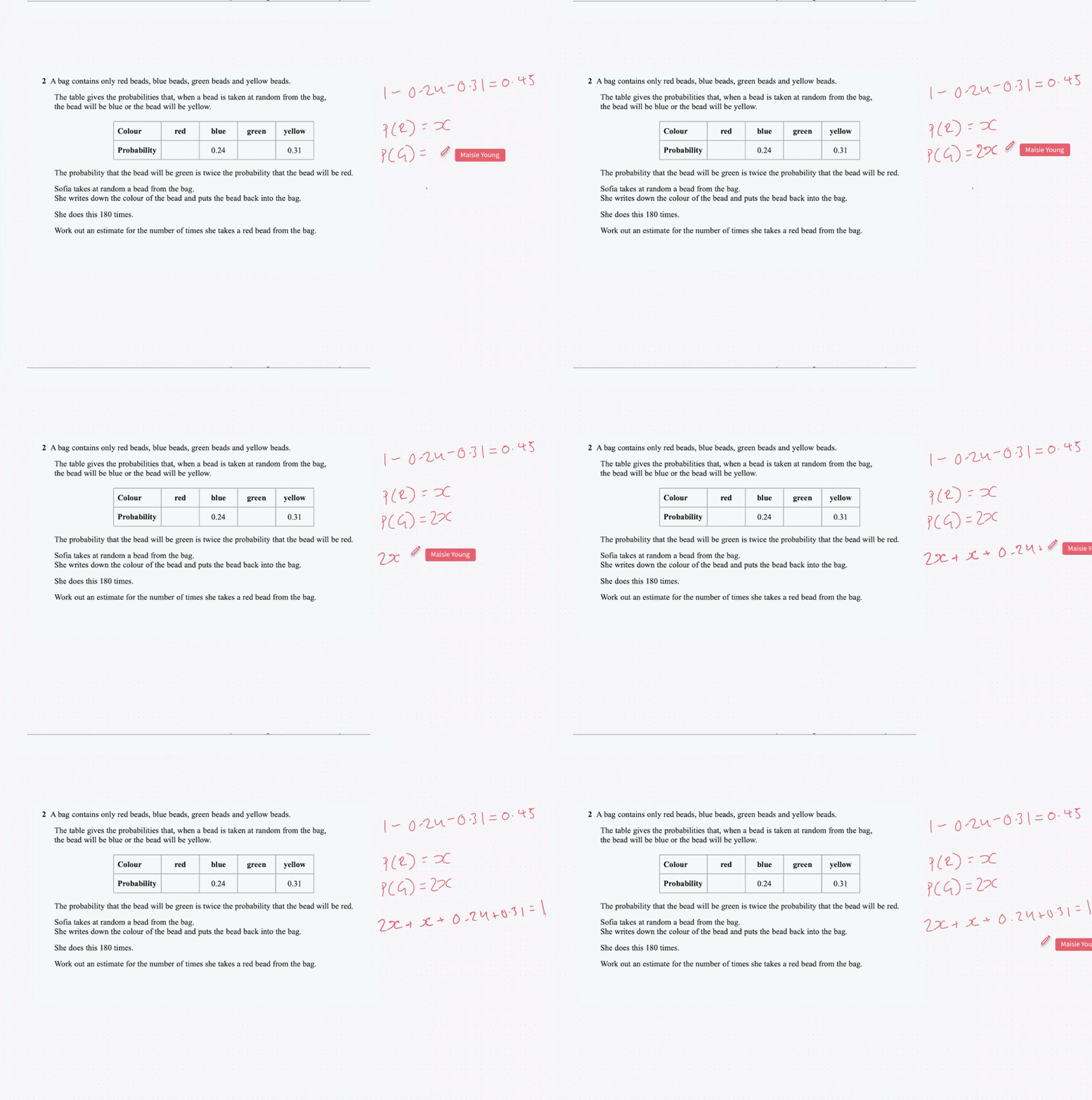
This clip shows a maths lesson recorded in Pencil Spaces, the online classroom used by Greenhill Academics.
Not sure if it is the science or the units?
Tell us how your child’s answers go wrong. A tutor can look at where the answers slip and see whether it is the units or the science.
Ask about a tutorTry this at home: a unit check on a marked paper
You can do this in about ten minutes. You need one of your child’s marked GCSE Science papers. You are only checking units, not re-marking the whole paper.
- Find the final answers (2 minutes). Go through the paper and circle the unit on every final answer.
- Name each one out loud (4 minutes). For each, your child says whether it is a unit of speed or velocity (metres per second) or a unit of acceleration (metres per second squared).
- Check it against the question (3 minutes). For each one, check the unit matches what the question actually asked for.
- Mark the mismatches (1 minute). Put a dot next to any answer where the unit did not match the question.
What should you look for?
If the quantity is right but the unit is wrong, that may suggest a unit-reading habit, and the check above is what to practise. If the quantity itself is wrong, that may point to a knowledge gap instead. One ten-minute check cannot establish the cause on its own, and it cannot set the overall grade or cover every GCSE Science topic. It only shows where units are being read and matched. A tutor can take the same paper, work through it with your child, and practise the unit check on the relevant answers.
Want a tutor to build this habit with your child?
Tell us the exam board and where the science is going. A tutor can start with a paper your child has already sat.
Send an enquiryHow a tutor builds the unit habit
In a lesson, a tutor watches your child answer under timed conditions and sees the moment the unit goes down. They stop at that line, ask “speed or acceleration?”, and have your child read the unit back.
Then they practise it on the questions where it matters, from motion graphs to the equations your child uses, so the unit check becomes part of how your child answers. There is no promise of a set grade. The aim is simple: help your child read and match the unit on the questions that ask for it.
The tutors who can help
These tutors studied at Oxford, Cambridge and Imperial, and teach GCSE Science and Maths. They work on the small habits, like reading units, that keep marks your child has earned.

Murray is in his fourth year of an MEng in Materials Science at Trinity College, University of Oxford, with A* in Maths, Chemistry and Physics at A Level. He teaches Maths, Chemistry and Physics from GCSE to A level, and has a Bronze in the first division of the Senior British Physics Olympiad.

Jessica is in her fourth year of Medicine at the University of Cambridge, after a degree in Psychology, with A*A*A*A* at A Level and 12 A* at GCSE. She teaches Biology, Chemistry, Maths and Physics, from GCSE to university entrance.

Jenna is studying Molecular Bioengineering at Imperial College London, with First-Class results and a place on the Dean’s List, and A*A*A*A at A Level in Chemistry, Biology, Maths and Further Maths. She teaches Maths, Chemistry, Biology and Physics to students aged 11 to 18.
Questions parents ask us about speed and acceleration units
My child knows the science, so why do they keep getting the units wrong?
Knowing the science and reading the unit are two different habits. Speed and acceleration look alike on the page, so the wrong unit can go down. A useful next step is to practise a unit check.
What is the actual difference between m/s and m/s²?
Metres per second (m/s) is the unit for speed: distance travelled each second. Velocity is the same, with direction added. Metres per second squared (m/s²) is the unit for acceleration: how much the velocity changes each second. The “squared” is the signal.
Is this only a physics thing, or does it matter for combined science?
The distinction matters in GCSE Science questions that use speed, velocity and acceleration. The meanings of m/s and m/s² do not change, so the same unit check can be practised on these questions.
How do I know if it is the units or the concept?
The ten-minute check can give you a clue. If only the unit is wrong, that may be a reading habit. If the quantity itself is wrong, the idea may need work first.
What can a tutor do that we cannot do at home?
A tutor can watch your child answer under timed conditions, notice when the unit goes wrong, and practise the “speed or acceleration?” check on the relevant answers.
Want a tutor to practise the unit check with your child?
Tell us the exam board and how the science is going, and we can talk about a plan to practise the unit check on the relevant answers.
Send an enquiry