

The short answer
- HL maths is harder than GCSE, but a low grade is not always a knowledge gap.
- Many capable students lose marks working out what the question wants, before any maths starts.
- One marked question and ten minutes at home can show whether your child needs help interpreting the question or checking the working.
- Ask them to explain what the question is asking before they write anything. What happens next tells you what to fix first.
- AA and AI trip students in different ways, so the fix depends on whether they take AA or AI.
They do the maths at home, then lose marks in the HL paper
Your child was good at maths. Then Higher Level started. Now they leave tests saying they ran out of time or did not understand the question. At home, they often know the method. That is usually when you start wondering whether an IB Maths HL tutor would help.
Here is the first thing to hold on to. HL maths is genuinely harder than what came before it. The course goes deeper and further. The IB recommends 240 teaching hours for an HL subject compared with 150 at Standard Level. But a harder course is not the only reason a capable student’s grade drops, and it is often not the main one. Before anyone books anything, one question at the kitchen table can help you see what is actually going on.
They understand the topic but cannot start the question
Your child may know the topic and still leave the page blank.
Long set-ups, extra details and late instructions can make the first step hard to see. Some students lose time before the maths even begins.
Schools do not always teach students how to turn a long question into a method. Your child may know the maths but struggle to find where to start.
Is it the maths, the wording, or both?
Take one marked question from a recent test. Choose one where your child lost marks. Do not ask them to solve it again. Ask them to explain what the question wants.
The ten-minute check to run tonight
The check
Ask your child to explain what the question wants and which details matter. They should do this before they write anything.
Outcome one
They cannot explain the question. They may need help with interpretation and method choice.
Outcome two
They explain it clearly, but the working still goes wrong. They may need help with accuracy, calculator use or checking.
Both outcomes give you a clear place to start.
Hugh made the same point while teaching a multi-part question:
From a real lesson
“It’s worth reading all parts of the question before starting.
”
Hugh, IB Maths and Physics tutor
Hugh said this during an A Level Physics lesson. The same reading habit applies when an IB Maths question unfolds over several connected parts.
Later parts of a question often tell you how to read the earlier parts. A student who starts too soon may miss the link and lose marks.
Your ten minutes this week
Run the check on one question tonight. Try it again with another topic later this week. If the same problem appears twice, you may have found a pattern. You can then decide what to work on first.
Does AA or AI change where they lose marks?
IB Maths HL has two routes. Students take either Analysis and Approaches or Applications and Interpretation. Both courses are hard, but students can lose marks in different places.
Which course is your child taking?
Analysis and Approaches (AA)
AA leans on abstraction. It uses more algebra, proof and abstract thinking. A short question can still be hard to start.
Applications and Interpretation (AI)
AI leans on context. It uses more modelling, data and real-world contexts. The maths may sit inside a longer question.
Use the same check for either course. Your child still needs to work out what the question wants before they begin.
They keep losing marks, but not always for the same reason
Each of the three students below has an invented name, and each story combines several children we have taught. The problems and the teaching are real.
Tomas knew the formulas but could not choose one
Tomas, on the Applications course, met a long question about borrowing money over several years. He knew the simple interest formula and the compound interest formula. What he did not have was a method for working out which one the question wanted, so he guessed and moved on. His tutor taught him to underline the words in the question that point at the model before touching the calculator. Tomas fits outcome one. He knew the maths but could not work out what the question wanted.
Priya knew the topic but did not recognise the task
Priya arrived with a string of grade 9s. At GCSE, she recognised familiar question types and knew what to do. IB asked her to apply the same ideas in less familiar situations.
Her tutor gave her past questions grouped by topic and asked her to say the method out loud before any working, so choosing an approach became part of her practice rather than a shock in the exam. She also fits outcome one because she needed more practice choosing an approach.
Elliot understood the question but still lost marks
Elliot could explain what each question wanted. He still lost marks by rounding too early or trusting the calculator.
His tutor taught him to estimate before calculating. The estimate helped him spot answers that did not make sense. Elliot is the reason the check has a second outcome, because his problem was execution, and more reading practice would not have touched it.
A low HL grade does not mean they are bad at maths
In the IB’s May 2025 statistics, 24,947 students took Analysis and Approaches HL. The mean grade was 4.9, and 16.2% reached a 7. More than a third finished on a 4 or lower. On Applications HL, the mean was 4.5 and 9.5% reached a 7.
Those figures cannot tell you why your child’s grade dipped, and they say nothing about any one student’s ability. What they do show is that a 7 is far from automatic at Higher Level, and that a middling grade puts your child in a large group rather than an unusual one. Reading questions well and checking answers well are both skills, and both can be taught.
Did the check show that the wording is the problem?
Tell us what happened when your child explained the question, and which course they take. We will match them with a tutor who can start with the problem you found.
Book a LessonWill an IB Maths HL tutor help if they already understand the content?
The lessons can still help. Usually, the first lesson starts with one question, not the full syllabus.
The tutor asks your child to explain what the question wants. That usually shows whether the problem is interpretation, method choice or accuracy. The tutor can then focus on the right skill.
You receive a written report after every lesson. The report shows what was covered and what still needs work.
The tutor adds follow-up practice to the shared board. Homework reminders are sent by email.
Inside a lesson
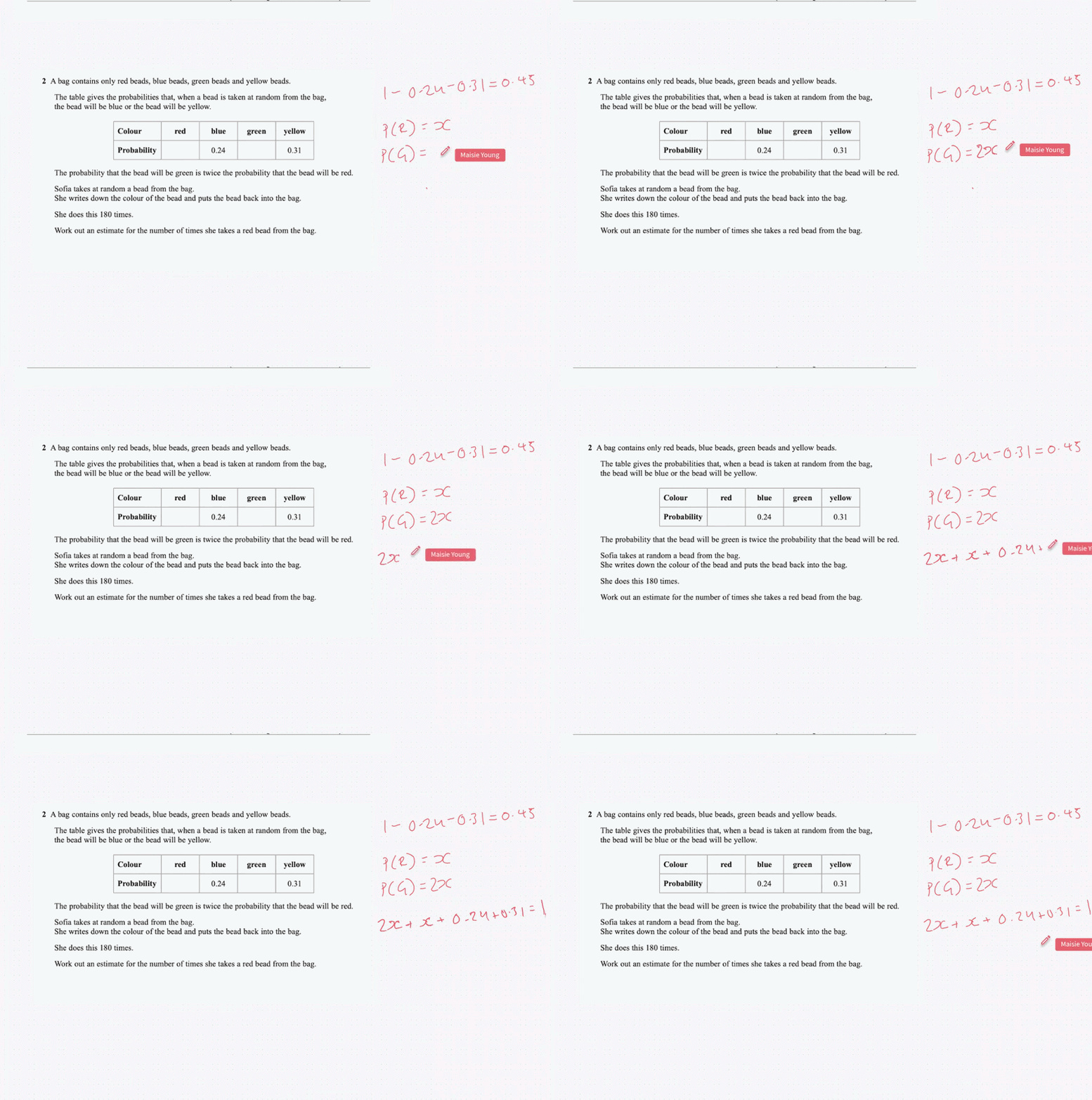
This clip is from a real Greenhill Academics maths lesson, recorded live on the same shared board your child would use, with the question and the working side by side.
Who your child would work with
The IB Maths tutors who start with the question
Hugh · Maths and Physics, Oxford
Hugh holds a doctorate from Oxford and a First Class MSci in Theoretical Physics from Imperial. He teaches IB Maths and IB Physics, and he is unusually good at taking a question that looks impossible and showing a student that the maths inside it is something they already know.

Ashruf · Mathematics, Cambridge
Ashruf read Engineering at Cambridge and finished first in his cohort for A Level Maths. He supports IB Mathematics as well as the maths admissions tests, and he is particularly strong with students who freeze on long, wordy questions.

Karol · Maths and Further Maths, Cambridge
Karol read Natural Sciences at Cambridge and is completing a teaching qualification there. He teaches IB Maths and Further Maths, and because he has trained in how maths is taught in classrooms, he is quick to spot the step a student was not actually taught.
What parents ask about IB Maths HL
Why did my child go from strong at GCSE to struggling at HL?
At GCSE, students often become familiar with the main question types. IB questions place more weight on applying ideas in unfamiliar situations, and that is a different skill. Students may not realise how different the questions will feel.
Should my child take HL or SL?
It depends on university requirements, school deadlines, current attainment and how much of their week maths can reasonably take. A tutor who has seen your child’s work can help you weigh those, rather than guessing from a predicted grade alone.
My child runs out of time in HL papers. What causes that?
Slow maths is not always the problem. Time can disappear at the start of each question, in working out what is being asked, though calculator habits and question choice can play a part too. The check helps you see whether the time is going on interpretation, calculator use or the working itself.
Do you teach both Analysis and Applications?
Yes, we teach both, at Higher and Standard Level. We match your child to a tutor who teaches their exact course, rather than a maths tutor who will pick it up as they go.
How soon could we start?
We can often start within a few days. Tell us which course your child takes, and we will arrange a first lesson at a time that works for you.
They have not stopped being good at maths. The next step is finding where they lose marks.
Tell us which course your child takes and what happened during the ten-minute check. We will match them with a tutor who teaches that course.
Book a Lesson