

Start here
- A test can feel as though it went well, because your child may not notice where the marks were lost while they are working.
- Marks may be lost for different reasons: a topic gap, trouble understanding what the question wants or problems in the working.
- Watch your child work through one past-paper question at home. Where they pause can give you an early clue.
- More practice helps most when someone has named the problem first. Otherwise the same mistake gets rehearsed.
- Our UK-based tutors teach both AA and AI at HL and SL, online, at times that fit the Dubai school day.
They think the test went well, but the grade comes back low
Your child comes out of an IB Maths test saying it went well. Then the result comes back lower than expected. When you look through the paper, the lost marks may come from different places: a word missed in the question, a slow method that used too much time or a step skipped near the end. The final grade does not tell you which one happened. That is often when a parent starts looking for an IB Maths tutor in Dubai. Families at schools such as Dubai International Academy, North London Collegiate Dubai and Repton Dubai will recognise the moment.
Here is the first thing to hold on to. A lower grade does not automatically mean there is a broad gap in your child’s maths. It also does not prove that the problem was only a small mistake. Watching them work through one recent question can give you an early clue about where to start.
They practise the topic, but the exam question looks different
Some questions look unfamiliar even when the topic has been practised. Your child may not recognise what the question is asking, may choose a longer method than necessary or may miss a step in the setup. The final answer can be wrong in each case, but the help they need is different.
The final grade alone may not show which one happened, which is why it helps to look at the working.
Is it the topic, the question or their working?
You can start that job at home. Choose one question from a recent paper or test. Ask your child to explain what the question wants before they begin. Then watch where they pause, which method they choose and whether each line of working answers the question.
Try this before Friday
Outcome one
They cannot start at all. The topic itself may not be secure. This may need direct teaching before more past-paper practice will help.
Outcome two
They start, but solve a different question. The wording may be the problem. They did the maths they recognised instead of the maths that was asked.
Outcome three
The method is right and the answer is wrong. Look at the working habits: skipped steps, no checking, or a calculator left in its case.
Each outcome suggests a different place to start.
Our tutors run the same kind of check in the first lesson, watching your child work through a recent paper. Hugh, one of the IB maths tutors below, put the first habit like this, mid-lesson:
From a real lesson
“It’s worth reading all parts of the question before starting.
”
Hugh, IB Maths and Physics tutor
Hugh said this in an A Level Physics lesson, working through a multi-part question. It is the first habit he builds in IB Maths as well.
Your ten minutes this week
Ask your child to work through one recent question tonight. Note which outcome you saw and keep the question. It gives the tutor a useful starting point for the first lesson.
More practice can repeat the same mistake
Past papers are useful, but they can reinforce the same mistake if nobody identifies what went wrong. A student may keep misreading the same instruction, choosing the same slow method or skipping the same step. Feedback makes the next paper more useful, because the practice is aimed at a specific problem.
The same grade can hide three different problems
Omar’s name is invented, and his story blends several students we have taught. So do Selin’s and Jude’s below. The teaching in each story is real.
Omar did by hand what the calculator should do
Omar treated his graphing calculator as a last resort. Faced with a quadratic or cubic, he would grind through the algebra by hand, even when the question only wanted the roots. So his tutor showed him when the calculator is the intended tool, graphing the function and reading the roots in seconds. This gave him more time for the questions at the end of the paper, which he had previously struggled to reach.
Selin knew the topic but not its disguises
Selin was solid on every topic she could recognise. Her marks dropped when a question dressed a familiar idea in unfamiliar wording, because she could not tell which topic it was testing. So her tutor drilled exactly that skill: reading a strange-looking question and asking what it is really asking for, before touching the algebra. Over the following weeks, fewer questions caught her out.
Jude had the right method and the wrong answer
Jude handled the financial maths topic well until the questions added a twist. In a loan problem, he kept forgetting to subtract the deposit from the amount borrowed, so his method was right and his answer was wrong. His tutor built him a short checklist for money questions, and the habit of reading his answer against the question before moving on. With regular practice, he began to lose fewer marks to that step.
One low grade does not tell you what went wrong
On its own, a lower grade tells you very little about what went wrong. For wider context, in the IB’s May 2025 statistics, 118,713 entries were recorded across the four IB Maths courses. At Standard Level, the mean grade was 4.5 in Analysis and Approaches and 3.9 in Applications and Interpretation.
These figures provide global context only. They cannot explain why one child received a particular grade, and that is exactly why finding the specific cause comes first.
Still unsure why your child is dropping marks?
An IB Maths tutor can review a recent paper and identify what needs work first. Tell us whether your child takes AA or AI, at Higher or Standard Level.
Book a LessonWill an IB Maths tutor in Dubai help if school is already covering the course?
Yes, because the lessons do a different job. School covers the course for the whole class. But a tutor can examine one child’s paper and working in detail, which makes it easier to identify whether the first priority is the topic, the question or the working method.
The first lesson usually starts with a recent paper. The tutor looks at the working as well as the answers and identifies the main issue, whether that is calculator use, question reading or a topic gap. They then agree a focused plan with your child, so you know what the coming lessons will work on, and why.
Our tutors teach both Analysis and Approaches and Applications and Interpretation, at Higher and Standard Level, and they work from your child’s own papers. You receive a written report after every lesson, and follow-up practice is added to the shared board. Homework reminders are sent by email.
Inside a lesson
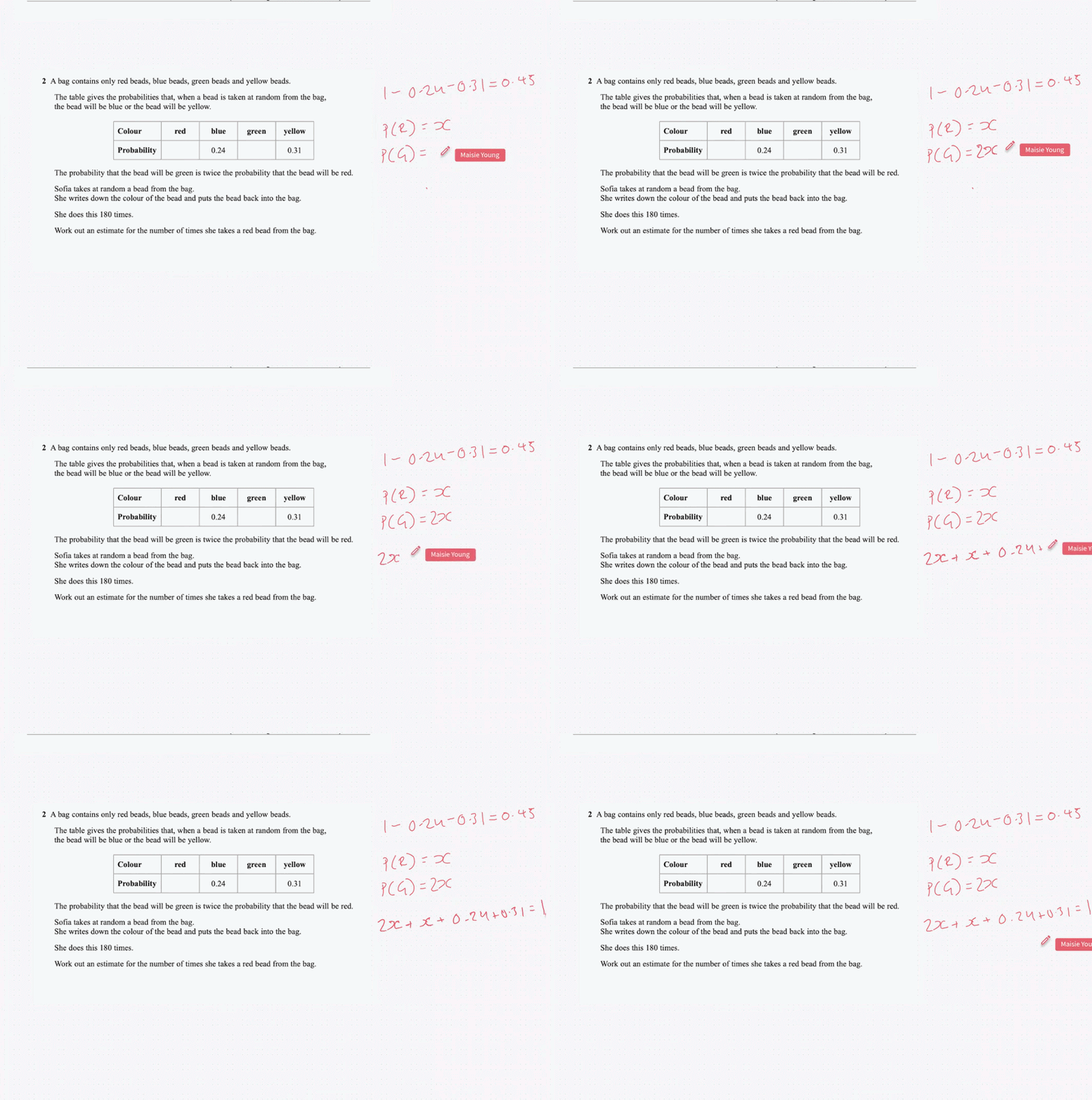
This clip is from a real Greenhill Academics maths lesson, recorded live on the same shared board your child would use, with the question and the working side by side.
Who your child would work with
UK-based IB maths tutors, teaching online across Dubai

Ejaz · Mathematics, Imperial College London
Ejaz is completing an MSci in Mathematics at Imperial and sat the IB himself, scoring 44 out of 45 with a 7 in Higher Level Maths. His own IB experience helps him understand the demands students face in the exam, and he teaches IB Maths at both levels.

Kevin · Financial Economics, Oxford
Kevin holds an MSc in Financial Economics from Oxford with Distinction and teaches IB Mathematics and Statistics. He is especially strong on the applied and financial topics, where one hidden step in a question so often separates the right method from the right answer.
Hugh · Maths and Physics, Oxford
Hugh holds a doctorate from Oxford and a First Class MSci in Theoretical Physics from Imperial. He teaches IB Maths and IB Physics, and he is particularly good at slowing a student down at the right moment, so the whole question gets read before any working begins.
Questions parents in Dubai ask about IB Maths
How do I find a good IB maths tutor in Dubai?
Look for a tutor who knows your child’s exact course, whether Analysis and Approaches or Applications and Interpretation, and who works from your child’s own papers. At Greenhill Academics we match each student with a specialist and teach online, which works well for families in Dubai.
What is the difference between AA and AI, and does the tutor need to match?
Analysis and Approaches leans towards algebra and pure maths, while Applications and Interpretation leans towards modelling, statistics and calculator work. The exams reward different skills, so the tutor should teach to your child’s exact course. Ours do, at both Higher and Standard Level.
My child thinks the test went well, but the grade is low. Why?
Often, the student does not notice the mistake while they are working. They may misread the question, skip a step or spend too long using an inefficient method. Watching your child work, at home or in a lesson, can show what the final grade alone cannot.
Are your IB maths tutors based in Dubai?
No. Our tutors are based in the UK and teach online, so your child learns from a specialist while staying at home in Dubai. Lessons can be arranged around the Dubai school day.
Can a tutor help with the Internal Assessment?
Yes. The Internal Assessment contributes to the final grade, and a tutor can guide your child on choosing a workable topic, structuring the exploration and using the maths correctly, while keeping the work entirely their own.
Find out what is costing your child marks in IB Maths
Tell us which course your child takes and share a recent paper, or what you noticed in the one-question check. We will match them with an IB Maths tutor who fits their course and starting point.
Book a Lesson