
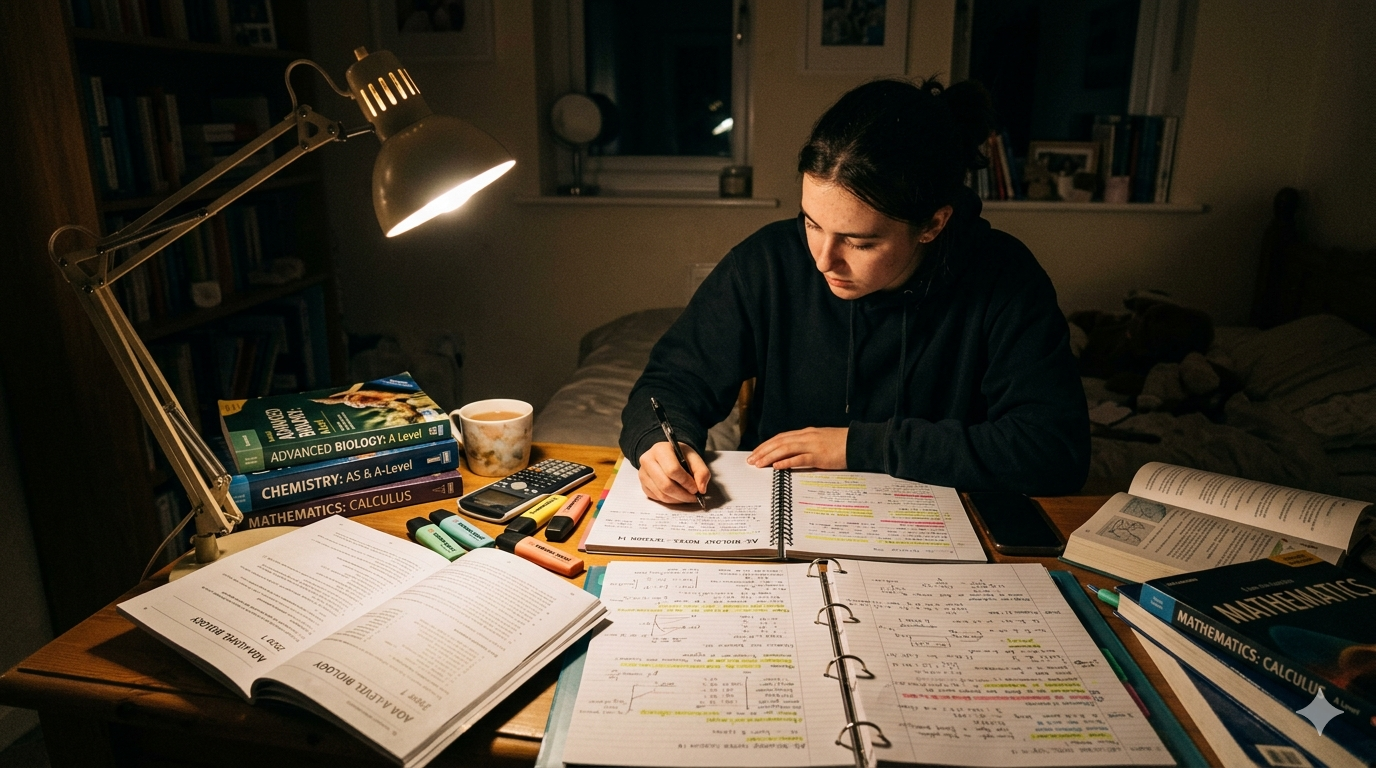

A Level exams sit at the end of two years of work. The final month is not the place to cover new ground, it is the place to convert everything already learned into the specific, well-structured answers that examiners reward. Students who treat the final month as more of the same revision they have been doing all year tend to plateau. Students who change what they do and how they do it tend to move.
This guide covers what the final month of A Level revision should look like, subject by subject, week by week, and what actually makes the difference between a B and an A, or an A and an A*.
The most common mistake in the final month
Re-reading notes feels productive. It rarely moves grades. The students who gain ground in the final month practise answers under timed conditions, mark them honestly, and fix the specific habits costing marks.
A Levels in the Final Month, Need Targeted Support?
Our A Level tutors can work through past papers with your child, identify exactly where marks are going, and build a focused plan for the time remaining.
How should you start A Level revision in the final month?
Before revising anything in the final month, spend the first few days working out where the time will produce the most return. Pull out recent past paper scores or mock results across every subject and write down the topics and question types where marks are being lost most consistently. Then look at the exam timetable. The combination of upcoming papers and known weaknesses produces the priority list for weeks two and three.
This is also the right moment to be honest about grade targets. A student sitting three A Level papers needs to think about which subjects are closest to a grade boundary and which have the most marks available to recover. The student sitting on a high B in Chemistry needs a different plan from the student sitting on a low A in Maths. Treating all three subjects identically in the final month is rarely the best use of limited time.
Do one diagnostic paper per subject
In week one, sit one past paper per subject with the mark scheme to hand. Mark it question by question and categorise every mark lost: is this a content gap, a technique issue, or a presentation problem? A content gap means the topic needs revisiting. A technique issue means the right knowledge is there but it is not being written in the format the examiner rewards. A presentation problem means working is incomplete, conclusions are missing, or answers are not structured correctly. Each type needs a different fix.
Which A Level revision methods work best in weeks two and three?
Sciences and Maths: questions over notes
In Maths, Chemistry, Biology, and Physics, the only revision that produces meaningful grade improvement in the final month is working through questions. Reading derivations, re-watching lecture videos, or copying out formulas are all forms of passive revision that feel useful but do not build the active recall under pressure that exams require. Work through topic-sorted past paper questions, mark against the scheme, identify patterns in errors, and repeat with different questions on the same topic until the pattern stops appearing.
For Maths specifically, the A Level papers reward fluency as much as knowledge. A student who knows every technique but works slowly will drop marks through time pressure alone. Timed question sets, ten questions, 20 minutes, build the speed that content revision alone cannot.
Essay subjects: practise structuring arguments
In History, English Literature, Economics, and similar subjects, the final month should be dominated by timed essay practice. Writing one essay per subject per week under timed conditions, then marking it against the examiner’s mark scheme and comments, is the single most effective thing an essay subject student can do in the final month. The marking should be honest: does the argument flow logically? Is every claim supported with evidence? Does the conclusion address the specific question asked? These are the habits the top grade band rewards.
Reading examiner reports, published by AQA, Edexcel, and OCR after each exam series, is also valuable at this stage. They describe in plain language what high-scoring answers did consistently and what mid-range answers got wrong. A student who reads three examiner reports on their most recent timed essays will find specific, actionable feedback that no revision guide can replicate.
The mark scheme is not optional
One of the most common reasons A Level students plateau at a B is that they mark their own work generously. They read their essay, feel that the points are broadly correct, and give themselves a reasonable mark. The mark scheme often tells a different story, specific terms missing, levels of analysis not reached, particular types of evidence not deployed. Getting in the habit of marking against the scheme rather than against intuition is one of the fastest ways to close a grade gap in the final weeks.
How should you use the final week before A Level exams?
The final week before exams should include at least one full timed paper per subject, sat under genuine exam conditions. No notes, no phone, full timing. The purpose is not to learn new material, it is to build the pacing, focus, and stamina that allows a student to perform consistently across a two or three hour paper rather than starting strongly and fading in the second half.
After each paper, mark it quickly and note only the things that most need attention before the real exam. Keep the list short and focused. Then address those specific points the following day and move on. The final week is not the time for sweeping revision, it is the time to confirm that the preparation done in weeks one to three has landed.
Managing multiple subjects in the final month
A Level students are revising three or four subjects simultaneously, which means the final month requires scheduling as well as method. A simple approach: assign each subject specific days based on the exam timetable, giving more sessions to the subjects with the earliest exams or the biggest gaps. Avoid revising more than two subjects in a single day, depth per subject is more valuable than coverage across all of them.
Build in rest. A student who revises seven days a week through May will be less sharp in the exam room than one who takes one day off per week and uses the rest more intensively. Fatigue accumulates over a month-long revision period and compounds under exam pressure. Rest is part of the preparation, not a break from it.
Not moving despite revising hard?
A tutor can read your child’s answers, identify exactly what the examiner is not rewarding, and fix the specific habits holding the grade back.
Book a LessonMeet some of our A Level tutors

Martin
Martin holds an MSc in Mathematical Sciences from Oxford (Distinction) and is completing a PhD in Applied Maths and Theoretical Physics at Cambridge. During a teaching placement he raised a Year 12 class’s pass rate by 54 percentage points, with 100% of his Further Maths students achieving A*. Martin tutors A Level Maths and Further Maths and is particularly effective at building the fluency and exam technique that separate the top grade bands in the final weeks before exams.

Murray
Murray is reading Materials Science at Oxford (MEng, expected First), having achieved A* in Maths, Chemistry, and Physics at A Level. He tutors A Level Maths, Chemistry, and Physics with over 150 hours of experience, and has delivered in-person sessions to groups of 150 students on problem-solving skills. In the final month before exams, Murray focuses on the specific question types where students are consistently dropping marks and builds the habits needed to address them under timed conditions.

Jessica
Jessica is completing her fourth year in Medicine at Cambridge, having achieved A*A*A*A* at A Level in Mathematics, Further Mathematics, Chemistry, and Biology. With hundreds of hours of tutoring experience across A Level sciences, Jessica has a precise understanding of what the mark scheme rewards at the highest grade levels and how to write answers that earn it consistently. She is particularly effective with students who are close to an A* but losing marks through incomplete reasoning or imprecise terminology.
Use the final month well
The gap between a B and an A, or an A and an A*, is almost never about knowledge. It is almost always about method, how answers are written, how marks are claimed, how time is managed across a paper. A specialist tutor who can read your child’s answers and identify the specific habits costing marks is one of the most efficient investments available in the final month. Get in touch and we will match your child within 48 hours.
Expert A Level Tutoring with Greenhill Academics
TARGETED SUPPORT IN THE FINAL WEEKS BEFORE A LEVEL EXAMS
Our Oxford and Cambridge graduate tutors work through past papers, identify the specific marks being lost, and fix the habits that are holding your child’s grade back. Matches made within 48 hours.
Book a LessonFrequently asked questions
