

Maybe your child has already worked through some Oxford MAT past papers. Then you read that the MAT is not running this year, and Oxford wants a different test called the TMUA. That can feel like a setback. The good news is your child is not starting from scratch. Oxford says the mathematical topics on the TMUA are very similar to those on the MAT, and that the spirit of problem solving is common to both tests. But the TMUA is its own test, with its own format, so part of the plan needs to change. That part is worth knowing now, because the dates are close.
The short version
- For 2027 entry, Oxford maths and computer science applicants sit the TMUA, not the MAT. Oxford has confirmed this itself.
- Oxford says the TMUA covers very similar maths to the old MAT, and the same kind of problem solving. So your child is not starting from scratch.
- Some things are new. The TMUA is all multiple choice, it has a separate reasoning and logic paper, and only the final answer scores.
- The two tests are not the same, so from here your child should prepare directly from the official TMUA materials.
What has actually changed for 2027 entry
For years, students applying to Oxford for maths sat the Mathematics Admissions Test, the MAT. That test is now retired. Oxford’s own Mathematical Institute says that for the 2026 admissions round the MAT will not take place, and all applicants will take the TMUA instead. The TMUA is the Test of Mathematics for University Admission.
So this applies to more than one course. At Oxford, the TMUA is now the test for Mathematics, Mathematics and Statistics, Mathematics and Computer Science, Mathematics and Philosophy, Computer Science, and Computer Science and Philosophy. You can check the full list on the Oxford admissions tests page.
The dates matter, and they are close. For 2027 entry, the test is sat in the window of 12 to 16 October 2026. Candidates must book a test slot by 6pm UK time on 28 September 2026. Registration opened earlier, on 1 June 2026, so booking the slot is the deadline to watch now. A tutor cannot do this for your child. It is done through an authorised test centre, so it is worth sorting soon.
Places are hard won, so the test is worth taking seriously. Across the three years from 2023 to 2025, only 9% of applicants to Oxford Mathematics were successful, from an intake of about 183 students a year. Still, every applicant sits the same test, whatever school they are at. Oxford looks at the TMUA score alongside the rest of the application when it decides who to shortlist.
Does your child’s MAT practice still count?
Yes, a good deal of it, and this comes from Oxford, not from us. Oxford says the mathematical topics on the TMUA are very similar to those on the MAT, and that the spirit of problem solving is common to both tests. The MAT was based on the first year of A level maths. The TMUA covers AS level and higher GCSE maths, plus a small number of topics from full A level maths. So much of what your child revised still applies. What changes is the format, and one new paper.
Here is what carries over, and what is new.
What still helps
- The core maths. The MAT and the TMUA cover similar early ground, so much of your child’s revision still applies.
- Problem solving. Using known maths in a question they have not seen before is the shared skill.
- Working by hand. The TMUA gives no calculator, so by hand and mental methods still matter.
- The multiple choice habit. In its final format the MAT was almost entirely multiple choice.
What is new
- It is all multiple choice. The MAT also had long written questions. The TMUA does not.
- Only the answer scores. There are no method marks.
- A reasoning paper. One whole paper is about mathematical reasoning and simple logic.
- New timing. Two papers, 20 questions in 75 minutes each.
Paper 2 is worth practising on its own. It puts more weight on mathematical reasoning and simple logic, so it deserves its own practice.
How the TMUA is set out
It helps to picture the test. The TMUA is made of two papers, and your child sits both. Together they take two hours and thirty minutes. Every question is multiple choice.
Paper 1 is called Applications of Mathematical Knowledge. It has 20 questions in 75 minutes, and it checks whether your child can use their maths in new situations. Paper 2 is called Mathematical Reasoning. It also has 20 questions in 75 minutes, and it looks at how your child reasons, with some simple ideas from logic. There is no calculator. The whole test gives one score, reported from 1 at the low end to 9 at the high end, to one decimal place. You can read the full format on the official UAT-UK TMUA page.
One detail is worth repeating to your child. Wrong answers are not marked down, and only correct answers count. So a sensible guess on a hard question is always better than a blank. That is a different mindset from writing out a full solution for method marks, and it is easy to practise once you know it.
It’s very natural for you to just quickly jump and go, ‘Okay, that’s the answer.’ For these ones, it’s just very careful to read all of the options they’ve given you.

AshrufTMUA and admissions tutor, University of Cambridge
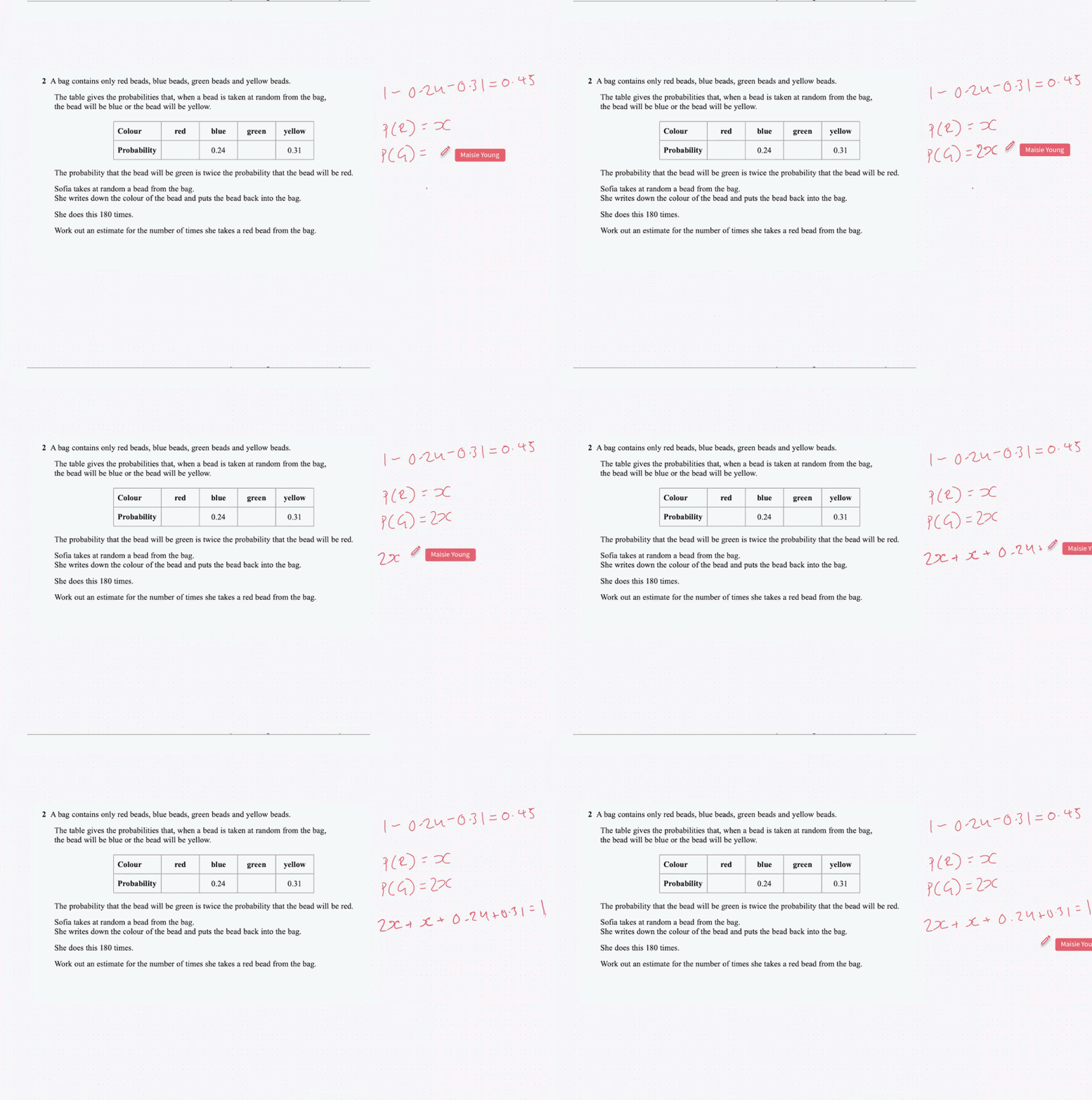
This clip shows a maths lesson recorded in Pencil Spaces, the online classroom used by Greenhill Academics.
Not sure which parts of the TMUA your child needs to work on?
Tell us what they have already practised for the MAT. A tutor can see what carries over and what is new.
Ask about a tutorHow to move your child’s prep from the MAT to the TMUA
Here is a clear order to work in. It keeps the practice your child has done and adds the new parts on top.
- Book the test slot first. Nothing else matters if the slot is missed. Candidates must book a test slot by 6pm UK time on 28 September 2026, through an authorised test centre.
- Keep the maths going. Do not stop the topic revision your child was already doing for the MAT, but check it against the current TMUA specification, because the syllabus and format are not identical.
- Switch to answer only practice. Move from writing full solutions to reaching the correct answer quickly, because on the TMUA only the answer scores.
- Add the reasoning paper. Spend real time on Paper 2: reasoning and simple logic. Its multiple choice format is different from the MAT, so it needs its own practice.
- Practise to time. Use the official TMUA practice materials under the clock, 20 questions in 75 minutes per paper, so the pace feels normal on the day.
Try this at home this week
You can do this in about ten minutes. You need one official TMUA Paper 2 reasoning question and a pen. It is worth doing soon, because the test-slot booking deadline is close.
- Pick one question (1 minute). Open the official TMUA practice materials and choose a single Paper 2 reasoning question, not a Paper 1 maths one.
- Ask them to try it out loud (5 minutes). Have your child talk through how they decide the answer, step by step, so you can hear their thinking.
- Watch how they work (2 minutes). Notice whether they rush to an answer or check each option, and whether it is the reasoning steps rather than the calculation that slow them down.
- Note what you saw (2 minutes). Write down the step where they got stuck. That is the part worth looking at.
What should you look for?
This may give you an early clue about which part of the reasoning question your child finds difficult. It cannot tell you their overall TMUA level or predict a score. So it is only a starting point. A tutor can take that same question, work on the reasoning approach, and check it against similar questions.
Want a tutor to build a TMUA plan around what your child has already done?
Tell us where they are up to. A tutor can start with the reasoning paper if that is the new part.
Send an enquiryMaths and admissions tutors who can help
These tutors studied at Oxford and Cambridge and teach maths at a high level. Of the three, Ashruf also prepares students for the MAT, TMUA and STEP, and for Oxbridge admissions.
Ashruf studied Information and Computer Engineering at the University of Cambridge, where he got an A* in Maths at A Level and was ranked first in his cohort. He prepares students for the MAT, TMUA and STEP, and for Oxbridge admissions.

Martin is reading for a PhD in Applied Maths and Theoretical Physics at the University of Cambridge, after a Master’s with distinction at the University of Oxford. He teaches A Level Maths and Further Maths.

Karol studied Natural Sciences at the University of Cambridge. He teaches Maths and Further Maths at A Level, and also Chemistry, and works with students from GCSE up to A Level.
Questions parents ask us
Has my child wasted the time they spent on the MAT?
No. The maths foundations overlap, and Oxford says the kind of problem solving the MAT rewards is useful preparation for the TMUA too. The tests are not the same though, so from here your child should prepare directly from the official TMUA materials.
Is the TMUA harder or easier than the MAT?
It is different rather than simply harder or easier. The TMUA drops the long written questions and adds a reasoning and logic paper. It is a new test to prepare for, and the multiple choice format takes some getting used to, because only the final answer scores.
Which Oxford courses need the TMUA now?
For 2027 entry it is the test for Mathematics, Mathematics and Statistics, Mathematics and Computer Science, Mathematics and Philosophy, Computer Science, and Computer Science and Philosophy. Always check the current Oxford admissions tests page for your child’s exact course.
When is the test and how does my child book it?
For 2027 entry the test is sat between 12 and 16 October 2026. Candidates must book a test slot by 6pm UK time on 28 September 2026, through an authorised test centre, not through us. Registration opened on 1 June, so book the slot straight away.
Are there official materials to practise with?
Yes. The TMUA is used by several universities and has been for years, with free official practice materials, including the test specification and a practice test. So working through them under timed conditions is one of the best things your child can do.
Worried the change to the TMUA has set your child back?
Oxford says the maths on the two tests is very similar, so much of your child’s work still counts. Tell us what they have already done for the MAT, and we can talk about a TMUA plan that keeps the useful work and adds the new parts.
Send an enquiry