

Before you add more revision
- A 5 does not say why it is a 5. Two children can get the same grade for different reasons, and the fix depends on the reason.
- Two things are worth checking at home first: whether earlier topics are still there, and whether marks are being lost on questions your child can already do.
- Ask the school which tier your child is entered for. On the 9 to 1 GCSE Maths courses, the Foundation paper cannot award more than a 5.
- Tutoring cannot promise a 7 by a date. What it can do is find what is holding the grade back and work on those exact things, lesson by lesson.
Your child is getting a 5 in GCSE Maths, but the target is a 7
A 5 is not a bad grade. On the 9 to 1 scale, the government recognises grade 4 as a standard pass, so a 5 is already above that threshold. But if your child’s target is a 7, the question is what stands between the grade they have and the grade they need.
That answer is different for every student. There are a few useful places to look first, and this article walks through them one at a time.
A 5 in GCSE Maths does not tell you what your child needs help with
Two students can come home with the same 5 and need completely different help. One learned every topic in class and cannot bring the older ones back in a test. Another understands the hard ideas and loses marks on the simple steps underneath them. A third is sitting a paper that cannot award more than a 5, whatever they do on the day. The grade on the report looks identical in all three cases.
This means the first job is not more revision. It is working out which of these applies to your child, because each points to a different starting point. The next three sections take them in turn.
Your child cannot remember maths they have already covered
GCSE Maths builds on earlier skills. Algebra can appear inside trigonometry, and basic number work can sit underneath longer problems. If an earlier skill is no longer secure, it can affect later questions that depend on it.
Earlier topics should not simply be treated as finished after one lesson. A tutor can return to them later and check whether the method is still secure. Maisie puts that idea simply:
Why tutors revisit earlier maths
“I know we started thinking about probability last time. But that was a while back, it was like two weeks ago. So I thought we’d go over some more stuff again just to really stick it in your brain.
”
Maisie, GCSE Maths tutor
Going back over a topic later is part of the job, not a detour from it.
Your child knows how to do some questions but still loses marks on them
There is a second pattern, and it is the harder one to watch. Your child can do the question. They know the method, they start correctly, and they still lose marks. A minus sign flips in the second line. A bracket gets expanded in a hurry. Two terms get collected wrongly. In one recent lesson, a student handled the hardest part of a proof and then lost the basic algebra underneath it, and those steps were worth six marks.
Working that stays in your child’s head makes this worse, because an examiner can only mark what reaches the page. Written working can earn method marks even when the final answer is wrong, and writing the first line down forces the method to exist on paper before the arithmetic starts.
A ten-minute check on maths your child has already covered
You can look into this at home before any tutoring starts. Choose one question from a topic your child finished earlier in the course. Give them no notes and no reminder of the method. If your child cannot start, that may point to an earlier topic that needs revisiting. If they start well but make a slip on the way through, the written work gives you something different to investigate. One question will not diagnose the whole course, but it can show you what to look at next.
Try one question from earlier in the course
Run the check this week, and keep the page your child wrote, whatever it looks like. If you book a first lesson, have your child bring that page along. It shows a tutor at a glance what a grade alone cannot.
Do you need to know what is stopping your child reaching a 7 in GCSE Maths?
A GCSE Maths tutor from Greenhill Academics can work through questions live with your child and identify whether the problem is earlier topics that are no longer secure, rushed working or something else. You receive a written report after every lesson.
Talk to us about a tutorYour child is aiming for a 7, but their GCSE Maths tier may limit the grade available
Before any revision plan, one structural fact is worth checking, because it decides what is possible on results day. The 9 to 1 GCSE Maths courses are sat in two tiers, and the Foundation tier covers grades 1 to 5 while the Higher tier covers grades 4 to 9. A student entered for Foundation cannot be awarded a 7, however well the exam goes.
So if the target is a 7, ask the school one question early: which tier is my child entered for? Moving to Higher is a real decision rather than a formality, because it changes the range of questions and grades available. Whether it is appropriate is something to discuss with your child’s school, using recent work to judge whether they are ready for it.
Students in Oman may also be taking IGCSE rather than GCSE. The British School Muscat follows GCSE Maths, while The Sultan’s School uses IGCSEs in Years 10 and 11. If your child takes Cambridge IGCSE Maths, the equivalent distinction is Core and Extended rather than Foundation and Higher. Whichever school your child attends, the question is the same: does the paper they are entered for allow the grade they are aiming at?
You know the target is a 7 in GCSE Maths, but you do not know what to work on first
If the tier is right but earlier topics and accuracy both need work, several jobs are competing for attention. Without a starting point, revision can spread thin across the course.
A clear order for working towards a 7
- Make the earlier maths secure first. Start with the earlier skills your child’s work shows are getting in the way. That might mean number work or basic algebra before moving into longer questions. Use that check as one clue alongside marked work and school feedback when deciding where to start.
- Keep coming back to what has been fixed. Return to the topic later and check whether it is still secure rather than treating one correct attempt as the end of the job.
- Then work on the longer questions. Take the multi-step questions slowly at first, with every line of working written down.
A tutor can run this order with your child, but there is no secret in it. It is one way to sequence the work when the target is a specific grade, and it starts from what your child’s own work shows rather than page one of a revision guide.
One thing this article will not do is promise that the order above produces a 7 by a certain date. Nobody can promise that, and you should be careful with anyone who does. What the order gives you is a place to start, while marked work gives you something concrete to review along the way.
How a GCSE Maths tutor helps when your child is on a 5 and aiming for a 7
Some of this can be checked at home. A tutor adds the chance to watch your child work in real time and notice things a finished page may not show: where they hesitate, which methods they cannot recall independently, and what gets done in the head instead of on paper.
Greenhill Academics matches your child with a GCSE Maths tutor. Tell us whether they are studying GCSE or IGCSE and which exam board they follow, so that information can be considered when matching. Lessons are online on a shared board, at times that fit the school week in Oman. You receive a written report after every lesson, and where homework is set, a reminder goes out before the next lesson.
Inside a GCSE Maths lesson
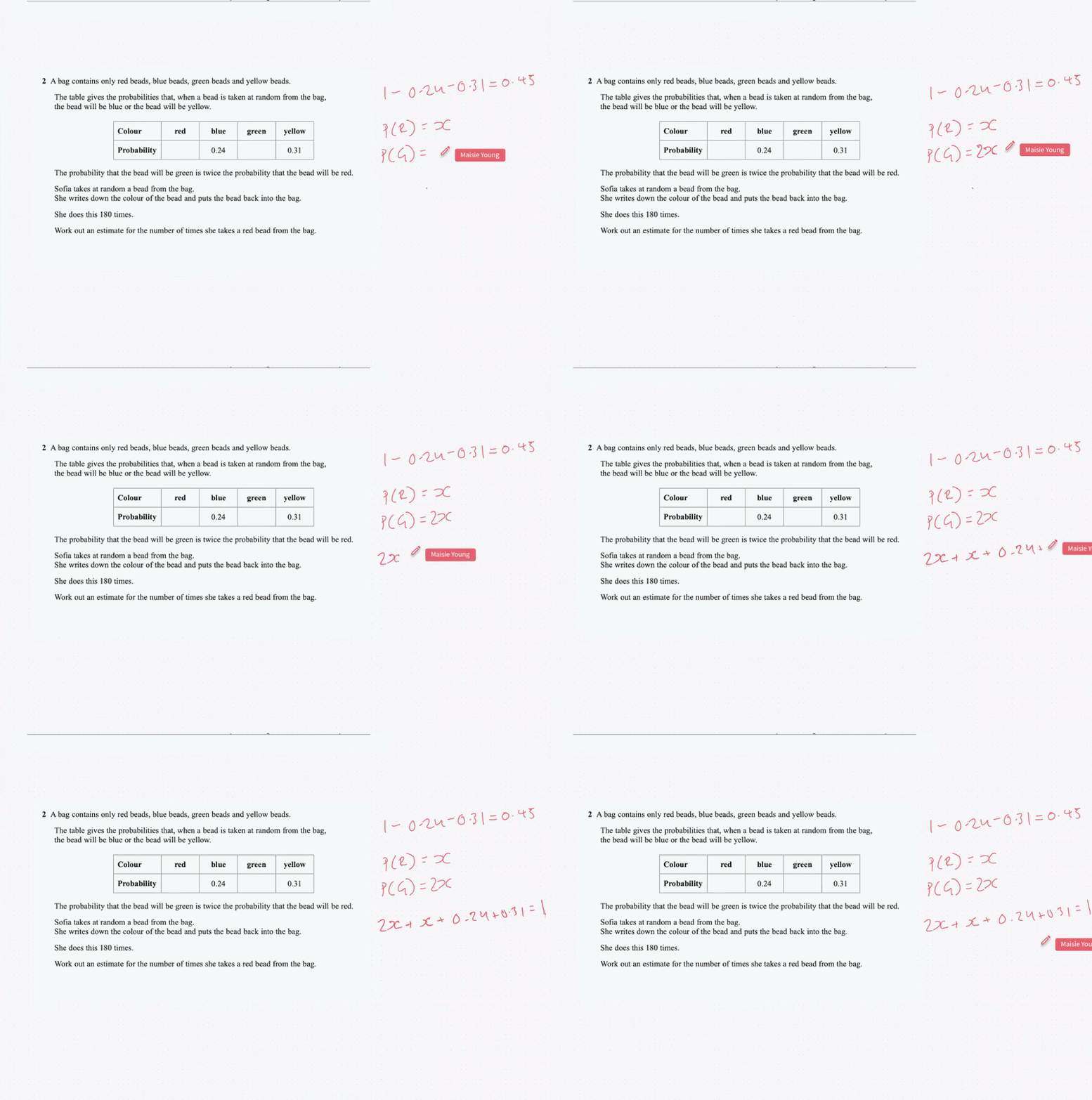
The question, the student’s working and the tutor’s notes share one screen in a Greenhill Academics maths lesson recorded live on the shared board.
Two GCSE Maths tutors your child could learn from
Meet Maisie and Murray
Maisie · Molecular Biochemistry, Oxford
Maisie is a final-year Molecular Biochemistry MSci student at Oxford, with First-Class marks throughout and an academic scholarship in every year of her degree. She achieved four A* grades at A Level, including Mathematics and Further Mathematics, and teaches GCSE Maths online.

Murray · Materials Science, Oxford
Murray is in the fourth year of a Materials Science degree at Oxford (Trinity College), on track for a First, with A*A*A* at A Level in Mathematics, Chemistry and Physics. He teaches Maths from GCSE through to A Level.
Questions parents in Oman have about GCSE Maths tutoring
Can a GCSE Maths tutor guarantee my child a 7?
No, and be careful with anyone who says they can. What a tutor can do is identify where your child is losing marks, revisit earlier maths where needed and build stronger written-working habits. Marked work then gives you something concrete to track.
My child is on the foundation paper. Can they still get a 7?
No. On the 9 to 1 GCSE Maths courses the highest grade available on Foundation is a 5, so a 6 or a 7 means being entered for the Higher paper. Whether and when to change tier is a decision to talk through with your child’s school, and a tutor can help your child prepare for the step up.
My child understood the maths in class. Why can they not do it in the test?
Following a method in class and bringing it back weeks later, alone and against the clock, are different tasks. One way to work on that difference is to revisit topics after a delay and check whether your child can still use the method independently.
Can my child have online GCSE Maths lessons from Oman?
Yes. Lessons are online on a shared board, at times that fit the school week in Oman. You receive a written report after every lesson, and where homework is set, a reminder goes out before the next lesson.
How does Greenhill Academics choose a GCSE Maths tutor for my child?
We match each student individually. Tell us the course and exam board your child follows, their current grade and the target, and we will match them with a GCSE Maths tutor who fits both the course and the way your child works.
Your child has a 5 in GCSE Maths and you need to know the next steps towards a 7
Tell us your child’s course, school year and target. Greenhill Academics will match them with a GCSE Maths tutor, and you receive a written report after every lesson.
Book a first lesson