
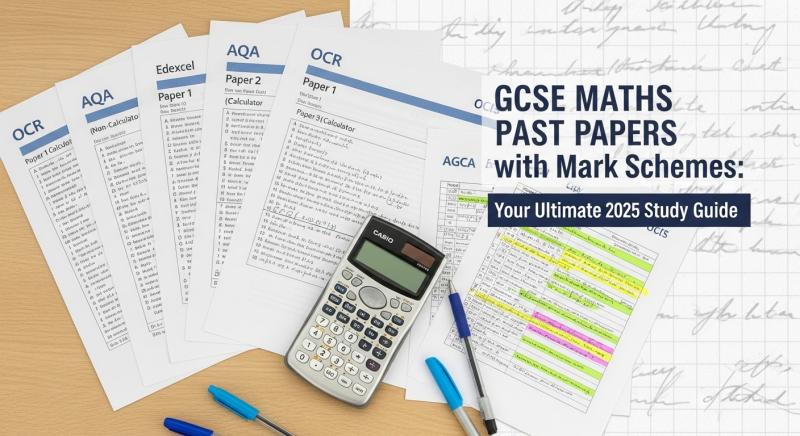

Your child sits down with a past paper, works through the questions, then opens the mark scheme to check their answers. The final answer is right. The marks are not. It happens constantly in GCSE maths, and the reason is almost always the same: the mark scheme is being read as an answer key rather than as a set of instructions for the examiner.
A GCSE maths mark scheme tells the examiner exactly what to award a mark for, step by step. Once your child understands how it works, they can write their working to match it. That shift alone is often worth several marks per paper.
The real issue
Most marks lost in GCSE Maths are not lost through wrong answers. They are lost because the right method was not shown clearly. The mark scheme rewards working, not just the final number.
Is Your Child Losing Marks on Method?
Our GCSE maths tutors teach students how to present working that earns every mark the mark scheme offers.
What does a GCSE Maths mark scheme actually tell you?
Every mark in GCSE maths is categorised. M marks go to the right method. A marks go to the correct answer. B marks are awarded independently for specific correct values. ft marks, short for follow-through, reward consistent working even when an earlier error was made. Each category tells you something different about what the examiner is looking for.
A question worth 4 marks rarely carries all four on the final answer. Your child needs to write working that earns each mark separately. Knowing the categories is the first step to doing that.
What M marks mean
M marks are method marks. The examiner awards them when your child demonstrates the right mathematical approach, regardless of whether the final answer is correct. Set up the right equation, apply the right formula, or identify the right technique, and the M mark is earned even if an arithmetic error follows.
This matters more than most students realise. A student who sets up a problem correctly but miscalculates can still pick up two out of three marks. A student who writes only the correct answer, with no working shown, may receive just one.
What A marks and ft marks mean
A marks are accuracy marks. They follow M marks and require both the correct method and the correct answer. ft marks are follow-through marks: if your child makes an error early in a question but carries it through consistently to the end, the examiner can still award marks for the correct process. An error in line two does not have to cost marks in lines three, four, and five. This is why showing every step is so important.
GCSE Maths Mark Schemes by Exam Board
Download past papers and mark schemes directly from your child’s exam board:
How should you use a GCSE Maths mark scheme for revision?
Work through a past paper question, then open the mark scheme and go through it line by line with your child. For each mark listed, ask: is this step visible in their working? Is it written clearly enough for an examiner to follow? This is a different exercise from simply checking whether the answer is right.
The goal is to train your child to think about presentation as part of answering. Most students in GCSE maths know enough to score higher than they do. The gap is often in how they show their working, and that is a habit that can be built with practice.
Compare your working to the mark scheme in detail
Take three or four past paper questions and work through them together. Attempt each question first, then open the mark scheme and identify exactly which marks were earned and which were not. Then write out a model answer that would earn every mark. Repeat this across several sessions and the pattern of what examiners reward becomes familiar.
Read the examiner notes
GCSE maths mark schemes include notes that explain what counts as a valid alternative method. These notes tell your child where the examiner has flexibility and where they do not. A student who reads these notes learns the principles the mark scheme is testing, not just the worked solutions. That understanding transfers to questions they have never seen before.
Is your child dropping marks on method?
A tutor can go through past papers with your child and show them exactly how to write working that earns every mark the scheme offers.
Book a LessonWhat do grade 9 answers look like in GCSE Maths?
Grade 9 questions ask your child to apply knowledge in unfamiliar situations. The mark schemes for these questions often include notes like “accept any valid method” or “award marks for equivalent approach”. That phrasing is worth paying attention to. The examiners are rewarding mathematical reasoning, not a memorised procedure.
Your child should read these notes closely. Understanding where the mark scheme is flexible gives them confidence when a question looks unfamiliar. They are looking for a valid approach, and knowing that changes how they tackle new problems.
Show every step, without exception
The most consistent piece of feedback from GCSE maths examiners is that students lose marks by skipping steps. Each line of working can carry its own mark. A student who jumps to the answer, even the correct one, risks losing method marks on every multi-step question. One extra line of working can be the difference between a grade 7 and a grade 8.
It is a habit. It takes a few sessions of deliberate practice to build, but once it is in place it applies to every question on every paper.
When mark scheme practice needs expert guidance
Working through mark schemes independently is a good start. But for many students, the real gains come from having someone read their working and tell them specifically what the examiner would and would not award marks for. That kind of targeted feedback is hard to replicate without a tutor who knows the mark scheme thoroughly.
Our GCSE maths tutors work through past papers with students and mark their working exactly as an examiner would. Students learn which steps earn marks, which steps they are skipping, and how to write answers that pick up every available mark.
Meet some of our GCSE maths tutors

Ejaz
Ejaz is studying for an integrated Masters in Mathematics at Imperial College London, where he achieved 8 Grade 9s at GCSE. With over 100 hours of experience tutoring GCSE and A Level Maths, Ejaz specialises in helping students understand what examiners are looking for. He works through mark schemes with students question by question, training them to show method clearly and pick up every available mark.

Martin
Martin holds an MSc in Mathematical Sciences from Oxford (Distinction) and is currently completing a fully funded PhD in Applied Maths and Theoretical Physics at Cambridge. During a teaching placement, he raised a Year 12 group’s pass rate by 54 percentage points, with 100% of his Further Maths students achieving A*. Martin brings that same precision to GCSE tutoring, with a focus on exam technique and structured working.

Murray
Murray is reading Materials Science at Oxford (MEng, expected First), having achieved A* in Maths, Chemistry, and Physics at A Level. With over 150 hours of tutoring experience, Murray works almost exclusively online using an interactive whiteboard, which makes going through mark schemes step by step particularly clear. He has delivered in-person sessions to groups of 150 students on problem-solving skills and brings that same clarity to one-to-one GCSE maths work.
Which GCSE Maths tutors can help your child pick up every available mark?
If your child understands the content but the grades are not reflecting it, the issue is often in how they present their working. The right tutor can go through past papers with them and show them exactly what the mark scheme is looking for. Get in touch and we will match your child with a specialist GCSE maths tutor.
Get Your Child to the Top Grades in GCSE Maths
EXPERT GCSE MATHS TUTORING WITH GREENHILL ACADEMICS
Our tutors teach GCSE maths students how to read mark schemes, present their working clearly, and earn every available mark. Personalised, one-to-one support with tutors from Oxford, Cambridge, and Imperial.
Book a LessonFrequently asked questions
