
My child didn’t get the predicted grades for university and is retaking in September. How do we make the most of this time?

Home › Blog › A Level

My child didn’t get the predicted grades for university and is retaking in September. How do we make the most of this time?

The retake window is about ten weeks, and most of it disappears into holidays. Here is how families who use it well actually spend it, week by week.

Published 16 July 2026 · 8 min read
Author Russell Greenhill Russell Greenhill · Founder & CEO, Greenhill Academics, Oxford Master’s Graduate

TL;DR

  • A September retake can change predicted grades, because most schools set them from the autumn results, not the summer ones.
  • The ten week summer is really about six working weeks once holidays come out, so the plan matters more than the effort.
  • Get the failed paper back before anyone revises anything. One paper usually fails for one or two reasons, not twenty.
  • Research shows only 16% of predicted grades are accurate anyway, which means teachers respond to fresh evidence.
  • Week one is diagnosis, weeks two to four close the gaps, week five is timed papers, week six is polish and rest.

Bad predicted grades after one bad summer mock exam

Your child worked all year, then one summer exam went wrong, and now their predicted grades are at risk. It feels out of proportion, because it is. Most schools set predicted grades from the last full exam before the UCAS deadline, which means the September retake often counts for more than the whole year that came before it.

So the retake is not a punishment. It is a second chance to put a better number in front of the teacher who writes the prediction. One family at Winchester College is weighing predicted grades an LSE application rests on. Another opened an E on results morning. The question never changes: how do we make the most of this time?

One more thing worth knowing, because it takes some pressure off. Research by Dr Gill Wyness at the UCL Institute of Education found that only 16% of predicted grades are accurate, and 75% of students are predicted higher than they go on to achieve. Predictions move. Teachers change them when the evidence changes. Your child’s job this summer is to hand them better evidence.

Do you have enough time to improve before retakes?

Ten weeks sounds like plenty. But take out the family holiday, a week of work experience and the first days back at school, and the real number is closer to six. The maths changes how you plan.

The summer, actually counted

10 weeks. What the calendar says between results day and the retake.

Minus 4 weeks. Holiday, work experience and settling back into school.

6 working weeks. At one lesson a week, that is six lessons to change the result.

Six lessons is enough, but only if none of them is spent guessing.

They revised hard and still failed the paper

Most families start with more revision. We start with the failed paper, because one bad result almost always has one or two causes, not twenty. Until you know which, every hour of revision is a guess.

You have probably already run through the possibilities in your head. Maybe they never really changed how they revise since GCSE, still reading notes and hoping it sticks, when A Level questions test whether they can use the material, not just recall it. If that is it, the fix is a method change, not more hours.

Or maybe the knowledge is all there and the marks vanish to small, avoidable slips: a misread question, working left off the page, an answer that was right in their head and wrong on paper. That one feels the most unfair, and it is the most trainable. Checking routines, showing working, reading the question twice: they sound small, but together they are worth a grade.

The third possibility is a genuine gap, often a topic taught in a week your child was ill or away, that never got filled in. Each of these has a different fix, which is exactly why the first lesson of the summer is a diagnosis, not a lecture. Our guide to moving from a predicted B to an A covers what that first session looks like in detail.

The six-week plan that turns a retake around

Here is the shape we use with retake students every summer. It bends around holidays, but the order never changes, because each step feeds the next.

The six week retake plan

Week 1

Get the paper, find the cause. Go through the failed paper question by question with the tutor.

Weeks 2 to 4

Close the two or three gaps. Teach the missing topics properly, with homework between lessons.

Week 5

Timed past papers. Full papers under exam conditions, marked against the mark scheme.

Week 6

Polish, then rest. Fix what the timed papers exposed, then ease off before the exam.

Two notes on the plan. First, rest is part of it, because a burnt out student underperforms in September no matter how much they covered in July. Second, the timed papers in week five matter more than any other single step, and our advice on revising for A Levels in the final month explains how to mark them the way an examiner would.

Want the diagnosis done this week?

Russell talks to every family himself before anything is booked. One lesson with the failed paper on the table finds the cause and the plan, and you decide from there.

Book a Lesson

From an E to a B: the summer plan to get back on track

Theo finished Year 12 with Bs all year and an E on the summer maths paper, and nobody in the house could say what had happened. Theo is three students stitched into one, with names and details changed, but the timeline and the result below are real.

In the first lesson, his tutor went through the failed paper with him. The cause was not the year of maths. It was one statistics topic taught while Theo was off school, plus a run of small slips in the algebra he actually knew. So the plan wrote itself: three weeks on the missing topic, a checking routine drilled into every homework, then two timed papers in week five.

Theo took two weeks of holiday in the middle and lost nothing, because the plan was built around it. He walked into the September retake having seen the exam format four times that summer. The result was a B, his teacher moved the prediction back to a B with an A in reach, and his university shortlist survived.

Well, B is not right, but let’s talk through why.

Hugh, physics tutor at Greenhill Academics

Hugh, Physics tutor, Oxford

Said mid-lesson in July, as a student picked the wrong answer on a past paper question.

One line from a June call sums up the goal of the whole plan. A parent rang about her son’s September history resit, and Russell told her: “We don’t want him thinking about too many things. He needs to go in there confident, plan it out, do it.”

Will online lessons actually work for my child?

Every lesson happens live on a shared online board, so your child and the tutor work on the same paper at the same time. You get a report after each session, homework reminders by email, and a WhatsApp group where lessons are booked and work is shared. Nothing depends on your child remembering to pass a message on.

Inside a lesson
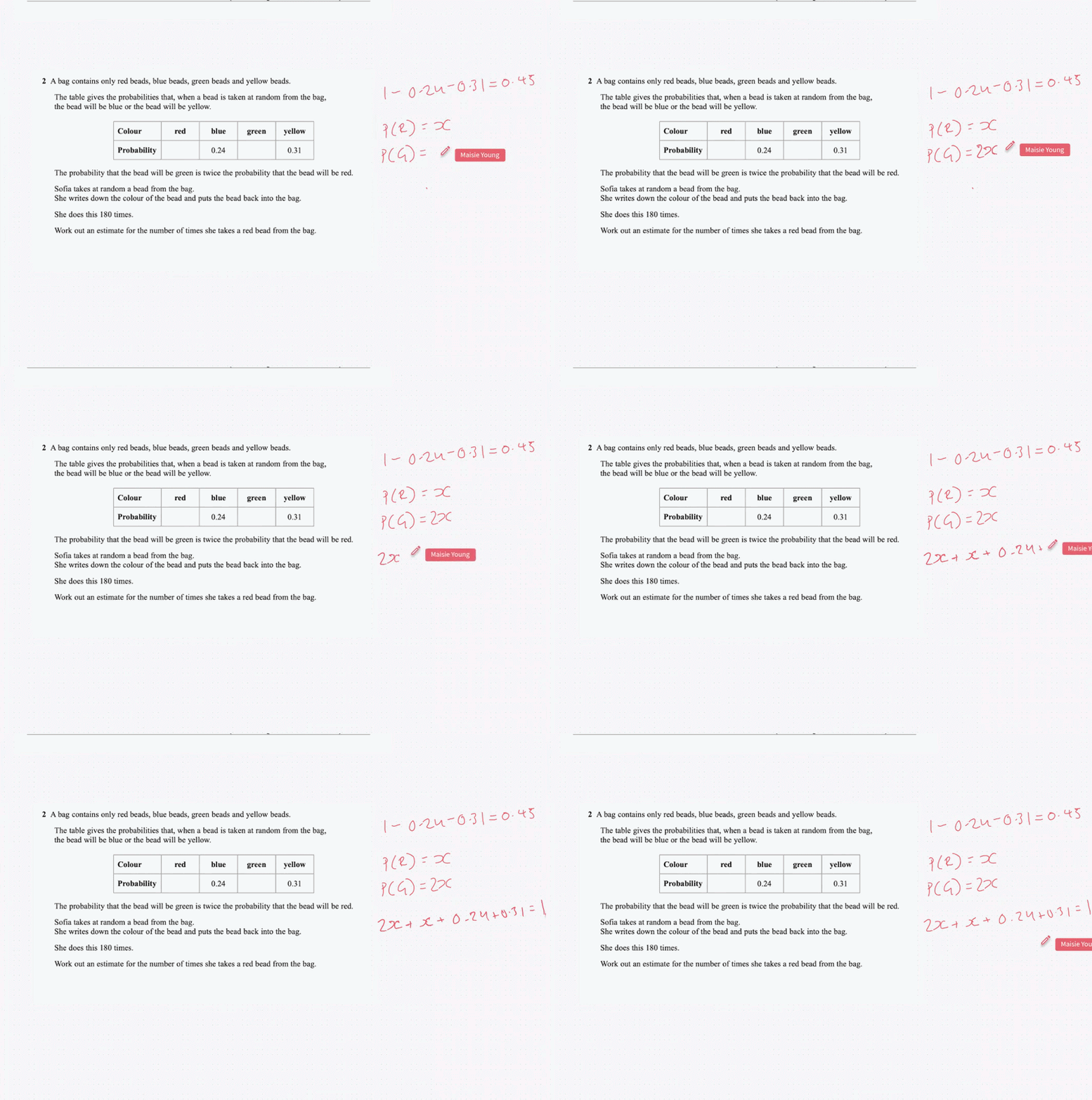
A real Greenhill Academics online lesson: a tutor working through an A Level maths probability question live on the shared board

A real Greenhill Academics lesson, recorded live: the tutor works through an A Level probability question on the shared board, thinking on the page as they go.

Your 30 minutes of homework this week, as parents

Email the school and ask for the failed paper back, or at least the mark breakdown by question. Then sit with your child for half an hour and sort the lost marks into three piles: didn’t know it, knew it but slipped, ran out of time. That one exercise is the diagnosis, and it is exactly how our tutors open the first retake lesson.

Tutors who have fixed this exact problem before

Who runs the September plan

Hugh, maths and physics tutor for predicted grades retakes

Hugh · Maths and Physics, Oxford

More than 20 of his recent students exceeded their predicted grades or secured places at leading universities.

Karol, chemistry and maths retake tutor

Karol · Chemistry and Maths, Cambridge

Starts every student with a diagnostic assessment, so summer lessons target the real gaps rather than the whole year.

Charlotte, science tutor helping students improve predicted grades

Charlotte · Biology, Chemistry and Physics, Oxford

Builds student confidence in exam technique through discussion-based learning, drawing on four years in the Oxbridge tutorial system.

The questions going through your head right now

Do September retakes really change predicted grades?

At most schools, yes. Predicted grades are usually set from the most recent full exam before the UCAS deadline, so a stronger September result gives the teacher direct evidence to raise the prediction. Ask your child’s school when predictions are finalised, because the date varies.

How many lessons does my child need before a September retake?

One lesson a week across the working weeks of summer is usually six lessons, and that is enough when the first one is spent diagnosing the failed paper. A student starting from an E, or covering a large gap, may need two a week.

Should my child rest over the summer or work through it?

Both, and in that order of importance. Do not burn your child out over the summer, because a tired student underperforms in September. Plan the holiday first, then fit the six lessons around it. The packages don’t expire, so a two week break costs nothing.

What if we don’t know why the exam went badly?

That is normal, and it is fine. You are not supposed to know the cause yet. The first lesson exists to find it, using the failed paper and the mark breakdown, so don’t wait until you have an explanation before starting.

Can we try one lesson before committing to a package?

Yes, and most families do. The first session is a single trial lesson, and you get a report on what it found before you decide anything. If the fit isn’t right, we change the tutor. For pricing and packages, book a consultation and we’ll talk you through what fits your child.

The retake is one exam. The plan is six weeks.

Tell us the subject, the exam board and the retake date, and we’ll match a tutor who can start this week.

Book a Lesson


If this helped, read these next

Need more help? Get in Touch

A Grade 9 at GCSE, Now Struggling at A Level? Here’s Why

Home › Blog › A Level Maths

A Grade 9 at GCSE Maths, Now Struggling at A Level? Here’s Why

The results came back and nobody expected them, least of all your child. It is almost never about ability, and it is almost never the whole subject. Here is what actually changed, and the one check that tells you where to step in.

Published 16 July 2026 · 9 min read
Author Russell Greenhill Russell Greenhill · Founder & CEO, Greenhill Academics, Oxford Master’s Graduate

Summary of this blog

  • It is almost never about ability. GCSE rewards spotting a familiar method. A Level rewards using it fluently, several steps in a row, with no signposts.
  • The problem concentrates. It is usually one of two things, the algebra underneath or the exam on top, and very rarely the whole subject.
  • A ten minute check settles it. One page of pure algebra, no calculator. Slow and slippy points to the maths. Quick and clean points to the exam.
  • Fix it in order: the algebra first, then exam technique, then timing. Grinding past papers before the algebra is solid wastes weeks.
  • Do not wait for the next mock. Year 12 piles on week by week, and a focused six to eight weeks is usually enough to turn it around.

They did nothing at GCSE and still got a 9

Your child sailed through GCSE. They barely revised, walked out smiling, and the Grade 9 came anyway. Now it is October of Year 12, the marks have fallen off a cliff, and for the first time they are coming home saying they do not understand maths. Nobody in the house saw it coming, and that is the part that frightens you most.

Here is the first thing to hold on to. Your child has not become worse at maths over one summer. GCSE and A Level are two different exams that reward two different things, and nobody tells families that in September. One child at Winchester College coasted to a 9 and hit a wall in the first term. Another walked in expecting the same easy ride and got the first low mark of their life. The subject did not change. The bar did.

This is one of the most common ways the A Level jump catches a strong student out, and the pattern almost never varies. So before anyone panics, or books a pile of extra lessons, it helps to know exactly what shifted between the two exams.

Is it the maths, or the exam? One check tells you

GCSE maths rewards spotting the method. Questions point you at the tool, the algebra is short, and a strong student scores well by knowing which one to reach for and using it cleanly. A Level maths rewards fluency. The questions run several steps, the signposts disappear, and the algebra inside each step is heavier than anything GCSE asked for. So a Grade 9 student has gone from an exam that hands them the method to one that expects them to choose it, chain it, and run three or four steps without a slip.

That means the drop almost always comes from one of two places: the algebra underneath, or the exam on top. Do not guess which. Check it.

Same subject, two different games

GCSE maths

Rewards spotting the method. Questions point the way, the algebra is short, single steps, marks for using a familiar tool cleanly.

A Level maths

Rewards fluency. No signposts. Long problems that chain heavy algebra, where one slip in step two costs the marks in step four.

The gap between the two is what actually caused the grade drop.

The ten minute check to run at home

Running it takes ten minutes. Sit your child down with one page of pure algebra and no calculator: indices, surds, algebraic fractions, rearranging formulae, expanding and factorising. Nothing from the A Level course itself, just the machinery underneath it. Then watch how they work rather than marking the score.

The ten minute check

✓ Slow or slippy

The maths is the gap. Rebuild the algebra first. A Level content cannot stick to foundations that are not automatic.

Quick and clean

The exam is the gap. The maths is there. Train method choice, structure, and how the marks are actually won.

One check settles it, and tells you exactly where to step in.

They understand it but make silly mistakes

Start here if the ten minute check came back slow or scrappy. This is the most common cause of the Grade 9 shock, and the most fixable one. Your child follows every new topic in class, then loses marks because the algebra inside each step costs them time and accuracy. The teacher says “understands the concepts, makes silly mistakes”, and you nod, because you have heard it before. That sentence is not a personality flaw. It is exactly what the maths gap looks like from the front of a classroom.

The fix is short, daily, and dull. Fifteen to twenty minutes of pure algebra practice most days for four to six weeks, aimed at the exact weak spots the check found. Not more A Level homework, and not past papers yet. The goal is to make the algebra second nature, so the new content has something solid to land on.

One thing to expect, because it trips families up. While the algebra is being rebuilt, the topic marks often stay flat for a couple of weeks, then jump. Families who give up in week three miss the jump. Our guide to the step up from GCSE to A Level maths shows what that first stretch looks like.

They get it in class but not in the exam

When the check came back quick and clean, the maths is not the problem. Your child knows it and still loses marks, which is the version parents find most maddening, because they can see the ability sitting right there. This is a real, teachable skill of its own, separate from the maths.

The usual causes are all fixable: diving into a question without choosing a method, showing too little working to bank the method marks, ignoring what the marks on offer are telling them about how much to write, and running out of time on the back half of the paper because the front half took too long. One parent put it exactly right about her son’s history exam: he “came out of the exam saying I really didn’t understand what they’re asking of me.” The knowledge was there. Reading the question was the gap.

The fix is focused exam practice, not more content. Work through past paper questions with the mark scheme open, and make the question “where do the marks come from?” not “what is the answer?”. Write the one line plan before touching the algebra. Time single questions before whole papers. Our advice on revising A Level maths past papers explains how to mark them the way an examiner would.

One low grade and their confidence is gone

Sometimes the honest finding is not the maths or the exam. It is confidence. A child who has only ever been top of the class can find the first low grade of their life genuinely shaking, and from there it tends to snowball: avoid the subject, slip a little further behind, prove the fear right, avoid it more. We had one parent describe her son after a run of top grades and one dip as “a little bit broken.” That is not drama. That is a bright child whose self image just took its first real knock.

The fix is not a pep talk, and it is not more pressure. It is making progress visible on paper and building in early wins, starting with problems just inside reach, so your child feels themselves getting better instead of being told they are. Push a little, but never so hard it stresses them. That balance is the whole job, and it is exactly what we match a tutor for.

If you mean business about doing well in your A Levels, you just have to spend the month before doing timed questions. That speed, it takes ages to develop.

Naomi, A Level tutor at Greenhill Academics

Naomi, A Level tutor, Oxford

How to make the most of your time before the next exam

The best use of the time is not more waiting. Waiting has a price, and it builds up. Year 12 does not pause while you decide. Each week of new content lands on the same weak spot, the gap between your child and the class widens, and the fix takes longer the later you leave it. A problem worth six weeks in October is worth a whole term by February.

One move pays for itself straight away. After every practice paper, sort the lost marks into three piles: did not know it, knew it but slipped, ran out of time. Almost every student who gets it in class but not in the exam finds the first pile is tiny, which changes both the plan and how they feel about themselves in a single sitting. Our piece on what to do between GCSEs and A Levels covers how to get ahead of this before Year 12 even starts.

Want a diagnosis, not a guess?

Russell speaks with every family first. Tell us what happened, and we will pinpoint whether it is the maths, the exam, or confidence, then match an Oxford or Cambridge maths tutor who has fixed it before.

Book a Lesson

Will online lessons actually work for my child?

Every lesson happens live on a shared online board, so your child and the tutor work on the same page at the same time. The first lesson is a diagnosis, not a quick recap. The tutor runs the algebra check properly, watches how your child attacks a real exam question, and separates what they do not know from what they know but keep dropping. By the end you have a specific answer: this is the gap, this is the order we fix it in, this is what the next few weeks look like.

You do not have to referee any of it. You get a full written report after every session, homework reminders by email, and a WhatsApp group where lessons are booked and work is shared. Nothing depends on your child remembering to pass a message on.

Inside a lesson

A real Greenhill Academics online lesson: a tutor working through an A Level maths problem live on the shared board

A real Greenhill Academics lesson, recorded live: the tutor works through an A Level maths question on the shared board, thinking on the page as they go.

The ten minute check to run at the kitchen table this week

Print one page of pure algebra with no calculator: indices, surds, algebraic fractions, rearranging and factorising. Give your child ten minutes and watch how they work, not just the score. Slow and slippy means the maths needs rebuilding first. Quick and clean means the gap is exam technique. That one exercise tells you where to start, and it is exactly how our tutors open the first lesson.

Who your child would work with

The maths tutors who find the gap

Hugh, maths tutor for students struggling at A Level

Hugh · Maths and Physics, Oxford

Reframes hard topics from several angles until they land. More than 20 of his recent students exceeded their predicted grades or won places at leading universities.

Holly, Oxford mathematics tutor building confidence

Holly · Mathematics, Oxford

Maps out exactly what a course covers so students can track progress and revisit weak spots, with a steady focus on building confidence alongside skill.

Murray, Oxford maths tutor for the GCSE to A Level jump

Murray · Maths, Chemistry and Physics, Oxford

A*A*A* at A Level in Maths, Chemistry and Physics, and clear about the exact habits that separate a top GCSE from a strong A Level result.

Answers to your questions

My child got a 9, surely they do not need a tutor?

A Grade 9 tells you the GCSE went well. It says very little about whether the algebra is automatic enough for A Level, which is a different and higher bar. The ten minute check is the fastest way to know, and it costs nothing to run at home first.

How quickly will we see the grade improve?

If the gap is the algebra, expect a few flat weeks then a jump, usually within four to six weeks. If it is exam technique, the change is often faster because the maths is already there. Either way, the improvement is visible well before the next set of mocks.

Is this a course or one to one?

One to one, online, and built entirely around the gap the first lesson finds. Nothing is pre-recorded, and you get a full report after every session, so you always know what was covered and why.

What if the problem is confidence rather than the maths?

That is common, and the first lesson is built to spot it. The tutor watches how your child works, not just what they score, and if confidence is the block we build in early wins and make progress visible on paper. We match on personality for exactly this reason.

Can we try one lesson before committing to a package?

Yes, and most families do. The first session is a single trial lesson, and you get a report on what it found before you decide anything. If the fit is not right, we change the tutor. For pricing and packages, book a consultation and we will talk you through what fits your child.

The maths has not gone. The right method has.

Tell us the exam board and what happened in the last mock, and we will match a maths tutor who can start this week.

Book a Lesson

If this helped, read these next

Need more help? Get in Touch

My child can’t get above a 4 in IB Biology. Here’s Why

Home › Blog › IB

My child can’t get above a 4 in IB Biology. Here’s Why

In IB Biology, a 4 is rarely about knowledge. It is usually exam technique, and that is fixable.

Published 20 July 2026 · 6 min read
Author Russell Greenhill Russell Greenhill · Founder & CEO, Greenhill Academics, Oxford Master’s Graduate

Summary of this blog

  • IB Biology is graded 1 to 7. A 4 usually means marks are being lost in more than one part of the exam, not that a topic is missing.
  • Understanding the content is not the same as answering the question. That one gap is what keeps a capable student on a 4.
  • The difference between a 4 and a 6 or 7 is usually exam technique, not intelligence. You’ll see how the marks are lost in one real answer, even without knowing biology.
  • The good news: this is a skill that can be taught. Once students answer IB questions properly, grades can improve in weeks, not months.

So why is your child stuck at a 4 in IB Biology?

Start with what a 4 actually means. IB Biology is graded from 1 to 7, and a 4 sits in the middle. It is often where capable students land when they understand the topics but have not yet learned how to turn that knowledge into marks.

The final grade comes from Paper 1, Paper 2 and the Internal Assessment. A 4 usually means marks are being lost across more than one of them, often for the same reasons. Knowing the Biology is not the problem. Knowing exactly what each question requires is.

The marks that turn a 4 into a 6 or 7 sit in the harder parts of the papers, and the Paper 2 essays are the clearest place to see them. Each essay is marked in parts. Here is one way a 16-mark essay breaks down.

One 16-mark Paper 2 essay, by the marks

Part A · 4 marks

Describe or label. A definition, a short description, or a labelled diagram.

Part B · 5 marks

Explain a process. Set out how a biological process or structure works.

Part C · 6 marks

Evaluate or explain in depth. The hardest marks, and where strong students drop the most.

Plus one mark for clear writing, for 16 in total. The six-mark question is where the marks hide.

A real answer that scored 2 out of 6

That final six-mark question is often where a 4 turns into a 6 or 7. Rather than just telling you what went wrong, I’ll show you a real student answer. You don’t need to know any Biology to spot the mistake, just read the question.

Here is one of those questions: “Evaluate the use of stem cells in treating human disease.” A strong student answered it like this, and it scored two out of six.

Answer A · scored 2 out of 6
  • Says what stem cells are, and the two types
  • Gives a real use: they already treat leukaemia
  • Names what is being researched: Parkinson’s, spinal injury

Mariam is a made-up name, and this answer combines parts of several real scripts we’ve marked. An answer like this really does score two out of six. Everything she writes is correct, but she never does what the question asks. She describes instead of evaluating. Now look at the very first word of the question: Evaluate.

She writes everything she knows and still loses marks

One word at the start of the question decides everything. IB calls this the command word. Here, the command word is evaluate. That doesn’t mean “write everything you know.” It means weigh up both sides, then reach a judgement. Mariam wrote what she knew, so she missed the marks for discussing the downsides and the marks for a clear conclusion, even though everything she wrote was correct.

Here is where those six marks come from.

Where the six marks come from

Benefits

The upside, with an example. Mariam had this, so she scored two.

Limitations

The ethical and practical problems. Missing, so nothing.

A judgement

Which side wins, and why. Missing, so nothing. The marks most students drop.

Same topic, same student. The marks live in the shape of the answer, not the facts.

This is common, and it shows in the results. Whether your child sits IB Biology at Sevenoaks, at King’s College School Wimbledon, or at an international school overseas, the papers are marked to the same command terms. The global average IB score is just over 30 points, and fewer than 5% of students worldwide score 40 or more. Much of the gap between a 4 and a 7 in IB Biology comes down to this one habit: writing about the topic instead of answering the question.

From an IB Biology session

I used to rush a lot in exams. What helps me is going word by word, visualising what the question is actually asking. Look at the verb, the action word.

Kriszta, IB Biology tutor at Greenhill Academics

Kriszta, IB Biology tutor, Oxford

That verb, the action word, is the command term. Reading it properly is what turns a 4 into a 6 or 7.

The answer that scored 6 out of 6 simply answered the question

Answer B · scored 6 out of 6
  • One clear benefit, with an example (leukaemia)
  • The downsides, including ethical concerns and risks such as rejection
  • A clear judgement at the end, explaining which side is stronger and why

Answer B never even explains what a stem cell is. It has fewer facts than the answer that scored two out of six, yet it earns full marks because it answers the question. It covers the good, the downsides and reaches a clear judgement, backed up with a reason.

That is the skill. It’s not about knowing more Biology. It’s about answering the question the way the examiner expects, and that’s a skill most students can improve far more quickly than learning a whole new topic.

Find the marks that turn a 4 into a 6

See exactly which marks your child is losing on Paper 2 and why. A tutor will work through a real answer, showing you exactly what examiners are looking for.

Get a Paper 2 diagnosis

Inside a session

A real Greenhill Academics session recorded live on the shared online board

A real Greenhill Academics session, recorded live on the shared online board. Every IB Biology session runs the same way.

Could your child find their own lost marks tonight?

Find one of these six-mark answers that disappointed you both. Read the first word of the question, then ask your child to score their own answer against it, out loud, point by point.

Most students find two or three gaps, go quiet, then say something like “oh”. That “oh” is worth more than a term of revision, because for the first time they can see the difference between what they wrote and what was being marked.

One command term drill to run at home

Print the official IB command terms list and stick it above your child’s desk. Take a marked answer from any paper. Before they read anything else, ask them to circle the first word of the question: evaluate, explain or describe. Half the lost marks come from treating that word as “just write what you know”. Breaking that habit can improve a student’s marks.

It’s not what she knows, it’s how she answers

Read the first word of the question every time. Describe, explain, outline, evaluate and discuss all ask for different things. Read the command word first, then shape your answer around it. That’s how students turn their knowledge into marks.

On data questions, answer the data. Paper 1 and parts of Paper 2 reward what the graph or table actually shows, not the topic it comes from. A strong student often writes what they know instead of what the data says.

Mark answers against the official IB mark scheme, not just the teacher’s ticks. It feels strange at first, but it quickly becomes one of the most effective ways to improve. The same skill is needed for the Internal Assessment too, so it helps raise the overall grade, not just one paper.

Who your child would work with

Who sits with your child on Paper 2

Charlotte, IB Biology tutor

Charlotte · Biology, Oxford (First Class, Balliol)

An Oxford tutor with a First in Biology, who teaches IB Biology and Chemistry, shaped by four years in the Oxbridge tutorial system. Her sessions run on discussion, which is exactly what an evaluate question tests.

Kriszta, IB Biology tutor

Kriszta · Biology, Oxford (First Class)

An Oxford tutor with a First in Biology, top 10 in her cohort, now doing a PhD in cancer biology. She is sharp about what a sentence actually claims, which is what an answer is graded on.

Mirsab, biology and medicine tutor

Mirsab · Medicine, Cambridge

A Cambridge medic who builds simple tools for the abstract parts of the course. He is used to showing a student the exact difference between knowing a topic and answering the question set on it.

What IB parents want to know

Everything she wrote was correct. How did it still score low?

Correct and relevant are not the same in IB. The mark scheme rewards the points the command term asks for, not everything true about the topic. Writing more does not earn more, and sometimes it earns nothing.

Is it only the essays, or the whole exam?

The whole exam. The same habit, answering the topic instead of the question, costs marks on the Paper 1 data questions and the internal assessment too. The essays are just where it is easiest to see, so that is where we start.

Isn’t this just teaching to the test?

It is teaching her to answer the question in front of her, which IB rewards everywhere, including the coursework. She still has to know the biology. She just has to aim it.

How long before we would see a difference?

Faster than for a content gap. This is a technique, and techniques get better with practice. Most students improve their marks within a few weeks of learning to read the command term and answer against the real mark scheme.

What should we bring to a first session?

A marked Paper 2, ideally one of the six-mark questions that upset her. We take one answer and go through it with the real mark scheme. That single conversation usually explains the whole grade.

The biology is not the problem. The technique is.

Tell us what happened in the last exam, and we will match a tutor who can show your child exactly where the marks are going, and how to turn a 4 into a 6 or 7.

Book your first lesson

Read these next on IB Biology

Need more help? Get in Touch

Studying hard at A Level Physics but the marks aren’t improving? Here’s why

Home › Blog › A Level Physics

Studying hard at A Level Physics but the marks aren’t improving? Here’s why

Your child is revising in the evenings and doing past papers at weekends, but the marks are not improving. The problem may not be how much they know. It may be how they are explaining it in the exam.

Published 21 July 2026 · 8 min read
Author Russell Greenhill Russell Greenhill · Founder & CEO, Greenhill Academics, Oxford Master’s Graduate

TL;DR

  • Your child may understand the topic but still lose marks because their explanation is too vague or incomplete.
  • These marks often disappear one or two at a time across short written questions.
  • A five-minute check at home can show whether your child can explain an answer clearly.
  • More revision will not help if the real problem is how the answer is written.

The effort is there, but the grades say otherwise

Your child is already putting in the effort. They revise in the evenings, work through past papers at weekends and make notes, but the marks are still not improving.

When you look through the paper, there may not be one obvious weak topic. The calculations may be correct, but marks are still lost on questions that ask your child to explain, describe or justify an answer.

Your child may say, “I knew that.”

They may be right. But in A Level Physics, knowing the answer is not enough. They also need to explain it clearly and include every point the examiner is looking for.

That is a different skill. If this is where the marks are being lost, more revision alone will not solve the problem.

Incomplete answers are costing them marks

A Level Physics is not only about getting the calculation right. Many questions ask students to explain, describe or justify their answer, and the marks depend on what they actually write down.

An examiner can only award marks for the points included in the answer. They cannot give credit for something the student understood but did not state clearly.

This is why a student can know the physics and still lose marks. If an important step, reason or conclusion is missing, the examiner cannot fill it in for them.

One of our physics tutors, Hugh, explained this to a student during a recent session:

Examiners cannot give you points for implied understanding, only for explicit understanding.

Hugh, A Level Physics tutor at Greenhill Academics

Hugh, A Level Physics tutor, Oxford

Hugh advised the student not to assume that any part of the answer was clear without saying it.

Students who understand a topic well often leave out important steps because the connection feels obvious to them. They write part of the explanation and assume the examiner will understand the rest.

A teacher in class may recognise what the student means and ask them to finish the point. An examiner can only mark what has been written.

This is not about intelligence or the school a student attends. It is a habit of writing incomplete answers, and it can be changed with practice.

Three questions from one session show the same problem

Here is what this looks like in practice. We will call the student Joel, a Year 12 student working through a past paper with Hugh during a Saturday session. Three questions from that session show the pattern clearly.

Question one · the dripping tap

The question: water drips from a tap at a constant rate. Explain how you can tell the droplets are accelerating.

Joel wrote: the gaps between the droplets get bigger as they fall.

What the full answer needs: the gaps get bigger while the time between drops stays the same. That second half is the proof. Joel got away with it because the question was only worth one mark. On a two mark version, half the idea would only get half the marks.

Question two · the trolley on the truck

The question: a truck accelerates and a trolley on its flatbed stays where it is. Explain this using one of Newton’s laws. Two marks.

Joel’s first answer described the situation correctly, with no resultant force on the trolley, but never named the law. One mark. His second try named Newton’s second law, but dropped the situation. One mark again.

Two marks means two jobs: name the law, and say why it applies here. Joel understood the physics on the first try. But the examiner could only give him half the marks, twice, because each answer only did one of the two jobs.

The same gap, heard out loud

Question three · say it out loud

The task: Hugh asked Joel to explain the photoelectric effect as if Hugh had never studied physics.

What happened: Joel had revised the topic all week and every fact was there, all four key observations. But the explanation came out as a pile of facts in no clear order. Hugh’s fix was simple. Find the one sentence the whole idea rests on, say that first, then add the details one at a time.

Why it matters: a six mark explain question is marked the same way. If the facts come out in no clear order, the answer scores badly, even when every fact is right.

More revision will not fix an incomplete answer

The revision was not wasted. It helped your child understand the physics.

But reading the notes again will not fix an incomplete written answer. The problem is not always missing knowledge. It may be that your child is leaving out an important step, reason or conclusion.

The fix is to practise writing full answers and checking that every part of the question has been answered.

Exam data backs this up. 44,957 students sat A Level Physics in summer 2025, and 31.9% of entries were awarded an A* or A. Two in three physics students finish below an A, and in our experience a good share of them understand more physics than their grade shows. For those students the writing is what lets them down, and writing can be taught. Our guide on how to get an A in A Level Physics covers what the top grades ask for across the whole course.

Try this at dinner tonight

You do not need to mark the answer or know any physics. Just listen.

Your one move this week

At dinner, ask your child to explain one physics topic they have revised as if you had never studied it. Can they explain it clearly, one step at a time? Or do they list the right facts without showing how they connect? You will usually hear the difference within a few minutes. This is also what our tutors listen for in a first physics session.

Did the explanation come out as a list of facts? That is the gap.

Russell speaks with every family first. Tell us what your child struggled to explain and what they scored in their last mock, and we will match an Oxford or Cambridge physics tutor who trains exactly this.

Book a Lesson

The September mock sets the predicted grades

For many Year 13 students the September mock is not a practice run. It is the exam that sets the predicted grades that go on the UCAS form, which means the universities your child can apply to are being decided before autumn half term. That is true at fee paying schools like Charterhouse and Brighton College, and at state sixth forms, and parents are often told it late, or not at all.

The good news is that a writing habit changes much faster than a knowledge gap. There is no new content to learn. In weekly sessions over the summer, your child can practise turning half answers into full ones on real past paper questions, and that usually shows in the first mock. If your child also needs a higher grade in that mock, our piece on going from a predicted B to an A shows what that looks like from the first session on.

What the first session listens for

The first session is not a lecture and it is not a run through the topics. Your child and the tutor work through real exam questions on a shared online board, and the tutor listens the way you did at dinner. Where does the explanation skip a step? Which half of the two mark answer keeps going missing? Then they fix answers together, line by line, until your child can see what a full answer looks like and write one on their own.

The feedback is honest and direct. Hugh tells his students that if he is not criticising them, he is not doing his job. He means it kindly, because finding the problems is what the sessions are for. The same student heard this from him in the same session: “This is what I specialise in, exam technique. So I’ve got you.”

You get a full written report after every session, homework reminders by email, and a WhatsApp group where sessions are booked and work is shared, so you always know what each session covered and whether it is working.

Inside a session

A live Greenhill Academics online session on the shared board, with the tutor and student working through an exam question together

A real Greenhill Academics session, recorded live on our online board: tutor and student thinking on the same page at the same time.

The tutors your child would work with

Who teaches exam writing, not just physics

Hugh, Oxford physics tutor who specialises in exam technique

Hugh · Maths and Physics, Oxford

He taught the session above and specialises in exam technique. More than 20 of his recent students exceeded their predicted grades or won places at leading universities.

Jasper, Cambridge tutor for physics, maths and computer science

Jasper · Maths, Physics and Computer Science, Cambridge

Took the top possible grade in Physics at St Paul’s School before Computer Science at Cambridge. Calm and structured, he breaks long answers into steps a student can repeat on their own.

Liza, maths and physics tutor educated at Yale

Liza · Maths and Physics, Yale

Nearly a decade of tutoring across the UK and US, with years of experience supporting students with ADHD and learning differences. Builds answers from the logic up, so they hold under exam questioning.

What A Level Physics parents want to know

My child revises for hours. How can the problem not be the physics?

Because revision builds knowledge, and these marks are being lost in the writing, not the knowledge. You can see it in the paper itself: if the lost marks sit on short explain questions rather than whole topics, the physics is there and the writing is the gap. The dinner table test above will usually confirm it in minutes.

Their teacher says they are doing fine in class. Why do the marks not show it?

Class rewards implied understanding. A teacher hears a half answer, sees the thinking behind it, and moves on. An examiner is not allowed to do that, so the same answer scores well in class and badly in the exam. That difference is exactly what we teach.

The September mock sets the predicted grades. Is there enough time?

Usually, yes. A writing habit changes faster than a knowledge gap because nothing new has to be learned. Weekly sessions over the summer, all on real past paper questions, tend to show in the first mock. The later the work starts, the more it competes with everything else in the autumn.

Questions about how the tutoring works

How will I know the sessions are actually working?

You get a full written report after every session, so you know what was covered and what improved. Homework arrives with email reminders, and the WhatsApp group keeps booking and progress in one place you can see. Improvement shows first in homework answers, then in the next mock.

Will it be the same tutor all the way to the exam?

Yes, that is the point of matching carefully at the start. Your child works with one tutor who learns exactly how they think and write, through to the exam. If the fit is not right after the trial session, we change the tutor, not the plan.

Help your child write answers that earn the marks

Tell us the exam board and what the last paper looked like, and we will match a physics tutor who can start this week.

Book a Lesson

Worth reading next

Need more help? Get in Touch

Top grades alone don’t get you into LSE; you need a top 5% personal statement

Home › Blog › University Admissions

Top grades alone don’t get you into LSE; you need a top 5% personal statement

LSE does not interview applicants, so the personal statement has to do the work of an interview. It is now split into three set questions, and the strongest answers are usually developed over the summer rather than rushed close to the January 2027 deadline.

Published 22 July 2026 · 8 min read
Author Russell Greenhill Russell Greenhill · Founder & CEO, Greenhill Academics, Oxford Master’s Graduate

The short version

  • LSE does not interview undergraduate applicants, so the personal statement matters.
  • Students now answer three questions within a 4,000-character limit.
  • Strong answers show what the student has done to explore the subject.
  • The best statements are developed over the summer, not rushed before the January 2027 deadline.

The boys at a top London school had all A* predictions. LSE still said no

Several boys from the same year group at a top London private school applied to LSE, all predicted A* across their A Levels. They did not get offers. The difference was the personal statement.

It breaks the rule most families trust: good grades open doors. At the most competitive courses, nearly every applicant arrives with good grades. The grades get your child considered, but they do not separate them from the thousands of applicants with the same results. The statement is what separates them.

Every student is judged through the same UCAS form. That form has recently changed, but much of the advice online is still based on the old personal statement.

LSE has no interviews, so the personal statement is all they see

Oxford and Cambridge interview their applicants, but LSE does not. Their own guidance says it plainly: the School does not interview for places, so the statement is an applicant’s only opportunity to show they are a good fit, and the quality of the statement is very important in their selection.

Your child will not get the chance to explain themselves in person, recover from a weak sentence, or answer a follow up question. Whatever the statement says is all they will ever hear from your child. For a strong student, that can be an advantage. A personal statement can be reviewed, improved and rewritten until every sentence earns its place.

Your child may be following personal statement advice that is now outdated

For 2026 entry onwards, the single UCAS essay was replaced by three questions:

  • Why do you want to study this course?
  • How have your studies prepared you?
  • What have you done outside education to prepare?

Students still have 4,000 characters in total, but their answer is now split across the three sections.

UCAS made the change partly because 83% of students said the old process was stressful, and many were not sure they had covered the right things. The three questions tell your child what to cover. What they do not do is make the answers good. An older sibling’s statement or a school template from a few years ago was written for a different format. Following it too closely can leave your child answering the wrong question.

One mistake has not changed: telling instead of showing. “I have always been passionate about economics” tells LSE very little. Discussing a specific book, entering an essay competition or researching a real question shows where that interest comes from.

One personal statement has to work for five different courses

Many families come to us stuck on the same problem. Your child applies to five courses, and they are rarely identical. One choice might be Economics with Economic History at LSE. Another might be pure Economics at UCL. One statement has to serve all of them, and it goes to every university unchanged.

The fix is to focus on what the courses have in common. The statement should be built around the main subject, with examples that are relevant across the whole application. Every course on the list shares a core subject, so the statement should be anchored in that subject, with evidence chosen so that each admissions reader finds something that fits their course. This needs to be decided before the writing begins. Otherwise, the statement can end up sounding too narrow for some courses and too general for all of them.

What the first session actually does

We will call the student Kerem, a Year 12 student applying for economics courses, including LSE. During a session in July, he and his consultant Kevin opened the three UCAS questions on the shared board and started with the first one.

Kerem already knew the first rule. He said it himself: he was not going to write that he loves economics, because you have to show it instead. So Kevin asked him a different question:

If you had to answer this question, why you want to study this course or field, what would you tell your parents or your friends?

Kevin, admissions consultant at Greenhill Academics

Kevin, admissions consultant, Oxford

The answer came out naturally. Kerem talked about why supermarkets put sweets beside the tills, why buffets make some foods easier to reach than others, and how a currency crisis had affected a country his family knows well. These were real examples of his interest in economics, explained in his own words. Those answers became bullet points on the shared board, which would later become the first draft. Kevin told him not to worry about polished sentences yet. The priority was to find the strongest ideas and have a complete draft by the end of the summer.

Two other moments from the session are worth sharing. Kerem wanted to include an impressive event he had attended through his school’s Economics Society. They decided to leave it out because it read as privilege rather than evidence, and the official guidance warns that knowing clever people does not prove you are too. Removing ideas can feel like losing useful material. Then Kevin asked whether he was trying to cover too many topics at once. Kerem laughed and said one hundred percent. In reality, choosing fewer, stronger examples gives the statement more focus and allows the student to explain each one properly.

Kerem is real, and so is every detail above apart from his name.

Year 13 starts, and the personal statement is still not written

Kerem’s aim is to have a full draft ready by 1 September. Once Year 13 begins, schoolwork, predicted grades and university deadlines quickly take over.

A strong personal statement usually takes several hours of focused work and more than one draft. Starting over the summer gives the student time to develop their ideas, receive feedback and improve the writing properly.

For LSE, applications are submitted by the January 2027 deadline. Count backwards from there, through mock exams and predicted grades, and the summer is not early, it is exactly on time.

Students who wait until the first week of Year 13 often have to complete the whole process in a few days. That rush is where many of the most common personal statement mistakes begin.

One thing to try this week

Ask your child to answer the first UCAS question out loud: why do you want to study this course? Do not judge the answer. Just listen to how it begins. If they start with “I have always been passionate about…”, that is the first sentence to change. A stronger answer usually begins with something specific they have read, studied, watched or worked out. That is where a good personal statement starts, and where a consultant would begin with them.

Send us the draft. We will tell you where it stands.

Russell speaks with every family first. Send us your child’s course list and current draft, and we will match a consultant who has written this exact application before.

Book a Profiling Call

From first ideas to final draft

The process starts with a profiling call. The consultant asks your child about their subject, interests and experiences to find the strongest ideas for the statement.

After the call, you receive a written report explaining what they already have, what is missing and what they should work on next.

The drafting then happens live on a shared online board. They begin with bullet points, organise the structure and then work on the sentences.

Your child writes the statement themselves. The consultant asks questions, challenges vague points and helps them choose examples that support the course application.

You receive a report after every session, so you can see what was covered, what still needs work and how the statement is progressing.

Inside a session

A live Greenhill Academics session on the shared online board where personal statement ideas are worked into drafts

A real Greenhill Academics session on our shared online board. Statement sessions work the same way: the questions go up, and the ideas get written down together.

Meet our personal statement consultants

Consultants who have written winning applications themselves

Kevin, Oxford admissions consultant for economics and LSE applications

Kevin · Economics and admissions, Oxford

The consultant in the session above. Holds an MSc in Financial Economics from Oxford with Distinction, and more than ten of his mentees have won places at universities including Oxford and LSE.

Kian, Oxford Classics graduate who coaches personal statements

Kian · Classics, Oxford

Supports personal statements, entrance tests and interviews across the humanities. A writer himself, he is quick to spot the sentence in a draft that actually sounds like the student.

Naomi, Oxford PPE graduate supporting politics and economics applicants

Naomi · Politics, Philosophy and Economics, Oxford

Read PPE at Oxford, where she won her college’s prize for the best overall student in Philosophy. She supports applicants aiming at politics and economics courses.

Questions parents ask about the personal statement

My child’s grades are excellent. Why would they need help with the statement?

Because at the most competitive courses, excellent grades are normal. Every serious LSE applicant has them, so the statement is where the choice between those applicants gets made. Strong students often find this the hardest part, because nothing at school teaches it.

One statement has to work for five different courses. How does that work?

You write to the overlap. Every course on the list shares a core subject, so the statement is anchored there, and the evidence is chosen so each admissions reader finds something relevant. A consultant maps that overlap with your child before any writing starts.

Do you write the statement for my child?

No. The ideas and the words are your child’s, and universities are good at spotting when they are not. The consultant asks the questions that pull the ideas out, shapes the structure, and challenges every weak sentence, which is the same way a good editor works with a writer.

How many hours does a good statement actually take?

Around five to ten hours of working time with a consultant, across two or three drafts, spread over at least four weeks. The gaps between drafts matter as much as the drafts, because your child keeps thinking between sessions.

When should we start?

The summer before Year 13 is the right time, with a full draft ready by early September. LSE applications go in by the January 2027 deadline, and a statement always reads better after it has been rewritten twice with time to rest in between.

Help your child write a statement that earns the offer

Tell us the course list and the deadline you are working to, and we will match an admissions consultant who can start this week.

Book a Profiling Call

Worth reading next

Need more help? Get in Touch

“I can’t remember the formula.” Why your child goes blank in 13+ Science exams

Home › Blog › Entrance Exams

“I can’t remember the formula.” Why your child goes blank in 13+ Science exams

Your child reaches a Science question, says, “I can’t remember the formula,” and stops writing. But forgetting the formula may not be the real problem. A simple five-minute check at home can show whether they need more revision or help working out how to start the question.

Published 23 July 2026 · 7 min read
Author Russell Greenhill Russell Greenhill · Founder & CEO, Greenhill Academics, Oxford Master’s Graduate

Summary of this blog

  • Forgetting the formula may not be the real problem.
  • Your child may know the Science but not know how to start the question.
  • Give them one question with the formula printed at the top.
  • If they are still stuck, they need help applying the formula, not memorising it.
  • Fix the method first, then work on recall.

They can do the homework, then leave the exam question blank

Your child reaches a question in a practice paper and says the sentence every parent has heard: “I can’t remember the formula.” The pen stops and the marks are lost before they have even tried the question.

The usual response is to revise the formulas again. You buy flashcards, print a formula sheet and ask them to learn the list. Then the same thing happens in the next paper.

That may be because the formula was never the main problem. Schoolwork often gives students more clues about which method to use. In an exam, they have to recognise the type of question, choose the right information and decide how to begin. Your child may know the Science but still be unable to find that first step. Until that is fixed, learning the formulas again may not change the result.

Same science, two different games

School homework

The formula was taught that week, so it is still fresh, and the question also makes it clear which method to use.

The 13+ Science paper

Topics are mixed together. Your child has to recognise what the question is testing, recall the right formula and work out how to use it.

That difference is often why they can complete the homework but get stuck in the exam.

Is it the formula, or do they not know how to start?

There are two reasons your child may get stuck, and each needs a different solution. If they cannot remember the formula, they need a short, regular recall routine. If they remember the formula but do not know how to start, they need to learn how to recognise what the question is asking and choose the right method. Repeating flashcards will not fix that. Do not guess which problem they have. Test it.

Choose one question from a past paper, write the formula at the top of the page and give both to your child. Then watch how they approach the question rather than counting the score.

The five minute check 🔍 one question · formula printed at the top

Still stuck

Remembering the formula is not the problem. Your child needs help recognising how to start the question and which operation to use. Leave the flashcards aside for now and work on the method below.

Solves it

Recall is probably the gap. A few minutes of regular formula practice can help rebuild it.

Five minutes now can stop your child spending weeks practising the wrong thing.

They know the topic but cannot start the question

Try this when your child knows the topic but cannot remember the formula.

A gravitational field exerts a force of 10 newtons on every kilogram. An object has a mass of 5 kilograms. What force acts on it?

Your child may not remember the formula, but the question still gives them two useful clues:

  • newtons per kilogram
  • kilograms

Say the units aloud: Newtons per kilogram multiplied by kilograms leaves newtons.

The units show that the numbers need to be multiplied: 10 × 5 = 50 newtons

Your child has found the answer without having to recall the formula first.

The units check in three steps

Step 1

Find the units the question gave you. They are printed on the page, so nothing needs to be remembered.

Step 2

Say them out loud. Newtons per kilogram, times kilograms, leaves newtons on its own.

Step 3

Let the units choose the operation. Ten times five then gives fifty newtons.

The formula can go missing under pressure. The units printed in the question can still help your child find a way to begin.

The same first step, taught in a real session

In some questions where you maybe don’t remember the formula, this is called dimensional analysis. It’s to check the units work.

Gonzalo, science tutor at Greenhill Academics

Gonzalo, Science tutor, Oxford

Said mid-session during a real 13+ Science session, at the moment a formula went missing.

Hana used to stop as soon as she reached a question that needed a formula she could not remember. Instead of asking her to learn the whole formula list again, her tutor showed her how to use the units in the question to work out where to begin. Within a few weeks, she was attempting questions she would previously have skipped. Hana is not her real name, and her story is drawn from a few students we’ve taught, but she really did get stuck like this and the fix really worked.

Your child can build two smaller habits alongside this. For numerical questions, they should check whether the answer needs a unit, because missing units can cost easy marks. And at the end of every calculation, your child checks whether the number makes sense, because a tiny force on a heavy object should not produce a massive acceleration.

The one question that replaces the formula

When your child gets stuck on Science homework because they cannot remember a formula, do not give it to them straight away. Ask your child what units the question gave them and what unit the answer needs, then stay quiet and let them work it out. It may feel slow at first, but with practice, the units can help them find a way into the question instead of leaving the page blank.

They can answer once the formula is in front of them

Start here if your child could answer the question once the formula was provided. That suggests they understand how to use it but are struggling to remember it.

The fix can be simple: spend five minutes on formula recall most days. Ask your child to say or write the formula from memory rather than reading it repeatedly.

Keep the sessions short and regular. A small routine they can maintain is more useful than a long session they quickly stop doing.

They should still practise using the units in the question. Knowing both methods gives them another way to begin if a formula is difficult to recall in the exam.

They have learnt the formulas but still skip unfamiliar questions

Your child can recite the formula list and still leave an unfamiliar question blank. That is the point at which parents realise that remembering the formula was only half the problem.

The paper expects the other half. Science is one of the three compulsory papers, and Common Entrance at 13+ is used by more than one hundred independent senior schools. The papers test how pupils use their knowledge as well as whether they can recall it, so a child who can work out how to start an unfamiliar question tends to do well. A child sitting St Paul’s at 13+, or the pre-tests used by Eton, Harrow, Winchester and Westminster, often meets the same kind of thinking.

Waiting has a price here, and it builds. Each paper your child sits with only one route into a question can teach them that Science questions are skippable. A question skipped in September is a topic avoided by January, and the fix takes longer the later it starts. Our tutors build the deeper skill by teaching problem solving rather than pattern spotting, one question type at a time.

Find out which gap is holding your child back

Russell speaks with every family first. Tell us what you saw in the five minute check, and we will match an Oxford or Cambridge tutor who has fixed both versions before.

Book a Lesson

Will tutoring help if they stop as soon as the formula is gone?

The units check may help with one type of question. Other questions need their own first step.

A tutor works through the exact papers your child is preparing for and watches what your child does when they first read a question. That shows whether the problem is recalling the formula or choosing the method, because the two can look identical at home. The tutor then teaches a repeatable first step for that question type, so your child always has somewhere to begin.

You receive a written report after every session, so you can see what the tutor found, what still needs work and how your child is progressing.

On the shared board

A real Greenhill Academics online session recorded live, with the tutor working through a question on the shared board

A real Greenhill Academics session, recorded live. The session shown is maths, and a 13+ Science session runs on the same shared board, with the tutor thinking on the page next to your child.

Who would teach your child this way

Matched to the schools you are aiming for

Gonzalo, science tutor for 13+ students

Gonzalo · Science, Oxford

Holds an Oxford First in Chemistry and is starting a Cambridge PhD. The featured line above came from one of his real sessions.

Murray, chemistry and physics tutor

Murray · Chemistry, Physics and Maths, Oxford

Teaches Chemistry and Physics alongside Maths, from KS3 through A Level, with a Silver Cambridge Chemistry Award and a British Physics Olympiad Bronze behind him.

Charlotte, science tutor

Charlotte · Biology, Chemistry and Physics, Oxford

Teaches all three sciences and builds confidence in reasoning through discussion-based learning, drawing on four years in the Oxbridge tutorial system.

Your questions about the 13+, answered

Should we drill formulas with flashcards?

Drill them only after the check, and only if it pointed at the memory. Flashcards fix recall, but many children who get stuck are not short on recall. They are short on a first step, and drilling does not teach that.

Is the 13+ harder than the 11+?

The 13+ asks for more depth rather than more speed. The papers contain real science and real reasoning, so a child who only pattern-matches usually comes unstuck around now.

When should we start preparing for the 13+?

A year gives you room to build habits rather than cram content. Shorter runs can still work, but then the sessions focus first on the checks that earn the most marks.

Do you prepare for a specific school’s paper?

Yes, we do. Name the schools when you book, and we will match your child with a tutor who knows those papers. Common Entrance and a school’s own scholarship paper ask for different things.

What if my child still goes blank in the real exam?

Going blank usually fades once a child owns a reliable first step. The units check gives them something to do in the first ten seconds of a Science question, and having a first step is what stops the panic.

A forgotten formula does not have to mean a blank answer

Tell us which schools your child is applying to and what happened during the five-minute check. We will match them with a tutor who can work on the exact problem the check revealed.

Book a Lesson

Two more reads for 13+ families

Need more help? Get in Touch

My child knows the answers at home. Why is the 11+ score still low?

Home › Blog › 11 Plus

My child knows the answers at home. Why is the 11+ score still low?

The problem may not be what your child knows. It may be what happens when the clock starts. One timed section tonight can show you where the marks are going.

Published 24 July 2026 · 6 min read
Author Russell Greenhill Russell Greenhill · Founder & CEO, Greenhill Academics, Oxford Master’s Graduate

In short

  • A low practice score often means exam habits, not missing knowledge.
  • One timed section tonight can show you which habit may be costing them marks. Say nothing and watch how they work.
  • The three habits to watch for: extra working, refusing to skip, and misreading one word in the question.
  • Fix the habit before adding more worksheets, because more practice with the same habit rarely helps.
  • Do not wait for the next full mock to find out. The check takes ten minutes.

You go through the paper together and they knew every answer

You sit down with the practice paper and go through it together. They knew that one, and that one too. So why is the score still low? Before you book an 11 plus tutor, try something tonight that costs nothing.

The score makes it look like a knowledge problem, and at home you can prove that it is not. In a timed 11 plus paper, marks are often lost to habits under the clock rather than to gaps in what a child knows: extra working, refusing to skip, or misreading one word. You can see all three with your own eyes, tonight, without marking anything.

The ten-minute check to run tonight

Watch the working

Do they keep going after the answer is certain? Extra working is time your child gives away for free.

Watch the skipping

What happens at the first hard question? A child who cannot leave it loses the end of the paper.

Watch the reading

When they get one wrong, ask them to read it aloud. One misread word changes the whole question.

You are watching how they work, not what they score.

They do more work than the question needs and run out of time

We will call her Freya. The name is invented and her story blends a few children we have taught, but the habit is real.

On a word question, Freya worked out that the first letter of the answer had to be M. Only two of the options started with M. She then found the second letter, and at that point the answer was certain. There was nothing left to work out, but she kept solving to the end anyway. She had been doing the same thing throughout the paper: solving every question all the way to the end, even when she already had enough information to choose the answer. By the final questions, she was running out of time.

If your child does the same, knowing more is not necessarily the answer. They need to learn when they have enough information to stop and move on. This matters particularly in verbal reasoning, where eliminating the wrong options can often get your child to the answer more quickly.

They will not leave a hard question, even when it costs them

Somewhere in the section there will be a question your child finds difficult. Watch what they do with it. Some children skip it and come back at the end. Others stay on it for too long, then spend the rest of the paper worrying about the clock.

We will call the second student Oscar. Like Freya, his name is invented and his story blends the experiences of children we have taught. Oscar began keeping to roughly a question a minute after his tutor showed him that it was okay to skip a difficult question and come back to it later. His reasoning did not change that week. His decision about where to spend each minute did.

They answered a different question from the one on the page

When they get one wrong, ask them to read the question out loud. You may be surprised by what you hear.

We will call the third student Leela. Like Freya and Oscar, her name is invented and her story blends the experiences of children we have taught. She kept losing marks on shape questions, and the reason turned out to be one word. She was reading “rotating” when the question said “overlapping”, so she was answering a different question from the one on the page. Her tutor asked her to underline the instruction word before looking at the shapes. That gave her a simple check to slow down and make sure she was answering the question she had actually been asked.

A few lost marks can be the difference between a place and a near miss

The competition is tight at the most selective schools. St Olave’s Grammar School had 1,682 applications for 124 Year 7 places for 2026 entry, more than thirteen applications for every place. The picture is similar at Queen Elizabeth’s School in Barnet, where the school reported 3,294 boys sat its entrance exam in 2024, competing for 192 places.

That is why marks lost through rushing matter. Your child may already know how to answer the question, but unnecessary working, spending too long on one question or misreading one word can still cost them the mark.

The answer is not always more revision. They need to stop giving away marks on questions they can already do, and the three habits above are where those marks go.

From a real 11+ lesson

Please don’t worry about getting it wrong. Getting it wrong is good.

George, 11 plus tutor at Greenhill Academics

George, 11+ tutor

Said to a student mid-lesson.

That line matters because worry can sit behind all three habits. A child who is frightened of getting something wrong may rush, spend too long on a hard question or keep working even when they already have enough information to answer. If the rushing looks more like worry than habit, start with our guide to supporting a child through 11+ stress.

Found the habit costing them marks?

Tell us what you noticed during the timed check and which schools your child is preparing for. We will match them with a tutor who can work on that habit using the papers they are likely to face.

Book a Lesson

Will tutoring help if they already know the answers?

Yes, because the lessons are not about teaching more content. The tutor works on the exact papers your child is sitting and watches how they use the clock: where the extra working happens, which questions they cannot leave, and what they do with the instruction words. Each habit then gets its own fix, practised against the clock.

You receive a written report after every lesson, so you can see what was covered, what still needs work and how your child is progressing. Homework comes with email reminders, and lessons are booked in a WhatsApp group you can see.

Inside a lesson

A real Greenhill Academics online lesson recorded live on the shared board

This clip is from a real Greenhill Academics lesson, recorded live. The lesson shown is maths, and an 11+ lesson runs on the same shared board, with the tutor watching how your child works in real time.

Your one move this week

Run the ten-minute check tonight: one timed section, and say nothing while they work. Then pick the one habit you saw most and work on that alone for a week. Fixing one habit at a time works better than worrying about all three at once.

The 11 plus tutors who work on these habits

The 11+ tutors who work on pace, not just content

Clemie, 11 plus maths and English tutor

Clemie · 11+ Maths and English, Cambridge

Clemie teaches both 11+ Maths and English, so she sees the same habits turn up in two very different papers. She is patient, calm and firm about slowing down, and children tend to relax with her quickly.

Martin, admissions maths tutor at 7 plus, 11 plus and 13 plus

Martin · Admissions Maths, Cambridge

Martin prepares children for private school admissions maths at 7+, 11+ and 13+, alongside a Cambridge PhD in applied maths and theoretical physics.

Murray, 11 plus admissions maths tutor

Murray · Maths, Chemistry and Physics, Oxford

Murray prepares children for 11+ admissions maths and treats pace as a skill to be coached rather than a personality trait.

Questions parents ask

My child knows the answers at home but not in the exam. Why?

Often it is the clock. At home there is no pressure, so they think. In the exam they hurry, and a hurried child answers the question they expected rather than the one in front of them.

Should my child answer every question?

They should aim to answer as much of the paper as they can, but they do not have to answer every question in order. If one question is taking too long, skipping it and coming back later can protect time for questions they can answer more quickly.

When should we start 11+ preparation?

A year out is comfortable. Six months is workable. Less than that is possible but tighter, and working on speed matters even more when time is short.

My child gets upset about getting things wrong. Can tutoring help?

Yes, and it is often the biggest improvement of all. A child who is not afraid of a wrong answer will slow down and think it through, and a child who thinks will score better.

How soon could we start?

We can often start within a few days. Tell us which schools your child is sitting for, and we will match them with a tutor who knows those papers.

The ability is there. The habits can be taught.

Tell us which schools your child is preparing for and what you noticed in the ten-minute check. We will match them with a tutor who can work on the exact habit costing them marks.

Book a Lesson

Worth reading next

Need more help? Get in Touch

Why a good IB English Literature essay still gets a 4

Russell Greenhill
By Russell Greenhill
Founder & CEO @ Greenhill Academics
Oxford Master’s Graduate • 8+ Years Tutoring Experience

You have read your child’s essay. It is thoughtful. The writing is good, the quotes are there, and they clearly love the book. Then the grade comes back and it is a 4. Nobody can tell you why. Parents looking for an IB English Literature tutor describe this same thing again and again. A child who can write. A subject they enjoy. A grade that makes no sense.

Usually the essay is not weak. It is simply answering a question the examiner did not ask. If a school report has recently landed and said something similar, our advice on what to do after a poor English report is a good place to start.

What is this article about?

Bright students often write the essay they prepared instead of the one they were asked for. That single habit caps the grade.

The prepared essay problem

Here is what happens. Your child revises a text properly. They build an argument they believe in, they memorise the strongest evidence, and they walk into the exam ready. Then the question appears, and it asks about something slightly different. Rather than adjust, they write the essay they came in with and hope it fits.

It never quite fits. The examiner reads a good piece of writing that does not address the question, and the grade is capped no matter how well it is written. This is why hard work often fails to improve the grade in this subject. Your child is working, but on the wrong task.

“If you do not get the question you revised for, you shift the introduction to meet the one you did get. You do not rewrite the essay. You aim it.”

One of our IB English Literature tutors

An IB English Literature tutor spends real time on this, because it is a teachable skill rather than a talent. Reading the question properly, deciding what it is really asking, and pointing an argument at it can be practised until it is automatic.

How we teach it, and how you will see it working

Our tutors work to your child’s exact texts and assessment criteria, so nothing is wasted. They mark written work against the real criteria, not a general impression, and they return short written feedback after each session. As a result, you can see exactly what changed. Most importantly, the technique goes back into school essays the following week.

For students aiming at the top of the scale, we have written separately about how to get a 7 in IB English Literature HL.

Three students and what changed

These are composites. The names are invented and the details blended, because these are real children from real families. The teaching is exactly as it happened.

Nadia, who wrote the essay she had prepared

Nadia knew her texts extremely well. Under pressure, however, she reached for the argument she had rehearsed rather than the one the question needed. Her tutor gave her ten past questions on the same text and made her write only the opening paragraph for each. No full essays. Just the aim. After a fortnight, she stopped writing past the question and started writing at it.

Ruben, who chose beautiful quotes

Ruben picked the lines he loved most. Unfortunately, the lines he loved were rarely the strongest evidence for his point. His tutor changed one thing: choose the quote that proves the argument, even when a lovelier one is sitting on the same page. His writing became less decorative and considerably more convincing, and the grade improved.

Sasha, who read the question too quickly

Sasha understood the texts and still lost marks, because she skimmed the question and answered a version of it that was in her head. Her tutor made her underline exactly what was being asked before writing a single word. It sounds almost too simple. Nevertheless, it was the single change that improved her grade, because she had never been losing marks on knowledge at all.

Sasha’s habit is not really an English problem at all. It shows up in every essay subject, which is why our History revision methods teach the same discipline: read what is being asked, then answer that.

What the first lesson looks like

Your child brings a recent essay. The tutor reads it in front of them and asks one question: what was the essay title, and where exactly does this paragraph answer it? That conversation usually reveals the whole problem within twenty minutes. Afterwards, they agree what to work on and you get a written summary the same day.

Have one essay read properly

Bring a recent piece of work and we will show you where the grade is going.

Meet three of our IB English Literature tutors

Laurie, IB English Literature tutor

Laurie

Laurie read English at Oxford and took a Double First. She teaches IB English Literature, including the Extended Essay and Theory of Knowledge. She is especially strong with international students meeting the UK system for the first time. Her feedback on essays is direct and specific, which is what a capable student needs.

George, IB English Literature tutor

George

George holds an MPhil in Linguistics from Cambridge and a First in English Literature from Manchester, and begins a PhD this year. He teaches IB English Literature alongside Philosophy and Religious Studies. His background in how language works gives him a sharp eye for whether an argument lands. That is the difference between a 5 and a 7.

Lucy, IB English Literature tutor

Lucy

Lucy read Theology and Philosophy of Religion at Cambridge and took A* Psychology alongside English Literature at A Level. She teaches English Literature at IB and A Level, and she is calm and patient with students who have lost confidence in a subject they used to enjoy.

Worth reading next

Ready to have the essay read properly?

If your child writes well and the grade does not reflect it, the problem is usually aim rather than ability. An IB English Literature tutor will show you the difference in one lesson.

Improve your child’s English grade

START WITH ONE ESSAY

Send us a recent essay. We will show you exactly where the grade is being lost, and how to fix it.

Frequently asked questions

My child writes beautifully but the grade is stuck. Why?

Good writing is not the same as answering the question. Examiners reward an argument aimed at what was asked. A lovely essay pointed slightly to the side of it will always be capped.

Can essay technique really be taught?

Yes, and quickly. Reading a question properly is a habit. So is deciding what it really asks, then aiming an argument at it. All three can be practised until they happen automatically.

Do you help with the Extended Essay?

Yes. Several of our tutors support the Extended Essay and Theory of Knowledge. They help from choosing a workable question through to structuring the argument.

Will a tutor know my child’s set texts?

We match your child with a tutor who teaches their texts and criteria. Tell us the titles when you book. We will confirm the fit before the first lesson.

How soon could we start?

Usually within a few days. Book a short call, send us a recent essay, and we will arrange a first lesson with a tutor who teaches your child’s exact course.

IB Maths HL: The questions get confusing, not harder

Russell Greenhill
By Russell Greenhill
Founder & CEO @ Greenhill Academics
Oxford Master’s Graduate • 8+ Years Tutoring Experience

Your child was good at maths. Really good. Then Higher Level started, and now they come out of tests saying they ran out of time, or that they did not understand what the question wanted. They can still do the maths when you sit with them. So what changed? Parents searching for an IB Maths HL tutor are almost always asking this exact question, and the answer surprises most of them.

The maths did not get much harder. The questions got harder to read.

The short version

Higher Level questions hide simple maths inside long, confusing wording. Your child needs to be taught how to decode them.

What actually changes at Higher Level

Pull apart a hard HL question and you will usually find the maths inside it is something your child can already do. Compound interest. A rearranged formula. A percentage change. The difficulty is not in the calculation. It is in three paragraphs of setup, a chunk of information you do not need, and a question that never quite tells you which method to use.

One of our tutors put it plainly during a session on a loan question. The student had gone quiet, so the tutor stopped and said what was really happening.

“The way these questions get harder is, it’s less maths, just more confusing.”

Ejaz, IB Maths tutor

That is the whole problem in one line. Your child is not falling behind on content. They are being beaten by the wording, and nobody has taught them how to fight back. An IB Maths HL tutor treats decoding the question as a skill in its own right, because at Higher Level it is one.

How we teach it, and how you will know

Our tutors teach to your child’s exact syllabus and exam board, so no time goes on material that will not be assessed. They set follow-up practice on a shared board after every session and send a short written summary the same day. Therefore you can see the work rather than take our word for it. Above all, we want the method used in school the following week, not just in the lesson.

If your child is aiming for a 7, our guide on how to get a 7 in IB Maths HL goes further into what the examiners reward.

Three students an IB Maths HL tutor worked with

These are composites. Names are invented and details blended, because these are real children from real families. The teaching is exactly as it happened.

Tomas, who reached for the wrong formula

Tomas met a question about borrowing money over several years. He reached for simple interest, because that was the formula he knew best. The question wanted compound. He had not misunderstood either formula. He simply had no method for working out which one the question was asking for, so he guessed and moved on. His tutor stopped teaching formulas and started teaching the signals that tell you which formula the question wants.

Priya, who learned the mark scheme at GCSE

Priya arrived with a string of grade 9s and a real problem. At GCSE she had learned what each question type wanted and delivered it, a habit we describe in our guide to reading a GCSE maths mark scheme. IB does not work like that. The questions test whether she can apply something in a situation she has never seen. Consequently, her old method stopped working overnight, and she thought she had got worse at maths. She had not. The rules changed and nobody told her.

Elliot, who kept getting the number nearly right

Elliot understood the method every time. His answers, however, kept coming out slightly off, usually through rounding too early or trusting the calculator without sanity-checking the result. In an exam that awards method marks, this was costing him marks he had genuinely earned. His tutor taught him to estimate the answer before calculating it. Once he knew roughly what the number should be, wrong answers stopped slipping through unnoticed.

Priya’s problem is really the step up, and it catches out the strongest students hardest. We look at that shift more closely in our piece on the jump from GCSE to sixth form.

What happens in the first lesson

Your child’s tutor gives them a question and asks them to talk through it, out loud, before writing anything. This shows immediately whether they are reasoning or guessing. Next, the tutor works out which topics are genuinely weak and which only look weak because the wording defeated them. Finally, they agree what to fix first. You receive a written summary the same day.

See where the wording is costing your child

One diagnostic lesson usually shows exactly what is going wrong.

Meet three of our IB Maths tutors

Hugh, IB Maths HL tutor

Hugh

Hugh holds a doctorate from Oxford and a First Class MSci in Theoretical Physics from Imperial. He teaches IB Maths and IB Physics alongside university entrance tests. He is unusually good at taking a question that looks impossible and showing a student that the maths inside it is something they already know.

Ashruf, IB Maths HL tutor

Ashruf

Ashruf read Engineering at Cambridge and finished first in his cohort for A Level Maths. He supports IB Mathematics as well as the maths admissions tests, and he is particularly strong with students who freeze on long, wordy questions. He teaches them to strip the question back before they touch a calculator.

Karol, IB Maths HL tutor

Karol

Karol read Natural Sciences at Cambridge and is completing a teaching qualification there. He teaches IB Maths and Further Maths, and because he has trained in how maths is taught in classrooms, he is quick to spot the step a student was never actually shown.

Worth reading next

Ready to fix the reading, not just the maths?

If your child can do the maths but the grade does not show it, the wording is usually where it is going. An IB Maths HL tutor can find that out in a single lesson.

Improve your child’s IB Maths grade

START WITH A DIAGNOSTIC LESSON

Our tutors teach students to decode the question first. The maths inside is usually already there.

Frequently asked questions

Why did my child go from strong at GCSE to struggling at HL?

At GCSE, a student can learn what each question type wants and deliver it. IB questions are written to test whether they can apply something in a situation they have not seen. That is a different skill, and almost nobody warns them it is coming.

Should my child take HL or SL?

It depends on what they want to study at university and how much of their week maths can reasonably take. A tutor can give you an honest read on this after one lesson, rather than a guess based on a predicted grade.

My child runs out of time in HL papers. What causes that?

Usually not slow maths. Usually time lost at the start of each question, working out what is being asked. Teach the decoding and the clock problem tends to solve itself.

Do you teach both Analysis and Applications?

Yes, at both Higher and Standard Level. We match your child to a tutor who teaches their exact course, rather than a maths tutor who will pick it up as they go.

How soon could we start?

Usually within a few days. Book a short call, tell us which course your child takes, and we will arrange a first diagnostic lesson at a time that works for you.

Small Mistakes, Big Cost in IB Maths: Help in Dubai

Russell Greenhill
By Russell Greenhill
Founder & CEO @ Greenhill Academics
Oxford Master’s Graduate • 8+ Years Tutoring Experience

Your child comes out of an IB maths test saying it went fine, and the mark says otherwise. When you look through the paper together, the story is always the same: they knew how to do it. A missed word in the question, a calculation done the long way that ran out of time, a step skipped near the end. Families at schools such as Jumeirah English Speaking School, GEMS Wellington International and Repton Dubai know this pattern well. A good IB maths tutor fixes it, and this guide explains how.

On this page

Where the marks really go in IB maths
How a tutor stops the small mistakes
Why more practice is not always the answer
What the first lesson looks like
Meet some of our IB maths tutors
Worth reading next
Frequently asked questions

Find your child an IB maths tutor

Oxbridge-educated tutors, based in the UK, teaching online across Dubai

Where the marks really go in IB maths

IB maths punishes small things. A question uses an unfamiliar phrase and your child does not recognise which topic it belongs to. Then a problem the calculator could solve in seconds gets ground out by hand, eating the time meant for the last two questions. Or a loan question hides one extra step, so the answer comes out wrong even though the method was right. None of this means your child is bad at maths. It means the exam rewards a set of habits that most students have never been shown.

Those habits are exactly what a tutor teaches. The maths ability is usually already there. What changes is how reliably it turns into marks.

The short version

In IB maths, small habits decide the grade: reading the question, using the calculator well, and not skipping steps. A tutor builds those habits directly.

How a tutor stops the small mistakes

Our tutors teach both Analysis and Approaches and Applications and Interpretation, at Higher and Standard Level, and they work from your child’s own papers. They set short practice between sessions and send a written note afterwards, so you can see what was covered. Here is what that looks like with real students, with the details changed so no child can be identified.

The student doing everything the long way

One boy we will call Omar treated his graphing calculator as a last resort. Faced with a quadratic or cubic, he would grind through the algebra by hand, even when the question only wanted the roots. His tutor showed him when the calculator is the intended tool: graphing the function and reading off the roots and intersections in seconds. It felt like cheating to Omar at first. It is not. The IB expects that skill, and once he used it, he finished papers with time to check his work.

The student thrown by unfamiliar wording

A girl we will call Selin was solid on every topic she could recognise. Her marks dropped when a question dressed a familiar idea in unfamiliar wording. She could not tell which topic it was testing. So her tutor drilled exactly that: reading a strange-looking question and asking “what is this really about?” before touching the maths. With practice, the odd questions stopped feeling like traps, and her confidence in the exam hall changed with it.

Losing marks your child should be keeping?

A tutor can find the habits behind the small mistakes and fix them for good.

The student caught by the hidden step

A third student, we will call him Jude, handled the financial maths topic well until the questions added a twist. In a loan problem, he kept forgetting to subtract the deposit from the amount borrowed. His method was right and his answer was wrong. His tutor built him a short checklist for that question type: what is actually being borrowed, what rate, what period. One habit, checked every time, and a reliable source of lost marks disappeared.

Why more practice is not always the answer

Doing paper after paper feels productive, but if nobody points out the habit behind the lost marks, your child just rehearses the same mistakes. The missed deposit stays missed. The calculator stays in its case. And the strange wording stays strange.

A tutor breaks that loop by looking at your child’s actual working and naming the habit that costs the most. If you want the wider picture of IB support in the city, our guide to IB tutoring in Dubai covers the full diploma.

What the first lesson looks like

The first session finds out where the marks are going, which is often not where your child thinks. There is no lecture and no starting from scratch.

In practice it covers three things. First, the tutor works through a recent paper with your child, watching the habits as much as the answers. Next, they name the one costing the most, whether that is calculator use, question reading, or a topic gap. Then they agree a plan together, so your child leaves knowing exactly what the coming weeks will fix.

Meet some of our IB maths tutors

Every IB maths tutor below knows the IB from the inside, whether by teaching it for years or having sat it themselves. All are based in the UK and teach online, with times that fit the Dubai school day.

Ashruf - IB Maths Tutor in Dubai

Ashruf

Ashruf studied Engineering at the University of Cambridge, having ranked first in his cohort in A Level Maths, and tutors IB Mathematics alongside A Level. His teaching is conversational and example-led: he treats maths as finding the most efficient route to an answer, which is exactly the mindset the IB calculator papers reward.

Hugh - IB Maths Tutor

Hugh

Hugh teaches IB Mathematics and Physics and works with both HL and SL students. He is calm and methodical, and particularly good at helping students recognise which topic a strangely worded question is really testing, so the exam holds fewer surprises.

Kevin - IB Maths Tutor

Kevin

Kevin holds an MSc in Financial Economics from Oxford with Distinction and teaches IB Mathematics and Statistics. He is especially strong on the applied and financial topics, where one hidden step in a question so often separates the right method from the right answer.

Keep the marks your child earns

If your child’s IB maths grade sits below their ability, the difference is usually habits, not talent. The right tutor names them and fixes them. Reach out, and we will match your child with an IB maths tutor who fits their course, HL or SL, and their goals.

Find an IB Maths Tutor in Dubai

SMALL HABITS, BIGGER GRADE

Our Oxbridge-educated tutors are based in the UK and teach online across Dubai. They stop the small mistakes and turn ability into the grade it deserves.

Worth reading next

If this was useful, these go further. One is our guide to a 7 in Analysis and Approaches, one answers the question every parent asks about cost, and one covers the HL paper specifically.

Frequently asked questions

How do I find a good IB maths tutor in Dubai?

Look for an IB maths tutor who knows your child’s exact course, whether Analysis and Approaches or Applications and Interpretation. The best ones work from your child’s own papers. At Greenhill Academics we match each student with a specialist and teach online, which works well for families in Dubai.

What is the difference between AA and AI, and does the tutor need to match?

Analysis and Approaches leans towards algebra and pure maths, while Applications and Interpretation leans towards modelling, statistics and calculator work. The exams reward different skills, so yes, the tutor should teach to your child’s exact course. Ours do, at both Higher and Standard Level.

My child says the tests go fine, but the marks disagree. Why?

Usually because the method was right and something small went wrong: a misread question, a skipped step, or time lost doing by hand what the calculator should have done. It genuinely feels fine in the moment. A tutor finds these habits by watching your child work, which a mark alone can never show.

Are your IB maths tutors based in Dubai?

No. Our tutors are based in the UK and teach online, so your child learns from an Oxbridge-educated specialist while staying at home in Dubai. The time difference is small, and lessons sit comfortably after the school day.

Can a tutor help with the Internal Assessment?

Yes. The IA carries real weight in the final grade, and a tutor can guide your child on choosing a workable topic, structuring the exploration, and using the maths correctly, while keeping the work entirely their own. It is often the easiest place to gain marks.